
What this service is
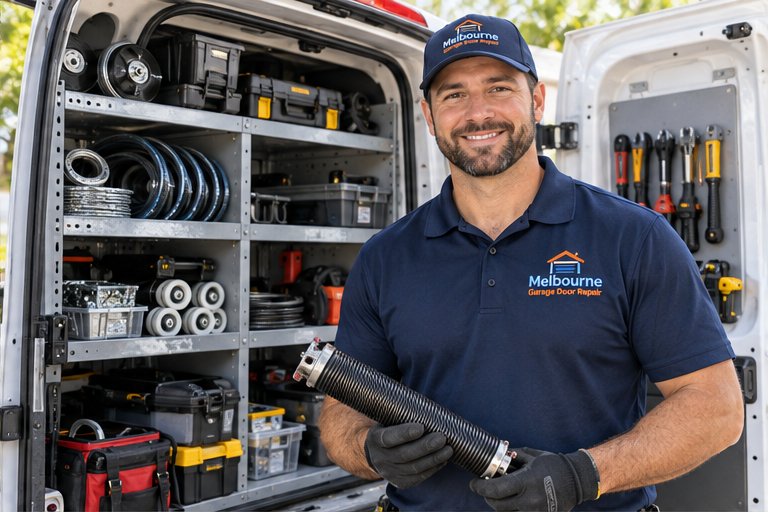
We repair, maintain and install garage doors and the equipment that moves them. That covers springs, cables, tracks, rollers and hinges, openers, safety sensors, remotes and keypads, door panels, weather seals, and complete new door installations. It also covers tune-ups for doors that still work but are starting to complain, and commercial doors for shops, workshops and small businesses.
Our technicians come to the property. A garage door is large, heavy and tied to the building, so most problems can only be understood by standing in front of the door and looking at it. We look at what is actually there, explain what we find in plain English, and then fix or replace what needs it.
This site exists to help you decide what to do next. Some visitors already know they need a repair. Others only know that something sounds wrong or looks different than it did last month. Both are welcome, and the information here is written for both.
Who we work with
Most calls come from homeowners, and the questions are usually practical. The door stopped halfway, the remote went quiet, a panel got dented in the driveway, or a loud bang came from the garage and nothing has moved since. We treat each of those as a specific problem with a specific cause rather than a reason to sell a bigger project.
Landlords and property managers have a different set of concerns. They are often dealing with a tenant report, a door they have not seen in person, and a need to know whether the fix is a small part or a bigger decision. We aim to give clear descriptions of what is wrong so that the person responsible for the property can make a sensible call.
Business owners rely on doors that open and close many times a day, sometimes with heavy use and little attention until something fails. Commercial work follows the same logic as residential work, with more attention to the way the door is used and what a stuck door costs the operation in lost access.
- Homeowners with a door, opener or remote that is not behaving
- Landlords and property managers handling tenant reports or turnovers
- Small business owners with a shop, workshop or storage door
- Buyers and sellers who want to understand the condition of a garage door
- People building or renovating who need a new door and opener installed
The approach: look first, then explain
The order matters. We do not decide what is wrong from a description alone, because several different failures can produce the same symptom. A door that will not lift may have a broken spring, a jammed track, a disconnected opener or a lock that was left engaged. A phone description narrows the field, but the diagnosis happens at the door.
Once we have looked, we tell you what we found in ordinary language. That includes what is broken, what is worn but still working, and what is fine. If something is not urgent, we say so. If something is a safety concern, we say that too, and we explain why.
Then we talk through the options. Often there is a straightforward repair. Sometimes there is a choice between repairing and replacing a part, or between fixing an old component and upgrading it. You decide, and we do the work you have chosen.
Diagnose before recommending
A recommendation only means something if it follows an inspection. We check the springs, cables, drums, rollers, hinges, tracks, panels, seals, opener and sensors as far as the situation calls for. We pay attention to the way the door moves, the sounds it makes and how it sits in the opening.
Explain without pressure
You should leave the conversation knowing what is going on with your door, even if you decide to do nothing yet. If a part is wearing out, we describe how it wears out and what usually happens next. That lets you plan rather than react.
Safety comes first, and it shapes what we tell you
A garage door is one of the heaviest moving objects in a home. The springs and cables that lift it hold a large amount of stored energy. When those parts fail or are handled wrongly, people get hurt. That is why safety is part of how we explain everything, not a footnote.
You will not find instructions on this site for adjusting, loosening or replacing springs, cables or lift brackets. Those jobs belong to trained technicians with the right tools. What we do share are the checks that are reasonable for an owner: looking, listening, testing the remote, cleaning sensor lenses, replacing remote batteries and using the manual release carefully, each with a clear point at which to stop.
If someone has been hurt, call 911 first. A door can be repaired later. Our garage door safety tests guide and the cable safety guide explain the basics of what to look for and what to leave alone.
How a typical job unfolds
The sequence is usually the same, whether the job is a single roller or a whole new door. It starts with a conversation about what the door is doing. You tell us what you have seen and heard, and we ask a few questions about the door, the opener and the property.
A technician then comes to the property to look at the door. After the inspection, we explain what we found and what the options are. When you have decided what to do, the work is carried out, and the door and opener are tested through full cycles to confirm they behave correctly.
Before leaving, the technician goes over what was done and anything worth watching in the future. If we noticed something unrelated that will need attention eventually, we mention it so that it does not come as a surprise.
- A conversation about symptoms, the door and the location
- A visit to the property and an inspection of the door and opener
- A plain-language explanation of what was found
- A discussion of options so that you can choose
- The work itself, followed by testing through full open and close cycles
- A short summary of what was done and what to keep an eye on
What a visit covers
Every visit begins with the same basic questions: does the door move freely, is it balanced, are the parts that carry load in sound condition, and does the opener do its job without strain? The answers tell us whether the problem is isolated or part of a wider pattern of wear.
The specifics depend on why we were called. You can read about the general flow in our guide to what happens during a service visit, which walks through the visit from the technician's side.
| Part of the door | What we check | Why it matters |
|---|---|---|
| Springs and cables | Condition, alignment and signs of wear | They carry the weight of the door and fail with little warning |
| Tracks and rollers | Straightness, spacing, wear and movement | Poor alignment causes noise, binding and uneven travel |
| Hinges and panels | Cracks, loose hardware and sagging | Weak points can spread damage across the door |
| Opener and sensors | Travel settings, force behavior and sensor response | Safety reversal depends on these working correctly |
| Seals and weather edges | Bottom seal, side seals and top seal | They keep out water, pests and wind-driven rain |
Repair, maintenance and installation
Repair is the most common reason people reach us, and it covers a wide range of work. Some jobs are small, such as replacing a worn roller or reprogramming a remote. Others are larger, such as replacing a broken torsion spring or bringing a door that has come off its track back into alignment. You can browse the full range on the services page.
Maintenance is quieter work that prevents some of the more disruptive failures. A door that is checked, adjusted and lubricated on a regular basis tends to wear more evenly and give more notice before something fails. Our maintenance and tune-up service is built around that idea.
Installation covers new doors and new openers. That might mean replacing a door that has reached the end of its useful life, installing a door in a new build, or swapping an opener for one with better features. We take measurements, discuss materials and styles, and install the new equipment so that it works smoothly with the opening it is going into.
Understanding the local setting
The Space Coast sits between the Atlantic and the Indian River Lagoon, and that setting shapes how garage doors age. Salt air, strong sun, high humidity and summer thunderstorms are all part of life here. Metal parts are exposed to moisture and salt, finishes weather in the sun, and the hurricane season adds wind loads and storm damage to the list of things a door has to survive.
Housing in the area ranges from older homes with original equipment to newer subdivisions with recent construction, plus rentals, townhomes and commercial buildings. The right advice for a door that has been on a home for decades is not always the right advice for one installed recently. We take the age, exposure and use of each door into account.
Our coastal climate guide explains how salt, moisture and heat affect hardware, and our service area pages describe what we see in individual communities.
What you can expect from us
You can expect to be told what we find, in words you can follow. You can expect that the first conversation is about your door and not about a sales target. You can expect to be asked questions about the symptoms and the setup, because those questions lead to better answers.
You can also expect honest limits. If a problem is outside what can reasonably be repaired, we say so. If a repair is likely to be short-lived because of the condition of other parts, we explain that. And if a part can be saved, we do not recommend replacing it just because replacement is the larger job.
- A clear explanation of what is wrong and what is not
- Options laid out so the decision stays with you
- Attention to safety throughout the visit
- Testing of the door and opener after work is done
- Respect for your property and your time
- Plain answers when you ask questions, including questions about cost drivers
What we do not claim
Because we want this page to be trustworthy, it is worth saying plainly what we leave out. We do not tell stories about company history, we do not quote staff numbers, and we do not list credentials or awards on this page. If you want to know about qualifications or insurance, ask us directly and we will answer the question you actually asked.
We also do not make promises that depend on conditions we cannot see. We cannot say how long a repair will take before we have looked at the door, or what it will cost before we know what is wrong. What we can promise is that we will explain what we find and what the options are.
The same caution applies to the content on this site. The articles and guides are general information to help you understand your equipment. They are not a diagnosis of your specific door, and they are no substitute for an inspection.
How cost is explained
Garage door work varies enormously. A single roller is a different job from a full door replacement, and two doors with the same symptom can need very different repairs. For that reason, we do not publish figures on this site. We talk about what shapes the cost instead.
The main factors are the type of parts involved, the size and weight of the door, the condition of related components, and whether the job is a repair or a replacement. Our guide to how service pricing is built goes through those factors so that you know what to expect when you talk to any garage door company.
When we have looked at your door, we explain the options and what each involves. You decide before work begins.
Working with landlords, managers and businesses
Rental properties and commercial buildings create practical questions that homeowners do not face. The person calling may not be at the property. Access may need to be arranged with a tenant or an employee. There may be an owner who needs to approve work, or a lease that sets out who is responsible for what.
We try to make that easier by being clear about what we found and what is recommended, in language that can be passed along to an owner or a manager. If a photo of the problem or a short description helps the conversation, we welcome it. Our guides on garage doors for rental properties and maintenance for business owners cover the questions that tend to come up.
Commercial doors often see more cycles in a month than a household door sees in a year. That changes the wear pattern, and it changes the value of regular checks.
How we think about older doors
A door that has been in place for a long time deserves a fair look. Age alone is not a reason to replace it. Many older doors are solid and only need a few parts renewed, and a well-maintained older door can outlast a poorly installed new one.
At the same time, there is a point at which repair after repair stops making sense. Panels that are cracked or delaminated, track sections that have rusted through, and openers that no longer support safety features are signs that a bigger decision is approaching. Our repair or replace guide describes how to think about that choice without being pushed in either direction.
We tell you where your door stands, including when it is in better shape than you feared.
Questions people ask before they call
Most people have a handful of worries before they reach out. They want to know whether the problem is serious, whether it is safe to keep using the door, and whether they will be pressured into something they do not need. These are reasonable concerns, and the answers shape how we run a conversation.
If you are unsure whether a problem is serious, our problem guides describe common symptoms and what usually causes them. If a spring has snapped, a cable has come off, or a door is hanging crooked, the safest course is to stop using it and get in touch rather than forcing it to move.
Is it safe to keep using the door?
If the door is moving normally and reversing correctly, a minor cosmetic issue can usually wait. If it is noisy, uneven, slow or shaky, it is telling you something, and you should not ignore it for long. If a spring or cable has failed, stop using the door.
Do I need to know the make or model?
No. Photos of the door, the label inside the door if you can see it, and the opener's label are useful, but we will work with whatever you have. Describing the symptoms in your own words is a good place to start.
Getting started
The simplest way to start is to tell us what the door is doing and where the property is. Mention anything you have noticed, such as a bang, a smell, a flashing light or a door that stops partway. Photos help if you can take them safely from a distance and without touching the springs.
We will tell you what we think is going on, what a visit would involve and what to do in the meantime. Details such as scheduling and availability are confirmed with you directly, because they depend on the situation.
Whenever you are ready, use the contact page to see what information is helpful and how to reach us.
Questions and answers
We are a garage door repair, maintenance and installation service for homes and businesses in Melbourne, Florida and the surrounding Space Coast and Indian River communities. Technicians come to the property, look at the door, explain what they find, and fix or replace what is needed. We cover springs, cables, tracks, openers, sensors, remotes, panels, seals and new doors.
No. Most calls involve houses, but we also work with landlords, property managers and small business owners. Commercial doors see heavier use and often have different hardware, so we look at how the door is used as well as what is wrong with it. The approach is the same: look, explain, then fix.
Yes. We look at the door first, then explain what we found and what the options are. You decide what to do before work begins. If something is not urgent, we say so, and if something is a safety concern, we explain why. You should never feel rushed into a decision you do not understand.
In most cases, yes. Many garage doors are built from similar components, and an experienced technician can identify what is needed by looking at the door and its hardware. Photos and any labels you can find help, but they are not required. Describing the symptoms is a good start.
No. Garage door work varies too much for a fixed figure to be useful, and a number that ignores your door could mislead you. Instead, we explain what drives cost and what the options are once we have looked at the door. Our pricing guide describes the main factors.
We strongly advise against it. Springs and cables hold dangerous tension, and mistakes can cause serious injury. Simple checks such as looking, listening and testing a remote are fine. Adjusting, loosening or replacing springs, cables or brackets should be left to a trained technician. If someone is hurt, call 911.
Use the contact page, which explains what information helps us understand the problem and how to reach us. Tell us what the door is doing, where the property is, and whether you have photos. We will explain what we think is happening and what the next step would be.