
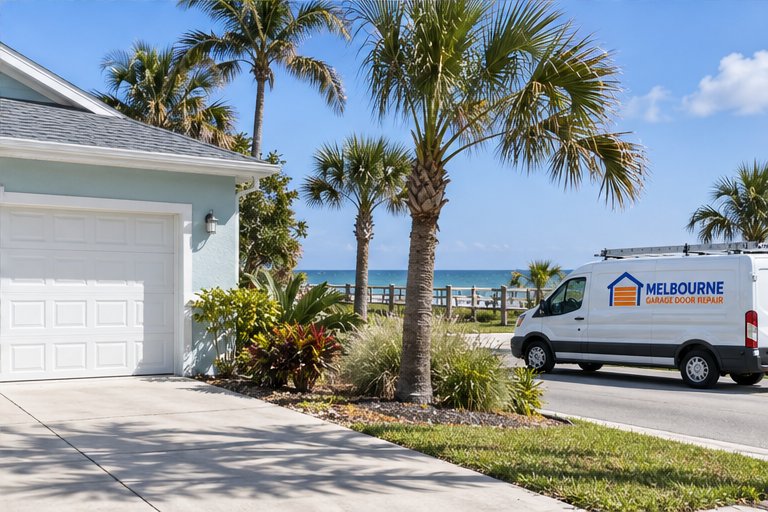
Life on the island side of the lagoon
Melbourne Beach is a barrier island town on A1A, with the Atlantic on one side and the Indian River Lagoon on the other. Homes here are close to the water, and a garage door is one of the largest moving parts on the house. It faces the street, takes the weather head on and works every time someone leaves or returns.
That position matters more than most owners expect. A door a few blocks inland may run for many years with little more than occasional lubrication. A door near the ocean carries a steady load of moisture and salt that reaches every exposed metal surface, including parts that you rarely look at.
This page is written for people who live and own property in Melbourne Beach and want to understand what is happening to their door. It walks through salt, sand, storms, power outages, seasonal homes and rentals, then explains what we do when we visit and how to decide what to fix first.
What salt air does to a garage door
Salt is hygroscopic, which means it pulls moisture out of the air and holds it against whatever it lands on. On steel, that creates a thin film of salty water that never quite dries, and corrosion begins in places where paint or galvanizing is thin or scratched.
Most of the damage starts out of sight. The inside face of tracks, the back of hinges, the coils of a spring and the ends of cable strands all collect salt that rain never rinses off, because the garage roof shelters them. Meanwhile the outside of the door gets washed by every storm and often looks fine.
The practical result is that a door can look presentable from the driveway and still have hardware that is near the end of its life. A visit that looks at the working parts, rather than just the paint, tells you far more.
Hardware that shows salt damage first
Not every part corrodes at the same rate. Knowing the usual order helps you spot trouble early and helps us explain what we see.
Springs and cables
Springs are made of tempered steel wire, and rust on the coils weakens them and increases friction between coils. Cables carry the lifting load, and corrosion between the thin strands can shorten their life. Both parts hold dangerous tension, so a rusty spring or a frayed cable is something to have looked at, never something to adjust yourself. See our page on torsion spring repair for what the work involves.
Hinges, brackets and fasteners
Hinges flex every time the door moves, so rust here shows up as stiffness, squeaks or a hinge that cracks along the bend. Bolts and screws that rust can back out or snap, which loosens the parts they hold.
Rollers, tracks and the opener
Steel roller shafts rust and seize, and tracks collect corrosion at the lower ends where water pools. Openers fare better because they sit under cover, but the rail, the trolley and the wiring at the wall button can all show green or white crust.
Surface rust or a structural problem
A little orange on a bolt head is a cosmetic issue. Flaking, bubbling metal, holes, or rust that leaves a stain trail down a panel is a structural issue, because the metal is losing thickness and strength.
A simple look from the floor will tell you quite a lot. Check the bottom of the lowest panel, the lower track ends, the lower hinges and the bottom bracket areas. These sit lowest, where water runs and splashes, and they rust first.
Do not scrape or pry at rust near the springs or the bottom brackets, because those fittings are under load. If the rust is in those areas, stop and have the door inspected. Our page on rust on a garage door and track explains what we look for and what the choices usually are.
- Light surface rust on non-moving parts can usually be cleaned and protected.
- Rust that pits or flakes on tracks, hinges or brackets suggests replacement of that part.
- Rust on springs and cable ends should be inspected by a technician before the door is used again.
Panels, paint and the door skin
The door itself is only one part of the story, but it is the part neighbors see. Steel panels depend on a factory finish, and once a scratch breaks through to bare metal, salt air does the rest. Aluminum resists rust but can pit and stain, wood needs sealing against moisture, and fiberglass and composite panels cope with the air better than steel but can still crack or delaminate.
A panel with a dented or cracked section may be repairable, or a single panel may be replaced when the style is still available. When the sections are heavily corroded or the door is no longer sold in that pattern, replacing the whole door is often more sensible than a patchwork. We cover that decision in repairing or replacing your garage door.
If you are repainting a steel door near the ocean, ask whoever does the work to clean away any salt film first and to prime bare spots. Paint over salt traps moisture and blisters later.
Older beachside homes and their doors
Many homes close to the water were built decades ago, and some have been added to, raised or remodeled several times. Garages in those houses may have an older door that was fitted to an opening that is no longer perfectly square, or a ceiling that sits lower than modern doors prefer.
Older doors often use extension springs along the sides of the track, simple light-duty rollers and a basic opener. Those parts may still work, but they wear and rust, and an old door can be out of balance without anyone noticing, because the opener has been quietly doing the extra work.
When we visit one of these garages, we check the door balance, the fit in the opening and the headroom before suggesting anything. Sometimes a tune-up and fresh hardware is enough. Sometimes the right answer is a new door matched to the opening. We would rather explain that plainly than push toward either.
Rebuilt homes and heavier modern doors
Newer and rebuilt homes in coastal towns often have doors that are heavier and better insulated, sometimes with larger openings for two vehicles or for a boat, trailer or a deep storage bay. A heavier door puts more load on the springs, cables, drums and bearings, and it makes balance more important.
If a heavy door is lifted by an opener that is also compensating for a weak spring, the opener works against the door instead of guiding it. That is hard on gears and on the travel limits, and it can shorten the life of both. Checking the spring and cable condition during any opener complaint is a good habit.
Tall or wide doors also benefit from reinforcing struts and well-matched hardware. A structural change like that is something we would discuss on site, with the door in front of us, rather than from a description. See new garage door installation for how a replacement is approached.
Storm season, before and after
The Atlantic hurricane season runs from June through November, and on a barrier island the garage door is one of the first weak points in strong wind. A garage door that fails can let wind into the garage and then into the house, so it is worth taking seriously before a storm, not after.
Before the season, it makes sense to have the door looked at as a system: springs, cables, brackets, track attachment, panels, rollers and the opener. After a storm, look for anything that has shifted, bent or been struck. Debris hitting a door can bend a panel or push a track out of line without any visible sign from the street.
Our guide to garage door hurricane preparation covers what owners can safely do, and our hurricane season service page explains what a technician checks. We will not tell you that any door is storm proof. We can tell you what condition yours is in.
Power loss and the manual release
Storms bring outages, and an outage means the opener cannot lift the door. Every opener has a manual release, usually a red cord or handle on the trolley, that disconnects the door from the motor so it can be moved by hand.
The release is meant for emergencies and should be used with the door closed, when possible, so that it cannot fall. A door with a broken spring or a damaged cable can be very heavy or can drop without warning, so if the door will not move easily, do not force it.
Plan ahead by finding the release, making sure it is not rusted shut and checking that everyone who might need it knows how it works. If you have a battery backup on your opener, test it. Our guide on using the manual release in a power outage goes through the steps in detail.
Sand, grit and moving parts
Wind carries fine sand and dust into garages, and that grit settles in the track, on the rollers, in hinge joints and in the opener rail. Mixed with old lubricant it forms a gritty paste that grinds metal away and makes the door noisier.
Wiping the tracks with a clean dry cloth now and then keeps debris from building up, and the right lubricant in the right places keeps parts moving. Track faces should be cleaned but not oiled heavily, since oil collects sand. Hinges, roller stems and the spring coil need the correct type of lubricant, and we cover that in our lubrication guide.
If you notice scraping noises, a door that shakes as it travels or rollers that no longer turn, grit and worn parts are a likely cause. A tune-up that cleans and lubricates the right parts, checks the hardware and tests the safety features usually helps.
Seasonal residents and visitors
Some Melbourne Beach homes are lived in for part of the year and closed up for the rest. A door that sits unused for months in humid air can seize slightly, and rubber and plastic parts dry out or stick. Remote batteries lose charge, and keypads can fail to wake.
When you return, test the door before relying on it. Press the wall button, watch the door travel its full path, and listen for anything unusual. Check that the safety sensors still respond by waving an object through the beam while the door closes, and see that the door reverses on its own.
Visitors and house sitters often need keypad codes or spare remotes. Our page on remote and keypad programming explains how access gets set up and changed, which is helpful before you leave for the season.
Rentals and second homes
A garage door in a rental sees more mixed use than one in a single-owner home. Tenants and guests may not know the manual release, may park too close to the door, or may force a stuck door instead of reporting it. Small problems are more likely to be ignored for weeks.
Owners can reduce risk with a few habits. Put a short instruction note near the wall button, make sure the safety sensors are clean and aligned, and arrange a periodic inspection between guests. A sticky door or an opener that grinds is easier to fix before a guest finds it.
If you manage several properties, it helps to keep a simple record of what has been serviced and what has been noted. Our page on garage doors for rental properties offers a practical way to think about it.
A maintenance rhythm that suits salt air
Coastal conditions reward regular small attention more than occasional large repairs. The table below sets out a sensible rhythm, which you can adjust to the way you use the door.
| When | What to do | Who |
|---|---|---|
| Every month | Watch the door open and close, listen for new noises, wipe the tracks and check the sensor lenses | Homeowner |
| Every few months | Rinse salt film from the outside of the door with plain water, then dry the tracks and hinges | Homeowner |
| Before storm season | Full inspection of springs, cables, brackets, rollers, track fixings and the opener | Technician |
| After a storm or impact | Look for bent panels, shifted tracks and loose fittings, and do not operate a door that looks damaged | Homeowner, then technician |
| Once a year | Lubricate correct parts, tighten hardware, test balance, reversal and sensors | Technician |
What a visit to a Melbourne Beach property looks like
We come to the property and start by listening to what you have noticed. Then we look at the door in the closed position, watch it travel and examine the hardware, paying particular attention to corrosion and signs of wear. We do not hurry past the parts that are hard to see.
Next we explain what we found in plain terms. If a spring is rusted or weakened, we say so and describe the options. If the problem is a sensor, a remote or a loose bracket, we say that too. You decide what to do with the information, and we do not ask you to make a decision before you understand it.
When repair work is needed, we carry it out and then test the door again, including the reversal and the sensors. For a closer look at the process, see what happens during a garage door service visit.
Arranging a visit in Melbourne Beach
If your door is stuck, noisy, rusted or simply overdue for a look, the next step is to get in touch. Tell us what the door is doing, what you have already tried and anything you have noticed about its age or past repairs. That helps us arrive with the right questions in mind.
If anyone has been hurt, call 911 before anything else. If a spring or cable has broken, keep people and vehicles clear of the door and do not try to lift it.
Use our contact page to reach us. We will look at the door, explain what we find and what the options are, and leave the decision with you.
Questions and answers
It can. Salt holds moisture against metal and speeds up corrosion, especially on springs, hinges, tracks and fasteners that are sheltered from rain. A door near the ocean often needs more frequent inspection and lubrication than one farther inland. Regular rinsing, drying and a yearly service make a noticeable difference to how the hardware ages. That way you know what is happening before any decision is made.
Light orange staining on a bolt is usually cosmetic. Flaking, pitting, holes or rust on springs, cable ends, bottom brackets or lower track sections is more serious, because those parts carry load. Do not scrape or pry near the springs or brackets. Have a technician look at the door before you use it again. We are glad to talk it through on site, with the door in front of us.
Yes, but keep it simple and safe. Have the door and opener inspected before the season, clear the area around it and know where the manual release is. Never try to adjust springs or cables yourself. If a storm is approaching, park vehicles clear of the door and consider your options for securing it. Describing what you have noticed helps us look in the right place.
First look at the wall control and the opener to see if power has returned. Then check whether the manual release has been pulled and the trolley is disconnected. If the door feels very heavy or will not move by hand, a spring or cable may be involved, so stop and call for service instead of forcing it.
It can be. Humid air stiffens rollers and hinges, remote batteries weaken and sensors may collect dust or insects. Test the door slowly, watch its full travel and check that it reverses when something blocks the beam. If anything seems wrong, have it looked at before the door is in daily use. Tell us what you see and we will explain what it means.
Sometimes. If the panels are sound and the hardware is the problem, repair is often reasonable. If the sections are corroded, bent or no longer available, replacement may make more sense. We look at the whole door and explain both options so you can choose with the facts in front of you. We explain what we find and what the options are.
Yes, we work with owners of rental and second homes as well as full-time residents. We look at the door, explain its condition and note anything that guests or tenants might misuse. A periodic inspection between stays can prevent small issues from becoming breakdowns while the home is occupied. That way you know what is happening before any decision is made.