
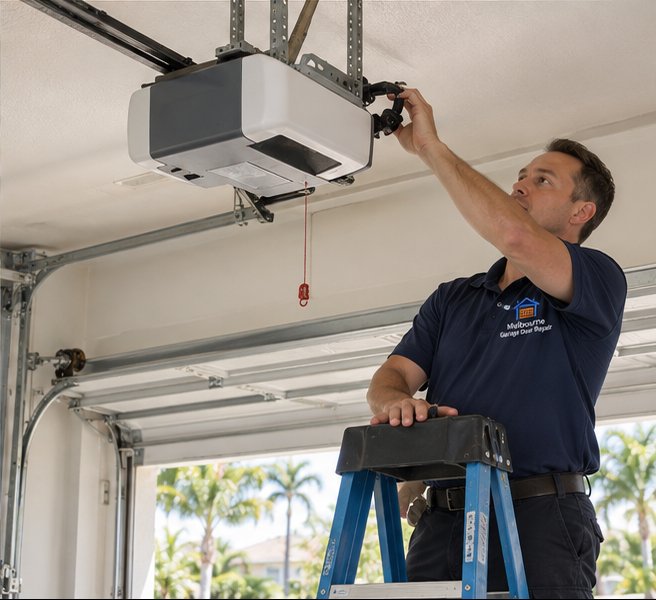
What this problem actually means
The opener is a motor and a drive. The drive pulls a carriage along a rail, and the carriage connects to the door through an arm. If the motor turns and the carriage moves but the door stays still, the link between them has broken or been released. If the motor runs but the carriage does not move, the fault is inside the opener.
That single distinction, whether the carriage moves or not, narrows the problem a great deal. It is the first thing we look for, and it is something you can see from a safe distance with the garage light on.
A second distinction matters just as much: whether the door is heavy to lift by hand or light. A door that has lost its spring support is dangerous to move, while a door that has simply been disconnected from the opener will feel normal.
The three main suspects at a glance
Most cases fall into one of three groups. The table below compares them side by side, and the sections that follow explain each in plain terms.
| Cause | What you see and hear | How the door feels by hand |
|---|---|---|
| Disconnected trolley or arm | Motor runs, carriage may slide freely or stay at the back, door does not follow | Normal, moves easily when the opener is released |
| Broken spring or cable | Often a loud bang earlier, door may lift a little then drop, motor strains | Very heavy, door will not stay up |
| Stripped or worn drive gear | Motor whirs or buzzes, a grinding or clicking sound, no carriage movement | Normal once released |
| Broken chain, belt or coupling | Motor spins, carriage does not travel, chain may hang slack | Normal once released |
| Bent or detached door arm | Carriage moves, arm flaps or has come off the bracket | Normal once released |
Suspect one: the trolley has been disconnected
Near the opener you will see a red cord with a handle hanging from the carriage. Pulling it releases the carriage from the door so you can lift the door by hand in an emergency. Sometimes the cord gets snagged, bumped by a car mirror, or pulled during a power outage, and the carriage stays disconnected.
When that happens, the opener happily runs back and forth on the rail while the door sits quietly. You may see the carriage slide to the front, then to the back, with no door movement at all.
This is the most welcome diagnosis because it is simple. Reconnecting the carriage is usually a matter of aligning it with the arm and letting it re-engage. Because the door is not the issue, the procedure carries a lower risk, but only if you are certain the door is balanced and properly supported.
How to tell it apart from a spring problem
With the door fully closed, look at the springs above the door or along the sides. If you see a visible gap in a spring, a spring piece that has moved, or a cable that hangs loose, do not touch the door. If those look normal, the cause is more likely a disconnected carriage or a drive fault.
A careful way to test
With the door closed, pull the release cord straight down once. Then try lifting the door a hand's width from the bottom, standing to the side rather than in front. A balanced door feels manageable and tends to stay where you leave it. A door that pulls hard against you, drops, or will not lift is heavy from lost spring support, and you should let go and contact us.
Suspect two: the spring has broken
Torsion or extension springs carry most of the door's weight. An opener is designed to guide the door, not lift it from scratch, so when a spring breaks the opener often runs but cannot raise the door. You might hear a loud bang when the break happens, sometimes from inside the house, and some people assume something fell in the garage.
A broken spring is a repair for a trained technician. The parts hold large stored energy, and the wrong move can cause serious injury. We never advise homeowners to adjust, wind or replace a spring or cable, and we ask that you avoid trying to force the door open.
If you suspect a spring, our page on broken torsion spring repair explains what we do, and the guide on torsion versus extension springs helps you recognise which type you have.
- A sudden loud bang earlier in the day or night
- A visible gap or break in the coiled metal above the door
- A door that feels very heavy or will not stay open when partly lifted
- An opener that strains, hums, and then stops without lifting
- A door that rises a short way, then drops back
Suspect three: a stripped or worn drive gear
Many chain and belt openers use a plastic or nylon gear inside the motor housing to transfer force to the drive. Over years of use, heat and load, the teeth on this gear can wear or strip. Once they do, the motor spins freely and nothing moves along the rail.
The sound is distinct. You may hear a whirring or buzzing that does not match the usual smooth run, or a rhythmic clicking or grinding as the gear teeth slip. The carriage stays put even though the motor is clearly working.
A stripped gear is repairable on some models, and on others it makes more sense to replace the opener. We look at the age, the parts situation and the condition of the rest of the system, then lay out both routes in plain terms. Our pages on opener repair and chain, belt and screw drive service cover the details.
Chains, belts, screws and couplings
The drive that pulls the carriage can also fail in other ways. A chain can stretch, jump a sprocket or snap. A belt can fray or split. A screw drive can have a worn coupling that no longer grips the screw. In each of these cases the motor spins, but the carriage stays where it is or moves only a little.
A slack chain that hangs in a loop, a belt lying on the rail, or a screw that turns inside a loose coupling are all easy to spot once you look. Take a flashlight, stand clear, and just look. Do not reach into the rail while the opener is powered, because the carriage can move without warning.
If the chain has simply jumped, the door itself is unaffected. Even so, a jump usually has a cause, such as a loose sprocket or a rail that has shifted, so it deserves a proper inspection, not just a reset.
Sound guide: what the noise can tell you
Sounds are one of the most useful clues, and you can gather them without touching anything. Press the wall button and listen from a safe spot.
A smooth hum with a moving carriage but a stationary door is typical of a disconnected arm. A hard strain, a groan, or a motor that quits after a second or two often points to a heavy door from a spring problem. A chattering, buzzing or clicking sound that seems to come from inside the motor head suggests a worn gear. Silence apart from a relay click can mean a power or logic fault, not a drive issue.
- Smooth hum, carriage glides, door still: arm or trolley disconnected
- Strained groan, motor stops: heavy door or a spring problem
- Buzzing or clicking from the motor head: worn or stripped gear
- Rattling chain with no travel: slack, jumped or broken chain
- Single click and nothing else: power, logic board or lockout
Checks you can safely do from the floor
These steps keep your hands away from moving or tensioned parts. If anything looks wrong, stop and contact us.
- Make sure the door is closed and nobody, including pets, is near it.
- Look at the springs and cables for visible breaks, gaps or loose ends.
- Check the red release cord to see whether the carriage has been pulled back.
- Watch the carriage when you press the wall button and note whether it moves.
- Look at the chain or belt for slack, fraying or breaks.
- Check that the opener's lock setting on the wall control is not turned on.
- Replace the remote battery if only the remote seems affected.
When to stop immediately
If you see a damaged spring, a loose cable, a door that sits crooked, or a door that you cannot lift easily after releasing the opener, do not continue. Keep the area clear and have the door inspected. If someone is injured, call 911.
Using the manual release the careful way
The manual release exists so a door can be moved during an outage or opener failure. It is safe only when the door is balanced. Pulling the cord on a door with a broken spring can cause it to fall or slam, and that has injured people.
If you have confirmed the springs look intact, close the door first, then pull the release, and lift slowly from the center of the bottom edge with your body to the side. If the door resists or feels heavy, put it down or let it settle carefully and stop. Our guide on using the manual release during a power outage covers the same steps in more depth.
Never use the release to move a door that is off its track, crooked or visibly damaged. In those cases, leave it where it is, and keep people and vehicles away from its path.
Why a quiet fault can still hide a bigger one
Sometimes the symptom looks like the simplest cause but the real trouble is underneath. A disconnected trolley can happen because someone yanked the release cord on a door that was already heavy. A stripped gear can follow years of an opener struggling against a weak spring.
That is why we check balance even when the story points to the opener. If the springs are tired, replacing a gear without addressing the load will bring the problem back. Fixing the cause once is better than repeating the repair.
The reverse also holds. If the spring has broken but the opener has also been working hard, we check the opener for damage after the spring is dealt with.
What we do during the visit
We begin by asking what you heard and saw, because your description often saves time. Then we confirm whether the carriage moves, test the door by hand with the opener released, and look at the springs, cables, drums, rollers and track.
Next, we inspect the opener: the drive, gear, coupling, circuit board and safety systems. We explain what we find in plain language, show you the worn or broken parts, and lay out the options. If the opener can be repaired reasonably, we say so. If replacement makes more sense, we explain why, and you decide.
After any work, we test the door for balance, test the safety reversal, and check the sensors. You can read more about the process in our page on what happens during a service visit.
Repair or replace the opener
A running opener that no longer moves the door is not always a reason to buy a new one. If the failed part is a gear, chain, belt, coupling or arm, and the rest of the opener is sound, repair often makes sense.
Replacement becomes the better choice when the opener is old, parts are hard to find, the logic board is failing, the safety system is dated, or the opener lacks features you want, such as a battery backup or quieter drive. Our guide to choosing a garage door opener helps you compare.
We do not push one route. We tell you what is wrong, what each option involves, and what to expect from the choice you make.
Local factors on the Space Coast
Warm, damp air and coastal salt wear on metal parts, and afternoon storms add power surges that stress circuit boards. Openers mounted in garages without much ventilation run hotter, which can age plastic gears faster.
Homes that sit empty part of the year, such as seasonal residences and rentals, often develop trouble after long idle spells. Lubricant dries, cords get bumped, and the first cycle after months of rest can expose a weak part.
If your opener serves a door that runs many times a day, such as a rental or a busy household, plan on periodic check-ups. A short visit as part of maintenance and tune-up service can catch a worn gear before it strips.
Questions to ask yourself before you call
A few simple observations make the visit more useful, and they cost nothing. You do not need tools, and none of them require touching the door. Think back over the last few days and weeks, because faults of this kind rarely appear with no warning at all.
Did the door seem slower, noisier or jerkier lately? Did anyone pull the release cord, or did the power go out? Was there a bang? Has a remote battery been changed recently, and does the wall control show any lights? Each answer points us toward one cause and away from another.
It also helps to know the age of the opener and the door, if you have it. The label on the motor head and the label on the door both carry useful details, and our guide to reading your garage door label shows where to look.
- What did you hear when it stopped working, if anything?
- Does the carriage move along the rail, or stay still?
- Did the problem start after a power outage, a storm or a vehicle bump?
- Does the door look level, or does one side hang lower?
- Is the wall control light on, off or blinking?
- How old is the opener, as far as you know?
Preventing a repeat
A few habits lower the chance of finding yourself with a humming opener and a door that will not move. Keep the release cord clear of car mirrors and shelving. Teach everyone in the house not to pull it unless the door is closed and balanced.
Listen for changes. A louder opener, a door that looks slower, or an occasional jerk are early signs. Having the door and opener checked when you first notice these is easier than waiting for a full stop.
If you only learn one thing from this page, let it be this: do not try to fix a spring, cable or bracket yourself, and do not pull the manual release on a door you suspect is heavy.
Questions and answers
The motor is working, but something between it and the door has let go. The most common causes are a disconnected trolley or arm, a broken spring or cable, a stripped drive gear, or a broken chain, belt or coupling. Watching whether the carriage moves helps narrow it down.
A broken spring often follows a loud bang. You may see a gap in the coil above the door, and the door will feel very heavy if released from the opener. Do not try to lift it or adjust anything. Spring work holds dangerous tension and should be left to a technician.
Only when the door is closed and you have no reason to suspect a spring problem. On a door with a broken spring, releasing the opener can let the door drop or slam. If anything looks wrong, leave the cord alone and contact us.
Usually a buzzing, whirring or clicking from the motor head while the carriage stays still. The motor spins but cannot transfer force to the drive. Repair is sometimes possible, and sometimes replacing the opener is the sensible route.
That points to a disconnected arm or trolley, or a bent or detached door arm. The door itself may be fine. Check the springs for damage first, and if they look normal, we can reconnect or replace the parts after looking at the system.
Yes. Some wall controls have a lock feature that stops remote commands, and in some cases the motor will not move the door. Check that the lock light is off. If the opener still runs without moving the door, the problem is likely mechanical.