
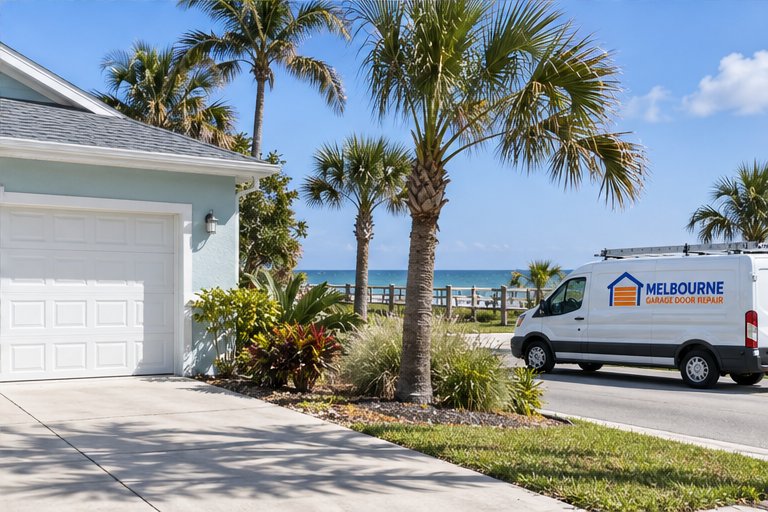
Why the coast is harder on a garage door
A garage door is one of the largest moving parts of a house, and it spends its life half inside and half outside. On the Space Coast, the outside half faces sea breeze, summer humidity, strong sun and the occasional tropical storm. The inside half sits in a space that is rarely air conditioned and often closed up for hours.
None of this means a door near the water is doomed. It means the normal wear a door would see anywhere is sped up in a few specific places: bare steel, moving joints, fasteners and anything electronic. Knowing where to look turns a vague worry about rust into a short, manageable routine.
This guide is educational. It describes what coastal conditions do, what a homeowner can safely look at, and what is better left to a trained technician. If you want to read how the whole system fits together first, how a garage door works covers the basic parts.
What salt air actually does to metal
Salt itself does not eat steel on contact. What it does is make moisture far better at carrying electrical charge, and that speeds up the chemical reaction we call rust. A film of damp, salty air on bare steel is a much better environment for corrosion than plain damp air inland.
Salt also settles. Fine particles from sea spray travel inland on the breeze and land on paint, glass, tracks and springs. Once they are on a surface, each morning dew or humid night dissolves them again and renews the reaction. That is why a door that looks fine in March can show orange freckles by the end of a wet summer.
The wind direction matters too. Homes on the barrier island between the Atlantic and the Indian River Lagoon see more direct spray than homes a few miles inland, but salt travels further than most people expect. Even a house well back from the beach can see its hardware dull and spot over the years.
Humidity and the air inside the garage
Humidity does its own damage apart from salt. A closed garage in a warm, damp climate holds moist air against the underside of the door, the tracks, the springs and the opener. When the temperature drops overnight, water can condense on cool metal surfaces, which is why you sometimes see beads of moisture on a track or on the bottom bracket in the morning.
Moisture also changes how materials behave. Wood swells, paper-faced insulation absorbs water, and rubber seals can soften or stick to the floor. Electronic parts such as sensors and circuit boards dislike damp air, and their connections can corrode quietly for months before a fault appears.
If your door tends to stick during wet weather and loosen up again in dry weather, the cause may be humidity rather than a worn part. You can read more about that pattern in a garage door that sticks in humid weather.
Sun, heat and what they do to finishes
Salt and water get the attention, but ultraviolet light and heat are just as steady. A door that faces south or west takes hours of direct sun each day. Paint chalks, dark colors fade, and plastic parts such as window inserts, sensor housings and weather stripping become brittle over time.
Heat also makes the panels expand. On a hot afternoon the skin of a steel door can get uncomfortable to touch, and the metal moves slightly against its hinges and fasteners. Over thousands of cycles, that movement can work small chips or hairline cracks into the finish, and those are exactly the places where salt and moisture reach bare metal.
Lighter colors reflect more heat and tend to show fading less, while very dark colors can look striking but ask more of the finish. If you are considering a color change, choosing garage door colors and finishes goes through the trade-offs.
Where corrosion usually starts
Rust rarely begins in the middle of a flat, painted panel. It starts where the protective coating has been broken or where water collects. Knowing the usual spots lets you check them in a minute with a flashlight.
The table below lists the common starting points and what to look for. It is a guide for looking, not for repairing.
- Look at the lowest few inches of the door from outside after rain.
- Check the lower corners where the door meets the vertical tracks.
- Run a flashlight along each hinge and note any brown streaking.
- Look at the tracks from inside with the door closed.
| Part | Why it is vulnerable | What you may see |
|---|---|---|
| Bottom edge of the lowest panel | Sits closest to standing water and splash from the driveway | Orange staining, bubbling paint, a rough or crumbling lower edge |
| Hinges and hinge screws | Many small steel surfaces that rub and trap moisture | Brown dust around pivots, stiff movement, streaks running down the panel |
| Track surfaces and corners | Bare or thinly coated steel that holds damp air | Light surface rust, dark film, rough spots where rollers ride |
| Spring and shaft | Large steel surfaces in a closed, humid space | Flaking, orange coating, dry and dusty look |
| Fasteners and brackets | Bolt heads, nuts and washers can rust before the part they hold | Rust rings, weeping stains, loose-feeling hardware |
| Cut edges and fastener holes in panels | Coating is thinnest where metal was cut or drilled | Hairline rust lines at edges and around screw heads |
Hinges, rollers and tracks
The moving hardware is where corrosion becomes a performance problem. A hinge that rusts at its pivot stops flexing smoothly. A roller whose bearings take on moisture gets noisy and rough. A track that develops a rough surface makes rollers chatter instead of glide.
Rollers come in different styles, and the style affects how they cope with damp air. Sealed bearing rollers keep moisture out better than open ones, and nylon wheels tolerate damp better than bare steel wheels. If you want to see how the options differ, types of garage door rollers explains them in plain terms.
Surface rust on a track or hinge is common and not always urgent. What matters is whether it is staying on the surface or starting to pit, flake or weaken the metal. A technician can tell the difference by touch and by looking at how the part wears, and they can explain what they see.
Signs the hardware is wearing faster than it should
Squeaking that returns within days of cleaning, a door that jerks slightly on the way up, and dust that looks like brown powder around the pivots are all signs worth noting. None of them is an emergency by itself, but together they suggest the door would benefit from a full look.
What to leave alone
Do not loosen or tighten the bolts on the large brackets at the ends of the springs or the brackets that hold the cables, even if they look rusty. Those parts carry heavy tension. Describe what you see to a technician instead of trying to clean or adjust them.
Springs and cables in damp air
Springs and cables are the parts that lift the door's weight, and they are the parts most affected by corrosion in terms of safety. A rusty spring has a rough surface where tiny cracks can begin, and a cable that has been damp for years can fray from the inside as its strands rust.
A homeowner can look at them. A homeowner should not touch or adjust them. Springs and cables hold dangerous tension, and a failure can cause serious injury. The right way to handle a worrying spring or cable is to stay clear, keep the door closed if you can, and have it looked at.
If you want to understand why cables matter, garage door cable safety explains what they do and what a worn one looks like. For springs, how long garage door springs last covers cycle life and why environment shortens it.
Openers, sensors and electronics
Openers contain circuit boards, wiring and sensors that do not enjoy damp air. In a humid garage, corrosion can form on terminal screws and connectors. It often shows up as a flaky fault: a wall button that works some days and not others, a remote that needs several presses, or sensor lights that blink for no clear reason.
Safety sensors sit low near the floor, which is exactly where splash, mist and insects gather. Spider webs and dust on a lens can interrupt the beam, and moisture on the lens can scatter it. Cleaning a lens with a soft, dry cloth is a safe homeowner task.
Lightning and power surges are a separate coastal worry. Florida has frequent storms, and an opener plugged into an outlet without surge protection can be damaged. For intermittent behavior, an opener that works only some of the time walks through the possible causes.
Weather seals, thresholds and the bottom edge
The rubber or vinyl seal along the bottom of the door does a hard job in this climate. It keeps out rain driven by wind, sand and dust, insects and small animals. It also takes the worst of the sun and the standing water that collects at the threshold.
A seal that has turned hard, cracked or flattened will let moisture under the door. That moisture sits against the bottom panel and speeds up rust and rot. If you can see daylight under a closed door, or if the floor inside is damp after a storm, the seal deserves attention.
Seals and thresholds are one of the more practical coastal upgrades because they protect the door itself. Bottom seal and threshold service explains what is involved, and a gap under the garage door helps you judge whether the gap is a seal issue or something else.
Door materials near the water
The material your door is made from decides how it handles the coast. Steel is common and economical in its structure, but it relies on its coating. Aluminum does not rust, though it can pit and dent more easily. Wood is attractive but needs ongoing finish care. Composite and fiberglass-faced doors resist moisture well, though their frames and hardware still need attention.
Insulated steel doors add a layer of foam between two skins, which can help with heat but does not change the corrosion picture. What matters most for longevity is the quality of the coating and how well cut edges and fastener holes are protected.
A full comparison is in garage door materials: steel, aluminum, wood and composite. If you are weighing a replacement, you can also read steel, aluminum, wood and composite doors compared.
Wood and swelling in humid weather
Wood doors respond to moisture in a way metal does not. They absorb water and swell, then dry and shrink. That movement can pull joints apart, crack paint and make the door bind in the track during the wettest weeks of the year.
A wood door depends on its finish. Paint or stain that has cracked or worn thin gives water a way in, and once wood has soaked up moisture repeatedly, it may begin to warp or rot, especially along the bottom rail.
If you have a wood door, check the bottom edge and the lower corners every season. Gently pressing with a thumb on a suspect spot is fine. If the wood feels soft or spongy, take a photo and have a technician look at it.
Rinsing and cleaning habits that help
One of the most useful coastal habits is also the simplest: rinse the outside of the door now and then. Fresh water carries off salt deposits before they build up and keep working on the finish. A gentle spray from a garden hose is enough; a high-pressure washer can force water past seals and into joints.
For cleaning, a soft cloth or sponge with mild soap and water is a sensible choice. Avoid abrasive pads, which scratch the coating and create new places for rust to start. Dry the surface afterward if you can, especially the lower edge.
Do not spray water at the opener, the sensors or any wiring. Keep the interior hardware dry. And when you clean, you are also inspecting: stains, bubbling paint and rough spots are easier to notice with a wet cloth in your hand.
- Rinse the outside gently with fresh water from a hose.
- Wash with mild soap and a soft cloth, then rinse again.
- Dry the lower edge and the seal if possible.
- Avoid pressure washers aimed at seals, joints or sensors.
- Note any chips, bubbling or staining for later attention.
Lubrication in a salty, damp place
Lubricant helps moving parts, but the wrong choice can attract dust and sand, which is a particular nuisance near the beach. A heavy grease can turn into a gritty paste. A product made for garage doors, applied sparingly to the right places, usually works better than a generic spray used liberally.
The right places are the pivots and rollers' bearings, not the track surface where the rollers run, and never the springs or cables unless a technician has told you otherwise. Wipe off extra lubricant so that nothing drips onto the floor or the car.
A detailed explanation of what goes where is in the lubrication guide. In a coastal setting, lubricating a little more often but in small amounts tends to suit the conditions.
Directly on the water or a few miles inland
Exposure varies a lot across Brevard County and the nearby Indian River area. Homes on the barrier islands, close to the Atlantic, see the most direct salt spray. Homes along the Indian River Lagoon get a different mix of brackish air and humidity. Homes further west, away from the water, see less salt but the same heat and damp.
A sensible way to think about it is in three bands. Right on the water, check and rinse more often. In the middle band, a seasonal routine is usually enough. Further inland, the main concerns become humidity, sun and storms rather than salt.
Garages differ too. A garage facing the prevailing breeze takes more spray than one on the sheltered side. A detached garage or a workshop that is opened frequently ventilates better than a closed garage that rarely moves. Use your own observations as a guide, because they say more about your door than any general map.
A coastal maintenance rhythm
Maintenance is easiest when it is tied to something you already do. Many homeowners find a monthly look, a seasonal rinse and an annual professional visit a workable pattern. A monthly look can be as short as a minute with a flashlight. A monthly garage door checklist provides a simple version.
Seasonal habits fit the Florida calendar. Before the wet summer months, check seals and the lower edge. Before the peak of storm season, check that the door operates smoothly and that the manual release works. After the season, look for any damage or salt buildup. The seasonal garage door checklist for Florida lays this out in more detail.
A professional visit is worth having periodically because a technician sees what a homeowner cannot safely check, such as the condition of springs, drums, and cable ends. Garage door maintenance and tune-up describes what such a visit covers.
When to stop and call a technician
Some coastal problems are cosmetic and can wait. Others are about safety. As a rule, anything involving springs, cables, drums or the brackets that hold them should be handled by a trained technician, never by the homeowner.
Call someone if you see a spring that looks rusted through, a cable that is frayed or has come off its drum, a track that has pulled away from the wall, or a door that has become noticeably heavier or more crooked. Keep people and vehicles clear of a door you are unsure about, and avoid running the opener repeatedly.
If someone is hurt, call 911 first. For everything else, a measured conversation is enough. We will look at the door, explain what we find and what the options are, and you decide what to do next. You can also reach out through our contact page.
- Spring or cable with heavy rust, flaking or visible fraying.
- Track pulling away from the wall or a bent section.
- Door that grinds, jerks or hangs crooked after months of damp weather.
- Large rust spots with soft or crumbling metal.
- Persistent moisture inside the garage after storms.
Questions and answers
It can speed up wear on bare steel, hinges, fasteners and any place the coating has been scratched. A door that is rinsed with fresh water now and then, kept lubricated at the right points and checked for chips tends to hold up better than one that is ignored. Exposure varies, so your own door is the clearest guide. If you want it looked over, get in touch.
Light surface rust is common near the coast and is not always urgent. What matters is whether the metal is staying solid or starting to pit, flake or weaken. If the door still moves smoothly and the metal feels firm, you can monitor it. A technician can judge the difference and explain it, which is part of a maintenance visit.
Not on everything. Lubricant belongs on pivots and the bearings of rollers, applied sparingly. It should not go on the track surface where rollers run, and you should not work on springs or cables at all. Too much lubricant attracts sand and dust. The lubrication guide explains which parts to treat. Doing so also keeps moisture and grit out of the pivots.
Humidity can swell wood, soften seals and add friction at hinges and rollers. A door that sticks when it is damp and improves when it dries often has a moisture-related cause rather than a failed part. Still, a door that binds can strain the opener. See a door that sticks in humid weather for ideas.
A gentle rinse of the outside with fresh water is fine and helps remove salt. Avoid high-pressure sprays aimed at seals, joints, windows or sensors, and keep water away from the opener and wiring. Dry the lower edge afterward if you can. Rinsing is also a good time to look for chips and staining along the panels.
There is no single answer, because each material has trade-offs. Steel depends on its coating, aluminum does not rust but can dent, wood needs steady finish care, and composite resists moisture but still needs sound hardware. Compare them in the materials guide, and think about how exposed your garage really is. Think honestly about how close to the water you are.
A short look every month, a rinse each season and a professional visit from time to time is a sensible rhythm for many homes near the water. Homes right on the shore may want to look more often, and homes further inland may need less. Use the monthly checklist to keep it simple. A technician can add detail on request.