
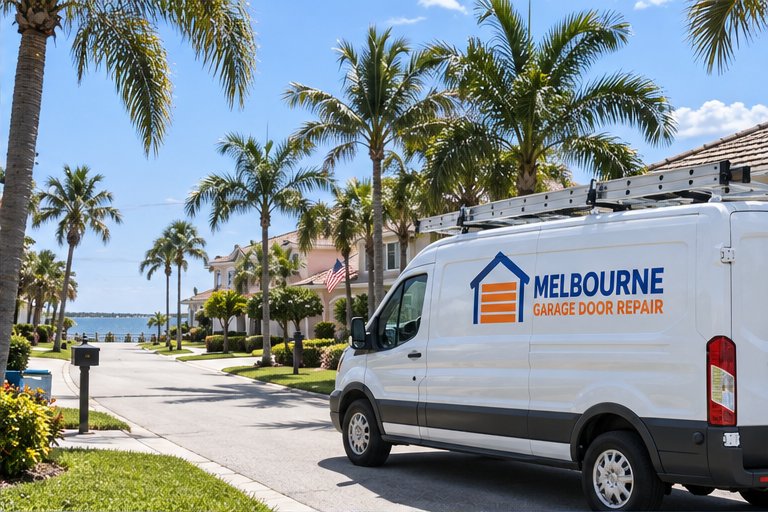
A hub city with a lot of different garages
Melbourne is one of the larger and older cities in Brevard County, and it works as a hub for the Space Coast. People live here whose families have been in the same house for decades, and others who arrived last year. That history shows up in the garages. Within a short drive you can pass a narrow single door from a mid-century house, a standard two-car door from a later subdivision, and a modern wide door on a recent build.
For a garage door service, that variety matters more than the name of the city. A door installed forty years ago and a door installed five years ago fail in different ways, need different parts, and call for different conversations. We start every visit by finding out which kind of door and which kind of opener we are dealing with, and we plan from there.
This page walks through the Melbourne situation from several angles: the age of the housing, the water on two sides, the seasons, shared buildings and commercial doors. If you only want to know whether we serve your street, the section near the end on coverage questions is the place to start, and the areas we serve page shows the wider region.
Reading a street by its garage doors
After enough visits you begin to read a neighborhood from the curb. The shape of the door, the way the opener is mounted and the type of hardware all give away the decade a house was built.
Older doors are often one-piece or have fewer, taller panels. They may be wood, with real wood trim, and many have been repainted several times. Newer doors are sectional steel, often insulated, with a smooth or embossed face and windows or decorative inserts. Between those two sit the doors from the middle decades, usually thin steel or early composite panels with extension springs on each side.
- Single-piece or tall-panel wood doors suggest an original installation that may be well past its design life
- Thin steel panels with long springs along the horizontal tracks suggest an extension spring system
- Insulated steel sections with a torsion bar above the opening suggest a more recent installation
- Wide openings for two vehicles are common across most eras of Melbourne building
- Rolled and reinforced bottom edges suggest a door built with coastal wind in mind
Why this helps a repair
Knowing the type of door lets us bring suitable parts to the visit. A set of rollers for a thin older track is different from a set for a modern door with a different stem and track radius. Photographs of the door and of the label on the inside edge of the bottom panel give us a good starting point.
Older homes and original doors
In the older parts of Melbourne, it is common to find a garage door that has been in place for most of the life of the house. These doors have often been through many hurricane seasons, a few repaintings and at least one opener replacement. They still work because someone has cared for them, or sometimes because nobody has touched them in years.
The risks on an older door are fairly predictable. Wood panels soak up moisture and rot at the bottom edge, where rain splashes and standing water collects. Extension springs lose strength and, on some older installations, have no safety cable running through them. Hinges and rollers are worn smooth. Track brackets have loosened with decades of vibration.
This does not mean an old door has to be replaced. Often a careful repair and some new rollers and hinges give a long-standing door more years. It does mean that the first visit is usually worth treating as an inspection. Our page on repairing or replacing your garage door sets out how that choice is thought through, with age, parts and safety all weighed together.
Eau Gallie and the streets near the water
Eau Gallie, which is part of Melbourne, has a long history as a separate community and still feels distinct. Housing there ranges from older homes close to the river and lagoon to newer construction on adjacent blocks. For garage doors the key point is how near the water a property sits.
Homes right on or near the water see more salt in the air than homes a few miles inland. That salt lands on every exposed metal surface, from the bottom bracket to the screws that hold a hinge. Painted steel doors chip at the edges and rust follows. The small hardware, which you rarely look at, is often the first part to give out.
If your garage is close to the lagoon or the ocean, a rinse with fresh water from time to time and a look at the lower edge and brackets pays off. Our overview of garage doors in a coastal climate explains what to look for and which materials cope well. Eau Gallie also has its own page, which you can reach through the main list of areas.
Newer neighborhoods and builder-grade doors
Melbourne has also grown outward, and newer subdivisions have the garages that go with them. These doors are generally in better shape, but they carry the habits of builder-grade construction. Builders choose doors that meet code and a budget, and the parts are often the plainest available.
Plain rollers with no bearings, thin hinges and light-gauge steel are common in this class of door. They work well at first and then wear in a predictable way after several years of daily use. Openers in new builds are usually chain-drive units that run loudly, and the plastic parts in them can fatigue under heavy use.
Newer homes may also be under homeowners association rules that influence what you can do with the door. Colors, window styles and even the hardware finish can be regulated. We discuss this in HOA rules and garage doors, and it is worth reading before you order a replacement.
The wide two-car door and what it asks of the hardware
Most Melbourne homes have a two-car garage, and a sixteen-foot-wide door is a heavy, long object. It spans a wide opening with several sections, each carrying its own hinges and rollers, and it is usually hung from one or two torsion springs.
A wide door magnifies small problems. A slightly weak spring on one side makes the door tilt. A worn roller at one end shows up as a visible lag. Light-gauge panels can flex in the middle if the struts that stiffen them are missing or have come loose. When the door tilts, the opener pushes harder, and the strain shows up as noise, stalls or reversals.
If your wide door is crooked, slow to rise on one side, or twisting as it moves, that is more than an annoyance. The page on a crooked or uneven garage door describes what the usual causes are and why we ask you not to adjust anything yourself.
What salt and humidity do to each part
The Space Coast is humid for most of the year, and the air near the lagoon carries salt on top of that. Different parts of a garage door react in different ways, so it helps to know where to look.
The table below summarizes what we commonly find in Melbourne garages and what each sign usually suggests.
Treat it as a guide to what to look at, not as a diagnosis. We confirm the condition of each part at the door.
| Part | What damp, salty air does | What you might notice |
|---|---|---|
| Steel panels | Rust starts at chipped paint and the bottom edge | Orange stains and bubbling paint low on the door |
| Wood panels | Moisture swells and rots the wood | Soft spots, peeling finish, a door that sticks |
| Roller bearings | Bearings corrode and dry out | Rough rolling, grinding, a rattling sound |
| Hinges and brackets | Pins and screws rust | Stiffness, squeaks, screws backing out |
| Springs and cables | Surface rust weakens metal over time | Flaking coils, a door that feels heavier |
| Opener circuit board | Humidity can affect electronics | Erratic behavior, random lights or reversals |
| Bottom seal | Rubber hardens and cracks | Gaps, leaves and water getting in |
Following the calendar through a Melbourne year
Garage doors do not wear on a calendar, but the weather does shape when problems appear. It helps to think of the year in terms of what each season does to the door.
In the wet summer months, daily rain and high humidity push moisture into every joint. Doors stick, wood swells, and openers act up when moisture reaches electronics. Afternoon storms bring wind and the occasional power flicker, which can confuse an opener's settings or leave the door stuck partway.
In the fall, the peak of hurricane season is the time to look at the door as part of preparing the house. In winter, the weather is gentler, and it is a good moment for the maintenance that gets skipped in summer. In spring, pollen and dust collect in the tracks and on the sensors, and lubrication should be refreshed.
A once-a-month look and a service visit once a year make for a sensible rhythm. Our seasonal garage door checklist offers a simple routine that fits the local year.
Getting the garage ready for storm season
Residents of Melbourne know the routine of preparing for a tropical system. The garage door is one of the largest openings in the house, and a failure there can let wind and water into the structure. Preparation is about the condition of the door, not about adding things to it.
Check that the door is in good working order before the season. Confirm that the panels are intact and the hardware tight by eye, that the weather seals are sound, and that the opener works on its normal power and on the manual release. Know where the red release cord is and how it works, and make sure everyone in the home does too.
Do not try to brace the door or add hardware that is not meant for it. If you would like the door looked at before a storm, our page on hurricane season garage door service explains what we check. After a storm, a damaged door should be examined before being used. Take photos first, since they are helpful with insurance.
Businesses, workshops and larger doors
As a hub city, Melbourne has businesses of many kinds: small shops, warehouses, workshops, service bays and storage buildings. Their doors are not all residential sectional doors. Some are rolling steel doors, some are wide commercial sectionals, and some are old doors that have been fitted with newer operators.
Commercial doors work harder than residential ones. They may cycle many times in a day, they carry heavier loads, and they are exposed to forklifts, vehicles and weather. A failure interrupts work, so planning matters more than with a home garage.
If you run a business here, it helps to know the type of door, its size and the operator it uses. Our page on commercial garage door service describes the work we do on business doors, and we are glad to talk through a maintenance plan that suits how your site operates.
Openers in a humid garage
A garage in Melbourne is rarely air-conditioned, which means the opener sits in heat and humidity all year. Plastic gears get brittle, circuit boards pick up moisture, and wiring terminals corrode. Many of the strange symptoms people report, such as a door that reverses for no reason or a remote that works only some days, trace back to those conditions.
An opener that is more than ten or fifteen years old may also lack features that newer units have, such as modern safety sensors, rolling-code remotes and battery backup. Replacement is not always required, but it is worth knowing what you have.
If your opener has become unreliable, our page on garage door opener repair describes what we check. For the question of whether to repair or replace an older unit, the guide to choosing a garage door opener lays out the main points to weigh.
Questions to ask about coverage and scheduling
When you are choosing someone to work on your door, it is reasonable to ask a few plain questions. Ask who will come to the property, what they will check, how they will explain what they find, and what happens if the repair turns out to need more than expected.
We do not make promises about arrival times or prices before we have seen the door, and a company that does so over the phone without knowing your door should be asked how it can. What we can say is that a technician will come to your property, look at the door, explain what is needed, and discuss the options before any work begins.
It also helps to have a few facts ready: the age of the door, any recent changes such as a power outage or a vehicle bump, and what the door does now. Photos taken from inside and outside make a big difference. Our guide to questions to ask a garage door technician gives you a fuller list.
What a visit at your Melbourne property looks like
A visit begins at the door. The technician looks at the whole system from the floor first: the panels, the tracks, the springs, the cables, the opener, the sensors and the seals. Anything that carries tension is examined by eye and handled only with the correct tools and procedure.
Then comes an explanation in ordinary language. What is worn, what is damaged, what is only dirty, and what could wait. You hear the options, the reasons behind them and the likely results of each, and you decide.
If a repair is chosen, it is carried out and the door is tested for balance, for smooth travel and for the safety reversal. If a new door or opener is the better route, we talk through styles, materials and any association rules that apply.
Nearby places and where to go next
Melbourne runs into several neighboring communities along the lagoon and the coast, and the garages there have their own character. West Melbourne to the west has newer streets and wide driveways, and Palm Bay to the south is the county's largest city with a very different layout. Each has its own page.
If you are not sure which page fits your situation, you can start from the symptom. The door that will not move, the opener that hums, the remote that stopped working and the spring that snapped each have a page of their own. The general services list explains the options in order.
When you are ready to have your door looked at, contact us, describe what you see, and we will take it from there.
Questions and answers
Yes, we work at homes and businesses across Melbourne, including the Eau Gallie area. Tell us the street or neighborhood when you get in touch, along with what the door is doing, and we will arrange a visit. We do not promise arrival times before we have the details of your door and your request. If you can, include the nearest cross street so we understand where the property sits.
It can. Salt and constant humidity speed up rust on hinges, brackets, springs, rollers and the lower edge of steel panels, and they swell and rot wood. Doors close to the lagoon or the ocean feel it most. Regular rinsing, drying, lubrication and a yearly inspection help parts last longer. Fresh water rinses and a dry cloth go a long way near the coast.
Not necessarily. An older door that is structurally sound can often be kept going with new rollers, hinges, springs or an updated opener. A door with rotted panels, missing parts or an unsafe spring arrangement may be better replaced. A technician can look at the door and explain which path makes sense. We will also check whether safety cables and sensors meet today's expectations.
Yes, we work on shared and individual garage doors in multi-unit settings. It helps to know who is responsible for the door, whether an association has rules about changes, and how the remotes are programmed. We will explain what we find and what the options are, and the owner or board can decide. Photos of the labels on the door and opener help us identify the parts.
Yes. We service doors at shops, warehouses, workshops and other business properties. Tell us the type of door, its size and the operator if you know them. Commercial doors work harder than residential ones, so we also talk about maintenance plans that suit how your site operates. Mention any forklift or vehicle contact, because impact damage is easy to miss.
Have the door inspected, make sure the panels and hardware are sound, confirm the weather seals are intact, and test the opener and the manual release. Do not add braces or hardware that the door was not made for. After any storm, have a damaged door looked at before you use it. Do not wait until a storm is in the forecast to find a problem.
Contact us with a short description of what the door is doing, the age and type if you know it, and a few photos if you can. We will arrange a visit, look at the door in person, and explain what we find and what the options are before any work begins. A short description of the symptom is enough to start the conversation.