
What we do and who we do it for
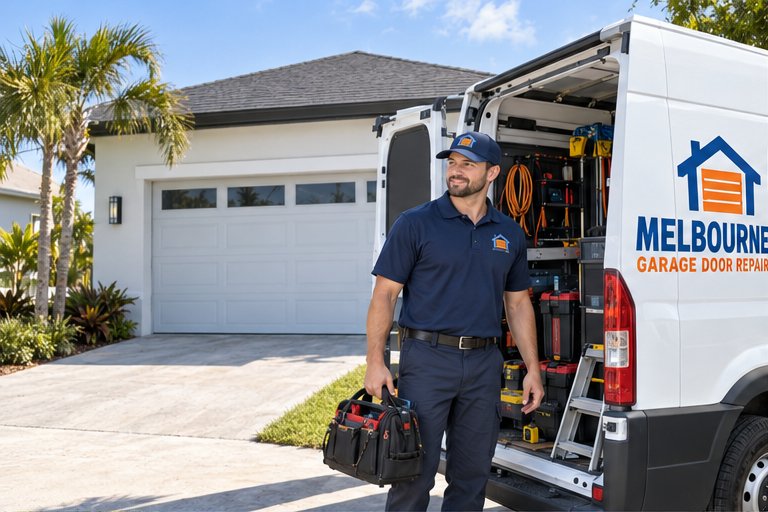
Melbourne Garage Door Repair is a repair, maintenance and installation service for garage doors. Our customers are homeowners, landlords, property managers and small business owners in Melbourne, Florida and the surrounding Space Coast, Indian River and nearby communities.
A garage door is the largest moving object in most houses, and it is easy to forget until it stops working. It is a system of springs, cables, drums, tracks, rollers, hinges, panels and an opener, and every part shares the load with the others. When one part wears out, the rest often show the strain.
Our approach is simple. We look at the whole system before we touch any single part, we tell you in plain English what we see, and we explain the options. You decide what happens next.
We also try to leave you better informed than when we arrived. Many garage door problems repeat because nobody explained the cause. If a roller has worn because the track is dirty, or a sensor keeps drifting because a bracket is loose, we point it out so the same fault does not return a few months later.
Whether the job is a small adjustment, a part replacement or a complete new door, the process stays the same: look, test, explain, agree, repair, test again. That rhythm keeps surprises to a minimum for you and for us.
Start with what the door is doing
Most people do not know the name of the part that failed. They know the door will not open, or it is loud, or it came down crooked. That is the right place to start, and this site is built around it.
Our garage door problems section is organized by symptom. Each page describes what you might see, hear or feel, what the likely causes are, which simple checks are safe, and which signs mean you should stop and leave the door alone.
If you already suspect a part, go straight to the matching service page instead. Either route ends in the same place: a clear idea of what is going on before anyone picks up a tool.
- The door will not open, or will not close
- The door reverses, stops partway, or sits crooked
- You heard a loud bang from the garage
- The opener runs but the door does not move
- The door is loud, shaky, heavy or slow to respond
The services in plain terms
Garage door work falls into a handful of families. Understanding which family your problem belongs to makes every conversation easier, including the one with us.
The full list of garage door services explains each one in detail. Here is the short version of how the work divides up.
| Family | What it covers | Typical signs |
|---|---|---|
| Lifting hardware | Torsion springs, extension springs, cables, drums, bearings | Loud bang, heavy door, door that drops or drifts |
| Travel hardware | Tracks, rollers, hinges, brackets, fasteners | Grinding, shaking, door off the track, uneven travel |
| Opener and controls | Motor, gears, drive, sensors, remotes, keypads, wall buttons | Hum without movement, blinking lights, remote silence |
| The door itself | Panels, struts, weather seals, insulation, new doors | Dents, cracks, sagging, light or water at the bottom |
| Care and planning | Maintenance, tune-ups, storm preparation, commercial doors | Noise creeping in, age, an upcoming season |
Springs and cables: why we treat them differently
Garage door springs hold a great deal of stored energy. Your door may weigh well over a hundred pounds, and the spring system is what makes it feel light enough to lift by hand. When a spring lets go, that energy is released suddenly.
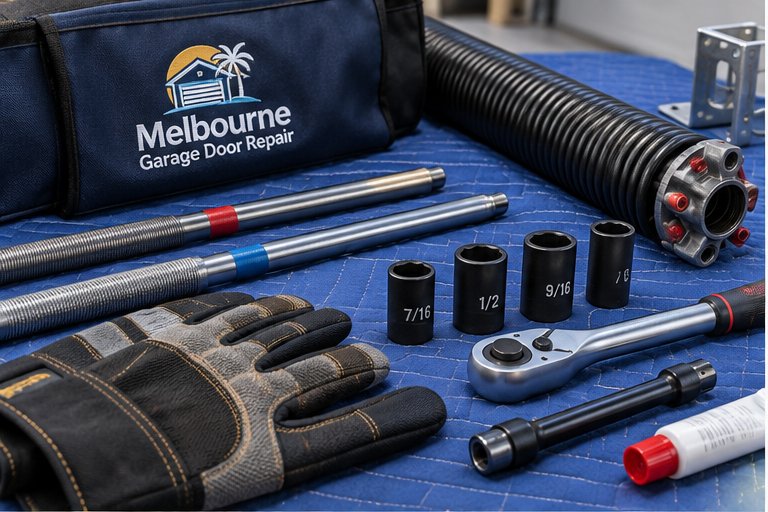
For that reason we do not suggest that homeowners adjust, loosen or replace springs, cables or the brackets that hold them. This is work for a trained technician with the right winding tools and a clear plan. Our pages on torsion spring repair and extension spring replacement explain what the work involves so you know what to expect.
If you hear a sharp bang from the garage and the door will not lift, a spring has probably broken. Keep people and vehicles away from the door, do not run the opener, and read what to do after a loud bang before you do anything else.
Openers, sensors and remotes
The opener is the part you notice most, and often the part that gets blamed for problems that start elsewhere. A motor that hums while the door stays shut is frequently pointing at a broken spring, not a failed motor.
We repair and install openers, and we work on the small parts that make them safe and convenient. The two photo eye sensors near the floor tell the opener whether something is in the way. Remotes, keypads and wall buttons tell it what you want.
If your opener behaves oddly, begin with opener repair or safety sensor alignment. If the problem is only the remote, remote and keypad programming covers it.
Sensors matter more than they look
The sensors are small, and people sometimes bypass them when they misbehave. We do not recommend that. They exist so the door reverses when a child, a pet or a bicycle is in its path, and they should be fixed and kept working.
Choosing a new opener
Chain, belt, screw and jackshaft drives each suit different garages. Our guide to choosing a garage door opener lays out the tradeoffs in plain language.
Doors, panels and weather seals
The door itself takes a beating. Lawn equipment, car bumpers, wind-blown debris and plain age all leave their marks. A dented panel can sometimes be replaced as a single section, and a worn bottom seal is a small part that makes a surprising difference.
Along the Florida coast, rain driven by wind finds every gap. A seal that has hardened or flattened lets in light, leaves, insects and water. Replacing it is routine work, and our page on weather seal replacement explains how it is done.
When a door is old, badly damaged or simply tired, replacement can make more sense than another repair. We lay out both paths honestly in our repair or replace comparison, and we are happy to talk it through at the door.
Maintenance that suits Florida
Humidity, salt air and heat are hard on metal parts and rubber seals. Rollers pick up grit, hinges stiffen, fasteners work loose, and a little rust on a track can grow over a few seasons.
A maintenance visit is a careful inspection with some lubrication, tightening and testing. We check the balance of the door, test the safety reversal, look at the cables and springs for wear, and tell you what we see. It is a chance to catch a small problem before it becomes a stuck door on a busy morning.
Read about what a visit includes on our maintenance and tune-up page. Coastal homeowners may also like our guide to garage doors in a coastal climate.
- Visual check of springs, cables, drums and brackets
- Roller, hinge and track inspection
- Lubrication of the right parts and only the right parts
- Balance test and safety reversal test
- Opener, sensor, remote and wall control check
Storm season and your garage door
The garage door is the largest opening in many homes, which is why it gets attention before a major storm. A door that is worn, poorly balanced or loosely fastened is more likely to struggle in strong wind.
Preparation is mostly inspection: hardware, seals, tracks, the opener and the manual release. A separate topic is wind-rated doors and local building rules. We do not make claims about codes here. Check with your local building department and your homeowners association before you decide on a wind-rated product.
Our pages on garage door service before storm season and preparing your garage door for storm season cover the practical side. If a storm has already passed, garage door damage after a storm explains what to check and how to document it.
Where we work
We serve Melbourne and the wider Space Coast, from the barrier island towns along A1A to the inland communities west of the Indian River Lagoon. Our reach extends north through Cocoa, Merritt Island and Titusville, south toward Palm Bay and Grant-Valkaria, and into Indian River County around Sebastian and Vero Beach.
Each place has its own mix of housing, weather exposure and garage styles. Salt air is a real factor on the barrier islands, while newer inland subdivisions tend to have more uniform doors and homeowner association rules. Our areas we serve page lists the communities, and each has its own page.
A few starting points are Melbourne, Palm Bay, Viera and Merritt Island. If your community is not listed, contact us and ask. Coverage is confirmed before any visit is arranged.
Local conditions shape the work. Near the water, we pay close attention to corrosion on tracks, fasteners and springs. In newer neighborhoods, we often see matching doors across a whole street, which helps when a section or a style needs to be matched. On larger rural lots, detached garages and workshops bring their own openers and longer runs of wiring.
How a visit works
When you reach out, we ask about the door, the opener and what happened. A few details at this stage, such as the size of the door and what you heard, help us arrive prepared.
At the property, the technician looks at the door and tests how it behaves before touching anything. We explain what we found, what the options are and what each involves. Nothing is replaced without you understanding why.
After the work, we test the door again: balance, travel, safety reversal and sensors. You see the door working, and we show you anything you should know about its care. Our guide on what happens during a service visit walks through the whole sequence.
Before the work starts
We inspect, explain and confirm the plan with you. This is the point where you ask questions, and we encourage them.
After the work is done
We test the door through its full travel and check that the safety features respond properly. If something about the door should be watched over time, we tell you.
How to prepare before we arrive
A little preparation makes the visit smoother. Clear the area around the door inside and out so the technician can reach the tracks, springs and opener. Move vehicles out of the garage if you can.
Gather what you know. When did the problem start? Did you hear a noise? Does the door move partway or not at all? Do the remote and the wall button behave the same way? Take a couple of clear photos of the door, the springs above it and the opener label if you can reach it safely.
If the door is stuck open or closed, tell us how it is stuck and whether anyone has used the manual release. Our guide to questions to ask a garage door technician helps you get the most from the conversation.
- Clear space around the door and the opener
- Note when the problem began and what you heard
- Photos of the door, the springs and the opener label
- Door size if you know it, or a rough measurement
- Any HOA or landlord approvals that apply to your property
Homes, rentals and businesses
A family home, a rental and a loading bay all use garage doors differently, and the planning is different too. A home door might open and close a few times a day. A business door might cycle far more, and downtime costs real time.
Landlords and property managers often want a maintenance rhythm that keeps tenants safe and avoids emergency calls. Our guide to garage doors in rental properties discusses planning in general terms.
Businesses can read about commercial garage door service, including sectional and rolling doors, safety and how to plan around downtime. The approach is the same: inspect, explain, repair what is needed, and test.
Simple checks you can do safely
Some checks need no tools and no risk. Look at the door. Listen as it moves. Test the remote with fresh batteries. Check that nothing is blocking the sensors, and wipe their lenses with a soft cloth. Confirm that the wall control is not in lock mode.
The manual release is the red cord that hangs from the opener rail. It lets you operate the door by hand when the opener is disconnected, but only when the door is closed and balanced, and only if you are sure the springs are intact. If the door feels extremely heavy, stop. That is a sign of spring trouble.
Never touch the springs, the cables or the brackets they attach to. If someone is hurt, call 911. For everything else, the garage door safety tests guide explains what you can check and where to stop.
Guides and comparisons before you decide
Good decisions come from understanding. If you are weighing a repair against a replacement, or choosing between opener types, you do not need to rush. Read first.
Our garage door guides cover how doors work, how springs wear, how to prepare for storms and how to talk to a technician. Our comparisons set options side by side, with tables where they help.
If you want one place to start, try how a garage door works. It builds the picture that makes every other page easier to follow.
Getting in touch
When you are ready, contact us and tell us about the door. Share what you see and hear, where the property is, and anything you have already tried. We will explain what we find and what the options are.
If you have questions that are not about a repair, such as how long springs last or what an opener needs, our questions and answers cover common ground.
Questions and answers
We serve Melbourne, Florida and the surrounding Space Coast, including the barrier island towns, Viera, Palm Bay, Merritt Island, Cocoa and Titusville, plus communities in Indian River County such as Sebastian and Vero Beach. Our areas page lists the communities with their own pages. If yours is not listed, contact us and we will confirm coverage before arranging anything.
We work on springs, cables, tracks, rollers, hinges, openers, safety sensors, remotes, keypads, wall controls, panels and weather seals. We also install new doors and handle maintenance visits and commercial doors. If you are unsure which category your problem falls into, describe what the door is doing and we will help sort it out.
We strongly advise against it. Springs hold dangerous tension, and the tools and training needed to release or wind them safely are specialized. A mistake can cause serious injury. If you think a spring has broken, keep people away from the door, do not run the opener, and contact us so a technician can look at it.
Start with simple checks. Make sure the opener has power, replace the remote battery, and confirm the wall control is not in lock mode. If the opener hums but the door does not move, or the door feels very heavy, stop and avoid forcing it. Our problems pages explain the likely causes and where to stop.
Yes. We service sectional and rolling doors for businesses, including loading areas. Commercial doors often cycle more than residential ones, so wear shows up sooner and planning around downtime matters. We look at the door, explain what we find, and talk through the options so the repair fits how your business works.
Have the door inspected, check the seals and hardware, test the opener and know how to use the manual release. Wind-rated doors are a separate topic, and you should check local building rules and your homeowners association before choosing one. Our storm season guide covers the practical steps in plain language.
It can be, with care. Use it only when the door is closed, and be sure the springs are intact. If the door feels very heavy or lifts unevenly, stop. A broken spring or snapped cable makes the door unsafe to operate by hand. When in doubt, leave it closed and contact a technician to look at it.