
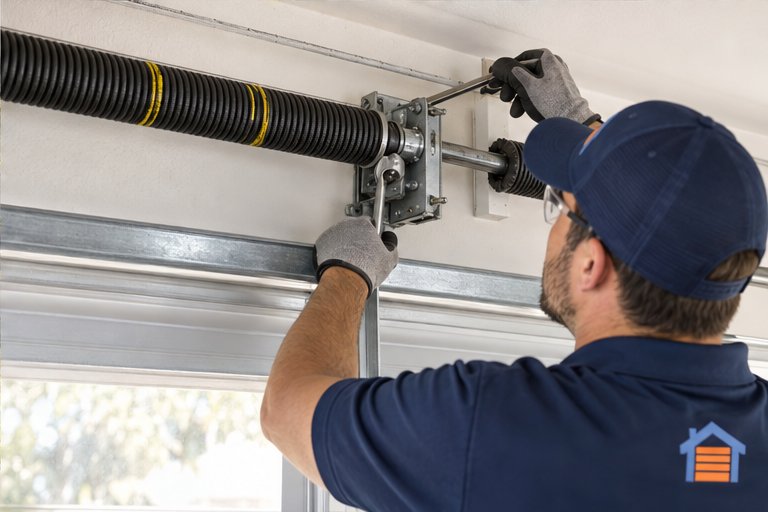
What a torsion spring actually does
A garage door is heavy. A typical two-car door can weigh a few hundred pounds, which is far more than a person or an opener could lift comfortably with every use. The torsion spring is the part that carries that weight. It is a tightly wound steel coil mounted on a metal shaft above the door opening, and it stores energy when the door is closed.
When the door goes up, the spring unwinds and helps lift it through cables attached to drums at each end of the shaft. When the door comes down, the spring winds again and absorbs the weight. A properly balanced door feels almost light in the hand, and the opener only has to guide it along its path.
This is why the spring matters so much. The opener is not designed to do the lifting. If the spring fails, the full weight of the door lands on a motor that was never meant to carry it.
Signs that a torsion spring has broken
Torsion springs rarely fail without some kind of signal, although the signal is sometimes noticed only after the fact. Most homeowners describe one of a handful of experiences.
The most dramatic sign is a loud bang from the garage, often when nobody is near the door. The sound is the spring releasing its stored energy as it breaks. If you have heard something like this, our page on what to do after a loud bang from the garage walks through the immediate safety steps.
- The door will not lift, or lifts only a short way before stopping.
- The opener runs and the motor sounds normal, but the door does not move or barely moves.
- The door feels extremely heavy if you try the manual release and lift by hand.
- A visible gap appears in the coil of the spring above the door, with a split section of metal.
- The door looks crooked, or cables hang loose or slack.
- The door comes down much faster than it should.
A broken spring can look quiet
Sometimes the break happens while you are away, and you discover the problem only when the door refuses to move. If the door will not open after a trip, a broken spring is one of the first things to consider. The page on a garage door that will not open lists the other possibilities.
Why the door becomes heavy when the spring breaks
The weight of the door has not changed, but the thing that was hiding it has disappeared. With a working spring, the door is balanced, which means the spring pulls up with roughly the same force that gravity pulls down. A balanced door stays where you leave it, partway open, without drifting.
Once the spring breaks, nothing offsets gravity. The door behaves like a very heavy object suspended on cables. An opener may groan and try to lift it, or it may hum while the door stays put. Many openers stop themselves after a moment to protect the motor.
This is also why we ask people not to keep trying the remote or the wall button. Each attempt strains the opener, the cables and the drive hardware. If you are curious about how this fits with other symptoms, an opener that runs while the door stays put explains the difference between a broken spring and a disconnected trolley.
Why this is not a do-it-yourself job
It is tempting to look at a broken spring and think that a replacement is just a matter of buying a part. The reality is different. Torsion springs are wound under great tension, and the bars and tools used to adjust them must be used correctly. A slipped bar or an incorrectly held spring can cause serious injury, and people are hurt every year.
The danger is not limited to the moment of replacement. A new spring that is wound incorrectly can leave the door unbalanced, strain the cables or drive the opener beyond its limits. The wrong size spring can fail early or let the door slam shut.
For those reasons, we do not recommend that anyone try to adjust, loosen or replace a torsion spring, a cable or a bracket without training. Nothing on this site tells you how, and that is on purpose. If a spring has broken, the safest approach is to leave the door where it is, keep people and vehicles clear and arrange a visit.
What to do right away
Start by keeping everyone away from the door. Do not stand beneath it, and do not let children or pets play near it. If the door is partly open, treat it as unstable.
Do not try to lift the door by hand, even with help. A door that feels stuck may not be fixed in place, and a sudden shift can be dangerous. Do not use the opener to push the door through resistance.
If a car is trapped inside and you need it, it is possible that the door can be opened with the manual release, but this depends on the door, the cables and how the break occurred. If you do not know whether the door is safe to move, do not move it. If anyone has been injured, call 911 first.
- Keep people, pets and vehicles away from the door.
- Stop using the remote, keypad and wall button.
- Do not touch the spring, cables or brackets.
- Take a photograph from a safe distance if you can; it helps when describing the problem.
- Get in touch and tell us what you saw and heard.
What a technician looks at first
A visit starts with a look at the door as a whole, not only the spring. The reason is that a spring rarely fails in isolation. Cables, drums, bearings, the shaft and the brackets that hold everything in place are all part of the same system, and the technician checks them together.
The technician will also look at how the door sits on its tracks, whether the panels are damaged and whether anything has shifted since the spring broke. A spring that releases suddenly can nick a cable or bend a bracket, and spotting that early prevents a second failure later.
You will be shown what has been found and told in plain language what each part does and what condition it is in. We will explain what we find and what the options are, so that you can decide what happens next.
Matching the right spring to your door
Springs are not interchangeable. The correct spring depends on the weight of the door, its height, the size of the drum and the wire used in the spring. A spring that is too weak will not balance the door. One that is too strong will make it fly up. Even two doors that look identical from the street may need different springs because of insulation, windows or added panels.
A technician identifies the right spring by measuring the existing one, checking the markings, and weighing or estimating the door where needed. Details such as the length of the coil, the inside diameter and the direction of winding all matter. Springs are also wound in opposite directions on two-spring systems, so the two must be paired correctly.
This is one more reason a part bought online and fitted without measurement is a risk. The guide on garage door weights and balance explains why door weight drives spring selection, and reading your garage door label shows where to find useful information on the door itself.
Why springs are often replaced in pairs
Many doors, especially wider ones, use two torsion springs on the same shaft. They were installed together, wound together and have cycled the same number of times. If one has broken, the other has had the same life and is likely to be close behind.
Replacing only one can leave a door with a new spring and an old one working against each other. The difference in strength can make the door lift unevenly and put extra stress on the cables and drums. Replacing both brings the system back to a matching state and avoids a second visit for the partner spring.
A technician will tell you what they see. If the second spring is fine, they will say so. If it shows signs of wear, they will explain why replacing it makes sense. It is your decision, and we will explain the options.
What the replacement itself involves
Replacement is a careful, step-by-step process. The technician secures the door so it cannot move, then releases the remaining tension from the old spring using the proper winding bars and procedures. The broken spring and its fittings are removed, and the shaft, bearings and drums are inspected.
The new spring is installed on the shaft, wound to the correct number of turns for the door and secured. The cables are checked for wear and re-seated on the drums. Any parts that show damage, such as a frayed cable or a worn bearing, are discussed with you before they are replaced.
Hardware is tightened and the door is lubricated at the points that need it. The technician will not guess at the number of turns or the tension. The aim is a door that moves smoothly under its own balance, rather than one that relies on the opener to hold it.
Related parts that are often checked
The visit is a good time to look at drums, bearings and the shaft, because they sit right next to the spring and wear with it. Cables are covered on the page about garage door cable repair and replacement.
Balance after the new spring is in
A spring is only correct if the door is balanced. After installation, the technician tests the balance by checking whether the door stays in place when it is partway open, and whether it rises and lowers evenly. A properly balanced door feels light and does not drift up or crash down.
If the door is heavy or springs upward, the winding is adjusted. If one side sits higher than the other, the cables and drums are checked. The goal is a door that the opener can lift easily with very little strain.
The page on garage door balance and adjustment describes the process in more detail. The opener's travel and force settings are also reviewed, because a door that has been running without a working spring may have had its settings changed to compensate.
Why springs wear out
Springs are built for a limited number of cycles. Each time the door goes up and down, the spring winds and unwinds, and the steel gradually tires. When it reaches the end of its life, it breaks. That is not a defect. It is how springs work.
Lifespan depends on the number of daily openings, the wire size and quality of the spring, and the environment. A household that uses the garage door many times a day will use up cycles faster than a household that parks and rarely goes out. Salt air and humidity can speed up rust on the coil, which weakens the steel over time.
The guide on how long garage door springs last explains this idea in more detail. For people who open the door often, spring upgrades and cycle life describes higher-cycle options in general terms.
Coastal conditions and spring wear
On the Space Coast, springs live in a harder environment than in many parts of the country. Salt air drifts well inland from the Atlantic and the Indian River Lagoon, and humid weather keeps metal damp for long stretches of the year.
Rust on a torsion spring is more than cosmetic. Small pits in the surface can become starting points for cracks, and a coil that looks dry and orange may be closer to the end of its life than one that looks clean. Light lubrication of the spring, done by a technician as part of a tune-up, helps slow the process and reduces noise.
A homeowner can help by looking at the spring from the floor, with the door closed, and noticing anything that has changed, such as new rust, gaps in the coil or unusual noise. See the guide on garage doors in a coastal climate for more.
After the repair: testing and safety checks
Once the new spring is in, the work is not finished until the door has been tested. The technician checks that the door opens and closes smoothly, that it stays in place when stopped partway, that the cables are seated and that the tracks and rollers move freely.
The opener's safety reversal is tested as well. The door should reverse when it meets an obstruction, and the photo-eye sensors should stop it from closing on anything in the path. If these safety features are not working, the repair is not complete.
You will also be shown how to use the manual release properly, and when not to use it. If you want to run similar checks yourself later, garage door safety tests you can do at home explains them with clear stop points.
Keeping the new spring healthy
A few habits will help a new spring reach the end of its life without trouble. Watch for changes in the way the door feels or sounds, and take them seriously. A door that starts to feel heavier or slower is telling you something.
Keep the door and tracks clean, and have the hardware lubricated and checked on a regular schedule. A planned visit, such as a maintenance and tune-up, costs less trouble than an unexpected failure, and it lets a technician spot the early signs of wear on other parts.
If you notice a gap in a spring, rust, a door that drifts, or a cable that looks worn, stop using the door and contact us so that it can be looked at before something fails.
Questions and answers
Common signs include a loud bang from the garage, a door that will not lift or opens only slightly, an opener that runs without moving the door, and a visible gap in the coil above the door. You may also find the door very heavy under the manual release. If you suspect a break, keep clear of the door and do not touch the spring.
We strongly advise against it. Torsion springs are wound under dangerous tension and the winding tools must be used correctly. Mistakes can cause serious injury and leave the door unbalanced or unsafe. This site does not explain how to adjust or replace springs, cables or brackets. A trained technician has the training and equipment to do the work safely.
The spring was carrying nearly all of the door's weight. Without it, the door is just a heavy object hanging on cables, and an opener or a person has to lift all of it. Do not keep trying to raise it by hand or with the opener, since doing so can strain parts and be unsafe.
Not always, but often it makes sense. Two springs on the same door have usually completed the same number of cycles, so the second may be close to failing. A technician will look at the other spring and tell you what they find. Matching springs also help the door lift evenly, which protects the cables and drums.
The spring must match the weight and height of the door and the drum size. A technician measures the old spring, checks its markings and considers the door itself, including insulation, windows and any added panels. A spring that is too weak or too strong will leave the door unbalanced, so the choice is made with care rather than by guess.
No. The opener is not made to lift the full weight of the door, and using it can strain the motor, gears and cables. It could also move the door in an unsafe way. Stop using the remote, keypad and wall button until the door has been looked at, and keep people and vehicles away from it.
The technician tests the balance of the door, checks that it travels smoothly, confirms that the cables are seated correctly and tests the opener's safety reversal and sensors. You are shown anything that has been replaced, and told how to use the manual release safely. The aim is a door that works smoothly on its own balance.
It can. Salt and humidity encourage rust on the steel coil, and small pits can become starting points for cracks. Regular inspection and light lubrication by a technician help. Watching for new rust, gaps in the coil or noise gives you early warning that a spring may be nearing the end of its life.