
What crooked really means
A garage door is supposed to rise and lower as a flat, level panel. Two cables, one at each bottom corner, share the lifting work, and the springs supply the force. When the two sides stop sharing equally, the door tilts like a table with one short leg.
You may notice a slanted bottom edge, a gap of daylight on one side, or a door that looks fine when closed but climbs crooked as it opens. Others hear a creak or scrape from one track only. A few just sense that the door does not look right.
The tilt is a symptom, not a diagnosis. It can come from a slack or broken cable, a spring that has weakened, a bent bracket, a worn roller, a bent section, or a floor that has settled. Each of those needs a different fix, so the first job is separating them.
Closed, opening or both: when you see the tilt
Watch from a safe place when the tilt shows up. The timing helps a great deal, and it costs you nothing.
A door that sits crooked even while resting closed suggests slack or damage on one side. A door that is straight when closed but tilts as it travels often points to uneven lifting force, a sticky roller or a binding track. A door that sits straight but leaves a gap along the floor on one side may be a floor or seal issue, not a lifting problem.
| What you notice | Possible meaning | Who should handle it |
|---|---|---|
| Bottom edge slanted when closed | Cable slack or failure, uneven spring support | Technician only |
| Tilts only while moving | Uneven lift, sticky roller, bent track | Technician |
| Gap along one side at the floor | Settled slab, worn seal, bent bottom section | Technician, after you look from a distance |
| One side of door hits the jamb | Bent hinge, shifted track, worn roller | Technician |
| Looks fine but scrapes in one track | Track out of line or dirty | Technician |
| Sags in the middle of the width | Section bowed, missing reinforcement | Technician |
Cable slack: the most common reason one side hangs low
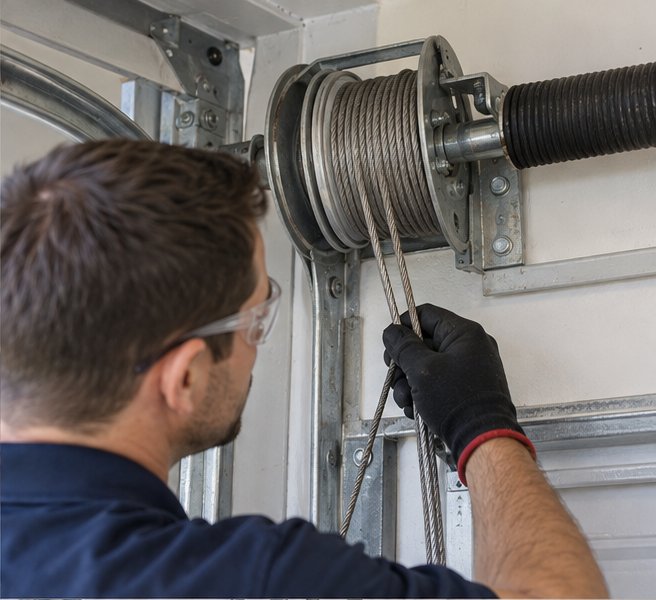
Each lift cable runs from a bracket low on the door, up the side, to a drum at the end of the spring shaft. As the door goes up, the drums wind the cables in and lift the door. If a cable becomes slack, frays, slips off its drum or snaps, that side of the door loses support and drops.
A cable that looks loose may not always be broken. It may simply have jumped the drum or lost tension because of a spring problem on the other side. Either way, the situation is unsafe to correct without proper tools and training, because the same cable path carries heavy tension.
Our page on garage door cable repair describes what we do, and the guide to a cable that snapped or came off the drum describes the warning signs in more detail.
- A thin metal cable hanging or curled near the bottom corner
- One cable that looks looser than the other
- Frayed strands visible along the cable
- A cable that has come off the drum at the top
- A bottom bracket that looks bent or pulled away from the door
Why you should never retie or hook a cable
It can look like a simple loop to put back, but the cable is connected to a system under heavy load. A slip can whip the cable, release the door suddenly or injure your hands. Treat any cable problem as a stop-and-call situation.
Spring imbalance and weakening
Springs wear with use. Each open and close cycle stretches and relaxes them, and over the years they lose strength. When a door has two springs and one weakens or breaks before the other, the door may favour one side. When a single torsion spring is worn, the door as a whole may feel heavy and may close faster than it opens.
A door with a spring problem often has other clues too. It may be heavy to lift by hand, drop when you let go partway up, or make the opener work harder than before. These clues overlap with the crooked-door symptom, so we examine both at the same visit.
Springs and the brackets that anchor them are dangerous. We never recommend that homeowners adjust, wind or swap them. For background, the guide on garage door weights and balance explains why balance matters, and how long garage door springs last covers ageing.
Bent hardware: brackets, hinges and sections
Hardware can bend when a door has been struck, forced closed against an obstruction, or run while off balance. A bent bottom bracket can tilt the corner of the door. A bent hinge can cause one section to ride out of line with the next. A bowed section can pull neighbouring sections off true.
Bent parts also create friction. A hinge that has folded slightly can rub in the track, which in turn raises resistance on one side and worsens the tilt. The door then compensates in odd ways, such as twisting as it passes through the curve at the top.
We look at every hinge, bracket and section edge. When something is bent, we explain whether it can be replaced individually or whether the damage suggests a larger repair. See hinge and track service and panel repair for how we handle these parts.
Signs of a bent section
Look at the horizontal lines of the door. If they ripple, the section has flexed. Creases, cracked edges and visible dents often accompany it. A section that has lost its stiffness no longer holds its shape in the track.
Signs of a bent hinge
A hinge bends when one of its leaves twists. You may see a gap between two sections on one side only, or a hinge that no longer lies flat against the door. These are worth photographing for us.
Rollers and tracks that favour one side
If one roller has cracked, flattened or stuck, that side of the door moves with extra friction. The door lags on that side and begins to tilt. If the track itself has shifted, dented or filled with debris, the same thing happens.
These causes are often easier to see than cable or spring trouble. Look at the track on each side while the door is closed. Is the gap between the rollers and the track the same on both sides? Is either track dented or pulled away from the wall?
Our guide to types of garage door rollers explains the difference between steel and nylon rollers and why they wear, and you can find service details on our roller replacement page.
- Cracked or flat spots on rollers
- Rollers that wobble on loose stems
- Dents or kinks in a track
- Dirt or grit packed in the channel
- Track brackets pulling away from the wall
Settled slabs, shifted jambs and building movement
Not every crooked door is a door problem. A slab that has settled or heaved changes the gap at the bottom of the door. A jamb that has shifted because of wood movement or moisture can leave the opening slightly out of square. In older homes, framing that has dried, cracked or rotted can allow the tracks to move.
This region's sandy soils, heavy rain and humidity all play a part. Water can wash soil from beneath a slab edge, and wood framing near a garage door opening takes a lot of moisture. Over the years these small movements add up.
A technician can tell the difference by checking whether the door itself is square and balanced, then comparing it with the opening. If the opening is the cause, we explain the findings and what options may exist, which may involve a carpenter or masonry professional as well as door work.
What you can safely check
Stay out of the door's path and treat the door as unstable. These steps involve only looking and noting.
- Stand to the side and compare the height of the two bottom corners.
- Look at the gap between the door and the jamb on each side.
- Check both cables for slack, fraying or a loose end, without touching them.
- Look at the springs for any visible gap or break.
- Look at each track for dents or separation from the wall.
- Take photos from a safe distance, including close views taken with zoom.
- Note whether the opener strains or makes new sounds.
What a safe observer does not do
Do not push on the door to test it. Do not lean a ladder against it. Do not climb up to look at the spring. Do not release the opener to see how the door moves by hand. If the door is crooked, it may not be safe to move.
Why you should avoid running a crooked door
It is tempting to keep using a door that still opens and closes, even if it looks off. The trouble is that a tilted door is working harder than it should, and the opener adds more force. That extra load can bend more hardware, fray a cable, or cause the door to come off its track.
A door that was only slightly uneven today can become a bigger repair next week. Using the opener again and again can also strain the gear or the circuit board, adding an opener repair to the list.
If the door is not clearly dangerous and you must use it, tell us when you call so we can advise. If it is off track or visibly unstable, read our page on a garage door that is off track and keep clear.
How we diagnose a crooked door
We start with a general look at the door and the opening, then examine the lifting system: springs, cables, drums and bearings. Next we check hinges, rollers, tracks and brackets one at a time. With the opener disconnected, we test how the door behaves by hand, because that shows balance problems the opener can hide.
We then compare findings. If both cables are intact and both sides are equal but the door still tilts, we look harder at sections and the opening. If one cable is slack, we ask why: did it break from wear, jump the drum, or lose tension because of a spring issue? Fixing only the cable would leave the cause in place.
Once we understand the cause, we explain it in plain language, show you the affected parts, and give you the options. You can read more about the process in our page on what happens during a service visit.
Repair options in plain terms
What fixes a crooked door depends on the cause. If a cable has failed, the cable and often related hardware need replacing and the system is rebalanced. If a spring is weak, springs are replaced as a set where appropriate and the door is adjusted. If a roller or hinge is worn, those parts are replaced. If a section is bent, a panel repair or replacement may be needed.
Replacing a whole door becomes a sensible option when several sections are damaged, when the door is old and parts are hard to find, or when the cost of repeated repairs stops making sense. We lay out each route without pressure, and the decision is yours.
If you want to think through the trade-off ahead of time, the comparison on repairing versus replacing a garage door is a helpful place to start.
- Cable replacement and rebalancing
- Spring replacement, usually in matched sets
- Roller and hinge replacement
- Track straightening or replacement
- Section repair or panel replacement
- Full door replacement when repair no longer makes sense
Doors damaged by impact or storms
A vehicle bump, a stray wind gust through an open door, or storm debris can all knock a door out of true. Often the damage looks modest from the outside, but hinges, brackets and sections may be bent behind the surface.
If your crooked door follows an impact, tell us what hit it and where. That helps us look in the right places first. If the damage came after a storm, our page on garage door damaged after a storm covers related signs.
Take photos before anything is changed, especially if the damage may relate to an insurance matter. We can describe what we find, and you can share that with whoever handles your claim.
Heat, humidity and salt on the Space Coast
Warm weather makes metal expand and contract through the day, and humid air keeps hardware damp. Salt from coastal breezes speeds corrosion on springs, cables, brackets and fasteners. A bracket that has rusted thin may bend under a load it used to handle with ease.
Homes close to the water often show faster hardware wear than those inland, though even inland garages feel the humidity. Regular lubrication and visual checks catch early rust, and the guides on garage doors in a coastal climate and garage door lubrication explain what to look for.
If your garage door has not been serviced in years, an uneven door may be only the first obvious sign of a system that needs a closer look.
Planning for a visit
When you contact us, describe what you see: which side is lower, whether it was always like that, whether you heard a bang, and whether the opener still runs. Photos help, as long as they are taken from a safe position. Written notes help as well. A short list of what you saw, in the order you saw it, often tells us more than a long description given from memory. Include any recent work on the door, any recent impacts, and any new sounds.
Please keep vehicles and belongings clear of the door and its path. If the door is stuck partly open, keep children and pets away from the opening. If you must secure the garage, close interior doors to the house.
We will explain what we find and what the options are. Our contact page shows how to reach us.
Questions and answers
The lifting system is probably not sharing the load equally. A slack or broken cable, a weak spring, a bent bracket or hinge, or a worn roller can each cause it. The cause needs to be found before anything is adjusted, because cables and springs hold dangerous tension.
We strongly advise against it. Cables carry heavy load and are connected to springs under tension. A slip can injure you or drop the door. If you see a loose or frayed cable, stay clear and contact us.
It is better not to. A tilted door puts extra strain on hardware and the opener, and can come off its track. If you must use it, tell us when you call so we can advise. If it looks unstable or off track, stop using it.
Possibly. A settled or heaved slab, a worn bottom seal or a shifted jamb can leave an uneven gap even when the door itself is sound. A technician can compare the door with the opening and explain which is responsible.
Sometimes, but not always. A cable often fails because of wear, a spring issue or a bent part. We look at why it failed before replacing it, so the problem does not return.
When several sections are damaged, parts are hard to find, or repairs keep stacking up. We explain the options for repair and replacement and let you choose based on what we find.