
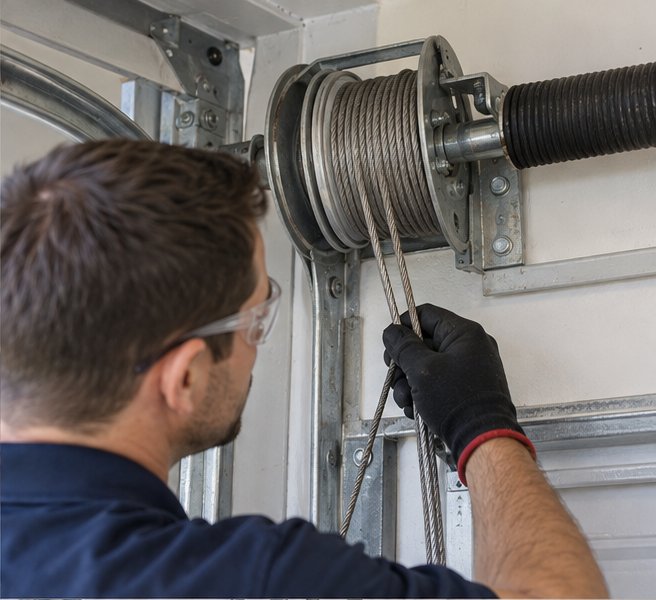
What lift cables do for your door
A sectional garage door is heavy, and the opener was never meant to carry that weight. The springs store the lifting force, and the lift cables are the link that passes that force to the bottom of the door. A cable runs from a bracket at each lower corner up to a drum at the end of the spring shaft, and it winds onto that drum as the door rises.
Because there is one cable on each side, they share the load and keep the bottom edge of the door level. If either side loses its cable, the other side suddenly carries more than its share. That is why a cable problem rarely stays small, and why a door with one damaged cable often looks twisted in its opening.
Most homeowners never see the cables until something goes wrong. They sit close to the edge of the door, just behind the track, and they are easy to overlook during a casual glance. Knowing roughly where they are and what a healthy one looks like helps you describe a problem accurately when you contact us.
How cables wear, fray and slip
Steel cable is made of many thin strands twisted together. Every time the door goes up and down, those strands flex around the drum and rub against their neighbors. Over thousands of cycles the outer strands begin to break, and the cable slowly loses strength even though it still looks mostly intact from a distance.
Along the Space Coast, salt in the air and high humidity speed up the process. Moisture gets between the strands and encourages rust, and rust makes the steel brittle where it bends. A cable on a door near the water can show corrosion well before the same cable inland would.
Signs of fraying
Fraying shows up as small wires sticking out along the cable, often near the bottom bracket or where the cable wraps the drum. You might see a section that looks thinner, flattened or fuzzy. A cable with broken strands should be looked at by a technician rather than left to see how long it lasts.
Signs of slipping
A cable can also come off its drum without breaking. This usually happens when the door hits something, when the cable goes slack for a moment, or when a worn drum no longer holds it in the groove. The cable then hangs loose or sits in the wrong place on the shaft, and the door will not lift evenly.
Symptoms that point to a cable problem
Cable trouble often announces itself through how the door behaves, before you ever look at the hardware. Pay attention to changes in how the door moves, and to anything that looks different from last week.
- One side of the door sits lower than the other when it is open or partly open.
- The door jams after rising a short distance, or tilts as it travels.
- A loose, dangling or coiled wire is visible beside the door.
- The opener strains, then stops, or the door will not leave the floor.
- You heard a sharp snap or a loud twang from the garage.
- The door looks fine closed but binds as soon as it starts to move.
- A cable end has pulled out of its bottom bracket.
Why a snapped cable can twist the door
When a cable breaks, one lower corner of the door loses its support. The spring on that side is still trying to lift, but the opposite side has nothing holding it in place. The door then lifts unevenly, the rollers on the weak side can jump out of the track, and the panels can bend as the frame of the door twists.
This is also why a door with a broken cable should not be run with the opener. The motor may push the door further out of line, and a door that is half off its track can fall without warning. If you suspect a cable has failed, leave the door where it is, keep people and vehicles away from it, and contact us rather than testing it again.
What we check during a cable visit
A cable problem is rarely only a cable problem, so we look at the lifting system as a whole. Replacing one cable and leaving the cause in place only invites a repeat of the failure.
The cables and bottom brackets
We examine both cables along their full length, including the end fittings. The bottom bracket takes a lot of strain and can crack, bend or pull loose. A cable that is in good shape on one side may still sit next to a weak bracket that needs attention.
The drums and shaft
The drums have grooves that guide the cable as it winds. If a groove is worn, burred or damaged, a new cable will not sit properly and may fail early. We also check that the drums are secure on the shaft and that the shaft turns freely in its bearings.
The springs and balance
Cables and springs work together, so we check the spring condition and how well the door is balanced. A weak or broken spring can leave a cable slack, and a slack cable is one that can jump off a drum.
How a replacement is done
Replacing a lift cable means releasing and then restoring the tension that the springs hold. That is not a job for a household toolbox, because a slipped tool or a misjudged step can cause serious injury. We carry the equipment made for this work and follow a set order of steps so the stored force is controlled the whole time.
Once the old cable is off, we fit the new one to the bottom bracket and wind it onto the drum in the correct direction and groove. The tension is then set on both sides so they match. Matching matters because even a small difference between the two cables will show up as a crooked door.
- Secure the door so it cannot move while the cable is being changed.
- Relieve the cable tension in a controlled way.
- Remove the damaged cable and inspect the bracket and drum.
- Fit the new cable and seat it in the drum groove.
- Restore tension evenly and recheck both sides.
- Test the door by hand before the opener is used again.
Alignment and balance after the new cable
A new cable is only half of a good repair. The door also has to sit square in its opening and travel without twisting. After fitting, we raise the door by hand and watch both sides. The bottom edge should stay level, the rollers should run in the middle of the track, and the door should stay where we leave it at about waist height rather than drifting up or down.
If the door was twisted when we arrived, the track brackets, a bent section or a roller may also need correcting. We explain what we found and what we recommend, so you can decide with the full picture in front of you.
Replace one cable or both
It is common to ask whether just the broken cable can be changed. Technically it can, but the two cables have lived the same life. They have been under the same load, in the same air, for the same number of cycles. If one has failed through age, the other is usually close behind.
When we look at the second cable and see wear, we will say so and let you choose. Changing both at once keeps the two sides matched in strength and condition, and it saves a second visit later. If the second cable looks sound and the rest of the system is healthy, we will tell you that too.
| Situation | What we usually discuss |
|---|---|
| Second cable shows rust or loose strands | Changing both so the sides match |
| Second cable looks clean and smooth | Changing only the failed cable is a reasonable option |
| Drum grooves are worn on one side | Looking at the drum along with the cable |
| Door has the original hardware and is many years old | Reviewing the whole lifting system together |
Cable trouble in the Space Coast climate
Homes near the Indian River Lagoon and the Atlantic deal with salt in the air nearly all year. That moisture settles on steel, and cables, drums and brackets are all steel. Doors close to the water often show surface rust on the hardware earlier than doors a few miles inland, even when the door itself looks fine.
Summer humidity adds to the problem, and the heat inside an unconditioned garage can dry out lubricant. After a storm, wind-driven rain can reach the lower hardware if the bottom seal has aged. Looking at your cables from time to time, from a safe distance, is a sensible habit in this part of Florida.
What you can safely do yourself
There is a short list of things a homeowner can do without touching anything under tension. Looking is always safe. Touching and adjusting the cable, bracket or drum is not.
Do not try to loosen, remove, rewind or reattach a cable, and do not loosen the bracket at the bottom corner. That bracket is under load from the spring even when the door is closed, and it can release suddenly. For more on this topic, our guide to garage door cable safety explains what to avoid and why.
- Look at the cables from the floor and note any rust, loose wires or a cable hanging slack.
- Listen for new sounds when the door runs, such as scraping or a sudden pop.
- Watch whether both sides of the door rise together.
- Keep the area under and beside the door clear of people, children and pets.
- Use the opener normally only while the door still moves evenly.
- Stop using the door if anything looks wrong, and contact us.
Cables on different door setups
Not every garage door lifts the same way. Most modern residential doors use torsion springs mounted on a shaft above the door, with a cable and drum at each end. Older doors, and some lighter ones, use extension springs that run along the horizontal tracks, with cables that loop through pulleys at the front and back. The cables look different, wear differently and fail in different ways.
On a torsion setup, a failed cable usually means the door tilts and the drum may spin or unwind. On an extension setup, a cable that lets go can whip back along the track, which is one reason we never recommend working around these parts without training. Our page on extension spring replacement explains how that system differs.
Wider doors, such as a two-car door in a newer subdivision, put a bit more reliance on the cables staying matched. A heavier insulated door adds weight as well. If your door has been upgraded since the original installation, tell us, because the lifting hardware may need to suit the new weight.
Questions worth asking your technician
Whoever looks at your door, you are entitled to understand what they are recommending. A few plain questions make the visit more useful and help you compare options with confidence.
- What caused this cable to fail, and could it happen again on the other side?
- Are the drums and brackets in good condition, or do they need work too?
- Is the door balanced after the repair, and how was that checked?
- Is there any damage to the track or panels that I should know about?
- What should I watch for over the next few months?
Planning your visit
When you contact us, a few details make the visit smoother. Tell us what you saw or heard, whether the door is open or closed, and whether the opener still responds. A photo of the cable or the drum, taken from a safe distance, helps us bring the right parts.
At the property we look at the door, explain what we find, and talk through the options before any work begins. We will tell you what must be done for safety and what could wait, so you are never left guessing. If you would like to learn how the whole system fits together first, how a garage door works is a good place to start, and our cable snapped or off the drum page lists common signs.
Keeping new cables lasting longer
After a replacement, a little regular care helps the new cables and the rest of the system. Our monthly garage door checklist lists simple visual checks that take only a few minutes, and none of them involve touching the cables.
A yearly look by a technician is also worth considering. Tension, balance, drum condition and bracket tightness are easy to miss and easy for us to measure. Catching a worn cable before it snaps is far better than finding out when the door is stuck with a car inside the garage. If you would like that kind of visit, you can contact us at any time.
Questions and answers
If the door is stuck partly open and you cannot be certain it will stay put, do not walk or drive beneath it. A door held up by one cable can drop suddenly. Keep people and pets away, leave the opener alone, and contact us so a technician can secure the door and look at the lifting system before anyone uses it again.
The opener may try, but it is not built to carry the weight of the door. Forcing it can bend panels, pull rollers out of the track and strain the motor. If a cable has broken, stop using the opener and the door and let a technician check the door first.
A snapped spring usually produces a loud bang and a door that feels very heavy to lift by hand. A cable problem more often shows as a crooked or tilted door, or a visible loose wire. Sometimes both have failed together. We check both parts at the visit and explain which one is responsible.
Cables wear out of sight. Strands inside the cable can fray around the drum while the outside looks acceptable, and rust under the surface weakens the steel. The door keeps working until the cable finally gives way. Salt air and humidity along the coast can shorten this process, which is why a periodic inspection is helpful.
No. The drum and cable are connected to springs under heavy tension, and a slip can cause serious injury. Even if the cable seems loose, the system is still loaded. This is work for a trained technician with the right tools, and we recommend you leave the cable alone and contact us.
Only when they need it. We look at the drum grooves, the set screws and how the cable sits. If a drum is worn, cracked or damaged, a new cable will not last on it, and we will recommend changing the drum too. If it is in good shape, we leave it in place.
A snapped cable often pulls a roller out of the track, so the two problems commonly come together. We look at the track, rollers and panels during the same visit, straighten or replace what is damaged, and set the door square again before testing it. We will explain each step along the way.