
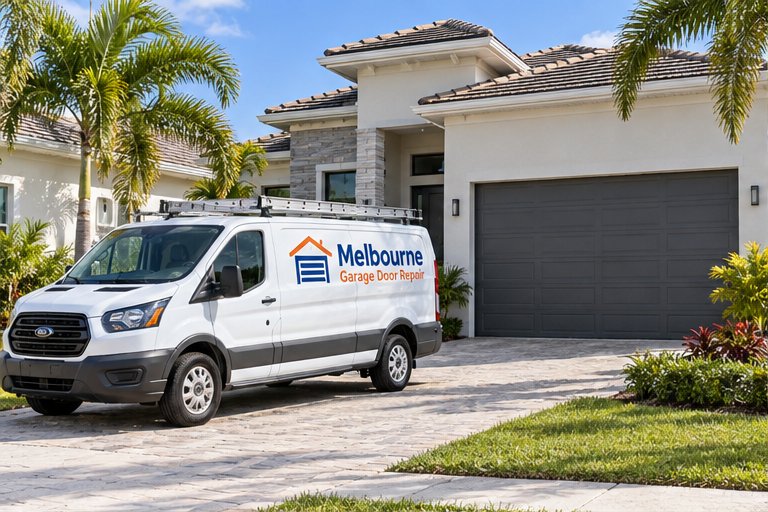
The garage as the front door
In many West Melbourne homes, nobody uses the front door on a normal day. People walk out through the garage in the morning, drive away, come home in the evening, pull in, and walk into the kitchen from the garage. The garage door is the main entrance to the house.
That changes what a failure feels like. A door that will not open is not just an inconvenience, it is a blocked car and a missed start to the day. A door that will not close leaves the house open while you are away. So the doors in this kind of neighborhood deserve a little more attention than the dusty door in a seldom-used storage garage.
Most of what we do in West Melbourne is aimed at keeping a heavily used door predictable. This page looks at the pressures that come with a commuter household, with newer construction, and with an inland setting, and it points you toward the pages that cover each repair in detail.
Counting cycles: how a commuter household wears a door
A door that opens and closes four times a day goes through about fifteen hundred cycles a year. A household with teenagers, deliveries and a second car can double that. Springs are rated in cycles, and a spring that was chosen as an ordinary standard part may reach the end of its working life sooner than the owner expects.
This is why a spring failure in a newer home can come as a surprise. The house is only a few years old, the door looks perfect, and then there is a loud bang from the garage. Nothing was wrong with the door, it simply used up what the spring had to give. Our guide on how long garage door springs last explains how cycles and spring type relate.
Rollers, hinges and the opener gear are all cycle-driven too. If your household uses the door more than most, it is reasonable to have the parts looked at earlier than the average schedule suggests. A short inspection every year catches a worn part before it fails on a morning when you are already late.
Newer subdivisions and the doors builders install
West Melbourne has a good share of newer streets, and those homes came with the doors that the builder chose. They tend to be insulated or non-insulated steel sectionals with a standard opener, sized for a typical two-car or three-car garage.
These doors meet the requirements for the time and place they were built, and they work well. They are not custom, though, and the parts are often chosen for cost. Rollers may have no bearings, the opener may be an entry-level unit, and the hinges may be thin gauge. After several years of daily use these parts start to show their limits.
If you bought a newer home from a previous owner, you may not know the age of the door, the type of opener, or whether anything has been replaced. The label inside the door and the label on the opener head hold most of that information. Our guide to reading your garage door label shows where to look and what the numbers mean.
Wide driveways, three-car garages and long doors
Wide lots and wide driveways bring wide garages. Three-car garages are not unusual in newer West Melbourne subdivisions, and some homes have a separate door for each bay, or one very wide door across two.
A long door has more of everything: more panels, more hinges, more rollers, and heavier springs. It also has more room for something to go out of line. A tilt that would be a small matter on a narrow door can be dramatic on a wide one.
Separate single doors are easier in some ways, because each is lighter, and a problem with one leaves the other bay usable. Both layouts can be maintained well. What matters is that each door is balanced, its springs match its weight, and its opener has the right strength for the job. We cover how balance is judged in garage door weights and balance.
Subdivision rules and what you can change
Many newer neighborhoods have an association. The association may have rules for the color, style and windows of garage doors, and a replacement door usually needs approval before it is ordered. This surprises some owners, who assume that a repair or replacement is purely their own choice.
A like-for-like repair, such as new rollers, a spring, or an opener, normally does not change how the door looks. A new door does. If the community has an architectural committee, the process typically involves sending a sample or a picture of the proposed door and waiting for a decision.
Rules also reach into small details. Some associations regulate the color of the trim, the hardware finish and whether the door has glass. Others are relaxed. We suggest you check before you shop, and our notes on HOA rules and garage doors give you a list of questions to take to your association.
A day-in-the-life checklist
Rather than a once-a-year list, here is a way of looking at the door that fits a working household. Each item takes under a minute and uses only your eyes and ears.
Treat anything that looks different from usual as worth a second look. Changes are more telling than absolutes.
- Morning: listen to the first cycle of the day and note anything new in the sound
- Morning: watch that the door reaches the full open position and stays there
- Evening: when you pull in, glance at the door's edge to see that it closes level
- Weekly: wipe the photo eye lenses near the floor and check that nothing blocks them
- Monthly: look at the springs, cables and rollers from the floor without touching them
- Monthly: press the wall button and the remote to be sure both respond
- After storms: look for new gaps, bent parts or signs the door shifted
What to do with a change
A new sound, a slower rise, a small shudder, or a door that stops short is the door telling you something. Write down what you noticed, when it started, and whether it happens every time. That description is more useful to a technician than the words something is wrong with my door.
Inland storms, lightning and power surges
West Melbourne is away from the water, but it is not away from weather. Summer afternoon thunderstorms are routine here, and lightning is one of the most common reasons for electronic problems in a garage. A strike near the house, or a surge on the power line, can damage an opener's circuit board, the wall control and the sensors.
The signs are varied. An opener that stopped responding after a storm, a wall button with dead lights, or sensors that blink without reason are all possible results. Sometimes only a part of the electronics is affected, and a repair is possible. In other cases the board is not worth repairing on an older unit.
A power outage brings its own problem. Many people do not know how to open the door manually when the power goes out, and a few are surprised when the door stays stuck afterward. Our guide to using the manual release during a power outage explains the careful way to do it, and the problem page on a door stuck after a power outage covers what to do next.
Remotes, keypads and the household with many drivers
A commuter household usually has several remotes: one in each car, maybe one on a keychain, and a keypad by the door. Teenagers join the mix, and family members come and go with borrowed cars. Remote systems get more attention than anyone expects.
Common problems include remotes that lose their programming when the battery dies, visor remotes left in hot cars that wear out, and keypads that stop reading because the buttons have worn or the battery is weak. A remote that works from close up but not from the street often points to a battery, an antenna or interference from something nearby.
Programming is usually simple once you know the steps for your particular opener. We have written about the process in programming garage remotes and keypads, and our remote and keypad service covers the cases where it does not take. If a remote has been lost, it is also worth having the codes reset, so the old remote no longer works.
Smart openers and phone control
Newer homes are the ones most likely to have, or want, a smart opener. Many modern openers can connect to home wifi and report whether the door is open or closed. That is useful for a commuter who wonders halfway to work whether the door was left open.
Smart features depend on the home network, so a weak wifi signal in the garage is a common stumbling block. Garage walls and metal doors can block signals, and a router placed at the other end of the house may not reach. A wifi extender or a different location for the access point often fixes it.
If you are thinking about upgrading, our guide to smart garage door opener basics explains what the features do and what they need. Smart control is a convenience, not a substitute for sound mechanics and working safety sensors.
What a door typically needs over its first ten years
Newer does not mean without upkeep. The table gives a general picture of how a typical busy residential door tends to age, to help you plan. Every door is different, and use and conditions change the timing.
It is meant as a rough map and not as a schedule. We confirm what a particular door needs only by looking at it.
| Stage | What commonly happens | What is worth doing |
|---|---|---|
| Early years | Everything works; small noises begin | Keep tracks clean and lubricate the right points |
| Middle years | Rollers and hinges loosen or wear; sensors drift | Inspect hardware, tighten by a technician, realign sensors |
| Later years | Springs near end of cycle life; opener gear wears | Plan spring replacement and consider opener condition |
| Beyond | Panels weather; seals harden; parts are harder to match | Weigh repairs against a new door |
Safety around kids, cars and the daily rush
A busy household is a place where a garage door can cause harm without anyone intending it. Children play in driveways, pets run through open doors, and a rushed driver may not see the door still coming down.
The safety reversal and the photo eyes are what protect people and cars. They should be tested occasionally, and any sign that they are not responding calls for attention. A simple test with a roll of paper towels or a board on the floor under the door shows whether the door reverses on contact.
Teach children not to play with the wall control or remote, and not to run under a moving door. Our page on garage door safety for kids and pets has more, and the garage door safety tests guide walks you through the checks.
Bumps, scrapes and sensor knocks on wide driveways
A wide driveway invites a wide turn, and a wide turn is how a bumper or a side mirror meets the door frame. Minor contacts are common in busy households: a car reversing a little too far, a bicycle tipped against the door, a ladder carried in at an angle. Most leave no mark, yet some leave the door slightly out of line.
The parts that suffer most are the small ones near the floor. The photo eyes sit a few inches above the ground on either side of the opening, and a gentle knock is enough to turn one so it no longer faces its partner. The result is a door that closes partway and goes back up, or an opener whose lights blink. Nothing is broken, the beams are just not meeting.
Look at the two sensors from the floor and see whether they point straight across the opening and sit at the same height. Wipe each lens with a soft cloth, and take care not to bend the bracket. If they will not line up easily, or one is cracked, a technician can replace or reposition them. Do not bypass the sensors, because they are a safety device.
Garages that double as workshops and storage
In plenty of West Melbourne homes the garage has stopped being only a place to park. It holds a workbench, shelves, a second refrigerator, bikes, holiday boxes and sometimes a hobby or a small home business. That changes how the door lives.
Stored items creep toward the door, and shelves and bins can block the sensors, the tracks or the swing of the door. A workbench against the side wall can interfere with the horizontal tracks overhead. Sawdust, paint spray and fine dust get into rollers and hinges, and a garage that is used for hobbies may also be left open for long stretches, which exposes the opener and the door to weather.
Keep a clear strip along each side of the door and across the opening, and nothing leaning on the panels. If you added an extra light, a fan or a storage rack on the ceiling, make sure it does not touch the door path or the opener rail. Take a look at the overhead space when the door is fully open, and note anything that comes close to touching.
Rentals, investors and homes that change hands
West Melbourne also has rental homes and houses that change hands. Investors and landlords care about doors that work every time, because a tenant who cannot open the garage calls promptly. Buyers and sellers care because the door shows up in an inspection.
If you own a rental, a yearly look at each door is a modest cost compared with an emergency call. Keep a note of the remote count, the opener model and any repairs. If you are buying, have the door inspected as part of the home check, and ask about the age of the springs and the opener.
We have notes on both situations: garage doors for rental properties and the buyer-focused guide on a garage door inspection when buying a home. Both are about avoiding surprises.
Shops, offices and light commercial doors nearby
West Melbourne has its share of commercial and light industrial buildings, and those doors carry different demands. Rolling doors, wide sectionals and doors fitted with commercial operators work in dust, in vehicle traffic and with more frequent cycles than a home door.
A business that depends on its door benefits from a simple schedule of inspections. A planned visit during a slow period costs the business less than an unplanned failure during a busy one. Our commercial garage door service page describes what that involves.
Arranging a visit in West Melbourne
To arrange a visit, tell us where you are, what the door is doing, and anything you have noticed. If the door is still operating, tell us whether it does so normally. If it is stuck, say whether it is open, closed or in between, and leave the door where it is.
We do not promise timing or pricing before we have seen the door. What we do is send a technician to your property, look at the whole system, explain what is worn and what is not, and talk through the options. You decide what happens next.
Photographs of the door, the springs, the opener and the label are a big help. When you are ready, contact us and we will go from there.
Questions and answers
Springs are rated by cycles, not by years. A household that uses the door several times a day can reach the spring's rated cycle count within a few years, even though the door looks new. When a spring breaks, stay clear of it and do not try to handle it yourself. Call for a technician to replace it.
Often yes, if your neighborhood has an association. Many have rules about color, style, windows and hardware, and a replacement door usually needs approval before ordering. Repairs that do not change the look of the door, such as springs or rollers, normally do not. Check your community documents or ask the association before you buy. A like-for-like repair rarely changes how the door looks, but a new door does.
Yes. A strike nearby or a power surge can damage the opener's circuit board, the wall control and the sensors. Signs include an opener that does not respond, dead lights on the wall button, or erratic behavior after a storm. A technician can test the parts and tell you whether repair or replacement makes sense. A surge protector on the opener circuit is a sensible precaution to ask about.
Weak batteries are the most common reason, so replace the battery first. An aged remote, interference from nearby electronics, or a damaged antenna on the opener can also reduce range. If a fresh battery does not help, the remote or the opener's receiver may need attention, and we can test both. If a battery swap does not help, we can test the remote and the receiver.
It can be convenient, since you can check the door status from your phone and close it remotely. It depends on a stable wifi signal in the garage, which is not always available. It does not replace working safety sensors or sound mechanics. We can explain the options for your current opener. It is a convenience feature and depends on a reliable connection from the garage.
A yearly inspection is a sensible rhythm for most homes, and a heavily used door may benefit from checks a little more often. The visit looks at springs, cables, rollers, hinges, tracks, balance, the opener and the safety reversal, so small problems are found before they cause a failure. A yearly visit also lets us listen to the opener and check the travel settings.
Stay calm and keep people clear of the door. If it is closed and you need to open it, use the red release cord carefully from the floor and lift only if the door feels light and balanced. If it feels heavy or drops, stop and wait for a technician. Never pull the cord while the door is moving, and do not stand under the door.