
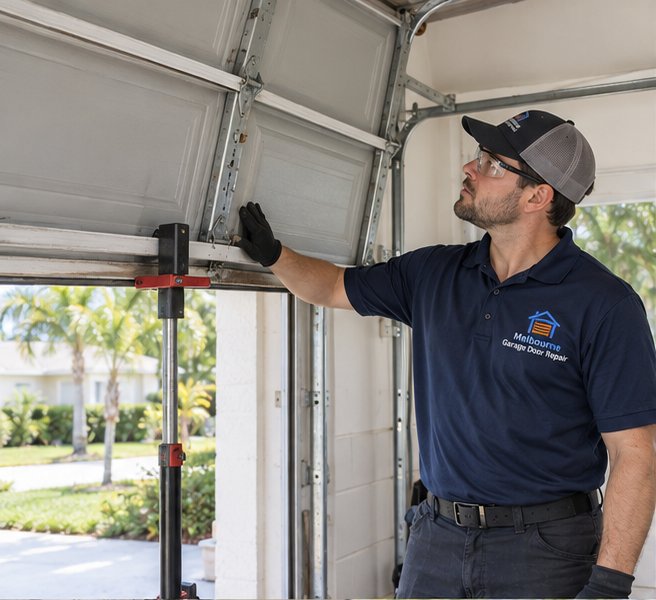
What off track really means
A sectional garage door rides on rollers that sit inside two metal tracks, one on each side of the opening. The tracks guide the door as it rises, curves overhead and comes to rest near the ceiling. When people say a door is off track, they mean one or more rollers have left that channel and the door is no longer being guided.
It can look different from one house to the next. Sometimes the whole top corner has popped out and the door hangs crooked. Sometimes only a single roller has slipped, and the door looks nearly normal until you try to move it. In every case the door is no longer carrying its weight the way it was designed to.
Why a door leaves the track
The track is held in a fairly tight shape, and it takes a surprising amount of force to push a roller out of it. Something usually changes first, and that change is what we try to identify.
Most cases fall into a handful of causes, and often a few of them combine. A small problem that was ignored for months can end with a door that suddenly jumps off in the middle of a normal cycle.
Impact
A vehicle bumping the door, a bicycle leaned against it or a ball thrown hard at it can knock a roller loose. Even a light tap against a door that is already slightly loose can be enough. Impact damage may also bend a track section or crease a panel.
Loose hardware
Track brackets are held to the wall and ceiling framing with bolts and lag screws. Over time, vibration from the opener loosens them. A track that wobbles a little will eventually let a roller slip out, and the movement is often easy to see once you know to look.
Worn or damaged rollers
A roller with a flat spot, a cracked wheel or a bent stem can wander in the track instead of rolling in line. When it finally climbs over the edge of the channel, the door twists. Rollers are inexpensive parts, but a failed one can cost far more than itself.
A snapped cable or broken spring
If a lift cable breaks, one side of the door loses support and the door tilts. The roller on the weak side can pop out almost immediately. This is why we always check the cables and springs when we are called for an off-track door.
Why you should not force it back
It is natural to want to push or pull the door into place, especially if a car is trapped inside. Please resist that. A door that is off its track is unstable, and the springs may still be pulling in directions they were not meant to.
If you push a roller back and the door is not otherwise sound, it can fall, or it can spring forward unexpectedly and strike you. A bent track will not hold a roller no matter how hard you push, and forcing it can twist panels beyond repair.
- Do not run the opener while the door is crooked or jammed.
- Do not stand or reach under a door that is hanging unevenly.
- Do not pry or hammer the track back into position.
- Do not release the manual cord unless you are certain the door is fully supported.
- Keep children and pets away from the area.
What we do when we arrive
Our first job is to make the door safe. We look at how it is hanging, which parts are carrying load, and where the stored spring tension is acting. Only then do we start taking things apart or putting things back.
We then trace the problem to its source. Did the roller slip because the track moved? Did the track move because the brackets loosened? Did something hit the door? Understanding the order of events tells us whether we are fixing a one-time accident or a developing fault.
- Secure the door against sudden movement.
- Look for damage to rollers, hinges, panels and track.
- Check cables, drums and springs for failure.
- Measure the track for alignment and plumb.
- Decide what can be straightened and what needs replacing.
- Reset the door and test it by hand before using the opener.
Straightening versus replacing track
A track is made of steel, and steel can be bent back if the damage is mild. A small kink or a slight outward bow can often be worked out with the right tools, provided the metal has not creased or stretched. We make that judgement after looking at the shape of the damaged area.
If the track has a sharp crease, a torn flange or a section that no longer keeps its curve, straightening will not restore it. The rollers will catch at the damaged point, and the door will keep jumping. In that case, replacing the affected section, or the whole track, is the dependable choice.
| What we see | What we usually discuss |
|---|---|
| Slight bow or outward lean | Straightening and retightening the brackets |
| Sharp crease or flattened channel | Replacing the damaged track section |
| Curved section bent out of shape | Replacing the curve, since it sets the door's path |
| Loose brackets with a sound track | Tightening or replacing the fasteners and brackets |
| Rust that has eaten through the steel | Replacing the track |
The curve and the horizontal run
Every door track has two main sections. The vertical part runs up the sides of the opening, and the horizontal part runs back along the ceiling. Between them is a curve where the door changes direction. That curve is where rollers are under the most stress, and it is the part of the track that most often shows damage.
The horizontal section depends on ceiling hangers and angle iron to stay level. If it sags, the door drags on the way up and a roller can leave the channel at the back of the garage, out of sight. When we assess a door, we look along the whole run, not just the spot where the problem showed itself.
Rollers, hinges and panels
The track is only part of the story. A door that jumped the track may have bent a hinge, cracked a panel edge or flattened a roller on the way. We check each of these before resetting the door, because putting a damaged piece back into service only leads to a second failure.
Hinges hold the panels together and carry the roller stems. A hinge that is bent or loose lets the door flex, and a flexing door puts uneven load on the rollers. If you want to read more about these parts, our pages on garage door roller replacement and hinge and track service go into more detail.
When panels are damaged too
A door that fell or twisted can crack at the stiles or buckle along a horizontal seam. A mild dent might be cosmetic, but a crease near a hinge point weakens the panel and can prevent the door from folding properly in the curve.
We will tell you honestly whether a panel can stay or needs attention. Sometimes one panel can be replaced. Sometimes the style, age or availability of parts means a conversation about a larger repair. Our guide on whether to repair or replace your garage door can help you prepare for that.
Off-track doors and your opener
An opener is meant to move a door that is already balanced and aligned. It is not meant to drag or push a door that is stuck. If the opener runs against a jammed door, the trolley, the rail or the gear inside the motor can be damaged.
If you find the door off track, disconnect nothing and leave the opener alone until the door is looked at. Pulling the red release cord can drop a door that is partly supported, so we do not suggest using it in this case. When the door is secure and aligned again, we test the opener and, if needed, reset its travel limits so the door stops where it should.
Off-track problems along the coast
Garage doors in coastal Brevard and Indian River counties live in salty, humid air. Steel track can rust at the bends, and brackets that look sturdy can be thin and weak where corrosion has been working. Rust that flakes away leaves a rough track surface, and rollers do not like it.
Storms add another factor. Strong wind pushing against a door can flex panels and bring rollers out of the channel, especially if the hardware is already worn. After a stormy week, it is worth watching how the door runs and listening for scraping. Our guide to garage doors in a coastal climate explains what the environment does to hardware.
What a homeowner can safely look at
There are a few safe observations you can make from the floor, and they help us understand what happened. They involve looking, not touching or pulling.
Write down or photograph what you see from a safe distance. These details are useful when you contact us, and they help us bring the right parts the first time.
- Which side of the door looks out of line, left or right.
- Whether a roller is visible outside the track channel.
- Any bent metal, gaps or sharp edges along the track.
- Whether the door sits flat on the floor or leans.
- Any hanging cable, loose wire or broken spring parts.
- What was happening just before: a bump, a storm or a strange sound.
Common situations we are called to
Every off-track door has a story, and the story shapes the repair. A few patterns come up again and again in homes and small businesses around Melbourne.
A garage used for storage often has boxes, bikes or shelving pushed up beside the door. A shifted shelf or a leaning ladder can catch a roller or hit the track when the door moves. A workshop garage may have a door that is opened many times a day, so wear builds faster and small faults show up sooner.
Rental properties and vacation homes are another case. A door that is used by several different people may be hit more often, and nobody is quite sure when the trouble began. In these situations we look carefully at how long the damage has probably been developing, because the older the fault, the more parts it may have touched.
After the door is back in line
Once the track is sound and the rollers are seated, we do not simply hand the door back. We run it by hand through its full travel and watch each roller as it enters the curve and leaves it. The door should rise smoothly, stay level, and stay put when we let go partway up.
If the opener is connected, we run it through several cycles and listen for scraping or hesitation. We also check the safety sensors and the auto-reverse behavior, since an opener that was jammed against a stuck door may have shifted its settings. Only when everything behaves normally do we consider the repair finished.
- Smooth, level travel through the whole range
- No scraping or visible roller wobble
- Door holds position when released by hand at mid-height
- Opener stops cleanly at both ends of travel
- Sensors and reversing function respond correctly
Why prompt attention matters
An off-track door that is left alone usually gets worse. Panels flex under their own weight, hinges bend, and the springs keep pulling at an angle they were not made for. A repair that might have involved a roller and a few bolts can grow into a larger job.
There is also the question of security. A door that cannot close properly leaves the garage open to weather, animals and people. Along the Space Coast, a partly open garage during a thunderstorm can let in wind-driven rain. If you cannot close the door, tell us, and we will talk about how to protect the opening until it is repaired.
Signs that an off-track event is coming
Most doors give hints before they leave the track. Learning these signs can save you from a stuck door and a car trapped inside the garage.
Scraping, a door that slows or hesitates in one spot, a visible gap between the roller and the track, or a track that wiggles when the door passes are all early warnings. A door that shakes as it rises, or one that sounds different from a month ago, is worth having checked. Our page on door off track lists the symptoms in more detail.
Getting the door looked at
When you reach out, tell us whether the door is open, closed or stuck in between, what you saw and heard, and whether anyone was hurt or anything was struck. If a person has been injured, call 911 first.
We come to the property, look at the door, and explain what we find. We discuss the options plainly, including what has to be done for safety and what could wait. We never ask you to commit to anything before you understand it. To start, contact us and describe the problem.
Questions and answers
Do not try to close it. A door that has come off its track may hang by one side, and moving it can make the damage worse or cause it to fall. If it is already closed, leave it alone. Keep people clear, avoid using the opener, and contact us so a technician can make the door safe first.
Repeated trouble on the same side points to something wearing or loose there, such as a bent track, a weak bracket, a damaged roller or a failing cable. Resetting the roller without finding the cause only buys a short time. We look for the underlying fault so the repair actually lasts.
No. A mild bow can often be straightened and the brackets tightened. A sharp crease, a flattened channel or a distorted curve usually needs replacement, because the rollers will catch at the damaged spot. We examine the metal and tell you which category yours falls into.
It can contribute. If the opener keeps pushing against a door that is binding, it may force a roller out of the channel. Incorrect travel limits can also slam a door into the floor or the stops. We check the opener settings after the door is realigned.
It can. A door that falls, twists or drops partway may strike a vehicle, particularly near the front or rear of a car parked close to the door. Please keep vehicles and people away from the door until it has been looked at and made safe.
Often it makes sense to look at them closely, because a worn roller is one of the usual reasons a door leaves the channel. If the wheels are cracked, flat or loose on the stem, replacing them at the same visit prevents a repeat. If they are sound, we leave them in place and tell you why.
Strong wind can flex panels and loosen worn hardware, and a door with aged rollers or brackets is more likely to jump the track in a storm. After severe weather, watch how the door runs and listen for scraping. If anything seems different, stop using it and contact us.
Look at the track from the floor. If a roller stem is visible outside the channel, or one side of the door is higher than the other, a roller has left. Do not push it back. Note what you see and contact us, and we will reset it after checking the rest of the system.