
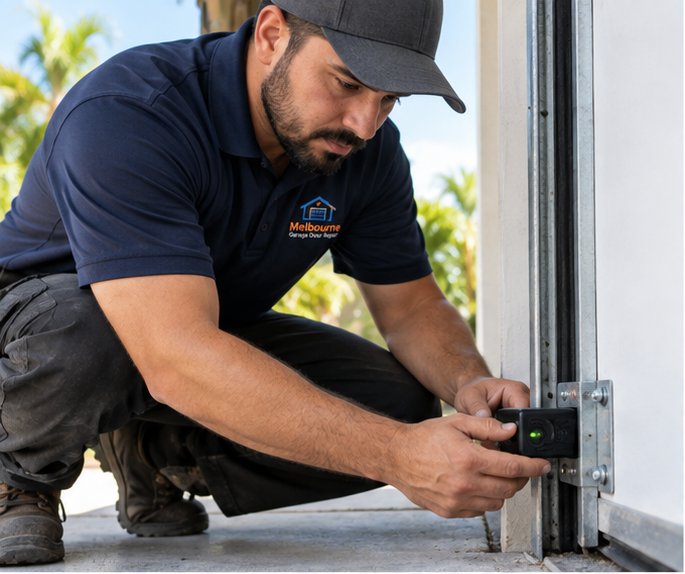
Why a door turns around on the way down
Every modern opener has a reversing feature. If the door meets resistance or the opener thinks the path is blocked, it stops and sends the door back up. That feature protects people, pets, cars and the door itself, so a reversing door is a safety system working, even when it is working at the wrong moment.
The reversing can come from two separate systems. One is the pair of safety sensors near the floor, which watch for anything crossing their beam. The other is the opener's own sense of effort and distance, which decides how far the door should travel and how hard it may push before giving up.
Our job on a visit is to work out which system is triggering, and then why. A door that reverses halfway down points somewhere different than a door that reverses the moment it touches the floor, so the exact moment of the turnaround is the most valuable clue you can give us.
Read the clue: when exactly does it reverse?
Before touching anything, watch a full cycle from a safe spot well away from the door's path. Note where in the travel the door turns around, and what the opener lights and the sensor lights are doing. Write it down if you can, because small details are easy to forget once you start explaining it.
Timing tells a story. A turnaround near the top of the travel behaves differently from one in the middle, and both differ from one at the very bottom. The list below shows the usual meanings.
| Where the door reverses | What it often points to |
|---|---|
| Almost at once after starting down | Sensor beam interrupted or misaligned, or a sensor wire problem |
| Somewhere in the middle of the travel | Binding in a track or roller, uneven balance, or an object in the path |
| Just as it touches the floor | Down travel set too far or force set too light for the door's weight |
| Touches the floor, then rises a short way | Close limit or force adjustment, or a bottom seal catching on uneven concrete |
| Different spot each time | Intermittent sensor connection, loose bracket, or a wiring fault |
Safety sensors: the most common culprit
Two small eyes sit about a hand's height above the floor, one on each side of the door opening. One sends an invisible beam and the other receives it. If anything breaks that beam while the door is closing, the opener reverses. If the beam never arrives because the eyes are not pointing at each other, the opener behaves as if the path is blocked.
Many openers show the sensor status with small lights on each unit. Steady lights usually mean the beam is healthy, while a blinking or dark light on one unit suggests misalignment or a wiring problem. Exact light behaviour differs by opener, so we read the manual for the model in front of us rather than assume.
Sensors get knocked more often than people expect. A bicycle handlebar, a mop bucket, a garden hose reel pushed against the wall, or a bumped bracket can turn an eye a few degrees. That is enough to lose the beam, particularly on a bright Florida afternoon when sunlight shines straight into a lens.
Simple sensor checks you can do
Stand clear of the door and look at both sensors. Check that nothing sits in the beam path, such as a box, a leaf pile or a cord. Gently wipe each lens with a soft dry cloth, because cobwebs, dust and salt film can weaken the signal.
Look at the brackets. If one unit is clearly tilted or pointing at the ceiling or floor, note it. You can mention it to us, but do not bend the brackets or loosen the garage door hardware around them.
When sunlight is the problem
If the door reverses mainly in the late afternoon and behaves in the morning, direct sun on the receiving eye may be washing out the beam. We often find this on east and west facing garages. Shading the lens with a simple shield or repositioning the unit are options we can discuss once we see the layout.
Travel limits: how far the opener thinks the door should go
The opener stores two positions, fully open and fully closed. If the closed position is set a little too low, the door reaches the floor, keeps pushing against it, and then reverses because it senses resistance. If it is set too high, the door may stop short of the floor and leave a gap.
Limit settings can drift after a power surge, a loose adjuster, a change of seal, or even a new slab finish. After a bottom seal replacement we often see this, because the new rubber is thicker and the door now meets the floor sooner than it used to.
Adjusting limits is a controlled procedure that varies from one opener model to another. It is not complicated for a trained technician, but it affects safety, so we ask homeowners to leave limit changes and force changes to us.
- Door touches the floor and bounces back up immediately
- Door stops a hand width above the floor and will not go lower
- Door closes correctly after a seal change, then starts reversing a week later
- Limits that were fine for months suddenly seem off after a storm power surge
Force settings and a door that is heavier than it should be
Openers also decide how much effort is acceptable on the way down. If the force setting is too low for the weight of the door, normal friction can look like an obstruction and the opener turns the door around. Raising force to hide the problem is a poor fix, because the real question is why the door needs more effort than before.
A door that has lost counterbalance from a tired spring feels much heavier to the opener. It may also come down faster than usual or sag on one side. When the spring system is the cause, nudging the opener settings only masks the problem and puts extra load on the gear and the rail.
That is why we test balance by hand with the opener disconnected before touching any setting. A properly balanced door stays roughly where you leave it at about waist height. A door that drops or climbs on its own needs spring attention, and that work belongs with a trained technician, not the homeowner.
Why we do not just turn the force up
A higher force setting means the door pushes harder against anything it meets, including a bumper, a child's toy or a pet. The reversing feature exists to prevent harm, and weakening it hides symptoms while removing protection. We would rather find the stiff roller, bent track or weak spring causing the extra effort.
Track, rollers and hinges that make the door drag
A door that rubs, jams or hesitates in the track gives the opener extra work to do. If the resistance spikes at the same place each cycle, the opener may read it as an obstruction and reverse. This is common with a worn roller, a dried-out hinge, a dent in the track, or a section that has shifted slightly out of line.
Look along each vertical track while the door is closed. You are checking for obvious bends, gaps between the rollers and the track, and dirt or sand packed into the channel. In coastal Brevard and Indian River neighbourhoods, salty air and grit also build up on the metal and make movement rough.
- Visible dents or kinks in the track
- Rollers that look cracked, flat or wobbly on their stems
- Hinges that are bent, dry or clearly loose
- A door section that scrapes on the jamb as it passes
- Track brackets that have pulled away from the wall or ceiling
What not to touch
Do not loosen or tighten track brackets, bottom brackets or anything attached to a spring or cable. Those parts are under heavy load, and a slip can injure you or collapse the door. If you see damaged hardware in those areas, stop using the door and call us.
Obstructions, uneven floors and worn bottom seals
Sometimes the cause is simple and physical. A pebble under the door edge, a rolled-up rug, a stack of boxes slightly off the wall or a drain cover that sits proud of the slab can hold the door off the floor just enough to trigger a reversal.
Slabs in this region settle and shift over time. A garage floor that slopes toward the door, or one that has cracked and heaved at one side, can make the door meet the ground earlier on one end. The opener sees a firm stop sooner than it expected and reverses.
Bottom seals can be the hidden cause too. A seal that has curled, torn or hardened can fold under the door and pinch, creating resistance. In that case the seal needs replacing, which is part of our bottom seal and threshold service.
Wiring, power and the opener's own electronics
Sensor wires run from each eye back to the opener, often stapled along the wall and ceiling. A pinched wire, a staple driven too tight, a rodent chew or a loose terminal at the opener can create a signal that comes and goes. That kind of fault is frustrating because the door may close perfectly ten times and then reverse on the eleventh.
Storms and brief outages can also leave an opener confused. Power surges can scramble stored settings or damage a circuit board. If the problem started right after a lightning event or an outage, tell us, because it narrows the search.
When the issue is inside the opener itself, a repair may be possible, or replacement may make more sense, depending on the age and model. We lay out both choices clearly in our opener repair page.
A simple, safe check routine at home
These steps are safe for most homeowners because they involve looking, wiping and watching, not adjusting tensioned parts. Stop at any step where you are unsure.
- Clear the floor area under and beside the door, including the sensor beam path.
- Wipe both sensor lenses with a soft dry cloth.
- Look at the sensor lights and note whether either one is dark or blinking.
- Watch a full close cycle from the side, and write down where the reversal happens.
- Inspect the bottom seal for tears, folds or objects caught under it.
- Try closing the door with the wall button, then with the remote, to see if the behaviour changes.
- Check whether the problem only occurs at certain times of day, which may point to sunlight.
The balance test, and why to stop here
Some guides tell homeowners to disconnect the opener and lift the door by hand to test balance. We would rather do this ourselves, because a door with a broken or weak spring can be heavy enough to drop suddenly. If your door feels extremely heavy, makes a loud bang, or shows a visible gap in a spring, leave it alone and contact us.
What we do when we arrive
We start by watching the problem happen. After that we check sensor alignment, lens condition and wire routing, then look at the door's path through the track and rollers, and finally test balance with the opener safely disconnected. Only after that do we look at the opener's limit and force settings.
Finding the real cause matters more than getting the door to complete one cycle. If the sensors are at fault, we realign or replace them. If balance or hardware is the cause, we explain what is worn and what options exist. If the opener is simply out of adjustment, we reset it and test the reversing feature with an obstruction to confirm it still protects people.
That last test matters. A correctly set door must reverse when it meets an object but must not reverse for no reason. We confirm both before leaving, and we explain what we found so you know what to watch for. You can read more about the process on our page covering what happens during a service visit.
Florida conditions that make reversing more likely
Heat, humidity and salt all play a part on the Space Coast. Humid air swells weatherstripping and can make a bottom seal grip the slab. Salt spray from the coast speeds rust on brackets and sensor housings. Afternoon sun hits low sensors at an angle that can wash out the beam, and afternoon thunderstorms bring surges that upset opener settings.
Rental homes, vacation properties and seasonal residences add another factor. A door that sits unused for weeks may develop stiff hardware and dried lubricant, then reverse on its first few runs after return. A short service visit before the busy season can catch this early.
If you live near open water or in a neighbourhood with irrigation overspray reaching the garage, expect more frequent cleaning of lenses and hardware. A basic routine from our monthly garage door checklist helps you spot trouble before the door starts turning around.
Safety first: what not to do
A reversing door is annoying, and the temptation is to override it. Please do not. Disabling sensors, holding the wall button down to force the door shut, or taping the sensors in place removes the protection that keeps people and pets safe.
Never stand under a door that is moving unpredictably, and never place a hand or foot in the path to test whether it will reverse. Use a soft object like a rolled towel only if you are following the manufacturer's testing steps and are comfortable doing so from a safe position.
If anyone is hurt or trapped, call 911 first. If the door is stuck partly open, keep children and pets away from the opening and from the vehicle area until it has been looked at.
- Do not bypass or disable the sensors
- Do not hold the close button as a workaround
- Do not adjust springs, cables or the brackets that hold them
- Do not climb a ladder to move the opener while the door is under load
- Do not leave a partly working door unattended with the garage open overnight
Repair or replace: how we think about it
Most reversing problems are repairs. Sensors can be realigned or replaced, limits and force can be reset, rollers and hinges can be swapped, and seals can be renewed. Replacement of the opener or door only enters the conversation when parts are worn through or the cost of continuing repairs stops making sense.
We explain what we find and what the options are, with the reasons behind each, and the choice stays with you. If the opener is old and has started to show multiple faults, we will tell you plainly. If the door itself is the issue, our guide to repairing or replacing your garage door walks through how to weigh it.
Questions and answers
That usually means the opener thinks the door has met an obstruction. The close limit may be set too low, the force may be too light for the door's weight, or a bottom seal may be pinching on the floor. A technician can reset the travel and test the reversing feature safely.
Yes. Dust, cobwebs or a film of salt on the lens can weaken the beam enough for the opener to treat it as blocked. Wiping each lens with a soft dry cloth is a safe first step. If the problem continues, the units may be misaligned or have a wiring fault.
No. The sensors protect people, pets and vehicles. Bypassing them can lead to serious injury if the door comes down on someone. If the sensors are causing trouble, have them realigned or replaced instead of overriding them.
Direct sunlight on the receiving sensor can wash out the beam at certain hours, especially on east or west facing garages. Shading the lens or repositioning the unit may help. A technician can look at the layout and suggest options.
Some openers have simple adjusters, but we recommend leaving them to a trained technician. Incorrect settings can weaken the safety reversal or strain the door and opener. We adjust them as part of a full check that includes balance and a reversal test.
It can. A door that has lost counterbalance feels heavier to the opener, and the extra effort can look like an obstruction. Spring work involves dangerous tension, so please do not attempt it yourself. Contact us so we can inspect the door.
It can. Surges may scramble stored positions or damage the control board, and the door may start reversing right afterward. Tell us when the problem began, as that detail helps narrow down the cause.