
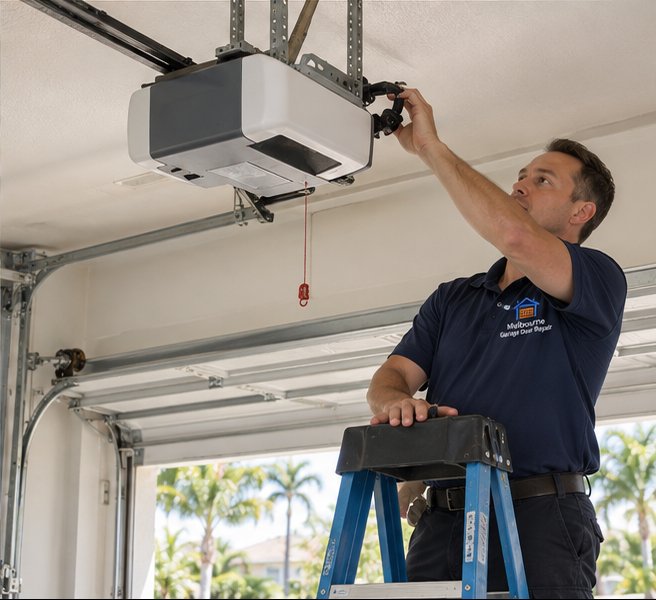
What an opener actually does
An opener is a motor and a control board mounted on a rail, and its job is narrower than most people think. It moves a door that is already balanced by springs. The springs carry the weight; the opener only guides the door up and down and tells it where to stop.
That matters because many opener complaints start somewhere else. A door that is out of balance or binding in the tracks makes a healthy opener look weak. So a proper opener repair always begins by checking the door itself, and our guide to how a garage door works explains why the two systems cannot be judged apart.
Common opener faults we see
Most opener calls fall into a handful of patterns. Knowing them helps you describe the problem clearly when you reach out, and it helps you tell a simple fix from a repair that needs a technician.
- The opener hums or clicks but the door does not move, which often points to a stripped gear or a stuck trolley.
- The motor runs and the door travels, but it stops or reverses partway, which usually involves travel, force or sensors.
- Nothing happens at all when you press the wall button, which can mean power, a wiring fault, or a failed board.
- The opener works on some days and not others, often a sign of a loose connection or a weakening component.
- The remote works only when you stand close to the door, which may be a battery, an antenna or a receiver issue.
- Grinding, rattling or screeching during travel, which can come from the drive, the rail, or the door hardware.
Motor problems
The motor is the part people worry about first, and it is often not the part that failed. A motor that hums without turning may be seized, but it may also be fighting a door that is too heavy because a spring has weakened. A motor that overheats and shuts off during repeated cycles may be working against friction in the tracks.
When we test an opener we listen to how it starts, how it sounds under load, and whether it finishes a full cycle. Where the motor itself has worn out, replacement of the whole unit is often the sensible route, because the motor is the core of the machine. Where the motor is healthy, the fix is somewhere else, and we say so.
Logic board and control faults
The logic board is the small circuit board that reads your button presses, remote signals and sensor inputs, then decides what the motor should do. Florida homes are hard on electronics. Humidity, lightning-related power surges and the occasional insect in a warm housing can all damage a board.
Signs of a board problem include an opener that ignores every control, lights that flash in patterns, or behavior that changes from one cycle to the next. Before we blame the board we check the supply, the wall control wiring and the sensor circuit, because those are simpler causes that look the same from the outside. Our page on opener indicator lights explains some of the signals a board gives you.
Gear kits and drive parts
Many chain and belt openers use a plastic or nylon gear inside the motor housing. That gear is designed to take the strain so that a metal part does not break, and over years of use it wears, chips or strips. The classic symptom is a motor that runs with a whirring sound while the trolley sits still.
A gear and sprocket kit can restore many openers of this type, provided the motor and board are in good shape. We look at the age of the opener, the condition of the other parts and the cost of the kit before recommending it. The drive itself, whether chain, belt or screw, is covered in more detail on our page about chain, belt and screw drive opener service.
Travel and force settings
Every opener has two kinds of adjustment that matter. Travel limits tell it where the door is fully open and fully closed. Force settings tell it how hard to push before deciding something is in the way. When either is wrong, the door may stop short, bounce back up, or press into the floor too hard.
These are the settings that people most often change by accident, and they are also settings that affect safety. A force setting that is too high can defeat the reverse feature that protects people and pets. We set travel and force to match your particular door, then test the reverse response as described in our garage door safety tests guide.
Travel limits
If the door stops before it touches the floor, or lifts past the top of its track, the limits are off. Correcting them is a matter of adjusting the opener, not the door, and it is one of the simplest repairs when the rest of the system is sound.
Force settings
If the door reverses on the way down for no clear reason, the force may be set too low for the weight of the door. If the door pushes hard against an obstruction before reversing, it may be set too high. Both need a careful test, not a guess.
Wiring, wall controls and power
Not every dead opener is a failed opener. Wires run from the wall control to the unit, and from the sensors to the unit, and they pass through staples, along rafters and over doorframes that move every day. A pinched or corroded wire can mimic a bad board.
We also check the outlet and any surge protector the opener is plugged into. A tripped outlet or a failed power strip is a common cause of a silent opener, and you can look at that yourself before you call. Wall buttons with a lock or vacation feature are another frequent surprise. If the problem seems to be the button itself, see wall control and opener light repair.
Safety sensors and why they matter to repairs
Almost every opener sold in the United States has a pair of safety sensors near the floor, one on each side of the door. If the beam between them is blocked or misaligned, the opener will refuse to close the door, or it will start closing and then reverse. Many calls about a broken opener turn out to be a sensor that has been knocked slightly out of line.
If you think the sensors are the problem, our safety sensor alignment and repair page covers what we check and why. It is worth reading before any opener repair, because the sensors are the part that most often masquerades as something bigger.
Repair or replace the opener
Repair makes sense when the opener is otherwise sound and the failed part is a known, replaceable one: a gear kit, a trolley, a sensor, a wall control, a travel setting. Replacement makes sense when several parts are failing at once, when the board has failed on an older unit, or when you want features that your opener cannot provide.
We do not push replacement. We tell you what is wrong, what the repair involves, what the realistic outlook is for the rest of the unit, and what a new opener would change. Then the choice is yours. If you are leaning toward a new unit, our page on opener replacement and installation and the comparison of chain, belt and screw drives will help.
| What you notice | Likely area to check first |
|---|---|
| Motor hums, door does not move | Gear kit, trolley, or a door that is out of balance |
| Door reverses before it closes | Safety sensors, force setting or a binding track |
| Nothing happens at all | Power supply, wall control wiring or logic board |
| Works sometimes, not others | Loose connection, remote battery or weak board |
| Door stops partway up | Travel limits or a door that is hard to lift |
| Loud grinding during travel | Drive parts, rail, rollers or hinges |
When the problem is the door, not the opener
A broken spring is the cause behind a surprising share of opener complaints. When the spring cannot carry the weight, the opener tries to lift the entire door by itself, strains, and either stalls or wears out its gears. Replacing the opener in that situation does not help for long.
If you can lift the door by hand only with great effort, or it falls when released partway, stop using the opener and do not attempt to adjust anything near the spring or cables. Those parts hold dangerous tension and are for trained technicians only. Our pages on torsion spring repair and on the problem of a hum without lift explain the connection.
Simple checks you can do before calling
There are a few safe things worth trying first. They cost nothing but a few minutes, and they sometimes solve the problem outright. They also give us a clearer picture when you do get in touch.
Stop at any point where you feel unsure, and never reach toward springs, cables or the brackets at the sides of the door.
- Confirm the opener is plugged in and the outlet has power, for example by testing it with a lamp.
- Wipe the two sensor lenses gently with a soft cloth and check that each shows a steady light.
- Replace the battery in the remote and try the wall button too, to see whether the problem is the remote.
- Look for objects, cobwebs or stored items near the sensors or in the path of the door.
- Check whether the wall control has a lock or vacation setting turned on.
- Pull the red release cord only if the door is fully closed, and lift the door slowly by hand to feel how heavy it is. If it is very heavy or uneven, stop.
What a repair visit covers
We arrive, listen to your description and watch the opener run if it will. Then we check the door balance, the tracks and rollers, the sensors, the wall control and the opener itself, in that order. Looking at the whole system first prevents replacing parts that were never the cause.
Once we know what is wrong, we explain it in plain language, show you the part if that helps, and describe the options. Nothing proceeds until you have decided. If you would like to know more about the process, read about what happens during a service visit.
Coastal conditions and opener life
Melbourne and the surrounding Space Coast communities have salt in the air, strong humidity and frequent summer storms. Those conditions shorten the life of exposed electronics and metal. Corroded terminals, rusted rail brackets and damp, swollen housings show up more often near the water, though inland homes are not immune.
A little attention helps. Keep the opener housing dry and clear of dust, keep the rail clean, and make sure the garage is ventilated. Our guide to garage doors in a coastal climate has more on how the setting affects every moving part.
How we test an opener after the repair
A repair is not finished when the door moves. It is finished when the door moves correctly, stops where it should, and reverses when something is in the way. We run the door through several full cycles and watch for hesitation, uneven speed or noise that was not there before.
We also test the reverse feature in two ways. First we place a solid object on the floor in the door's path and confirm that the door reverses when it touches it. Then we interrupt the sensor beam during closing and confirm that the door stops and goes back up. If either test fails, we keep adjusting until it passes, because those behaviors protect children, pets and vehicles.
You are welcome to watch the tests and ask questions. We would rather you understand how the opener behaves than simply hand back the remote.
Signs an older opener is nearing the end
Openers do not usually fail all at once. They give hints. Knowing the hints lets you plan instead of being caught with a door that will not open on a rainy morning.
None of these signs alone means the unit must be replaced, but several together usually point that way.
- Repeated repairs within a short period, especially of different parts.
- A motor that sounds strained on a door that was recently confirmed to be balanced.
- Controls that need several presses before the opener responds.
- Parts that are no longer easy to obtain for your model.
- Lack of the current safety features, such as the reverse response and sensors on very old units.
- Noise that has grown steadily louder even after cleaning and checking the rail.
Power outages and surges
Storm season brings outages, and an outage is the moment people discover their opener cannot lift the door without power. The manual release exists for this reason, and it should be used carefully, with the door fully closed and the weight understood. A battery backup is another option some homeowners consider, and it is described on our page about battery backup for openers.
Surges are the other risk. A surge can damage the board even when the unit still lights up. A surge protector on the outlet helps, though it is not a substitute for checking the opener after a nearby lightning event.
Questions and answers
A humming motor with no movement often points to a stripped drive gear, a stuck trolley, or a door that is too heavy because a spring has weakened. Do not keep pressing the button, since that can damage the motor. We check the door balance first, then the gear and drive, and tell you which repair applies.
Many openers can be repaired when the failed part is a gear kit, trolley, sensor, wall control or setting. Replacement is more sensible when several parts are failing, the board has failed on an older unit, or you want features the unit lacks. We explain both options and you decide.
No. A heavy door usually means a worn spring or an out-of-balance door, and the opener is not built to lift it alone. Stop using the opener and leave the springs, cables and brackets alone. Have a technician inspect the door before it is used again.
That reversal is the safety system doing its job. It is usually triggered by misaligned or dirty sensors, an obstruction, a binding track, or force settings that need adjustment. Wipe the sensor lenses and check for blockages, and if it continues we test the sensors and settings properly.
Parts and procedures do vary by model, so we look at the unit in front of us rather than assuming. Some older models have parts that are hard to find, which can affect whether repair is practical. We tell you plainly what is available for your particular opener.
It can. Surges often damage the logic board, and the damage may not be obvious right away. Symptoms include erratic behavior, ignored controls or flashing lights. A surge protector helps, and we recommend having the opener checked after a nearby lightning strike or an outage with a surge.
Simple checks such as batteries, sensor lenses and the outlet are reasonable. Anything involving the spring system, cables or brackets is not, because of the tension involved. Internal opener repairs also need proper testing of the reverse feature, so we suggest leaving them to a technician.