
What a safety test is meant to tell you
A modern garage door system has several protections built in. Photo-eyes watch the opening, the opener senses resistance and reverses, and a manual release lets the door be moved by hand when the power fails. These features exist because a garage door can injure people and pets, and because it can damage cars.
Testing them from time to time answers a simple question: will the door do what it is supposed to do on the day it matters? A test is not a repair. It is a way of finding out whether something needs attention before it fails.
The tests described here use ordinary care and no tools. None involves the springs, the cables or the brackets that hold them. Those parts carry a great deal of stored force, and adjusting them is work for trained technicians only.
Ground rules before you start any test
Safe testing starts with preparation. Choose a time when no children or pets are in the garage, when the driveway is clear and when you are not hurried. Remove cars from the path of the door if you can. If a second adult is available, ask them to stand where they can see you and the door.
Read the manual for your opener if you have it. The manual explains the lights, the release handle and any settings that your particular model uses. If you cannot find it, look up the model number on the opener's label and find the manual from the maker.
Decide in advance where you will stop. If a test does not give the result described, you stop, you leave the door as it is, and you arrange for a technician to look at it. You do not try to make the test pass by adjusting something you do not understand.
- Keep children and pets out of the garage and away from the door.
- Never put any part of your body in the path of a closing door.
- Do not touch springs, cables, drums or their brackets.
- Stop at the first unexpected result and do not repeat it again and again.
- If someone is hurt, call 911.
The photo-eye test
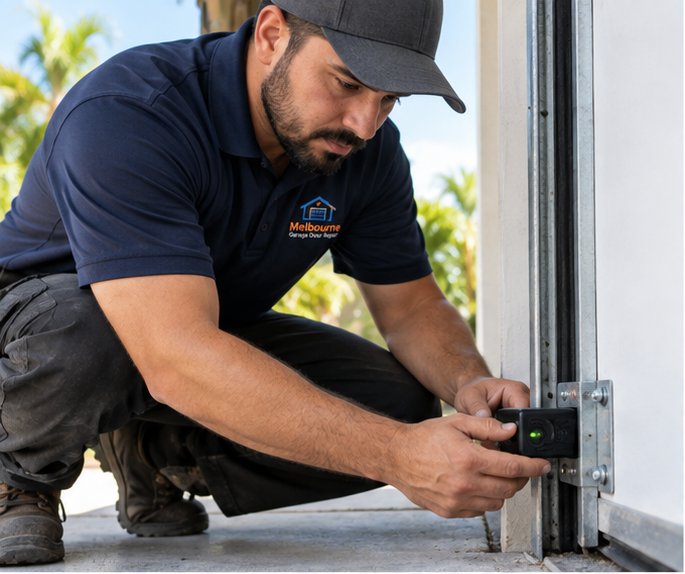
Photo-eyes, also called safety sensors, are two small units mounted low on either side of the door opening. One sends an invisible beam and the other receives it. If anything crosses the beam while the door is closing, the door should stop and reverse.
The test is simple. With the door fully open and the area clear, press the button to close the door and, while it is moving, pass a broom handle or a long object through the beam near the floor. Keep your body out of the door's path and keep your hands clear. The door should stop and go back up.
Many people prefer a variation: with the door open, hold a broom across the beam and press the button. The opener should refuse to close, and the opener's light may blink. Either version tells you the sensors are responding. Do not use your foot, hand or leg as the obstacle.
Step by step
Open the door fully. Check that both sensor lights are lit steadily. Press the close button, and as the door starts to descend, extend a broom handle across the opening about a hand's width above the floor, standing well to the side. Watch the response, then press the stop button if needed.
What a good result looks like
The door stops and reverses without hesitating, and the opener returns it to the open position. Both sensor lights stay steady except for a brief change while the beam is broken. This is the behavior you want.
Reading the photo-eye result
If the door did not respond to the beam, or the lights behaved oddly, the cause is often something simple, such as a dirty lens or a sensor that has been knocked out of line. The table lists common results and what they usually point to.
- Wipe both lenses with a soft, dry cloth before testing again.
- Check that nothing is stored near the sensors.
- Do not bend the sensor brackets to force a light to come on.
| What you see | What it often means | What to do |
|---|---|---|
| Door stops and reverses, lights steady | Sensors are working as designed | Note the date in your log and repeat later |
| Door does not reverse, lights steady | Sensors may not be connected to the opener or may have failed | Stop using the automatic close and arrange a visit |
| One light dim or blinking | Misalignment, dirt or an obstruction in the beam | Clean the lenses with a soft dry cloth and clear the area, then test again once |
| Neither light on | No power to the sensors, a wiring fault or a failed sensor | Check the opener has power, then arrange a visit |
| Door will not close at all | Sensors are not seeing each other | Read the sensor lights, clean the lenses and consult the guide |
The reversal test with an obstruction
The second protection is the opener's ability to sense that the door has hit something and reverse. This works through the opener's electronics and does not depend on the photo-eyes. It is the last line of defense if the beam fails or if something is lower than the beam.
To test it, open the door fully and lay a flat object, such as a roll of paper towels or a flat piece of wood about the thickness of a thick book, on the floor in the center of the opening. Stand clear and press the button to close. When the bottom of the door touches the object, the door should stop and reverse.
Use only a light object that cannot damage the door or the floor. Never use a person, a pet, a hand or a heavy item. Do not do this test in a hurry or with anyone near the door.
If the door does not reverse
If the door pushes on the object and keeps going, press the stop or wall button immediately. Then press the button to open the door and remove the object. Do not run the close cycle again until the door has been looked at.
A door that does not reverse can be a serious hazard. It may mean the opener's settings are off, a part has worn, or the door itself is out of balance and pushing too hard. Some openers have adjustable force or travel settings, but changing them without understanding what they do can hide a problem rather than fix it. It is safer to leave adjustments to a technician.
While you wait, use the door by hand if it is safe to do so, or keep it closed and use another entrance. The page on a garage door that reverses before closing describes the opposite problem, which is also connected to these settings.
Balance: what it means and what you can safely observe
A garage door is heavy, and the springs carry nearly all of its weight so that the opener only has to guide it. When the springs are doing their job, the door feels light to move by hand and stays where you leave it. When they are not, the door becomes heavy, may drift, and puts extra load on the opener.
A technician checks balance with the opener disconnected and the door at several heights. That is a test that belongs with someone with the right training and tools, because a door that is out of balance can fall or rise suddenly. You cannot safely adjust balance yourself, and you should never try to change spring tension.
There are still clues you can notice without any risk. A door that suddenly sounds strained, a door that moves more slowly than it used to, or one that slams or drifts at the end of travel is telling you about balance. The article on garage door weight and balance explains the idea in more detail.
A cautious hands-on check, with firm limits
Some homeowners do a light hands-on check as part of their routine. It is optional, and you can skip it. If you do it, the rules are strict.
Do it only when the door is fully closed. Pull the red release handle, as described in the opener's manual, to disconnect the door from the opener. Then lift the door by the handle or a firm grip point only a short way, to about hip height. Feel the weight, then lower it gently to the floor. A balanced door feels manageable and does not pull downward hard.
Stop at once if the door feels very heavy, if it lifts unevenly, if you hear any pop or bang, or if you have to strain. Never lift the door overhead, never release the opener when the door is open, and never stand underneath. Reconnect the opener as the manual describes, or ask a technician to do so.
- Only with the door fully closed.
- Lift no higher than hip height.
- Stop at the first sign of heaviness, noise or uneven lift.
- Never do this with the door partly open.
- Never try to correct a heavy door by adjusting anything on the springs.
The manual release and the emergency cord
The red cord and handle hanging from the opener rail are there for emergencies, such as a power outage or a person trapped in the garage. You can look at the cord regularly. It should be intact, easy to reach, and not tangled or knotted.
Know where it is and who in the household can use it. The cord should hang at a height that adults can reach, and it should not be tied up out of the way. If it is frayed, stuck or snapped, the release may not work when needed.
Practice with the release only as described in the earlier section, with the door closed. The guide on using the manual release during a power outage explains what to do in an actual outage.
What never to do during any test
A short list of things to avoid is worth keeping near the garage door. Most injuries around garage doors happen when someone tries to fix, force or bypass a safety feature.
Do not disable the photo-eyes to make a door close. Do not place a hand, foot or pet in the path to see whether the door reverses. Do not wedge anything under a door to prop it. Do not hold a heavy door by hand while someone else touches the opener. And do not try to loosen, tighten or remove anything attached to the springs or cables, however loose it looks.
- Do not bypass or disconnect the photo-eyes.
- Do not use your body to test whether the door reverses.
- Do not prop a door open with wood, a car or a stack of boxes.
- Do not change spring, cable or bracket settings.
- Do not leave the opener running a struggling door.
How often to test, and what to write down
A common rhythm is to run the photo-eye and reversal tests a couple of times a year, and to look at the release cord and balance clues during the monthly check. You may prefer to link the tests to dates you already remember, such as the start of storm season or the changing of the clocks.
Record each test in a simple note: the date, the result and any odd behavior. If the door passes, a single line is enough. If it fails, write down exactly what happened, because a clear description helps a technician understand the problem before they arrive.
Do not worry about a perfect routine. A test done twice a year with care is far better than a complicated plan that never gets done.
Households with children and pets
Where small children or animals share the home, the safety systems matter even more. Teach children never to play near the door and never to run under it as it closes. Keep remotes out of reach and make sure the wall control is mounted high.
Testing should happen when children are elsewhere. Do not ask a child to hold an object in the beam, to stand in the opening or to help with a test. Check the sensor height, because small pets pass below some beams.
Garage door safety for kids and pets covers household rules in more detail, and it is a good companion to this page.
What a technician adds to these tests
A technician checks the same protections but with training and tools. They can examine the springs, cables and drums, test the balance at several heights, check the alignment of the tracks, and set the opener's travel and force properly. They can also explain why something failed and what the options are.
That matters because a failed test is only a symptom. The reason might be a worn sensor, a loose track, an unbalanced door or a faulty opener, and each calls for a different response. A professional can tell them apart.
If you need your door's balance corrected, garage door balance and adjustment explains how that service works. For sensor problems, see safety sensor alignment and repair.
When a test fails: what to do next
If a test fails, treat it as useful information, not a failure of your own. Stop the test, clear the area and keep the door in the safest position, which is usually fully closed. Note what happened. Avoid using the automatic close if the door did not reverse.
If a person is trapped or hurt, call 911. For anything else, a calm conversation is enough. Describe what you did, what happened, and any sounds or lights you noticed.
You can reach us through the contact page. We will look at the door, explain what we find and what the options are, and you decide how to proceed.
Questions and answers
Many households test it a couple of times a year, along with the photo-eyes, and again after any opener repair or door service. Use a light flat object on the floor, never a person or pet. If the door does not reverse, stop using the automatic close and have it looked at instead of changing settings yourself.
Only in a very limited way. With the door fully closed and the opener disconnected, you can lift it a short distance to feel the weight, and you stop if anything feels heavy or uneven. Real balance testing and any adjustment belong to a technician, because the springs hold dangerous tension. Please do not experiment beyond that.
A blinking light usually means the sensors cannot see each other. Wipe both lenses with a soft dry cloth, clear anything from the beam path, and check that neither unit has been knocked. If it keeps blinking, read the sensor guide or arrange a visit rather than bending brackets. Writing down what you saw helps a technician understand the problem.
Some openers have settings for travel and force, but they are easy to set incorrectly, and a wrong setting can make a door unsafe or hide a balance problem. If a test fails, it is safer to have a technician look at the door and settings together. Do not use the settings to make a test pass.
Passing is good news, but the tests do not show everything. They do not tell you about the condition of springs, cables, drums or hinges. A periodic professional visit looks at those parts, and your own monthly checks catch changes in between. The two work together. A short note of the date and result is enough for your own records.
Press the stop button, open the door, remove the object and keep people clear. Do not run the close cycle again until the door has been looked at. Use another entrance if you can. This behavior can come from several causes, so it is a job for a technician to diagnose. That keeps you safe and gives a technician a clear starting point.