
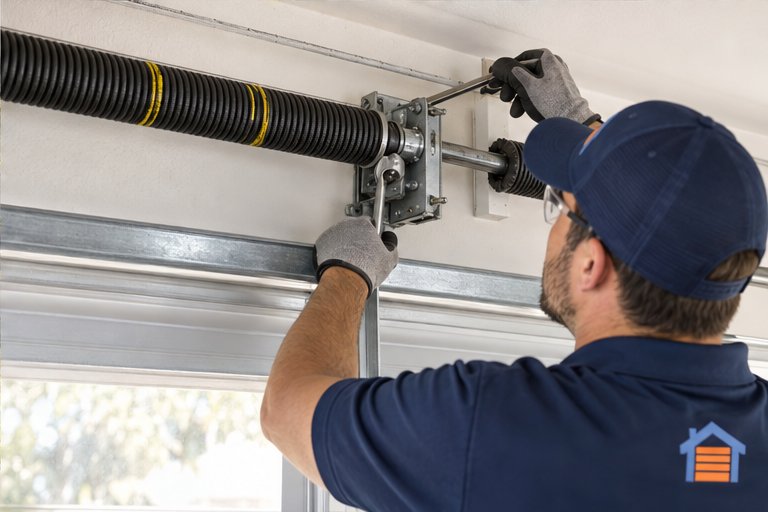
Where extension springs sit and how they work
If you look at the side of a garage door that uses extension springs, you will see a long, narrow coil running alongside each horizontal track, usually from near the door opening back toward the ceiling or rear of the garage. A pulley is mounted at the front of each track, and a cable passes through it before connecting to the bottom corner of the door.
When the door is closed, the springs are stretched out and hold a great deal of energy. As the door opens, they contract and pull on the cables, which helps lift the panels. When the door closes, the springs stretch again and slow the descent. A well-balanced door moves easily because the springs are doing most of the work.
This design is common on older homes and on lighter doors. Newer homes often have torsion springs mounted above the opening instead, and the page on torsion springs versus extension springs shows how the two differ. If you are not sure which type you have, a careful look along the side tracks from the floor will tell you.
Keep your distance while you look. You do not need to touch anything, climb a ladder or open the door. A glance from the middle of the garage, with the door closed and the opener left alone, is enough to see whether the springs run along the tracks or sit on a shaft above the opening, and that single fact tells a technician a great deal about the work ahead.
The safety cable running through the spring
Because extension springs stretch and snap back, a broken one can whip across the garage. To limit this, many installations include a safety cable that runs through the center of each spring and is anchored at both ends. If the spring breaks, the cable is meant to contain the pieces rather than let them fly.
Not every older door has these cables, and in some cases they were removed, loosened or installed incorrectly. A technician will check whether safety cables are present, whether they are secure and whether they are in good condition. If they are missing, we will explain what that means and what the options are.
A homeowner should never rely on a safety cable as a reason to handle the springs. It is a backup for a failure, not a license to adjust anything. Springs, cables and the brackets that hold them remain under tension, and they should be worked on only by trained people with the proper tools.
Signs that extension springs are wearing out
Extension springs usually give some warning before they fail, although the signs are easy to miss if you do not know what to look for. Most are visible or audible from the garage floor, with the door closed and nobody near it.
Look at each spring from a safe distance, without touching it. A healthy coil has even spacing between turns. Look for the signs below and take note of anything that has changed.
- Gaps or uneven spacing in the coils of one or both springs.
- Rust, flaking or a dry, orange look on the coil.
- A spring that looks stretched or longer than its partner.
- A door that moves unevenly, with one side lagging.
- New popping, creaking or twanging sounds when the door moves.
- A door that feels heavier than it used to when raised by hand with the opener disconnected, or that drifts down when stopped halfway.
- Visible wear, flattening or fraying on the pulley cables.
Why small changes matter
Because two springs share the load, one weakening spring can put extra strain on the other. A slight difference in the way the door sits or moves can be the first clue that a spring is losing strength.
What happens when an extension spring breaks
When an extension spring breaks, it usually does so with a sharp bang, and the broken ends can move suddenly. In many cases the door stops lifting normally. It may feel heavy, it may be crooked, or it may not open at all.
Because the two springs work as a pair, the failure of one often leaves the door lopsided. The side with the broken spring has no help, while the side with the intact spring is still pulling. The door can twist in its tracks, and the cables may slip or tangle.
If you hear a bang and find the door will not move, keep clear and do not force it. See our page on a loud bang from the garage for the immediate steps, and a door that is crooked or uneven if the door looks lopsided.
Why extension springs are replaced in pairs
The two springs on a door are bought, installed and used together. They have been stretched the same number of times, exposed to the same air and carried the same load. If one has broken, the other is close behind.
Mixing a new spring with an old one is a common mistake. The two will have different strengths. The door may lift unevenly, the cables may stress and the new spring may take more than its share of the load. Replacing both at the same time returns the pair to matching condition and keeps the door lifting straight.
A technician will examine the second spring and tell you what they see. In most cases, the sensible approach is to replace both, and we will explain why. The decision is yours, and we will describe the options.
Why this is not a homeowner job
Extension springs look less intimidating than torsion springs, and some people assume that replacing them is a simple weekend task. It is not. The springs are stretched under real tension, even when the door is open, and a slipped hook or a failed anchor can release that energy suddenly.
The hardware that holds them, including pulleys, eye bolts, S-hooks and brackets, can also fail under load. Working under a door that is supported only by springs and cables is dangerous, and injuries from this kind of work are common.
We do not recommend that anyone adjust, loosen or replace springs, cables or brackets without training. The right approach is to stop using the door, keep people clear and have it looked at. If anyone has been hurt, call 911.
Choosing the right replacement springs
Extension springs are rated by the weight of the door they are meant to lift, and they are not one-size-fits-all. A pair that is too light will not balance the door, and a pair that is too strong will make it hard to close. The spring length, the wire thickness and the type of end all matter.
A technician checks the existing springs, notes the markings, considers the door's size, material, insulation and any windows, and selects replacements that match. They will also check whether the cables, pulleys and fittings can be reused or need to be replaced at the same time.
Weight is the starting point for the whole decision. The guide on garage door weights and balance explains how door weight, springs and balance connect, and reading your garage door label points out where to look for useful information.
What a replacement visit involves
A visit begins with an inspection. The technician looks at the door, springs, safety cables, pulleys, cables, tracks and brackets before anything is touched. Wear in these parts is common when a spring fails, and finding it early avoids surprises.
The door is then secured so it cannot move, and the tension is released from the old springs in a controlled way. The old springs, pulleys and fittings are removed, and worn parts are set aside to show you. New springs are fitted, the safety cables are threaded through them and anchored, and the cables are attached and set.
The technician then adjusts the springs evenly on both sides, tests the door and checks it again. The work ends with a look at the tracks, rollers and hinges, since the loads those parts carry changed while the spring was weak.
Parts that are often replaced alongside the springs
Pulleys can wear on their axles, cables can fray where they bend and S-hooks can open under load. These parts are replaced when they show wear. See garage door cable repair and replacement for more on cables, and roller replacement if rollers are worn.
How the door is rebalanced
Balance is the point of the whole job. A technician sets both springs to the same tension so that each side of the door gets equal help. The door is lifted partway by hand with the opener disconnected, and it should stay where it is left, neither rising nor falling.
If the door drifts up, the springs are too tight. If it drops, they are too loose. If one side is higher than the other, the cables or springs need to be evened out. The aim is a door that moves smoothly and holds its position.
Only after balance is right is the opener reconnected and its travel and force settings checked. A door that is balanced puts little strain on the opener. For a fuller explanation, see garage door balance and adjustment.
Extension springs and older garage doors
Many homes in established parts of Melbourne and neighboring communities have garage doors that have been in place for a long time. Extension springs are common on these doors, because they were a simple, inexpensive way to balance lighter wooden and early steel doors.
Age brings its own issues. Hardware may be rusted, brackets may be bent, wood may be swollen, and the tracks may have shifted. A technician will check the whole system, and it may make sense to look at related repairs, such as new rollers or track work, at the same visit.
If the door is very old, or has several problems at once, the page on when to repair and when to replace a garage door can help you think through the choice. We will explain what we find and what the options are.
Salt air, humidity and spring life
Extension springs are exposed. They sit along the tracks in plain view, and in a coastal garage they are regularly touched by damp, salty air. Rust is the usual result. Surface rust can be removed, but pitting weakens the steel and shortens its life.
Garages that are open to the outside, hold wet gear or sit near the water tend to be harder on springs. Regular lubrication by a technician slows corrosion and keeps the coils from rubbing on each other. It also reduces the squeaks and groans that often get a homeowner's attention.
If your door is near the ocean or the river, consider a regular look at the springs. The guide on garage doors in a coastal climate explains how the local environment affects hardware, and a maintenance visit gives you a trained set of eyes.
Cycle life and when to think about an upgrade
Every spring has a limited number of cycles in it. One cycle is a full opening and closing. A household that uses the door several times a day will reach the end of a spring's life sooner than one that opens it once.
In some cases, it is worth discussing a different spring option, such as a higher-cycle spring or a change in spring type. The service page on spring upgrades and cycle life explains these ideas in general terms.
Ask the technician what the options are, how each would change the way the door works and what it would involve. Do not assume that a different system can simply be swapped in. Changing springs can involve other parts of the door, and it should only be done by someone who has looked at the whole setup.
After the work: checks you can make from a safe distance
Once the new springs are in, you can help catch problems early. Watch the door as it opens and closes. Both sides should rise together, without wobbling, jerking or leaning. There should be no new rattles, bangs or scraping sounds.
Look at the springs from the floor, with the door closed. They should look even, without twisted turns or kinks. The safety cables should run through the centers of the springs. If anything looks odd, do not touch it. Stop using the door and let us know.
Your door should also reverse when it meets an obstruction, and the sensors should stop it from closing on anything in the way. If you have questions about how to test those features safely, garage door safety tests you can do at home gives clear steps with stop points. When you want us to look at your springs, get in touch.
Questions and answers
Look along the horizontal tracks on both sides of the door. If you see a long coil running parallel to each track, with a pulley near the front and cables running to the door, you have extension springs. If the springs are on a shaft above the door opening instead, you have torsion springs. Do not touch either type.
The two springs share the load and have been stretched the same number of times, so when one breaks the other is usually close to the end of its life. Mixing old and new springs can leave the door lifting unevenly and strain cables and pulleys. A technician will check the second spring and explain what suits your door.
The safety cable runs through the center of each spring and is anchored at both ends. If the spring breaks, the cable is meant to hold the pieces so they do not whip across the garage. Not every door has them, and some are missing or loose, so a technician will check and explain what they find.
Yes. Extension springs are stretched under tension even when the door is open, and a slipped hook, bent bracket or failed anchor can release that energy suddenly. People are injured doing this work each year. We recommend leaving springs, cables and brackets to trained technicians and keeping clear of them if you notice a problem.
It is common. When only one spring breaks, the other side still lifts and the door can twist in the tracks. Do not force it or run the opener. Keep people and vehicles away, and have the door looked at. A crooked door may also have cable or track damage that needs attention.
The technician inspects the cables, pulleys, S-hooks and brackets, since they work with the springs and wear alongside them. Parts that show fraying, flattening, bending or rust are discussed with you and replaced where needed. Reusing a worn part can lead to another failure soon after the new springs go in.
With the opener disconnected, the door is lifted partway and released. A balanced door stays where it is left, neither rising nor falling, and it moves evenly on both sides. The technician adjusts tension until the door behaves that way, then reconnects the opener and checks its settings and safety reversal.
It can. Extension springs sit in plain view along the tracks, so they are exposed to damp, salty air. Rust and pitting weaken the steel and shorten spring life. Regular inspection and lubrication help slow the damage, and a technician can tell whether the springs you have are in good condition.