
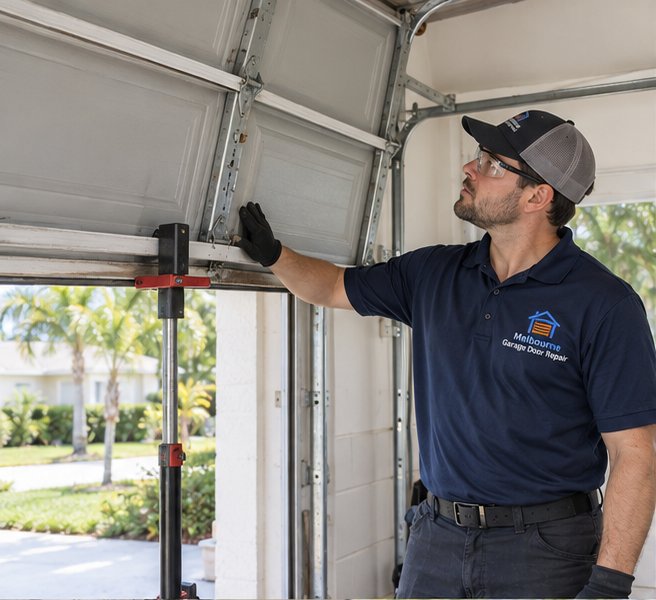
The parts that keep your door on its path
A sectional door is a series of flat panels joined by hinges. Those hinges let the door fold as it moves from vertical to horizontal, and they hold the stems of the rollers. The rollers run in steel tracks fixed to the walls and ceiling, and the tracks are tied into the building by brackets and angle iron.
None of these pieces is dramatic on its own. Together they define exactly how the door travels. If one is loose, bent or out of line, the others begin to compensate, and a small fault becomes a noisy, uneven, difficult door. This service is about making that structure true again.
How hinges work and where they fail
Every joint between panels has hinges, usually two or three across the width, with extra hinges at each end where the rollers attach. The end hinges are heavier because they carry the load. The center ones are lighter, since they mostly hold panels in line.
Hinges are numbered by position and by gauge, and a hinge in the wrong position is more likely to bend. Failures usually come from repeated flexing, loose screws or a knock to the door. Salt air does not help, because corrosion starts at the edges and around the pivot.
Cracks and bends
A hinge can crack at the bend, especially if it has been flexing in a door that is out of balance. A bent hinge no longer lets the panel sit flat against its neighbor, so you may see a gap or a step between sections. Either one is a sign to have the hinge replaced.
Loose fasteners
Hinges are held to panels with screws or bolts. Vibration slowly loosens them, and in lighter doors the screws can strip the panel material. A loose hinge lets the door rattle and lets rollers wander, so tightening or replacing the fasteners is an ordinary part of our visit.
Worn pivots
The pivot is the point where the two halves of the hinge meet. When it wears, the hinge turns sloppy and the panels shift against each other. Light lubricant at the pivot helps a healthy hinge, but it will not rescue one that is worn through.
How tracks guide the door
Each track has a vertical section beside the opening, a curved section where it bends toward the ceiling, and a horizontal run overhead. The vertical track is set to angle slightly, so the door presses gently against the weather seal as it closes. The horizontal track slopes just a little as well.
These small angles are deliberate, and they are why alignment matters so much. A track that has moved a few millimeters can change how the door seals, how the rollers sit and how easily the opener moves the load. A good alignment is hard to see by eye, but easy to feel when the door runs.
Signs that hinges or track need attention
Hinge and track faults tend to creep up. You may live with them for months before the symptoms get bad enough to notice, so a periodic look is worthwhile.
- A rattling or shaking door, especially as it moves through the curve.
- Visible gaps or steps between panels when the door is closed.
- Scraping, squeaking or a catching sensation at the same spot every cycle.
- A track that moves or flexes when the door passes by.
- Bolts or screws backing out, or brackets that look loose on the wall.
- Rust streaks, flaking metal or holes near hinges and brackets.
- A door that does not close evenly against the floor.
- Rollers that appear to sit off-center in the channel.
What a track and hinge inspection covers
We begin by watching the door run and then examine each component with the door secured. The goal is to find the cause of the symptom instead of only treating it.
Here is what we typically look at on a visit.
- Every hinge for cracks, bends, elongated holes and pivot wear.
- Fasteners that hold hinges and brackets, checking tightness and condition.
- Track sections for dents, bows, creases and rust.
- Spacing between the track and the door edge on both sides.
- Plumb of the vertical tracks and level of the horizontal run.
- Ceiling hangers and wall brackets for movement or corrosion.
- Rollers sitting in the channel, as part of overall travel.
- Weather seal contact along the sides and top.
Tightening, realigning and the limits of both
A surprising number of noisy doors are fixed by tightening what has worked loose. Loose lag screws in the track brackets, hinge bolts that have backed out and fasteners that have lost their grip can all be addressed. When we tighten, we also look at why they loosened, since fasteners rarely loosen without a reason.
Realignment means moving the track to the right position and fixing it there. Slotted holes in the brackets allow small adjustments, and the track gap, plumb and level are set with measurement rather than a glance. There are limits, though. If the track is bent, the brackets are damaged, or the wall framing has crumbled around a fastener, tightening alone will not last. We explain what we find and the choices that follow.
Track brackets and what they connect to
The brackets that hold the track to the wall are fixed into framing behind the drywall or into the door jamb. In the ceiling, the horizontal track hangs from angle iron fastened to the rafters or joists. If the wood those fasteners sit in has dried, cracked or gotten damp, the screws lose their grip.
This is more common than people expect in Florida. Humidity and the occasional roof leak soften wood, and termites and rot occasionally play a part. When fasteners will not hold, we may need to relocate them to solid framing. Our guide to how garage doors work shows how all of these parts relate.
When to replace rather than repair
Replacement is the right answer when the part itself is the problem. A hinge with a crack is finished. A track section with a crease cannot guide a roller smoothly. Rust that has eaten into the steel will not be reversed by cleaning or paint.
Replacing a single hinge or short section is often a modest repair. If many parts are worn at once, it may be worth thinking about the door as a whole. Our comparison on repair versus replace gives a simple framework, and we are happy to talk it through with you at the property.
| Finding | Usual approach |
|---|---|
| Loose hinge screws, sound hinge | Retighten or refit with better fasteners |
| Cracked or bent hinge | Replace the hinge |
| Track bracket loose in solid framing | Tighten and realign |
| Fastener spinning in soft wood | Relocate to solid framing or reinforce |
| Creased or rusted track section | Replace the section |
| Track slightly out of plumb | Loosen slotted brackets, realign and retighten |
Work we leave to a technician
Some hinge and track jobs look easy but are not. The bottom bracket and the lift cable it holds are under spring tension at all times, and loosening them can cause serious injury. The same goes for any track bracket on a door that is partly supported by its springs, because the door's weight shifts as hardware moves.
If you spot a loose hinge or bracket, you can note it, take a photograph and tell us. We would rather you did not remove anything yourself. For the safest background reading, see our guide on garage door safety tests, which covers checks that do not require touching tensioned parts.
Hinge and track trouble in the Space Coast climate
Moist, salty air does slow damage to steel. Hinges and track brackets are thin, so corrosion matters more on them than on thicker structural parts. Doors on homes near the water often show orange streaks near the hinge pivots and at the bottom of the vertical track, where moisture gathers.
Wind-driven rain during the summer storm season can also reach the lower hardware. Over the years the bottom hinges and the bottom track take the worst of it. If your door is close to the coast or the lagoon, a yearly look at the metal is a useful habit. Our coastal climate guide has more on how the environment affects a door.
Smooth travel is the goal
After the work, we judge the result by how the door moves, not just by whether the parts look right. The door should rise without hesitation, stay level, and glide through the curve. Panels should sit flat against each other when the door is closed, and the door should close firmly against the weather seal without being forced.
We also test the door by hand at several heights. A properly set up door tends to stay where you leave it. If it drifts upward or falls, the balance is off, and that usually points to the springs. We tell you what we observe and recommend next steps, rather than leaving a subtle fault unspoken.
We also leave you with a plain account of what was done. Which hinges were changed, which fasteners were replaced, whether the track was moved or only tightened, and what we would keep an eye on. That record is useful if you sell the house, rent it out or call us again later, because it shows the history of the hardware.
If the opener is connected, we finish by running it through full cycles and confirming that it stops where it should and reverses when it meets an obstruction. A door that was dragging against loose hardware sometimes needs its travel settings revisited once it moves freely.
A short homeowner routine
You do not need tools to keep an eye on hinges and track. A few minutes now and then is enough, and it gives you a baseline for what normal looks like on your own door.
Our monthly garage door checklist expands on this routine.
- Stand back and look along the door when it is closed. Do the panels line up?
- Watch the door run once and listen for new sounds.
- Look at the visible hinges for cracks, rust or gaps.
- Look at the track brackets for loose bolts or hairline cracks in the wall around them.
- Wipe dust from the inside of the track with a dry cloth when the door is closed.
- Stop and contact us if anything has changed since last time.
Different doors, different hardware
Not every garage has the same setup. A basic single-car door in an older Melbourne neighborhood may have light hinges and thin track, while a wider two-car door in a newer subdivision typically carries more weight and uses heavier hardware. Insulated panels add further load, and doors with windows have their own stress points.
Track comes in a few standard widths, commonly two inches or three inches, and the rollers must match. Some homes have low-headroom or high-lift track layouts because of ceiling height or a ceiling-mounted storage rack. Replacement parts must suit the existing layout. We identify what is on your door before ordering or fitting anything.
Commercial doors are another category, with heavier gauges and different mounting. If you manage a shop or warehouse, our page on commercial garage door service covers that work.
How we keep fasteners from loosening again
Fasteners loosen because of vibration and movement, so the cure is a joint that holds firmly and a door that does not shake. We use the correct size and type of bolt or screw for each position, and where the old hole has worn out we choose a different approach rather than repeating something that has already failed.
Where a hinge sits on a thin panel edge, we may add reinforcement or use longer fasteners that reach the panel's inner structure. Where a bracket screw has lost its bite in soft wood, we reposition it into sound framing. Small decisions like these are the difference between a repair that lasts and one that is back in a few months.
Planning your service
Tell us what you have noticed, such as a rattle, a gap or a loose bracket, and when it began. If you can, take a photo of the part from a safe position. It helps us bring suitable hinges, fasteners or track sections.
We come to the property, look over the hinges and track, and explain what we find. You will know what needs work now, what could wait and what the options are. If you would also like to review your rollers, our page on garage door roller replacement explains that service. When you are ready, contact us to arrange a visit.
Questions and answers
It is better to let a technician do it. Track brackets support a door that is partly held up by spring tension, and changing the position of a bracket can shift the way that load acts. A bolt that seems simple may be connected to something dangerous. If you see loose hardware, note it and contact us.
A gap or step between sections usually means a hinge has bent, cracked or loosened, or a panel has shifted. It can also come from a door that is out of balance. We look at the hinges, fasteners and panel edges to find the cause, then repair or replace the parts involved.
No. Hinges differ in thickness, position and the way they hold the roller stem. End hinges carry more load than center hinges, and a hinge in the wrong position tends to fail sooner. We match replacement hinges to the door and location so they do the job they were designed for.
Light surface rust is common near the coast and is often only cosmetic. Rust that flakes, pits or reaches through the steel is a different matter, because it weakens the track and roughens the surface the rollers use. We examine the metal closely and tell you which situation you have.
Yes. A track that is out of line makes the door bind, and the opener must push harder to move it. That extra load shortens the life of the motor, the drive and the trolley. Correcting the track often makes the opener run more smoothly.
Common signs are scraping on one side, uneven gaps between the door and the track edge, and a door that shakes or hesitates in the curve. The change is often gradual. A technician can measure plumb, level and spacing to confirm, then adjust the brackets or replace damaged sections.
A casual look every month or two, as part of a short visual routine, helps you notice change early. A technician's inspection once a year is a sensible habit, and more often if the door is used heavily or sits close to salt water. Inspection finds loose hardware and early rust before they turn into larger repairs.
Not necessarily. Noise can come from rollers, dry pivots, loose fasteners or the opener. We listen to the door and look at each part before recommending anything. If a hinge is sound and only dry or loose, it can usually stay in place.