
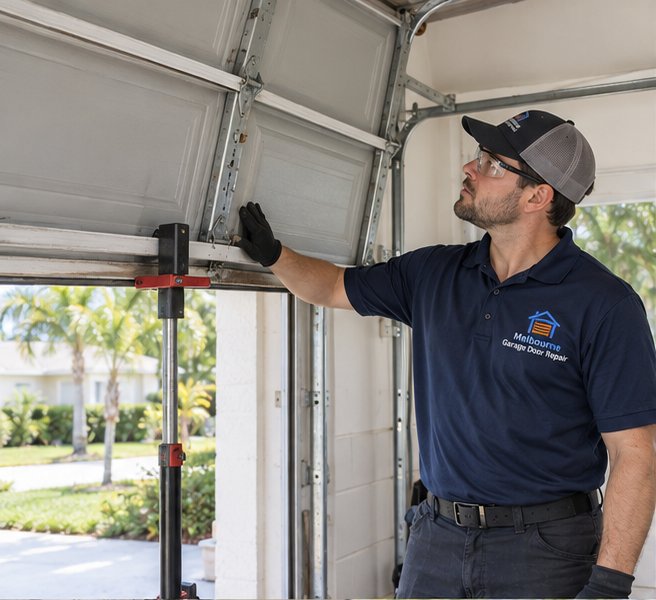
What an off-track door looks like
A sectional garage door rides on rollers set into steel tracks on each side. When a roller leaves the track, or the track itself pulls away from the wall, the door loses the guidance that keeps it flat and aligned. What you see depends on how far the damage has gone.
Sometimes the sign is subtle, such as a door that sits slightly tilted or rubs on one side. In other cases a whole section bows outward, the top corner sticks out from the wall, or the door hangs at an angle with a roller visible outside the track. It can happen at any height, and it often happens during travel when the door meets resistance.
If you walk into the garage and the door looks wrong, treat that as a warning. A door that is partly out of its track is no longer working as designed, and its weight may be resting on parts never meant to carry it.
- One side of the door higher or lower than the other
- A roller visible outside the track channel
- A gap between the door edge and the jamb that was not there before
- A section that bulges or bends outward
- A track that looks bent, detached or pushed away from the wall
- Cables hanging loose or slack beside the door
Why forcing the door is dangerous
A garage door weighs a good deal, and its springs store a large amount of energy. When the door is on its track, the system balances that weight so the opener only needs to guide it. Once it comes off, the balance is lost, and parts may be under unusual strain or twisted.
Pushing, pulling or running the opener against a door that is off track can bend sections further, snap a cable, rip a bracket out of the wall or send the door crashing down. Even a door that looks stuck in place may be held up only by a bent roller or a cable at an odd angle.
That is why we advise against using the opener, the remote or the wall button on a door you believe is off its track. The motor will try to move it, and the force it applies can turn a repairable fault into a damaged door, or injure someone standing nearby.
The hidden danger of the springs
Springs and cables are connected to the bottom of the door and to the drums or brackets above it. If the door shifts, those parts can shift too. A cable that jumps its drum or a bracket that loosens can release stored energy suddenly. We never recommend that homeowners touch springs, cables or the brackets that hold them.
Why a door can still look usable
Some off-track doors appear almost normal from the driver's seat. They may even move a little. That is misleading, because the sections can be twisted or the rollers can be jammed against the track edge. One more cycle can finish the damage.
Common reasons a door leaves its track
There is usually a cause behind it, and finding that cause matters, because replacing a roller without fixing the cause invites a repeat.
The most frequent trigger is impact. A car bumping the door, a bicycle falling against it, or a delivery cart striking the lower section can push a roller out of the track. Another is an obstruction in the path that catches a roller or the bottom edge, so the door twists as it moves.
- A vehicle or object hitting the door or track
- Worn, cracked or loose rollers that no longer sit securely
- Track brackets that have worked loose from the wall
- A cable that broke or slipped, leaving one side hanging lower
- Debris or an object lodged in the track
- Storm movement or a strong gust against an open door
- Hardware rusted through from salt air and damp
Cable trouble and the lopsided door
One of the most common paths to an off-track door starts with a cable. Cables run from the bottom corners of the door up to the spring system. If one snaps or comes off its drum, one side of the door loses support and drops, while the other side stays higher. The door twists, and the lower roller can jump out of its track.
If one side of your door sits clearly lower than the other, or you notice a thin metal cable hanging loose, do not try to hook it back or retie it. The cable carries heavy load, and the tension in the system makes this a job for a trained technician.
Our page on garage door cable repair explains what is involved, and the guide to garage door cable safety helps you spot cable warning signs before they cause damage.
Bent tracks, loose brackets and shifted walls
Tracks are not very thick, and they can be bent by a bump or pushed out of line by a bracket that has pulled loose. Even a small bend can catch a roller. In older homes, wood framing around the opening may have shrunk, split or rotted, so the screws holding the track no longer bite.
In this area, moisture and salt can speed up the damage. Fasteners corrode, the wood behind them softens, and a track that was solid for years suddenly lets go. A door in that condition may appear fine until it carries the extra load of a moving cycle.
Fixing the track means more than pushing it back. We check the backing, replace fasteners where needed and make sure the tracks are properly aligned and plumb. For related work, see hinge and track service and off-track door repair.
What to do right now
If you think your door is off track, the right response is calm and careful. Nothing about this needs to be rushed, and taking the cautious route protects you and the door. Think of the next hour as a time for gathering information, not for repairs. Photos, notes and a clear area are all you need to provide.
- Stop using the door. Do not press the wall button or the remote.
- Keep people, pets and children away from the door and from under it.
- Do not stand or walk beneath the door, even if it looks stable.
- If the opener is running, unplug it only if you can do so without walking under the door.
- Do not try to push the door back into the track by hand or with tools.
- Take a few photos from a safe distance to show the technician.
- Note any noises you heard when the problem occurred, such as a bang or scrape.
- If a vehicle is parked inside, leave it unless moving it is clearly safe.
If someone is hurt
Call 911 right away. Do not try to lift the door off a person unless it is clearly safe and necessary, and follow the emergency operator's instructions.
What not to do
Many people want to fix this on their own, and the instinct is understandable. The risks are real, though, and the following actions are the ones we most often hear about after a bad outcome.
- Do not run the opener to see if the door will correct itself
- Do not hammer, pry or bend the track back into place
- Do not loosen or tighten brackets at the bottom corners of the door
- Do not release the opener and try to lift or lower a damaged door
- Do not wedge the door with random objects and leave it unattended
- Do not prop open a door with a ladder or a jack that could slip
About the manual release
The release cord is for a door that is balanced and on its track. Pulling it on a damaged door can let the weight shift unpredictably. If the door is crooked or off track, leave the release alone and wait for help.
Securing the garage in the meantime
A door that is stuck open or stuck partly open creates a security and weather problem. It is natural to worry about the contents of the garage, but a rushed patch is not worth an injury.
If the door is stuck open, you can keep valuables out of sight, lock internal doors to the house, and avoid leaving the garage unattended at night if you can help it. If the door is stuck closed and you need to remove a vehicle, ask us whether this is safe before releasing anything.
If a storm is approaching, tell us, because the situation changes. A damaged door is weaker against wind, and in Florida a door that cannot close properly is a hurricane season concern. Our page on garage door hurricane preparation explains why.
How a technician approaches the repair
We begin by making the situation safe. That means looking at the whole door before moving anything, checking the condition of the cables, springs and drums, and assessing how the weight is being carried.
Next we figure out how far the damage has gone. Is it one roller out of one track, or are sections bent? Are the cables and drums intact? Is the track bent, or just loose? We take our time with this part, because the right fix depends on it.
With the cause understood, we secure the door, release tension as needed using proper tools and methods, and reseat rollers or replace damaged hardware. Where tracks are bent we straighten what can be straightened and replace what cannot. Where sections are twisted or creased, we explain whether repair is realistic or whether replacement of a panel or the door is a better route.
What we check after the door is back on track
We test balance, check that every roller sits correctly, look over the cables and drums, and confirm the track is plumb and firmly fastened. We then run the opener through full cycles and test the safety reversal and sensors.
When the door sections are damaged
A door that has been off track for a while, or that was struck hard, may have damaged panels. Creases, cracked edges, torn skins and bent horizontal stiffeners all weaken a section. A weakened section can flex, causing the door to come off again.
Sometimes one panel can be replaced, which is the case when the door design is still available and the match is acceptable. In other cases, replacement of the full door is more sensible, particularly with older doors where sections are no longer made.
You can read more on panel repair and on repairing or replacing your garage door before you decide. We explain the options and leave the decision to you.
Off track at the top versus off track at the bottom
Where the door left the track matters. A roller that pops out near the top, in the curved section, often points to an alignment or hardware problem where the track bends. A roller that slips out near the bottom is more often linked to an impact, a loose bottom bracket, or a cable that has failed.
A door that jams in the middle of the vertical run may have a bent section or a dented track. We note these patterns during the inspection, because they guide which parts to examine first.
Regardless of where it happened, the same safety rules apply. The door is no longer under normal control.
Commercial and heavy-use doors
Business doors usually run more cycles in a day than a home door runs in a month. Heavier doors, wider openings and forklifts or delivery vehicles raise the odds of impact and fatigue.
A door that is off track at a business also affects deliveries, security and staff safety, so it deserves prompt attention and a clear plan. Keep the area cordoned off, and let customers and staff know the door is out of service.
Our page on commercial garage door service describes how we approach commercial doors, and routine care for business owners is covered in our guides.
Preventing a repeat
Many off-track doors are preventable. Keep the path under the door clear of anything that could be caught. Teach drivers to leave extra room when parking, and consider a visual marker on the wall.
Look at your door each month. Check that rollers sit in the track, that the track is straight, and that the brackets look snug. Signs of rust or rotted wood around the tracks are worth mentioning to us. A small habit now avoids a larger problem later, and a monthly checklist shows what to look at.
Regular lubrication and service of rollers and hinges keeps the door moving smoothly, which reduces the chance that something catches. In coastal conditions, that care counts for more.
Homes, rentals and vacation properties
A homeowner who lives in the house sees the door every day and tends to notice early signs. A landlord, an absentee owner or a seasonal resident often does not. A door can come off its track in a rental between tenants or in a vacation home while nobody is around, and the first person to find it may be a guest or a property manager.
If you manage a property, it helps to give guests and tenants a simple instruction: if the garage door looks wrong, do not use it, and report it. A short note near the interior door works well.
When we arrive at a rental, we also look at how the door has been used. Heavy daily traffic, shared remotes and frequent vehicle changes all increase wear. That context helps us suggest sensible hardware and spacing for the next stretch of use, without guessing about things we cannot see.
- Tell tenants who to contact if the door misbehaves
- Keep parking guidance clear so vehicles stay away from the door edges
- Ask property managers to report any door that looks tilted
- Check the door between guests when the property is vacant for long periods
How to tell us what happened
The more detail you can share, the better prepared we are. Tell us what you saw and heard, whether a vehicle or object touched the door, whether the opener was running, and where the door stopped.
Photos help a lot, particularly of the sides of the door and the tracks. Take them from a safe distance and never lean under the door to get a better angle.
When you contact us, we will explain what we find on arrival and what the options are. Our contact page shows how to reach us.
Questions and answers
We advise against it. An off-track door is unbalanced, and the springs and cables may be under unusual strain. Pushing or hammering can bend the track further, snap a cable or drop the door. Keep clear and let a trained technician handle it.
No. The opener will try to move a door that cannot move normally, and the force may bend sections, damage the opener or bring the door down. Stop using the wall button and remote until the door has been inspected.
Common causes include impact from a vehicle or object, worn or loose rollers, loose track brackets, a broken or slipped cable, and debris in the track. Corrosion from salt air and damp can also weaken fasteners over time.
Often it can be repaired by reseating rollers, straightening or replacing track and replacing damaged hardware. If sections are badly creased or twisted, a panel or full door replacement may be the better route. We explain both options after inspection.
Keep people and pets clear, avoid walking under the door, and do not try to force it down. You can secure the interior doors and keep valuables out of sight. Contact us so we can look at it and explain the options for making it safe.
No. The release is meant for a balanced door on its track. On a crooked or damaged door, releasing the opener may let the weight shift suddenly. Leave the cord alone and wait for a technician.