
What a normal door feels like
A typical residential garage door weighs well over a hundred pounds, often much more. Yet a person can lift a healthy one with a few fingers once it is disconnected from the opener, because the springs are doing nearly all of the work. The door should rise smoothly, and it should stay where you leave it at about waist height rather than falling or shooting upward.
That feeling of lightness is the whole purpose of the spring system. The springs store energy as the door closes and give it back as the door opens, so neither a person nor an opener has to carry the full load. When a door feels heavy, it is a direct message that this arrangement is no longer working as designed.
To see how the springs, cables and drums fit together, read how a garage door works. It helps to know what the parts are before you try to guess which one is at fault.
Why a heavy door is a warning, not just an annoyance
It is easy to treat a heavy door as a minor nuisance. You grunt a little, lift it and carry on. But the extra effort tells you that the springs are not holding up their share, and the weight is going somewhere else: into your arms, into the opener or into the cables and track.
A door that is hard to lift is also a door that can become hard to control. If it is lifted and then released, it may drop. Because it is out of balance, the drop can be faster than expected and can catch a hand, a foot or a vehicle.
That is why this problem deserves a prompt look, even if the door still moves. A technician can tell you whether the springs are tired, whether the balance has drifted or whether another part is dragging.
Common reasons a door becomes heavy
Several causes can make a door feel heavy, and more than one can be present at the same time. Some develop slowly over years and some arrive suddenly. Think back over when you first noticed the change, because the timing is a useful clue.
- A spring that has broken, so the door is being supported by fewer springs or none at all
- A spring that has weakened with age and cycles, losing some of its lifting force
- A balance that has drifted over time, with the tension no longer matching the door weight
- A cable that has slipped, frayed or come off its drum, so one side carries more load
- Rollers, hinges or tracks that are dry, worn or binding and adding friction
- Added weight, such as a new coat of paint, insulation, glass inserts or items attached to the door
- A section that has been damaged or has absorbed moisture and become heavier
Sudden heaviness
If the door was fine last week and heavy today, a spring may have broken. You might have heard a loud bang from the garage, though some households hear nothing at all. A sudden change is a reason to stop operating the door and have it examined.
Gradual heaviness
If the door has been getting harder to lift over months, the springs are likely wearing out. Metal springs lose strength gradually, and the effect is easy to miss because everyone in the household adjusts without noticing.
How springs lose their strength
A spring is a coil of steel that twists or stretches each time the door moves. Every cycle, which means every opening and closing, slightly fatigues the metal. After enough cycles, the spring begins to lose its ability to lift, and eventually it can break.
Humidity and salt air speed the process. On the Space Coast, moisture settles on metal surfaces and encourages rust, which creates tiny weak points. A spring that looks fine from a distance may have surface corrosion that shortens its life.
Our guide to how long garage door springs last looks at the factors that affect lifespan, and the point to remember is that springs are wear parts. Eventually every spring needs replacement, and replacing them as a pair is a common approach.
Torsion springs and extension springs feel different
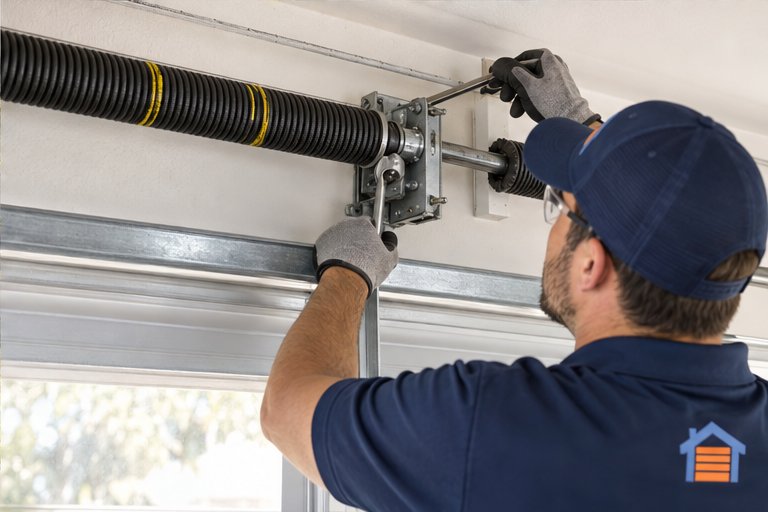
Garage doors use one of two spring systems. A torsion system has a spring or springs mounted on a bar above the door opening, and the springs twist to store energy. An extension system has long springs running along the sides of the horizontal tracks, which stretch to store energy.
When a torsion spring breaks, the door often feels dramatically heavy, as though it has lost its helper altogether. When an extension spring breaks, the door may feel lopsided or lean to one side, because the remaining spring pulls unevenly.
Each system has its own strengths, and the choice usually depends on the door and the space above it. Knowing which system you have helps a technician talk through what is happening, but do not try to identify tension or condition by touching the parts.
What you can safely observe
You can learn quite a lot without touching anything dangerous. Start with the door closed and stand well back. Look at the springs from the floor, at the cables on each side and at the horizontal bar above the door if you have torsion springs.
With a torsion system, look for a visible gap in the coil of the spring, which looks like the spring has been cut in two. With an extension system, look for a spring that hangs limp, has separated, or is missing from one side. Do not touch or reach toward either one.
Also notice what the door does when the opener runs. If the opener strains, hums, or stops partway, that is further evidence that the door has become heavy. Write down what you see and hear so you can describe it later.
- A visible break or gap in a spring
- A cable that hangs loose or sits off its drum
- A door that sits crooked or higher on one side
- A top edge that bows or leans away from the opener
- An opener that strains, hums or stops partway
Why you should not keep lifting it
If the door is heavy, you might think the sensible thing is to lift it by hand until help arrives. But a door with weak or broken springs is exactly the kind of door that is unsafe to handle. Its weight is no longer balanced, so a slip or a sudden release can send it down hard.
Lifting it repeatedly also loads the rest of the system. Cables, drums, rollers and the opener were not designed to carry the whole weight of the door, and extra strain may cause a cable to jump or an opener part to give way. A broken spring plus a damaged cable is a more complicated repair than a spring alone.
The safest course is to leave the door in its current position if you can, keep people out of its path, and arrange for a technician to look at it. If you must move it, do it once, slowly, with the door fully closed, and never stand underneath it.
The emergency release and a heavy door
The red emergency release cord disconnects the door from the opener so it can be lifted by hand. If the door is already heavy because of spring trouble, releasing it changes what holds the door: the opener's carriage no longer supports the door at all, and nothing else is helping.
That is why we advise against pulling the cord on a door that feels heavy, is partly open or hangs unevenly. With the door closed and lightly stuck, a release can be fine. With the door raised, it can fall.
If you are in the garage with the door shut and need to get a vehicle out in an emergency, take your time, keep your body clear of the door path and lift only if the door moves smoothly. If it resists or tilts, stop and ask for help. A related page, a spring that snapped with a loud bang, describes the typical moment of failure.
How a technician checks balance
Balance is the relationship between the lifting force of the springs and the weight of the door. A technician tests it by disconnecting the opener, raising the door partway and seeing whether it stays still. A balanced door stays where it is. One that is too heavy sinks and one that is too light rises.
The same test reveals other problems. If the door binds partway, the rollers or hinges may be worn. If one side lifts easily and the other does not, a cable may be at fault. The test is simple in principle, but it is safe only for someone who knows how to hold the door safely and what to do if it moves unexpectedly.
Balance can drift over time even without broken parts. Our garage door balance and adjustment service is aimed at doors that are still working but no longer feel right.
Weight, paint and added items
Sometimes the door has not changed, but its weight has. A heavy coat of paint, new insulation panels, large window inserts or a decorative overlay can add pounds, and springs that were right for the old weight may be wrong for the new one.
Moisture can also add weight, particularly in wood and some composite doors. A section that has absorbed water is heavier than it was, and it may also be warped. This is common in damp climates where doors are exposed to sustained humidity.
If you recently changed anything about the door and then noticed it felt heavy, mention it. The guide to garage door weights and balance explains why a small change can matter and how the springs are matched to the door.
Friction that can mimic a heavy door
Not every heavy-feeling door has a spring problem. Dry or damaged rollers, stiff hinges, bent tracks and debris in the track can all increase friction. The door may feel as though it needs more effort even when the springs are fine.
Clues include a noisy door, a door that sticks at the same point each time or one that scrapes the track. These suggest friction rather than lost spring force, though both problems can be present together.
Routine care helps. A garage door maintenance and tune-up visit includes checking the moving parts, so friction does not build into something bigger. If a door seems stiff, it is worth finding out whether the cause is simple.
What the opener is telling you
An opener is designed to move a balanced door, and it does so with a modest motor. When the springs fail, the opener inherits most of the weight. You may see it labor, slow down, pause or reverse part way, and the door may stop short of fully opening.
Over time, that strain can wear gears, burn out a motor or damage a rail. If you replace an opener without addressing a spring problem, the new unit will face the same burden.
If your opener hums but the door will not move, the cause can be a spring problem as well as an opener fault, and a technician should check the door first.
What replacement involves
Replacing a spring is work for a trained technician with the right tools. The springs hold a lot of energy, and winding or unwinding them incorrectly can cause serious injury. For that reason we do not describe the steps for a homeowner, and we strongly advise against attempting it.
On a visit, we confirm the type of spring system, check the cables and drums, measure what is needed to match the door's weight and replace the part. We also test the balance afterward and look for any related wear.
Spring size is not a matter of choosing something that looks similar. The wire thickness, the coil length and the winding direction all affect how much force the spring delivers, and a spring that is close but not right will leave the door either too heavy or too eager to rise. Matching the spring to the actual weight of your door is the core of the job.
Our broken torsion spring repair and extension spring replacement pages describe the work. If one spring has failed, we will explain whether the others are worth replacing too.
Keeping it from happening again
You cannot stop springs from wearing, but you can help them last. Keep the door lubricated at the moving points, keep the tracks clear and have the balance checked occasionally. A door that moves smoothly puts less strain on every part.
Pay attention to small changes. A door that slowly takes more effort, makes a new noise or begins to sag at one side is asking for attention. Catching it early may be the difference between a simple adjustment and a bigger repair.
A yearly look by a technician is a sensible habit for most homes. It gives someone the chance to compare the lifting force with the door weight, check the cable ends and drums for early wear, and tell you whether the springs are likely to last another season or two. That information lets you plan a repair rather than react to one, and it keeps the cost of a surprise failure from landing at an awkward moment.
Storage habits matter too. A garage that is used as a workshop or storage room can collect moisture, dust and heat, all of which are hard on metal parts. Keeping the area around the door clear lets you see the springs and cables at a glance, and it keeps stored items from leaning into the path of the door.
Finally, be careful about repeated cycles. If a household uses the garage door many times each day, springs will age faster. That is not a defect, only a reason to check the door a little more often.
Questions and answers
The springs carry most of the door's weight, so sudden heaviness usually means a spring has broken or lost much of its strength. A slipped cable or a binding track can also contribute. Stop operating the door, keep people clear and have a technician look at the springs and balance. When in doubt, keep everyone clear of the door and let a technician look at it first, because that is the safer choice.
Not as a habit. A door with weak springs is out of balance and can drop suddenly if it slips or is released. If you must move it, do so once with the door closed, lift slowly and keep your body out of its path. Otherwise wait for a technician. We will explain what we find and what the options are, and the decision about what to do next stays with you.
No. Springs and the brackets that hold them carry dangerous stored force, and adjusting them has caused serious injuries. Even a small change in tension affects how the door behaves. This work is for trained technicians with the proper tools and procedures. When in doubt, keep everyone clear of the door and let a technician look at it first, because that is the safer choice.
Openers are built to move a balanced door, not to lift its full weight. A heavy door makes the opener work harder, and over time that can damage gears, the motor or the rail. It is better to fix the spring problem than to rely on the opener. A technician can look at the whole door in person, which is far more reliable than guessing from a single symptom.
Broken or weak springs often cause a sudden or very noticeable change, sometimes with a visible gap in a spring. Friction from dry rollers or bad tracks tends to come with noise and sticking at the same spots. A technician can tell the two apart and sometimes both are present. Describe what you saw and heard when you contact us, since small details help a technician understand what is happening.
Often both are replaced, because springs of the same age have gone through the same number of cycles and the second may be close behind. A technician can look at the second spring and explain whether it makes sense to replace it with the first. A technician can look at the whole door in person, which is far more reliable than guessing from a single symptom.
Yes. Extra load can strain the cables, drums, rollers, track and the opener itself, and a cable under uneven load may fray or jump its drum. Addressing the cause early usually keeps the repair simpler than waiting until other parts have also been damaged. We will explain what we find and what the options are, and the decision about what to do next stays with you.