
What balance means for a garage door
A balanced door is one where the springs carry nearly all of its weight. With the door released from the opener and left at roughly waist height, a balanced door stays where it is, or drifts only a little. It does not slam down and it does not shoot upward.
The opener is not meant to lift the door. It is meant to guide it and to hold it in position. When the springs do their job, the opener can be a modest machine that lasts. When they do not, the opener becomes a lifting motor, and it was never built for that.
Balance is also a safety matter. A door that is too heavy will slam down on anything in its way, and a door that is too light can fly up and out of control. Neither is a situation to leave alone.
Why balance drifts over time
Springs are made of tempered steel wound into a coil, and every cycle of the door flexes them. Over thousands of cycles the steel fatigues and loses some of its strength. The change is slow, so you may not notice it for a long time.
Other things shift the balance too. Adding weight to the door, such as a coat of heavy paint, a decorative overlay, an insulation kit or a window insert, makes the door heavier than the springs were chosen for. Removing weight can have the opposite effect.
Temperature plays a part as well. Steel expands and contracts, and a door that feels fine in the cool morning can behave a little differently under the hot afternoon sun. These small changes can add up in a Florida summer.
- Spring fatigue after many cycles
- Added weight from paint, overlays or insulation kits
- A bent or damaged panel that changes how the load sits
- Cables that have slipped or stretched
- Drums that have shifted or worn
- Rust that makes a spring stiffer or weaker in places
Signs your door may be out of balance
You do not need special tools to notice that something is off. A door that is out of balance often tells you in ordinary use, and the signs are worth knowing.
- The door feels heavy if you ever lift it by hand
- It slams down or closes harder than it used to
- It rises with a jerk, or the opener strains, hums or slows
- It drifts open or falls closed when released from the opener
- The opener reverses on the way down for no clear reason
- The door is noisy, or the chain jerks along the rail
- One side of the door sits or moves differently from the other
A door that opens partway
If the door lifts only a little and stops, balance is one of several possible causes. Our page on a door that opens partway describes the others.
The hand test, explained safely
Technicians use a simple hand test to judge balance. You may have read about it, and it is useful to understand, but it needs care. The door must be closed to start, and no one should stand under it or put hands near the springs, cables, brackets or track edges.
In the test, the door is released from the opener by pulling the emergency release cord. Then the door is lifted slowly by hand, using the handle or the middle of the bottom edge, to about waist height and let go gently. A balanced door stays near where it was left.
We do not ask homeowners to carry out this test if anything seems wrong. If the door feels very heavy, if it moves unevenly, or if it falls when you let go, stop at once and keep clear. Heavy resistance or a door that drops suddenly is the very reason the test exists, and it also means the adjustment needs a trained technician.
Stop points for the hand test
Do not attempt it if a spring or cable looks damaged, the door is off its track or crooked, the door is stuck partway, or you cannot lift it without strain. In any of these cases, leave the door alone and contact us.
What the results tell us
A door that falls when released has too little spring tension. A door that rises when released has too much. A door that holds near the middle is close to ideal.
What a technician adjusts
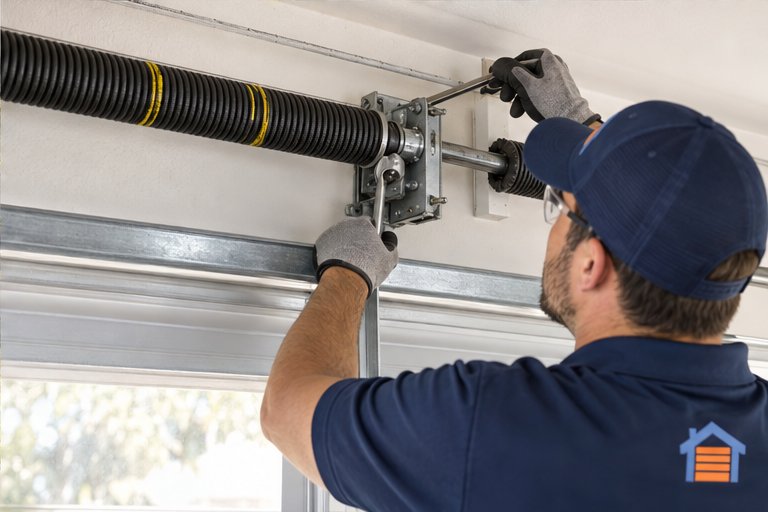
Balance on most residential sectional doors is set by the spring tension. On a torsion spring system, the tension is changed by turning the winding cone with winding bars, a specific procedure with the right tools. On an extension spring system, tension is changed at the pulley end of the spring.
Both procedures involve stored energy that can cause serious injury if the tools slip, the wrong bar goes in, or the technician is not trained. That is why we never advise homeowners to adjust springs, cables or brackets.
Beyond the springs, a technician may check the cables for equal tension, make sure the drums are seated properly and confirm that the track is level and plumb. A door can look unbalanced because of one of these items rather than the spring itself.
- Spring tension, set to suit the weight of the door
- Cable condition and equal tension from side to side
- Drum and bearing position
- Track alignment and level
- Opener travel and force settings after the balance is corrected
Torsion and extension spring systems
Most newer doors use torsion springs, mounted on a bar above the door, while many older doors use extension springs, which run along the sides of the track. Each balances the door differently, and each has its own wear patterns.
Torsion systems tend to give smoother, more even balance. Extension systems stretch and contract with the door and rely on safety cables to keep a broken spring from whipping about. Both can be correct when installed and adjusted well.
Our guide to torsion and extension springs explains the difference in more detail, and it is worth a read if you are not sure which kind of door you have.
How the opener fits into the picture
The opener's job is to move the door along a path the springs have already made easy. When balance is correct, the opener runs gently and the force settings can stay low. When balance is wrong, the opener often compensates, and a homeowner may increase the force without knowing why.
Raising the force on the opener to hide a balance problem is a poor choice. The door becomes less safe, since the reversal feature may be slower to respond, and the opener wears out sooner.
After correcting balance, we check the opener travel and the close force, and we confirm that the reversal still works. If you want to learn more about reversals, see our page on a door that reverses before closing.
What a balance visit looks like
A technician arrives, looks over the door and asks what you have noticed. We check the springs, cables, drums and tracks by eye before touching anything, and we check that the door is safe to test.
Next, we release the door from the opener and observe the balance. We note which way it moves, how sharply, and whether the movement is the same on both sides. From that we judge what needs to change.
Then comes the adjustment. With the proper tools and procedure we bring the spring tension to the right level, check the cables, and test the door again by hand and by opener. We repeat the test until we are satisfied, then explain what we did.
- Visual inspection of the whole spring system
- Release from the opener and test by hand
- Adjustment of spring tension where needed
- Cable, drum and track checks
- Retest by hand and with the opener
- Safety feature check and a plain explanation of the results
When an adjustment is not enough
Sometimes a spring has lost too much strength to adjust back into good shape. Tension can only be added to a point, and a tired spring may need replacing rather than winding. We explain the difference when it comes up.
A broken spring is a different case altogether. A door with a snapped spring is very heavy, and there is nothing to adjust. Our pages on broken torsion spring repair and extension spring replacement describe those repairs.
Springs are often replaced in pairs, since the surviving one has had the same number of cycles. We discuss what makes sense for your door so the decision is informed.
Spring life and cycles
Springs are rated for a number of cycles, and a door used many times a day uses them up sooner than one used a few times a week. A technician can tell you what fits the way you use the door.
Heavier doors, insulation and added features
Insulated doors, wood doors, doors with glass and doors with decorative overlays are heavier than basic steel doors. Springs are chosen to match the weight of the door, and a change in weight calls for a change in the springs.
If you plan to add insulation, glass or heavy paint to your door, tell us first. The springs may need to be changed to suit the new weight, or the door may drift out of balance and stress the opener.
This also applies in reverse. If a previous owner swapped springs without matching them to the door, you may have a balance problem that no amount of adjusting will fully solve. We can look at the labels and sizes and explain what we see.
Coastal conditions and spring balance
Salt air makes springs and cables rust sooner, and rust is hard on balance. A rusty spring can lose strength unevenly, develop weak spots and finally break. Cables that rust can fray and change how the load is carried.
On the Space Coast, we often see corrosion at the ends of springs and at the drums. These are places where moisture collects and where it is hard to notice from the floor.
Our guide to garage doors in a coastal climate explains how salt, humidity and heat affect the system, and why a yearly look at the springs is a sensible habit.
Cables, drums and the other half of balance
Springs get most of the attention, but cables and drums share the job. On a torsion system the cables wind onto drums at each end of the spring shaft, and the two sides must carry equal load. If one cable sits looser than the other, the door hangs crooked and the balance feels off even when the springs are fine.
A cable that has jumped a groove, a drum that has slipped on the shaft or a frayed strand can all produce a door that tilts as it rises. We look at these items every time, since an uneven door strains the track and the rollers.
If you see a cable hanging slack or a door that sits visibly crooked, do not run it again. Our page on a cable that snapped or came off the drum describes the warning signs, and the work itself is for a technician.
- Cables seated evenly in the drum grooves
- No fraying, kinks or rust at the cable ends
- Drums fixed firmly on the shaft
- Both sides of the door rising at the same height
- Safety cables in place on extension spring doors
Things homeowners can observe without touching hardware
You can learn a surprising amount just by watching. Stand well clear of the door, with children and pets kept back, and let it run through a full open and close. Notice whether it moves smoothly and whether both sides keep pace.
Listen to the opener as well. A motor that slows down or hums harder near the start of the lift is working against weight that the springs should be carrying. Write down what you notice and when, since a clear description helps us a great deal.
That is as far as a homeowner should go with balance. Looking and listening are always fine, but touching springs, cables or brackets is not.
A short list to share with us
Tell us whether the door slams, drifts, strains or tilts, whether it has changed recently, and whether anything was added to the door. That is usually enough to start the diagnosis.
Why balance matters for safety and cost
A balanced door is a safer door. It is less likely to fall on a person, a pet or a car, and the opener is able to detect obstructions and reverse the way it was designed to. Poor balance weakens every one of those safeguards.
A balanced door is also easier on the parts. Rollers, hinges, cables, drums and the opener all work under lighter loads when the springs do their job. Those parts last longer, and breakdowns come less often.
Balance is not a luxury adjustment. It is a basic part of how a garage door is meant to run, and it is one of the things we check at every visit.
Balance as part of regular maintenance
Balance changes slowly, so it is easy to miss. A yearly check as part of a tune-up catches drift before it becomes a problem. Our page on garage door maintenance and tune-up describes what a full visit includes.
If you notice that the door feels different, sounds different or moves differently, do not wait for the next scheduled visit. Describe what you notice when you contact us, and we will tell you what we think is going on.
Questions and answers
A balanced door tends to stay near where you leave it when it is released from the opener. Only attempt a check if the door looks sound and moves freely, and stay clear of springs, cables and brackets. If the door is heavy, drops or rises on its own, stop and call a technician. Your safety comes first, so when in doubt, stay clear.
We strongly advise against it. Spring tension involves stored energy, and the tools and procedure matter. A slipped winding bar can cause serious injury. Leave any spring, cable or bracket adjustment to a trained technician who has the right equipment. We are glad to explain why in person. We are glad to explain why in person.
A straining opener often means the springs are not carrying enough of the door's weight. The opener then has to lift part of it, which wears the motor and gears. A technician can check the balance and tell you whether the springs need adjustment or replacement. Catching it early protects the whole system.
Not always. It can mean a weak spring, a slipped cable or a broken spring. A door with a snapped spring is usually very heavy to lift. Whatever the cause, do not walk or park under the door and do not force it. Contact us and we will look at it. We explain what we find before any work begins.
It can, since extra weight puts more load on the springs. A modest coat of paint rarely matters, but an insulation kit, glass inserts or an overlay can. Tell us before making changes and we will check whether the springs suit the new weight. We will help you decide before the work is done.
A check during a yearly tune-up is a sensible habit. Doors used many times a day or located near salt water may benefit from more frequent attention. If the door feels heavy or sounds different, have it looked at promptly rather than waiting. We tailor the schedule to your door and how you use it.
Yes. An opener that must lift part of the door's weight works harder and wears faster. Gears, motors and drive parts can fail early. Raising the force setting to cover a balance problem also makes the door less safe. Correcting the balance protects the opener. It is a small step that protects a larger investment.
Balance is about spring tension and how well the springs carry the door's weight. Alignment is about the position of the tracks, rollers and panels. Either can make a door act oddly, so we check both and explain which one is causing the trouble. We look at both and tell you which one needs attention.