
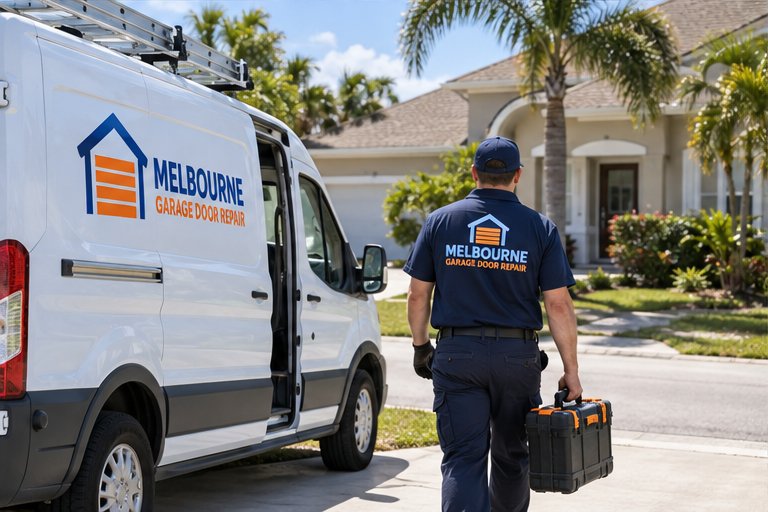
Why a larger lot changes the garage door
On a typical subdivision street the garage is attached to the house, the driveway is short and the door gets opened a handful of times a day. Out on a larger lot, the picture is different. The garage may sit well back from the road, it may be detached, and it often does more than park a car. It becomes a workshop, a place for the mower and the trailer, a spot for a boat on a lift cart, or storage for everything that does not fit in a small house.
Those uses put different demands on a door. A door that is opened to roll out a mower three times in an afternoon cycles far more than one that only sees a commute. A door that is left open for hours while someone works inside collects dust, bugs and humidity. A door on a building with no air conditioning swings in temperature and moisture all year.
This page is written for that kind of property in and around Harbor City. It looks at how rural and larger lot garages behave, what tends to wear out first, and what to tell us when you call so the visit is useful from the first minute.
Detached garages and outbuildings
A detached garage is simply a small building, and it comes with its own quirks. The framing around the door opening may have settled or shifted over the years. The slab may have a slight slope. The wiring that feeds the opener may run underground or overhead from the main house, and it may be older than the opener itself.
We look at all of this when we look at the door. A track that was installed square to a wall that has moved will rub, and no amount of lubricant fixes that. An opener that loses its power when the wire run is long or damaged will seem to fail at random. These are the details that decide whether a repair holds up.
- Check whether the door sits level and square in the opening before blaming the opener.
- Note whether the outbuilding has its own electrical panel, a long wire run or a shared circuit.
- Mention if the structure has been added to, raised or re-roofed since the door was hung.
- Tell us if the door is a different size from the usual single or double, because parts are matched to the opening.
Walk-in doors beside the overhead door
Many outbuildings have a side entry as well. People often use it all day and leave the overhead door closed, which means the overhead door may sit untouched for weeks. When it is finally needed it can be stiff, noisy or stuck, simply from disuse. A door that sits is not a door that is safe, so we treat the first visit like a full look rather than a short adjustment.
Workshop doors that work for a living
A workshop door is opened for ventilation, for lumber, for the tractor and for the dust. In a space where saws, sanders and grinders run, fine dust gets onto tracks, rollers and the opener rail. It mixes with grease and turns into a paste that makes rollers drag and chain drives rough.
Sawdust, metal filings and paint overspray also get onto the safety sensors near the floor. A sensor lens coated in dust can read as if something is blocking the beam, and the door will refuse to close. You can wipe the lens with a soft dry cloth, which is a safe check, but if the light stays out of alignment after that, it is time for us to look.
- Wipe dust off sensor lenses and the tops of the tracks with a dry cloth, never with a solvent.
- Keep stored materials clear of the door path, the springs and the opener rail.
- Do not hang tools, hoses or cords from the door or its hardware.
- Tell us if welding, grinding or spray work happens near the door, because sparks and chemicals affect finishes and seals.
Power, surges and the end of the line
Rural lines on a larger lot can be long, and the last building on the run sometimes sees the worst of the power. Storms, brief outages and voltage swings put stress on opener circuit boards. A door that has been working for years can suddenly start to behave oddly after a bad thunderstorm: lights that blink, a remote that sometimes works, a wall button that does nothing.
If you are having these symptoms, read our page on an opener that works only some of the time, then call. A board that has been hit by a surge may be repaired or the opener may need replacing, and we will explain which makes sense once we have tested it. A surge protector on the opener circuit is a sensible habit on any property with long power runs.
If the power goes out, remember that the door can be operated by hand with the release, but only when the door is fully closed or the springs are in good order. Our guide on the manual release during a power outage explains what is safe and where to stop.
Sandy soil, damp air and the lagoon
Harbor City is close to the Indian River Lagoon, so the air carries moisture even where it does not carry much salt. The soil is sandy, and sand finds its way into everything that moves. In a garage with a dirt or gravel apron in front, grit gets carried onto the slab by tires and boots, and from there onto the bottom seal and the lowest rollers.
The result is a familiar pattern. The bottom seal wears flat and starts to tear. The lowest track sections gather grit and begin to scrape. Hinges and rollers near the floor rust first because they stay damp longest. None of this is dramatic, but it adds up to a door that gets harder to move and noisier every season.
Our page on garage doors in a coastal climate covers the general effects of humid air on steel, and the same habits apply here: wipe, inspect and lubricate the right parts, and replace seals before they let water and pests in.
Wildlife, insects and the open garage
A garage on a larger lot, close to trees and water, gets visitors. Anoles and geckos, spiders, mice and rats, and the occasional snake look for shade and shelter. A worn bottom seal or a gap at the corner of the door is an invitation. Mud dauber wasps build nests on the door, in the track and sometimes inside the opener housing.
These are not just a nuisance. A nest in a roller track can stop a roller from turning. Nesting material and droppings inside an opener can cause shorts. Chewed wire to a sensor can stop the door from closing. If you find any of this, keep your hands clear of springs and moving parts, and tell us what you saw.
What a good seal does here
A fresh bottom seal and snug side stops will not make a garage airtight, but they close the gaps most animals use. We explain the options on our page about weather seal replacement, and we check the seal as part of any other visit.
Long driveways and the remote range question
When the garage is a long way from the road, the remote has to reach across more distance, and the signal has to get past trees, metal roofs and sometimes the house itself. A remote that worked fine in a short driveway may drop out halfway up a long one. People often blame the remote battery first, and that is a fair first step, because a weak coin cell shortens range noticeably.
If a fresh battery does not help, the problem may be the opener receiver, the antenna wire hanging from the motor unit, or interference. Some openers allow the antenna to be repositioned or extended. A wall keypad mounted outside the garage can be a useful second way in, and so can a smart opener that you can operate from your phone.
Our guide on programming garage remotes and keypads shows the safe steps you can try yourself. If the range stays poor after that, we will test the receiver and discuss what can be done.
Carrying more weight: doors with extras
Property owners on larger lots often add to the door. A wood or composite overlay for looks, extra insulation for a hot workshop, windows, a heavy hurricane rated build, or a coat of thick paint all add weight. The springs on a door are matched to its weight when it is installed. When weight is added afterwards, the balance changes.
A door that is out of balance puts a strain on the opener, which was designed to guide a balanced door, not to lift a heavy one. You may hear the opener strain, see the door drift when it is stopped halfway, or notice that it slams down or struggles to rise. These are signs that the springs no longer match the door.
Do not try to adjust springs or cables yourself. The tension is dangerous, and it can cause serious injury. We will check the weight and balance, and if the springs need changing, we will explain why. The details are in our guide on weights and balance.
Boats, trailers and tall loads
Many properties near the lagoon have a boat, a trailer, a jet ski or a camper that has to fit into or past the door. Higher doors, taller headroom and extended tracks suit these uses. The shape of the door opening also matters, because a tall load can strike the door, the opener rail or the header while the door is moving.
If a vehicle or trailer ever strikes the door, stop and look before you run it again. A bent panel, a track pushed out of line or a cable knocked loose can look minor and still be dangerous. Our page on a garage door hit by a vehicle explains what to check and what to leave alone.
If you often bring in a tall load, mark the safe clearance on the wall and teach everyone who drives to check it. It takes a moment and saves a door.
- Measure the tallest load and compare it to the clear opening and the lowest part of the opener rail.
- Keep the door fully open before moving a load through, never trusting a door that is still rising.
- Remove ties, straps and loose gear before closing.
- Tell us if you plan to change the door height or add a lift, because that affects the tracks and springs.
Seasonal storms and what to do before them
Harbor City, like the rest of the Space Coast, goes through hurricane season every year. On a property with a larger, wider door, the garage door is often the largest opening the wind can reach. A door that is not rated for wind, or that has weak panels, loose hardware or worn tracks, is the first place a storm finds.
Before a storm, look over the door and the tracks, and make sure everything is bolted tight and moving smoothly. After a storm, check for dents, bent tracks, loose brackets and water in the opener. Our guide to garage door hurricane preparation gives a plain list of what to do and what not to do.
Take pictures of damage before you touch anything, and do not operate a door you suspect is damaged. A door that has been pushed out of line can fall suddenly, and a damaged opener can start a short.
What maintenance looks like out here
A property with larger lots, uses beyond parking and a mix of weather deserves a simple routine. It is not complicated, and most of it takes minutes. The aim is to catch small changes before they become a stuck door on a day you need the truck.
Twice a year, look over the door while it is closed, then open and close it by hand with the opener disconnected, only if the door is closed and the release is used as the manual describes. The door should move smoothly and stay where you leave it about waist high. If it feels heavy, drifts down or springs back up, stop and call us.
Wipe dust from the tracks, check the seals, listen for new noises and test the sensors with a broom handle across the beam. Our maintenance and tune up service covers lubrication of the right parts, tightening of hardware, and a look at the springs, cables and rollers, all by a technician.
Commercial and farm use in the area
Not every door in the area belongs to a house. Small shops, storage buildings, agricultural sheds and light industrial units use garage doors and rolling doors, often larger and used harder than home doors. They face heavier traffic, deliveries, forklifts and constant cycling.
These doors have different springs, heavier panels and, in some cases, different operators. Wear shows up faster, and a failure can stop a workday. Regular inspections matter more here, because the cost of a door that will not open is not just inconvenience.
We handle commercial garage doors as well as homes. Our page on commercial garage door service explains how we approach larger doors and busy sites. When you call, tell us the door size, the type and how often it cycles.
How a visit works for a Harbor City property
When you contact us, we ask what the door is doing, how big it is, whether it is attached or detached, and what you have already tried. Pictures are helpful, especially of the springs, the tracks and any label on the opener.
A technician comes to the property, looks at the door, tests the opener and the safety devices, and explains what they find. We describe the options in plain terms: what needs fixing now, what can wait and what we would watch. You decide what to go ahead with.
If your property has a locked gate, a long drive or a dog, tell us ahead of time. Make sure the area around the door is clear, and keep children and pets away from the door and the hardware while we work. For more on the process, see what happens during a service visit.
Questions and answers
Yes. Detached garages, workshops and outbuildings are common on larger lots, and we look at the door, the framing around it and the way the opener is powered. Tell us the size of the door and whether the building has its own electrical supply, and we will plan the visit around what you describe. Photos of the door and the opener label also help us bring the right parts.
Lightning and power surges can damage the circuit board of an opener. Try unplugging the opener for a short time and plugging it back in, and replace the remote battery. If the odd behavior continues, stop using the opener and contact us so we can test it and explain whether it can be repaired or should be replaced. A surge protector on the opener circuit is a sensible habit afterwards.
Distance, trees, metal roofs and a weak battery all cut the range. Start with a new battery and check that the antenna wire on the opener hangs freely. If the range is still short, the receiver may need attention. We can test it, and a keypad or smart opener can add another way in. We will explain what we find and what the options are.
A door that is rarely used can stiffen, rust or lose its balance without anyone noticing. Springs and cables also age whether the door moves or not. Before using a door that has sat for a long time, look at it, watch it open and close, and stop if anything looks wrong or sounds unusual. If it moves roughly or drifts, call us before trying it again.
They can. Mud dauber nests in tracks or opener housings can stop rollers or cause shorts, and small animals can chew wires to sensors. Keep your hands away from moving parts and springs, note what you see, and tell us. Worn seals are a common entry point, so we check them during any visit and can replace them when they are worn.
Yes. Springs are matched to the weight of the door, and extra weight changes the balance. An unbalanced door strains the opener and can drift or slam. Do not adjust the springs yourself. We can check the weight and the balance, then explain whether the springs need to change. Never loosen or adjust springs, cables or brackets on your own.
We do. Commercial and agricultural doors are larger and cycle more often than home doors, so wear shows sooner. Give us the width, height and type of door and how often it moves, and we will look at the springs, rollers, tracks and operator and explain what we find and what the options are for your site.