
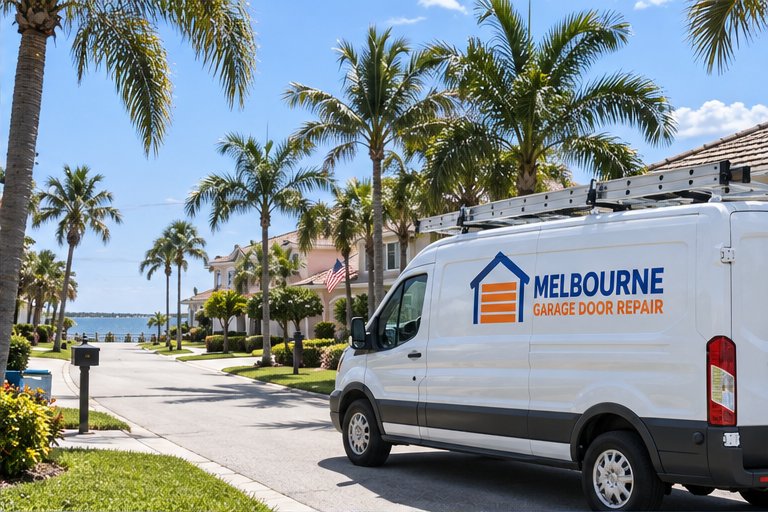
A planned neighborhood with a lot of similar homes
Port Malabar lies in the southern part of Palm Bay, in Brevard County. It was planned as a large community of residential lots, and it shows. Street after street of single story homes with attached garages sit on lots of broadly similar size, and a walk through the area reveals how many houses share a basic shape.
That similarity helps us as technicians. A great many Port Malabar garages hold a standard double door or a pair of single doors in an opening made for a common size. The parts are familiar, and the problems that come up tend to repeat from house to house.
It also means that equipment installed in one era often reaches old age together. When one neighbor's spring gives way after many years, others a few doors down are not far behind.
What decades of use do to a door
Many homes in this part of Palm Bay have stood for a long time, and their garage doors may have been replaced once, or never. A door that opens and closes several times a day, every day, collects thousands of cycles in a few years.
Wear is quiet and cumulative. Rollers flatten, hinges loosen at their screws, steel cables fray at the ends, and springs lose their strength. None of it shows until a morning when the door will not lift, or lifts crookedly, or comes down with a bang.
That is why we like to look at the whole door during a visit, not only at the part that failed. Our guide to how long garage door springs last describes why springs wear out in cycles, and why one failed spring often means its partner is near the end.
The original opener question
In an area where houses were built over many years, it is common to meet openers of very different ages. Some are recent, some are older than the people living in the house, and a few may have been added by an earlier owner and forgotten.
An older opener can still work, but there are practical limits. Replacement parts become harder to find, remotes and keypads may not pair with modern accessories, and older units may lack safety features that newer ones include as standard, such as improved reversing and sensor monitoring.
When an opener acts up, we help you weigh a repair against a new unit. Our pages on garage door opener repair and garage door opener replacement describe both routes, and what we look at before making a suggestion.
Two car garages and the single wide door
The typical Port Malabar garage is a two car space. Some have one wide door, usually sixteen feet across, and some have two separate single doors. The choice matters when something goes wrong.
A wide door is heavier and puts more strain on the springs, cables and the opener. If one side of a wide door lifts before the other, the panels twist and the rollers bind in the track. Two single doors split the load, so one can fail while the other keeps working.
If you are not sure which type you have, count the springs and the openers. A wide door usually has one or two springs across the top and one opener in the middle; two single doors have separate hardware. Our comparison of single and double garage doors sets out the pros and cons.
Rain, flat ground and standing water
Much of the area is flat, and heavy summer rain can pool on driveways and lawns before it drains away. A garage slab with a low edge, or a door seal that has worn away, lets water creep under the door and across the floor.
Water brings its own set of troubles: rust on the bottom panel, swollen bottom seals, wet rollers and a corroded opener if it sits low on a shelf. In a heavy storm it may also push debris to the threshold.
We often find that a tired bottom seal or a worn threshold is the real source of the dampness. Our page on bottom seal and threshold service explains how a new seal and a properly set door close the gap.
Lightning and the opener's electronics
Summer afternoon thunderstorms are a feature of the area, and lightning does its worst through wiring. A strike nearby can send a surge through house circuits and burn the opener's control board while leaving the rest of the house untouched.
The signs are familiar to us: an opener that is dead after a storm, one that responds to the wall button but not the remotes, or a light that stays on. The door itself is unhurt, but the electronics need attention.
A surge protector on the opener's plug helps with small surges. During a nearby storm, unplugging the opener is a simple precaution for a house that will be empty. If the opener seems affected, unplug it and use the manual release with the door closed, then contact us.
Palms, trees and the things that fall
Palms and oaks line many Port Malabar streets, and a windy afternoon drops fronds, limbs and acorns on driveways. Debris at the foot of the door can get into the tracks, block the sensors or catch under the bottom seal.
A heavy limb can do more: dent a panel, bend a track or push a door off its rollers. If something has hit the door, look at it from a distance first and do not force it to move.
Keep the sensor area and the foot of the door clear of leaves and fronds as a habit, and have a look at the tracks from inside after big blows. Our page on a garage door damaged after a storm explains what is safe to check.
Rental homes and investor owned houses
Port Malabar has many rental homes, and some owners live elsewhere. A garage door in a rental takes a particular kind of use: several remote controls in circulation, tenants who come and go, and long gaps between professional checks.
Owners who manage a house from a distance benefit from a short, regular look at the door. A rental can be turned around between tenants with a check of the springs, rollers, sensors and remotes, and a note of any wear that will need attention soon.
A change of tenants is also a good moment to reprogram the remotes and keypad so that old codes no longer work. Our guide to garage doors for rental properties sets out the points a landlord may wish to cover.
Empty lots, new builds and mixed ages on one street
Parts of Port Malabar still have empty lots between established houses, and infill building brings new homes next to old ones. A single street can include a house from decades ago and a new one with a modern door and opener.
New builds bring their own questions. Newer homes may have wind rated doors, newer opener models with Wi-Fi and different mounting hardware. Older neighbors may ask whether they should upgrade to match, or simply to gain the newer features.
If a door is being replaced in an older opening, we measure the opening, check the framing and the header, and discuss the options. Our guide to measuring for a new garage door shows what we look at, and gives you a sense of what information helps.
Hurricane season and the older garage
The garage door is often the largest opening in a house, and in high winds it is a point of weakness. Older doors that are not rated for wind can flex, buckle or burst inward under pressure, which then puts pressure on the rest of the house.
Before the season starts, look at the door's condition: panels that sag, hinges that have loosened and tracks that are bent are the first to give way. Know where the manual release is and how to use it with the door closed.
We cover the topic in more detail in our guide to garage door hurricane preparation. Whether to upgrade a door is a decision that depends on your home and your budget, and we explain the choices without pressure.
Humidity, salt air and summer heat
Port Malabar sits inland from the ocean beaches, though the humidity is high for much of the year. Steel parts rust where the paint is scratched, and a damp garage encourages mildew on stored boxes and on the lower edge of a door.
Summer heat also takes a toll. The inside of a closed garage can run very hot, which dries grease, cooks the electronics in the opener and makes rubber seals brittle over the years.
A modest routine goes a long way: a wipe of the tracks, a look at the hinges and rollers, and a light application of the right lubricant on the parts that call for it. Our seasonal garage door checklist puts the tasks in order.
Boats, bikes and the full garage
A garage in this part of Palm Bay is often a storage room as much as a place to park. Bicycles, kayaks, fishing rods, holiday decorations and shelves of paint all end up inside, and the door has to work around them.
Clutter near the opening can block the safety sensors, rub the panels and tempt people to lean ladders on the tracks. Keep a clear lane on both sides of the door and avoid piling things against the sensor housings.
A shelf mounted on the wall next to the door can be hit by the door if it is too close. Check that nothing sticks out in the path of the opening panels, and that stored items cannot fall onto the tracks.
Security and the long block
The long, uniform streets of a planned community mean that a door left open stands out, and so does a house that looks empty. Many owners prefer to know that the garage door is closed and locked without having to check.
A keypad on the outside wall avoids hiding a spare key, and a remote kept in a vehicle is an exposure if the vehicle is entered. Changing the keypad code occasionally and removing old remotes from circulation helps.
Smart controls can report whether the door is open and let you close it from a phone. Our page on smart opener and Wi-Fi setup explains what these add and what they depend on.
What a Port Malabar visit looks like
We come to the house, look at the door in question and ask what you have noticed. Then we examine the door, the hardware and the opener, and test the safety features.
We explain what we find in plain words, show you worn parts when that helps, and describe the options for each. If a spring or cable is involved, we handle it ourselves and ask you to keep clear of those parts.
On a street of similar homes, we are often asked to look at a second door or a neighbor's door while we are there. Each house is its own case, and we treat it that way.
Nothing is changed until you understand it. If a part has to be ordered, we say so before we leave, and we describe what is safe to do with the door in the meantime. If the door should not be used until it is repaired, we tell you plainly and explain how to open and close it with the manual release, with the door fully closed before you disconnect it.
We also test the safety reversing and the sensors before we finish, so that the door and opener work together as they should.
Signs a Port Malabar door is asking for attention
Doors rarely fail without warning. Most give weeks or months of small hints, and the owners who notice them pay for smaller repairs. After years of looking at doors in neighborhoods like this one, a few warning signs come up again and again.
A door that was quiet and has become noisy, a door that shudders on the way up, a gap of light along one side, a cable with a fuzzy, broken strand, or an opener that now strains: each one tells us something about wear that is on its way.
- A new rumble, scrape or squeal that was not there last year
- One side of the door rising slightly ahead of the other
- A door that feels heavy by hand or will not stay open halfway
- Cable strands sticking out near the bottom corners or the drums
- An opener that hesitates, hums or reverses for no clear reason
- Rust, flaking paint or dark staining on the bottom panel
Getting in touch from Port Malabar
If your door is noisy, slow, crooked or has stopped working, contact us and tell us what you see and hear. Photographs of the door and the opener label are very useful.
You can reach us through the contact page. We will explain what we find and what the options are.
Questions and answers
Yes. We serve homes in Port Malabar and across Palm Bay and the surrounding Space Coast communities. We come to the property, look at the door and opener, and explain what we find and what the options are before anything is changed. Contact us with a description of the problem and, if you can, photographs of the door.
Not necessarily. An older door may still be sound and need only fresh rollers, hinges or a spring. We look at the panels, the track, the balance and the opener, and tell you honestly whether repair makes sense or whether replacement would serve you better. The decision is yours, and we describe both routes.
A nearby lightning strike or a power surge can damage the opener's board or receiver, leaving it partly working. A weak battery in a remote or moisture in the wiring can also cause the same symptoms. Unplug the opener if it behaves oddly after a storm, and contact us so we can test it.
Yes. We work with owners and managers on doors, openers, remotes and keypads. A check between tenants, along with reprogramming of remotes and keypad codes, is a sensible routine. Tell us whether you are the owner or the manager and who will be at the property, so we can arrange the visit sensibly.
Often it is. A worn bottom seal, a gap at the threshold or a door that does not meet the floor evenly lets water in during heavy rain. Sometimes grading or drainage outside is to blame, and we will tell you if that seems to be the case. A new seal and a correctly set door usually make a clear difference.
It is sensible to have the door checked. A door in poor condition is more likely to buckle or come off its track in high wind. We look at panels, hinges, tracks and the opener, and explain what we find. Know where the manual release is and how to use it with the door closed.
Yes. Many properties have a second door, a workshop door or a neighbor with the same problem. Let us know when you contact us and we will plan the visit around the doors you would like checked. Each door is looked at on its own merits, and we explain what we find on each one.