
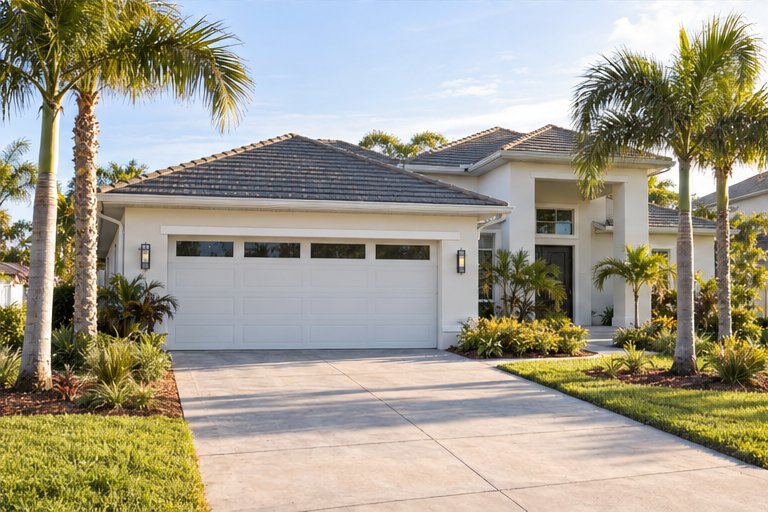
Why the garage door gets special attention before a storm
Most homes have one very large opening that is closed by a light, segmented door instead of a solid wall. When strong wind pushes on that door, the load is spread over a wide area, and the door depends on its tracks, brackets and fasteners to stay in place. If it fails, wind can enter the garage and raise pressure inside the house.
That is why people who work in storm preparation often mention the garage door first. It is not a reason for alarm. It is a reason to make sure the door and its hardware are in good order before the season starts, rather than discovering a weakness when a storm is already in the forecast.
This guide is written as an educational overview for Space Coast homeowners. It does not replace the instructions of emergency officials, your insurer, your building department or the manufacturer of your door.
A season, not a weekend
Storm preparation works better when it is spread out. The Atlantic season begins on June 1 and ends on November 30, and most households think about storms only when a named system appears on the map. By then, hardware stores are crowded and technicians are busy with other homes.
A better habit is to treat the arrival of June as a reminder to do a short garage door review. That review can be done in one afternoon, with a flashlight, a notepad and a phone for photographs. If it turns up anything worrying, you have months to have it looked at calmly.
The photographs have a second use. A set of dated pictures of your door in good condition can be helpful later if you need to explain to an insurer what the door looked like before a storm.
Walk around the door and look first
Begin from outside with the door closed. Stand back and look at the whole surface. Notice dents, cracks, bulges, and any sign that the panels are not in a straight line. Check the glass or window inserts for cracks. Look at the edges where the door meets the frame and see whether the seal is intact.
Then go inside. With the door closed, look at the tracks on both sides, the brackets that hold them to the wall, and the horizontal tracks overhead. You are looking for anything that seems loose, bent, rusted or separated from the framing. Do not touch the springs, the cables or the brackets that hold them.
Take a few photographs as you go. If something looks odd, a photo helps a technician understand what you noticed before they arrive.
- Panels in a straight, even stack with no creases or bulges.
- Window inserts intact and firmly seated.
- Weather seal continuous along the bottom and sides.
- Vertical tracks straight and firmly attached to the wall.
- Horizontal tracks level and supported by their hanging brackets.
- No gaps where hardware has pulled away from wood.
Tracks, brackets and where the door is held
In high wind, a garage door is held mostly by its tracks. The tracks are fastened to the building, and the rollers keep the panels inside them. If the track is bent, loose or poorly anchored, the door can bow out of the opening and come off its rollers.
You can check this visually. Look at the bolts or screws holding the track to the jamb and see whether any have backed out or whether the wood around them looks cracked or rotted. Look at the overhead track hangers for the same signs. A track that wobbles when lightly pressed by hand needs attention.
Anything involving the tension system, including the springs, drums, cables and their brackets, is strictly for a trained technician. Please do not tighten or loosen those parts, even if something appears obviously loose.
Wind-rated doors and what the label tells you
Some doors are built and tested to resist stronger wind than others. These doors typically have stiffer panels, extra struts or reinforcement, heavier hinges and tracks, and a design pressure rating on a label or in the documentation. The rating describes how much wind pressure the door was designed to handle, and it applies to the door as a complete system with its installation.
Check whether your door carries a label or a certificate, often on the inside of the door or in the paperwork from the installation. If you cannot find any rating, that does not automatically mean your door is unsafe, but it does mean you do not know what it was designed for.
If you are curious about how to read the information on your door, reading your garage door label and opener data explains the common markings. For a broader orientation to ratings and rules, see wind ratings and building rules: the basics.
Reinforcement as a concept
Reinforcement means adding strength to a door that was not designed with high wind in mind. A common approach is to attach rigid struts across the panels, so the door resists bending under pressure. Some kits also add heavier track brackets or additional fasteners to the framing.
The key point is that reinforcement is a system, not a single product. A kit has to be matched to the door's size, weight and construction, and it has to be installed the way its maker describes. Adding the wrong hardware, or adding it incorrectly, can create new problems, including extra weight that upsets the spring balance.
Because of that, reinforcement is a topic to talk through with a professional, not a project to improvise with lumber from the garage. A technician can look at your door, explain which options exist for that particular door, and explain what each one does and does not change.
Why homemade bracing is a poor idea
Boards propped against a door or screwed across panels are sometimes tried in a hurry. They can damage the door, change its weight and prevent the opener or manual release from working. They also give a false sense of security. If you want more strength, ask about a proper kit or a door designed for the purpose.
Local rules, permits and your HOA
Rules about garage doors and wind differ from place to place. Florida's building code addresses wind load for exterior openings, and local building departments decide how it is applied and when a permit is needed. A replacement door, or a reinforcement that changes the structure of the opening, may involve permits or inspections.
If you live in a community with a homeowners association, there may also be rules about the appearance of the door, the use of storm panels, and the timing of installing them. Those rules are separate from the building code.
Before you buy anything, check with your city or county building office and, if it applies, your association. Ask what is required for your address. That one conversation can save you from buying hardware that cannot be used or a door that does not meet the local requirements. Our overview of HOA rules and garage door changes may help you prepare questions.
The opener, power and the manual release
In a storm, power can fail for hours or days. An opener that depends on mains power then stops working, and the door can remain stuck either open or closed. This is a common surprise for people who have never used the manual release.
The manual release is the cord with a red handle hanging from the trolley on the opener rail. Pulling it disconnects the door from the opener so the door can be moved by hand. It should be used with care, and only when the door is in a safe position, because a door that is disconnected can move freely if its springs are out of balance.
The right time to learn about it is in calm weather, not during a storm. The article on using the manual release during a power outage explains the steps and the stop points.
Battery backup and surge protection
Some openers can be fitted with a battery backup that lets them run for a limited number of cycles during an outage. Others have a backup built in. If your opener has one, check that the battery is in good condition, because batteries age and fail without warning.
Surge protection is a different matter. A storm can send voltage spikes through the power lines, and an opener can be damaged even if the door itself is fine. A surge protector at the outlet, or unplugging the opener ahead of a storm in a stable situation, are both sensible ideas.
A battery system adds convenience but does not change the need to understand the manual release. Treat the two as complementary. You can read about options on battery backup for garage door openers.
A timeline you can follow
Preparation is easier when it is broken into stages. The table below suggests a simple sequence, from the start of the season through the days after a storm. Adjust it to your household.
| When | What to do | Who does it |
|---|---|---|
| Early in the season | Walk-around inspection, photographs, check for rating label, test the manual release in calm conditions | Homeowner |
| Early in the season | Have springs, cables, tracks and fasteners looked at if anything seemed worn or loose | Technician |
| Before a storm is expected | Park vehicles inside if the garage is considered safe, remove loose items near the door, check the remote battery | Homeowner |
| When a storm is close | Close the door fully and do not operate it again until the storm has passed | Homeowner |
| After the storm | Look at the door from a distance, check tracks and panels, avoid using it if damage is visible | Homeowner, then technician if needed |
What to do with the contents of the garage
A garage often stores fuel, paint, propane and chemicals. Before a storm, think about what is stored there and whether it is secure. Items close to the door can become projectiles if wind or water gets inside. Heavier items should be kept low and away from walls that may take water.
Cars are another question. Many people park inside to protect vehicles from hail and debris, but that depends on how your garage and your door are built. If the door has been damaged earlier or you have doubts about it, think carefully about where vehicles will be safest.
Remote controls and keypad codes deserve a moment, too. If you plan to leave the area, make sure someone you trust knows how the door works, and make sure the door is fully closed and locked in the way your household usually uses.
During the storm
When the wind is up, stay away from the garage door. Do not stand near it, do not try to hold it, and do not open it to see what is happening. A door under wind load can move suddenly or fail in ways that are hard to predict.
Do not operate the opener repeatedly. If the power flickers and the door reacts, leave it be. The aim is to keep the door closed and stable until the wind has passed.
If someone is hurt, call 911. If you have a safe room in the house, use it, and stay away from the exterior walls of the garage.
After the storm: look before you use it
Once the weather has passed and it is safe to go outside, look at the door before you operate it. Check for dents, tears, cracks, bent tracks and panels that have shifted. Look at the tracks and the places where the hardware meets the wall. If the door looks out of line or you see anything bent, do not run it.
A damaged door that is run by the opener can make matters worse, because the opener will keep pushing against a problem it cannot see. It can also be unsafe if a part is ready to give way. Leave the door in place and arrange a visit.
The page on a garage door damaged after a storm describes the signs in more detail and explains what a technician checks.
Water, flooding and debris
Rain driven by strong wind will find any gap. Weather seals along the bottom and sides are the main defense for a garage door, and a worn seal can allow water to run across the floor. After a storm, check the seals for tears and look for sand or debris stuck in the bottom edge.
If water entered the garage, switch off power to the opener if the outlet or the opener may have been wet. Do not touch electrical devices while standing in water. Wait for the area to dry, and have a professional check anything electrical that was soaked.
Salt and debris left on tracks and hinges after a storm can start corrosion. A gentle rinse and dry, avoiding the electronics, helps. If you are not sure whether something was damaged, a technician can look at it.
Common mistakes to avoid
Waiting until the last minute is the most common, and it is understandable. Another is assuming the opener will work in a power outage. A third is trying to repair springs or cables at home because a door seems heavy. That last one is dangerous and should never be attempted.
Other frequent errors include leaving the door unlocked when it can be locked, forgetting to check the remote battery, and putting stress on the door by leaning heavy items against it. Some people also buy reinforcement hardware without knowing whether it fits their door.
- Waiting for a storm warning before checking the door.
- Assuming the opener will work without power.
- Using improvised bracing that changes the weight of the door.
- Working on springs, cables or their brackets.
- Running a damaged door with the opener.
- Skipping the permit or HOA question before buying hardware.
Booking a seasonal visit
A seasonal visit is a chance to have a trained person look at parts you cannot safely check. A technician can examine the springs, cables, drums, rollers, hinges and fasteners, test the balance, and tell you what they see in plain language. You can then decide whether anything needs attention before the season is in full swing.
You can read what that kind of service includes on garage door service before storm season. Our seasonal garage door checklist for Florida also gives a year-round perspective. If you would like to talk it over, contact us and we will explain what we find and what the options are.
Questions and answers
The season runs from June 1 through November 30, and the calmest time to prepare is at the start, long before a storm is in the forecast. An early walk-around, a test of the manual release and a technician visit if anything seemed worn give you time to act. Waiting until a storm is near leaves little room for repairs.
It is better not to. Improvised bracing can damage panels, change the door's weight and block the manual release. Reinforcement kits are designed for specific doors and need correct installation. If you want more resistance to wind, ask a professional about options for your particular door, and check the local building rules first. Taking photographs of the door as it is now can also help later.
Not unless it has a battery backup. Without power, you can disconnect the door from the opener with the manual release and move it by hand, with care. Learn how it works in calm weather and read the manual release guide before you need it. Ask the door maker or a technician what your door was designed for.
It depends on where you live and what the work involves. Replacement doors and some reinforcement can require a permit or inspection under local rules. Your city or county building office can tell you what applies to your address. If you are in an association, ask about its requirements as well. Local officials can confirm the rules for your address.
That depends on your garage and door. A door in good condition is a reasonable protection for vehicles, but one that is damaged or weak is a concern. Follow guidance from local officials, think about debris and flooding, and stay away from the door while the wind is strong. The manufacturer or a technician can tell you how to reconnect it.
Do not run it with the opener. Look at it from a distance, keep people and cars clear, and note what you see with photographs. A bent track or shifted panel can get worse when the door moves. Have it looked at, and read about storm damage signs while you wait. Each home is different, so use your own judgment alongside official advice.
No. A rating describes the pressure a door system was designed to handle when it is installed as intended. It does not promise that nothing can go wrong, and it depends on the condition of the hardware and the framing. Keeping the door maintained matters as much as the number on the label. Maintenance and sound installation both play a part.