
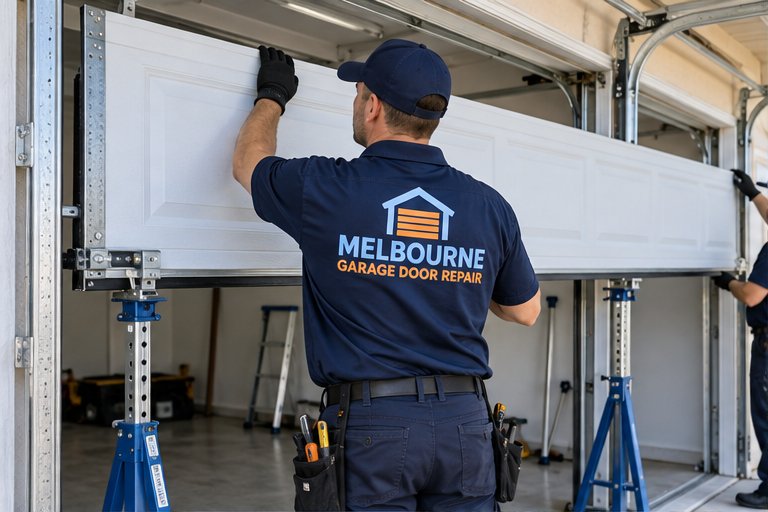
Two honest answers to one question
Homeowners often ask us whether their door should be repaired or replaced, as if there were a single rule. There is not. A broken spring on a sound door is a repair. A door that has been struck by a car and folded in the middle may be a replacement. Between those two ends sits a wide range of cases where reasonable people could choose either.
What helps is a clear way of weighing the factors. In this guide we walk through them in the order that matters most: safety first, then the state of the door itself, then the availability of parts, then the cost of living with the door as it is.
None of this replaces having someone look at the door in person. It does mean you can arrive at that conversation prepared and know what questions to ask.
A useful habit is to separate the problem from the symptom. A door that will not open is a symptom, and the cause could be a power issue, a dead remote battery, a broken spring or a bent track. Deciding between repair and replacement before the cause is known is how people end up choosing the wrong thing.
Start with safety
The first question is whether the door is safe to use. A door that falls unexpectedly, one with a damaged cable or spring, or one that does not reverse when it meets an obstruction is a hazard to the people who walk and drive beneath it.
If the door is unsafe, it should not be used until it is dealt with. That might mean a straightforward repair, such as replacing a spring or cable, or it might mean replacing parts that cannot be made safe again. Safety does not decide between repair and replacement on its own, but it sets the urgency.
A door that has lost its balance or that cannot be reliably stopped by its safety systems deserves attention before any discussion of appearance or cost.
Look at the panels first
The panels are the largest and most visible part of the door, and they are often the deciding factor. If the panels are straight, solid and in good condition, the door has a lot of life left, whatever else is wrong. If they are cracked, rotted, badly bent or rusted through, repair becomes harder.
A single damaged panel can sometimes be replaced, provided a matching panel is available. Matching can be difficult on older doors, because styles, colors and profiles change, and manufacturers stop making them. A new panel that does not match the others may look out of place.
Our page on garage door panel repair explains what can be done with dents, cracks and sagging, and when it makes more sense to look at the whole door.
Age and what it really tells you
People often ask how old is too old. Age is a clue but not a verdict. A well made door that has been maintained and used lightly can be in good shape long after a neglected door of the same age has worn out. The question is not how many years have passed but how much wear the door shows.
Still, age brings patterns. Older doors often have thinner steel, less insulation, older style hardware and, in some cases, no modern safety features. Their openers may lack the sensors that newer models have. Springs, rollers and cables have been replaced, or should have been.
When a door is old and several major parts are worn at once, the sum of the repairs can start to look like a lot of effort for a door that will still feel dated. That is when replacement deserves a serious look.
Wear shows up in small ways. Look for panels that flex more than they used to, hinges that have worn loose in their holes, rollers that have flat spots and a track that no longer sits square to the wall. Several of these together say more about the door than a date on a label does.
The kinds of damage that are usually repairable
Many common problems are well within the reach of a repair. Worn rollers, noisy hinges, a broken spring, a frayed cable, a failed sensor, a stripped opener gear, a tired remote, and a cracked bottom seal are all routine jobs. Doing these on a sound door brings it back to normal operation.
Even a door that has come off its track can often be put back, provided the track and panels have not been seriously bent. The key is whether the structure is intact. A good technician checks this carefully before offering a repair, since forcing a bent door back into place can cause further damage.
- Springs and cables on a door with straight panels.
- Rollers, hinges and bearings that have worn out.
- Openers with failed boards, gears or sensors.
- Seals, weather stripping and threshold parts.
- A door pushed off track without panel damage.
The kinds of damage that point to replacement
Some damage is hard to repair well. A door struck by a vehicle often has bent panels, twisted sections and damaged tracks all at once. Fixing each element one at a time may cost more effort than starting fresh, and the result may never sit quite right.
Rot in wood panels, rust that has eaten through steel, widespread cracking in composite or fiberglass, and panels that have delaminated or lost their insulation layer are other signs that the door is near the end of its useful life.
Read our page on a garage door hit by a car for the usual sequence of checks, and on bent garage door panels for what can sometimes be straightened and what cannot.
Parts availability: the quiet deciding factor
A repair is only possible if the right parts exist. For most standard doors, springs, cables, rollers, hinges and seals are easy to find. For older, unusual or discontinued doors, matching panels, special track or proprietary hardware may no longer be available.
Openers raise the same question. Some older models have boards or remotes that are no longer made, and the available replacement may require upgrading the whole unit. In that case the choice is not between repair and replacement of the opener, but between a stopgap and a modern replacement.
We tell you plainly when a part is hard to source. Sometimes a close equivalent works, and sometimes it does not. If a repair depends on a part that may not fit, we say so before starting, so that you can decide with that knowledge.
It is also worth asking whether a repair part will be a match in quality. A poor quality roller that wears out early, or a spring chosen only to fit, may not give the same life as one properly chosen. The cost of a repair is more than the part itself, so consider how long you expect it to last.
Think about the whole system, not one part
It helps to remember that a garage door is a system. If one part has failed, the others have been working just as hard for just as long. A spring that gave out may be followed by a cable, a roller or a hinge shortly after.
This is not a reason to replace everything at once, but it is a reason to ask your technician what else shows wear. If several parts are close to failing, it can be sensible to deal with them in a single visit instead of calling again in a few months.
Our guide to how a garage door works explains how the parts share the load and why wear in one place shows up in another.
Think too about what each part does for the others. A door with a brand new spring and tired cables is still at risk, and a new opener on a heavy, poorly balanced door will strain from the first day. The aim of any repair should be a door that works as a complete unit, not one good part among worn ones.
The opener is a separate decision
Repairing or replacing the door does not decide what to do about the opener. The two are separate machines that work together. A new door can run on an older opener, and an old door can be fitted with a modern opener, as long as they are compatible and the door is in balance.
If you are replacing the door, it is a good moment to ask whether the opener should be looked at too. A new door may be heavier or lighter than the old one, and the opener may need adjusting or replacing to suit it.
Safety features on newer openers, including improved sensors and battery backup options, may be worth having if your current unit lacks them. See garage door opener replacement for how we approach this.
Insulation, noise and everyday comfort
Sometimes the reason to replace is not that the door is broken but that it no longer suits how the garage is used. An uninsulated door on a garage that has become a workshop, gym or office can leave the space hot in summer and uncomfortable at other times of year.
A newer, insulated door can also be quieter, since it is often built with a more rigid panel and nylon rollers. If noise from the garage reaches bedrooms or a neighbor's property, that may be a factor.
These benefits are real, but they are not a reason to discard a perfectly sound door in every case. Consider how the space is used, how much the heat or noise bothers you, and whether a smaller change such as new rollers or insulation inserts might be enough.
Appearance and the value of the home
A garage door can take up a large part of the front of a house, so its condition affects how the property looks from the street. Faded, dented or mismatched panels can make the whole home look tired.
Replacing a door is one of the more visible exterior changes a homeowner can make. If you are preparing to sell, or if you are planning exterior work, appearance may weigh more heavily in the decision than mechanical wear.
At the same time, a repair that returns a door to smooth, quiet operation and a fresh coat of paint can also make a good impression. Our guide to garage doors and home selling looks at this from the seller's point of view.
Local conditions on the Space Coast
In coastal Florida, climate is a constant factor. Salt air, humidity, strong sun and storm season wear on doors in ways that inland owners rarely see. A door that has been through years of this may show rust at the hinges, fading on the panels and hardened seals long before the springs are tired.
Wind loading is another point. Doors in this part of the state may be subject to local building rules, and replacing a door may bring those into play. We do not interpret the code, and your local building department or your insurer can tell you what applies. Our guide on wind and building rules basics outlines the questions to ask.
If you live near the water, it is worth thinking about materials that resist corrosion. Our comparison of door materials is in garage door materials compared.
How to compare the two paths fairly
The clearest way to decide is to put the two options side by side. Ask for what each involves, what it leaves untouched, and what you will still have to deal with afterward. We do not quote figures in articles, but we are happy to explain the details once we have seen the door.
The table below shows the questions that tend to matter most, with the way they usually point.
| Question | Leans toward repair | Leans toward replacement |
|---|---|---|
| Are the panels straight and solid? | Yes, with minor marks | No, bent, cracked, rotted or rusted through |
| Is the failed part available? | Yes, standard parts | No, discontinued or unusual |
| Is the problem a single part? | Yes, such as a spring or roller | No, many parts are worn at once |
| Does the door suit how you use the garage? | Yes, as it is | No, too hot, noisy or dated |
| Is the structure intact after an impact? | Yes, track and panels are straight | No, sections are twisted or folded |
| Is the door safe once repaired? | Yes | Not reliably |
The cost of putting it off
Many people delay a decision because the door still works, more or less. It opens most days, it is loud, and one corner sticks, but it does the job. The trouble is that a door in this state is often working against itself, and the strain spreads to the opener, the cables and the track.
Delay also changes the options. A door with one worn part today may have several by next season, and the repair that would have been simple may become a larger one. A door that is allowed to run off track, or to be forced by the opener while it is jammed, can bend panels that were straight.
Waiting is not always wrong. A door that is sound, safe and only a little noisy can wait for a convenient time. But a door that is unsafe, unbalanced or visibly damaged should not be left, and it is reasonable to have it checked as soon as you notice a change.
Storm season is a particular case. If your door is weak and you live in a coastal area, it is sensible to deal with it before the busy months. Our hurricane season service page and the guide on garage door hurricane preparation explain what to look at.
What a visit should tell you
When a technician looks at your door, you should come away knowing what is wrong, what is worn but still working, and what the realistic options are. A good explanation covers repair, and if it applies, replacement, in plain language.
You should not be pressured. If someone insists on one answer without showing you why, ask them to point to the part. A door that can be repaired should be repaired if that is what you want, and a door that cannot should be explained properly.
Our guide to questions to ask a garage door technician gives you a list to take along, and how garage door service pricing is built explains what goes into any estimate.
Getting a clear answer for your door
If you are weighing repair against replacement, the most useful step is to have the door looked at. We come to the property, examine the panels, springs, cables, track, rollers and opener, and explain what we find. Then you can decide with the facts in hand.
If you are leaning toward a new door, new garage door installation describes how that process works. If repair makes sense, we will tell you which parts and why. In either case, contact us and describe what you have seen.
Questions and answers
Age alone does not decide it. What matters is the condition of the panels and the availability of parts. A well kept older door with straight panels can often be repaired, while a newer one that has been damaged or has rusted through may not be. A technician can look at the door and explain which category yours is in. See repair versus replace.
Usually not. Springs are wear items, and replacing them on a sound door is a routine repair. The door only needs replacing if the panels or track have also been damaged, or if it is worn out in many places. Never try to fix a spring yourself because it is dangerous. See torsion spring repair. We explain what we find before any work begins, so you can decide.
Sometimes. If a matching panel is available and the rest of the door is sound, replacing one panel is possible. On older or discontinued designs, matching can be difficult, and a new panel may differ in color or profile. We tell you honestly whether a match is realistic. See panel repair. We explain what we find before any work begins, so you can decide.
Not always. A new door can often run on an existing opener if the opener is in good order and suited to the door weight. But if your opener is old, noisy or missing modern safety features, it may be a good time to consider a new one. We explain the options after seeing both. See opener replacement.
It can improve how the home looks from the street, which matters to many buyers. But a sound door that runs smoothly and quietly may serve just as well, and a repair can be enough. It depends on the condition of the door and the market. Our guide to garage doors and home selling covers this. We explain what we find before any work begins, so you can decide.
Have the door looked at before deciding. We come to the property, examine the whole system and explain what we find, including what is worn, what is damaged and what the options are. You can then choose with real information. Contact us and describe what you have noticed, and we will go from there. We explain what we find before any work begins, so you can decide.