
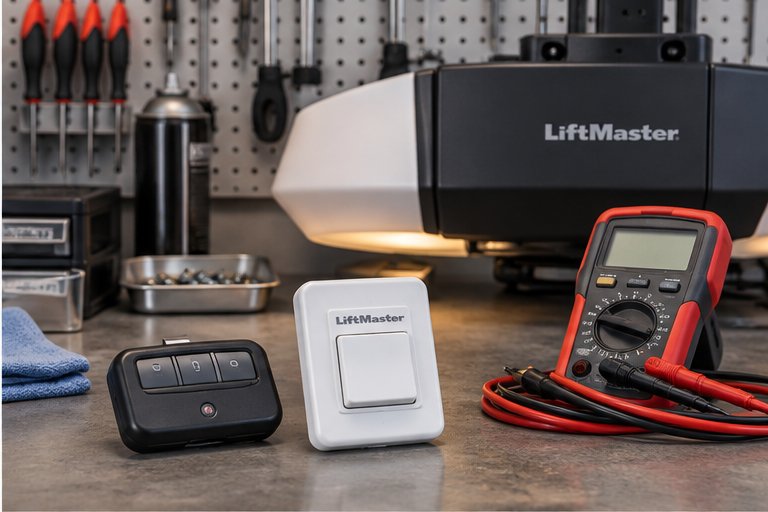
What the drive system does
Every opener has a motor in the head unit mounted to the ceiling. The motor turns a mechanism that moves a trolley back and forth along a rail. The trolley connects to the top of the door through an arm, so as it travels, the door opens or closes. The mechanism between the motor and the trolley is the drive system.
There are three common versions: a chain, a belt or a threaded steel rod called a screw. They all do the same job, and they all assume the door is properly balanced by its springs. They differ in the sound they make, the parts that wear and the way they respond to weather and use.
If you are choosing a new opener, the drive type is one of the first decisions. If you already have one, knowing the type helps you describe a problem accurately and know what to expect. Our wider guide to garage door opener drive types gives background, and this page focuses on the direct comparison.
How a chain drive works
A chain drive uses a steel chain, similar in principle to a bicycle chain, running along the rail. The motor turns a sprocket, the sprocket pulls the chain, and the trolley attached to the chain moves with it. It is the oldest of the three designs and remains common because it is simple and sturdy.
Chains are metal moving against metal, and that produces noise. The sound is a rattle and a clank as the chain runs over the sprocket and along the rail, and it can carry through the framing of the house. Over time the chain can stretch and sag, and a sagging chain slaps against the rail.
Chain drives need lubrication and an occasional tension check. They are well suited to detached garages and to places where the sound does not matter much, and many owners are happy with them for years.
How a belt drive works
A belt drive replaces the chain with a reinforced rubber belt, often strengthened with steel or fiber cords. The belt runs on a pulley instead of a sprocket, and because rubber does not clatter against metal, the sound is far softer. The belt moves the trolley in the same way a chain would.
The quiet running is the chief reason people choose belts, particularly when a bedroom or living space sits above or beside the garage. Vibration is also reduced, which is gentler on the door and the framing.
Belts do not need lubrication, which removes one maintenance chore. They do age, though. Rubber can stiffen with heat and wear, and a belt that has been through many seasons of Florida heat may crack or lose tension. Belts are usually a little more expensive at purchase, though we will not name a figure here.
How a screw drive works
A screw drive uses a long threaded steel rod, sometimes called a worm screw, that runs the length of the rail. The motor spins the rod, and the trolley rides along the threads like a nut on a bolt. There is no chain or belt to stretch, so the system has fewer moving parts.
That simplicity is a selling point. With fewer parts to wear, the drive can be quite durable, and the trolley travels at a steady pace. The sound is a lower hum and a rhythmic noise that is usually more subdued than a chain but not as hushed as a belt.
Screw drives like to be lubricated, and their performance can vary with temperature and with the condition of the threads. They are also somewhat sensitive to a door that is out of balance, since there is little give in the system. Some people find the noise changes from season to season.
The three designs in one table
The table below compares the designs across the questions that matter most to owners. Real results depend on the specific model, the quality of installation and the condition of the door. Use it as a starting point for conversation rather than a final ruling.
Note that we do not endorse a brand or model on this page. The comparison is about the drive type only.
| Point of comparison | Chain drive | Belt drive | Screw drive |
|---|---|---|---|
| How it moves the trolley | Steel chain on a sprocket | Reinforced rubber belt on a pulley | Threaded steel rod turned by the motor |
| Noise | Loudest of the three; rattle and clank | Quietest; a soft hum | Moderate; a hum and rhythmic sound |
| Vibration | Noticeable through framing | Low | Low to moderate |
| Routine upkeep | Lubricate the chain; check tension | Little needed; check belt condition | Lubricate the screw; check for wear |
| Main wear parts | Chain, sprocket, trolley | Belt, pulley, trolley | Screw, trolley nut, bearings |
| Travel speed | Steady; varies by model | Steady and smooth; varies by model | Often a brisk, steady travel; varies by model |
| Effect of weather | Tolerant; chain can rust near the coast | Rubber ages in heat and sun | Can be sensitive to temperature and thread condition |
| Tolerance of a poorly balanced door | Some tolerance, but chain slaps if loose | Smooth, but strain shows as belt wear | Little give; imbalance shows up readily |
| Suited to | Detached garages, sturdy everyday use | Attached garages, rooms above or beside | Owners wanting few parts and moderate noise |
| Typical purchase level | Usually the most modest | Usually higher | Often in between |
Noise: what to expect in a Florida home
Noise is the question that decides most purchases. If the garage is attached and the master bedroom sits above it, a chain opener starting up at night can be heard throughout the room. A belt opener is a better match for that situation, since the sound is a gentle hum.
On a detached garage or a workshop, noise matters less, and a chain or screw drive may be perfectly fine. Many Space Coast homes have the garage at the front with living rooms nearby, so it is worth thinking about where the sound will travel.
Remember that the opener is not the only source of sound. A door with worn rollers, loose hinges or dry bearings can be louder than the opener itself. If your garage is noisy, a technician can listen to see which part is responsible. See our page on a very loud garage door for more.
Maintenance: what each type asks of you
All three types benefit from regular attention, though what they need differs. The aim is to keep the drive clean, correctly tensioned and clear of the buildup of dust and old grease. A short routine before storm season and again after is a sensible habit.
A chain should be lightly lubricated with a product suited to the purpose and checked for sag. A belt should be looked at for cracks, fraying and glazing, and for correct tension. A screw should be lubricated according to the maker's guidance, and the trolley nut should be checked for wear.
If you have no idea whether the drive is the right tension, do not guess. Over-tightening can load the motor, and a loose drive can jump. Our service page for belt, chain and screw drive opener service covers what a technician checks and adjusts.
Speed and travel
Travel speed depends more on the opener's design than on the drive type alone. Many owners find screw drives move briskly and steadily, while belts and chains vary by model. Some openers have a soft start and soft stop that slow the door at the ends of its travel, reducing noise and wear.
A faster opener is not necessarily a better one. Doors that move too rapidly place more stress on the hardware, and a door that moves very slowly can be a nuisance. A steady, controlled movement is what most people want.
If the door slows, speeds up or hesitates unexpectedly, that is a symptom worth investigating, because it can point to a drive problem, a force setting or an imbalance in the door. Do not adjust springs or cables yourself, and have the door looked at if it behaves differently from before.
Parts that wear and what failure looks like
Each drive has its own typical signs of age. Knowing them helps you spot a problem before the door stops. None of these signs requires you to open the opener or touch the springs. Listen, look from a safe distance and report what you notice.
Chain drives
A chain that sags, slaps against the rail, jumps a tooth or makes a grinding sound is due for attention. A broken chain leaves the trolley loose and the motor spinning without moving the door. Our page on a chain that jumped or a belt that is slipping describes the symptoms.
Belt drives
Look for cracks, frayed edges, a shiny glazed surface, or a belt that has gone slack. A belt that slips will make the motor run while the door moves in jerks or not at all.
Screw drives
Warning signs include a rough or grinding sound, a door that stalls at certain points, and worn threads on the trolley. Dryness often shows first as a squeal.
When the opener hums but the door does not move
This is a very common complaint, and the drive type matters to the diagnosis. If the motor runs and the door stays put, the cause may be a broken spring, a disconnected trolley, a stripped gear, a slipping belt or a jammed chain. Each of these is different, and the fix is different too.
Start with the simple observations. Does the door lift by hand when the opener is disconnected using the manual release? If it is very heavy, the springs are the likely problem and you should not keep trying the opener. If it lifts easily, the opener or drive is more likely to be at fault.
Use the release cord carefully and only with the door closed. Our page on an opener that runs but the door does not move walks through the reasoning in more detail.
How the drive type affects the rest of the system
The drive system is attached to a door that has its own balance, springs, cables and track. A good opener cannot make up for a poor door. If the door is heavy because of a failing spring, even the smoothest belt will struggle, and any drive will wear faster.
That is why a technician checks the door before blaming the opener. Balance, rollers, hinges and track alignment all shape how hard the drive has to work. A smoothly running door extends the life of whichever drive type you have.
The reverse is also true. A drive that is out of adjustment can push the door harder than it should or stop it short, which can stress the door and the sensors. The opener's travel and force settings are there to match the door, and they should be set by someone who understands the whole system.
Features that are separate from the drive type
When shopping, it is easy to mix up drive type with other features. Many modern openers offer smart connectivity, battery backup, soft start and stop, built-in lighting and keypad entry. These come on openers of any drive type, and they should be weighed separately.
A battery backup is worth considering in an area that sees storms and power cuts. Our page on battery backup for garage door openers describes how it works. Smart features can be useful too, though they add a layer of electronics that depend on your Wi-Fi and phone.
Whatever the features, every opener should have working safety reversing, including photo-eyes, and a manual release that you know how to use. These are not optional extras.
Matching the drive to the household
A few simple scenarios show how the choice often plays out. They are examples, not rules, and a technician can help you weigh your own situation.
A family with a bedroom over the garage is often well served by a belt drive, because the sound is gentle and the vibration is low. A homeowner with a detached garage that stores tools and a boat may be content with a chain, which is sturdy and simple. Someone who wants a drive with few parts and moderate noise may find a screw drive a sensible middle path.
- Bedroom or living space next to the garage: lean toward a belt.
- Detached garage or workshop where noise matters little: a chain is often enough.
- Preference for fewer wear parts and a steady travel: consider a screw.
- Heavy door: ask about the motor's lifting power as well as the drive type.
- Near the coast: ask about corrosion, and keep metal parts lubricated and clean.
- Rental or a property with several users: choose something simple to maintain and repair.
Repair or replace the opener
If your current opener is misbehaving, the question is whether to repair it or replace it. A worn chain, a slipping belt, a failed circuit board or a stripped gear can often be repaired. An older unit that has several problems at once, or one that lacks modern safety features, may not be worth further spending.
A technician can inspect the opener, test the safety devices and explain what is worn. We describe the two paths on our pages for opener repair and for opener replacement. We will explain what we find and what the options are, and the decision stays with you.
Questions to settle before you choose
Before committing to a drive type, it helps to answer a handful of questions. They keep the decision grounded in how you actually live with the garage rather than in a catalog description.
Ask yourself where the sound will go, how often the door is used, how much upkeep you are willing to do, and what the climate does to metal and rubber. Think about the weight of the door and whether it is balanced. Think about whether a power cut would leave you stuck.
If you would like to talk it through, our contact page is the place to start. Tell us what you have now and what bothers you about it, and we will look at the door and the opener together.
Questions and answers
A belt drive is generally the quietest, because rubber does not clatter against metal the way a chain does. Screw drives sit in the middle, with a steady hum. Chain drives are usually the loudest. The condition of the door, rollers and hinges also affects noise, so a technician can listen to confirm where the sound comes from.
The belt itself does not, which is one of the attractions. The rail, trolley and door hardware still benefit from suitable lubricant, and the belt should be checked for cracks, glazing and correct tension. Heat can age rubber over time, so a periodic look is sensible, especially in a hot Florida garage.
No. Chain drives are simple, sturdy and widely used, and they suit detached garages and places where noise is not a concern. Their drawbacks are sound and the need to lubricate and check tension. If your garage is next to a bedroom, a belt may suit you better.
Screw drives have few parts, but they like regular lubrication and can respond to temperature changes and worn threads. They also leave little give if the door is out of balance. A rough sound or a stall at one point on the rail is worth having checked.
It could be a slipping belt, a jumped chain, a stripped gear or a disconnected trolley, but a broken spring is also common. Try lifting the door by hand with the opener released. If it is very heavy, stop using the opener and keep clear, because the springs are likely at fault. Do not adjust them yourself.
In general, drive types are built into the opener model, so changing means choosing a different unit. Some models allow certain parts to be replaced like for like, such as a chain or belt. A technician can tell you what your opener allows and whether repair or replacement makes more sense.
Not directly. Battery backup, smart connectivity, soft start and lighting are features of the opener model and are available with different drive types. Choose the drive for its noise, upkeep and fit, then compare features separately. Every opener should have working safety reversing and a manual release you know how to use.