
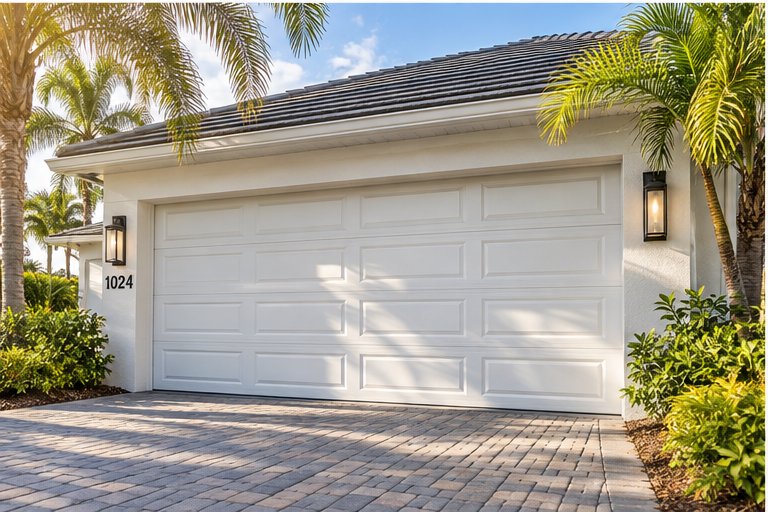
Why the material matters more near the coast
A garage door is the largest moving part of most houses. It faces the weather every day, and in Melbourne that means strong sun, daily humidity, salt carried inland on the breeze and the occasional tropical storm. The material you choose decides how the door handles all of that over the years.
Many homeowners pick a door by how it looks in a brochure. Looks matter, but the skin of the door also decides how often you will repaint, how the door reacts to a dent, how heavy it is for the springs to lift, and whether the panels stay straight in damp weather.
This comparison looks at four common materials: steel, aluminum, wood and composite. We keep it practical. For each one we describe what it is made of, how it ages here, what it asks of you in upkeep, and what a technician usually notices when it comes in for service.
The comparison table at a glance
The table below summarizes how the four materials compare on the questions we hear most often. Treat it as a starting point, because the exact construction of a door matters as much as the name of the material. A thin steel skin and a heavy steel skin are not the same door.
| Material | Durability | Upkeep | Insulation | Coastal suitability |
|---|---|---|---|---|
| Steel | Strong and common; can dent and can rust where the coating is scratched | Occasional washing and touch-up of scratches | Good when the panel has an insulated core | Good with a sound coating and attention to scratches and bottom edges |
| Aluminum | Light and does not rust; dents more easily than steel | Washing; frame hardware still needs lubrication | Limited unless built with an insulated backing | Good for corrosion, but the lighter skin shows impact damage |
| Wood | Handsome and repairable; can swell, split or rot if moisture gets in | Highest: sealing, staining or repainting on a schedule | Natural wood insulates a little; extra layers help | Demanding in humid, salty air unless kept sealed |
| Composite | Resists rot and splitting; quality varies by construction | Low to moderate; occasional refinishing | Often built with a core that insulates | Generally good because moisture does not swell the skin |
Steel doors
Steel is the most common garage door material in the country, and for good reason. A steel panel is strong for its weight, it holds paint well, and it can be formed into raised panels, flat panels and carriage house looks. Most sectional doors that come into our service calls are steel.
Quality varies mostly by thickness and by the coating. A thicker skin resists dents better, and a sound zinc or paint coating protects the metal from moisture. Steel doors are often made as a sandwich, with a layer of insulation between an outer and an inner skin, which also stiffens the panel.
The weakness of steel is what happens when the coating breaks. A scratch from a bicycle handlebar or a bump from a trash bin can expose bare metal, and in humid coastal air that spot can start to rust. Small touch-ups early are far easier than repairs later.
How steel behaves in humidity and salt
Steel handles Florida humidity well as long as the finish is intact. The areas that need watching are the bottom edge of each panel, the places around hinges and the bottom panel where water sits after a rainstorm. Rust tends to start low and creep up.
If you live close to the water in Melbourne Beach, Indialantic or the barrier island, rinse the door with fresh water now and then to take salt off the surface. It is a simple habit that helps the coating last.
What a dent means for a steel door
A dented steel panel is common after a bump from a car or a ball. Sometimes the dent is only cosmetic. If the dent is near a hinge or the crease of the panel, it can stress the section and make the door run unevenly. We look at that during a visit and explain whether a panel repair or replacement of that section is sensible.
Aluminum doors
Aluminum garage doors are usually made from an aluminum frame with panels of aluminum or glass. They are popular for modern looks, especially full view doors where the panels are clear or frosted glass set in a slim frame.
The big advantage is that aluminum does not rust. Salt air will dull the finish or leave a white powder on bare metal, but the structure is not eaten away the way unprotected steel can be. That makes aluminum attractive for homes near the water.
The tradeoff is strength. Aluminum is soft, so a bump that would barely mark steel can crease an aluminum panel. Glass panels can also crack under impact. Because the door is light, the springs are matched to a lighter weight, and that balance needs to be set correctly when glass or extra panels are added.
- Resists rust and corrosion, which suits coastal air
- Lighter than most other materials, which is easier on the opener
- Often chosen for full view and modern styles
- Dents and creases more easily than steel
- Needs an insulated backing if the garage is used as a workspace
Wood doors
Real wood doors have a warmth that no other material copies. Cedar, redwood and similar species are often used, and a wood door can be built to match a historic or custom home. Wood is also the most repairable material in one sense: a damaged section can often be patched or replaced and refinished.
The cost of that beauty is upkeep. Wood moves with moisture. In a humid climate it swells in the wet season and shrinks in dry spells, and that movement can pull joints apart and make the door bind in the tracks. Finish that is allowed to wear thin lets water in, and from there rot and insects are possible.
Wood is also heavy. A heavy door needs the correct spring size and a properly set balance, which is one reason we never guess at springs. If you own a wood door and the opener strains, the first thing we check is balance.
Who wood suits
Wood suits owners who enjoy maintenance and want a specific look. A covered entry that keeps rain off the door helps a great deal. Wood is a harder fit for a south or west facing door in full sun with no overhang, because sun and rain both attack the finish.
Upkeep a wood door asks for
Plan on checking the finish each year, especially the bottom edges and the end grain of each panel. Re-sealing before the finish fails is much easier than repairing a panel that has already absorbed water. Keep sprinklers pointed away from the door.
Composite doors
Composite is a broad word. Most garage doors sold as composite use a steel frame with a wood fiber or resin composite skin, or a molded composite surface built to look like wood grain. The idea is to give the look of wood without the rot and splitting.
Because the skin is a manufactured material, it does not swell and crack the way real wood can. Good composite surfaces hold their shape in humid weather and take paint or stain well. They are usually built with an insulated core as well.
The quality range is wide. Some composites are excellent and others are thin imitations that fade or peel. Ask what the skin is made of, how it is attached to the frame and what the finish needs. A technician looking at the door in person can often tell the difference within a few minutes.
Durability compared
For raw durability, steel and well built composite generally lead for everyday knocks and weather. Steel resists impact, composite resists moisture, and both hold up to years of daily cycling when the hardware is maintained.
Aluminum is durable against corrosion but not against impact. Wood is durable only when it is kept sealed and dry, and it is the material most likely to need repair work as time goes on.
One point applies to all four: the door skin is only part of the story. Springs, cables, rollers and hinges wear out on a schedule that depends on how often the door is used, not on the panel material. A beautiful door with tired hardware still gives trouble. Our guide on how long garage door springs last explains that side of ownership.
Upkeep compared
Upkeep is where the four materials separate most. Steel and composite ask for little: wash the door, look for scratches, touch up bare spots and lubricate the moving parts. Aluminum asks for similar care, with the added caution to avoid impacts.
Wood asks the most. A wood door needs a finish that is checked and renewed on a schedule, and it benefits from a covered location. If you are not prepared to do that work or pay for it, wood can become a source of frustration.
Whatever the material, moving parts need attention. Rollers, hinges and springs benefit from the routine described in our garage door lubrication guide, and a periodic maintenance and tune-up visit catches wear before it becomes a breakdown.
Insulation and temperature
Insulation is usually a feature of how a door is built, not of the material name. Steel and composite doors are commonly sold with a polystyrene or polyurethane core between two skins. Aluminum doors can be built with an insulated backing, though many are not. Wood gives some natural resistance to heat flow but not much compared with a foam core.
In Melbourne the main goal of insulation is to keep summer heat from pouring into the garage, which matters if you have a workshop, a laundry area or living space above or behind it. Insulation also dampens sound and makes the panel stiffer.
If you are weighing a door with a core against one without, our page on insulated and non-insulated doors goes into what changes and what does not. For a broader explanation, see garage door insulation explained.
Coastal and storm suitability
Coastal suitability is the question most Space Coast owners should ask first. Steel and composite both do well if the finish is sound. Aluminum handles salt well but is softer against flying debris. Wood is the hardest to keep in good shape in salt and humidity.
Storm performance is a separate matter from material. Wind loads are carried by the way the door is reinforced, the track mounting and the fasteners, not just by the skin. Doors in wind-prone areas are often built with added bracing, and local building rules decide what is required for a replacement.
For a fuller discussion, read our guides on garage doors in a coastal climate and wind and building rule basics. If you want a door looked over before the season, our hurricane season garage door service covers that.
Weight, springs and the opener
Every material has a different weight, and the weight decides which springs the door needs. A steel door with a foam core is heavier than a bare steel door. A wood door is heavier still. A light aluminum door is lighter, but adding glass changes the number again.
Springs are set so that the door nearly balances itself. When a door is heavier than its springs were chosen for, the opener works harder and wears out sooner. When springs are too strong the door can fly up. This is why a door swap should never be treated as only a cosmetic change.
Springs and cables carry dangerous tension. We do not advise owners to adjust them. Our technicians match spring size to the actual door and set the balance on site. You can read how this works in our guide to garage door weights and balance.
Looks, styles and finishes
Each material offers a different range of looks. Steel comes in raised panel, flat panel, long panel and carriage house styles, with painted finishes or wood-grain prints. Aluminum leans toward modern and full view designs. Wood offers true grain and custom shapes. Composite aims for the wood look with lower upkeep.
Color matters in the Florida sun. Dark colors absorb heat and can fade sooner, while lighter colors are gentler on the finish. Some neighborhoods also have association rules for door colors and styles, so it pays to check before ordering.
If appearance is the main driver, read our pages on garage door styles and curb appeal and HOA rules and garage doors before you decide.
Choosing by situation
It helps to match the material to your real situation rather than to an ideal. The short list below reflects what we most often see on the Space Coast.
- Home on the barrier island or near the river: steel with a sound coating, or composite, with regular rinsing
- Modern home that wants glass: aluminum full view, with care around impact
- Historic or custom home with a covered entry: wood, if you accept the upkeep
- Rental or investment property: steel, because it is forgiving and easy to service
- Workshop or garage used in summer: an insulated steel or composite door
- Busy household with kids and bikes: steel or composite that tolerates knocks
When repair beats replacement
Many material questions come up only because a door has started to give trouble. Before you commit to a new door, it is worth asking whether the door needs replacing at all. A broken spring, a worn roller or a bent track does not mean the panels are finished.
If the panels are in good shape and only the hardware has failed, repair is usually sensible. If several panels are damaged, the door is rusted through or the sections no longer line up, replacement may be the better path. Our page on repair or replace sets out the factors, and the guide on repair or replace your garage door walks through examples.
When a technician looks at the door, they will explain what they find and what the options are. We do not push toward a new door when a repair will do.
What to do next
If you are choosing a material, take a few minutes to look at the doors around your neighborhood. Notice which ones look good after several summers and which ones show rust, peeling paint or sagging panels. Local experience is a good teacher.
If you are replacing a door, think about the wind rules that apply, the weight the springs must handle, the opener you already have and how you use the garage. Those details matter more than the sample swatch.
When you are ready, our new garage door installation page explains how a visit and installation work, and you can contact us to have a door looked at and the options explained.
Questions and answers
There is no single answer, because construction matters as much as material. Well made steel with an intact coating and good composite both hold up well to humidity and sun. Aluminum resists corrosion but dents more easily. Wood can last a long time only with steady sealing. Hardware wears on its own schedule, so regular maintenance matters for every material.
Steel can rust where the coating is scratched or worn, especially along bottom edges where water collects. A sound finish protects it well. Rinsing the door with fresh water now and then removes salt, and touching up scratches early keeps small spots from spreading. A technician can check the lower panels during a service visit.
Aluminum does not rust, so salt air is less of a worry for the structure. The tradeoff is that the metal is soft and glass panels can crack from impact. If you like the modern look and can protect the door from knocks, it is a reasonable choice. We check balance carefully because light doors are sensitive to spring size.
Not always, but they ask for more care. Humidity makes wood swell and shrink, and a worn finish lets water in. A covered entry and a regular resealing schedule help a lot. If you want the look and accept the upkeep, wood can work. If you want little maintenance, steel or composite is easier. Whichever you choose, the door is only as good as its hardware and upkeep.
Most are built from a steel frame with a skin of wood fiber, resin or a molded composite that imitates wood grain, often over an insulated core. The skin does not swell like real wood. Quality varies, so ask what the skin is and how the finish is protected before choosing one. We can look at a sample and tell you how it is built.
Yes. Springs are sized to the weight of the door, and each material and construction weighs something different. Adding insulation, glass or heavier panels changes the number. Springs and cables are under dangerous tension, so we set the size and balance on site and advise owners not to adjust them themselves. Please leave springs alone and let a technician handle them.
If the garage is used as a workshop, laundry area or storage for items that dislike heat, an insulated door helps keep summer heat down and makes the door stiffer and quieter. If the garage is only for parking, the benefit is smaller. Our insulation comparison page explains what changes and what does not. Walls, roof and seals also matter to the result.
Sometimes. If the damage is limited to one or two sections and the door model is still available, a panel replacement can work, though color and finish may not match older panels perfectly. If several sections are damaged or rusted, a new door often makes more sense. We explain the options after looking at the door.