
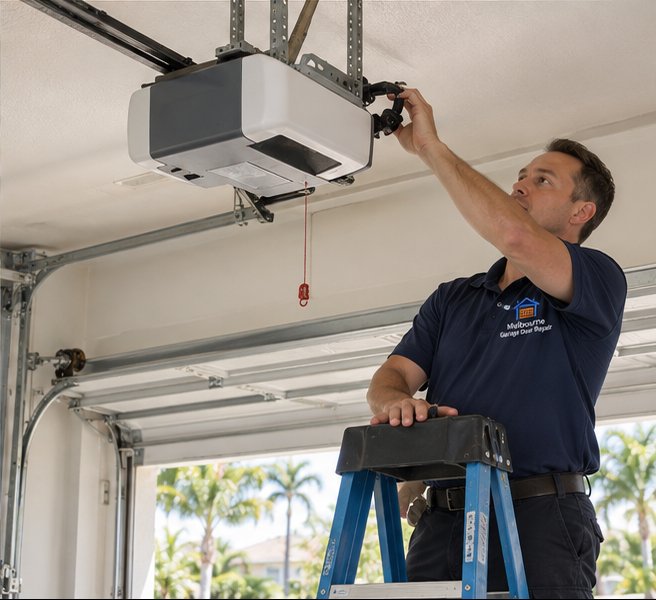
What the drive system is
Inside the power head of an opener, an electric motor spins. That spinning has to become a straight pull along a rail above the door. The part that makes this conversion is the drive system, and it is the main thing that separates one opener family from another.
A trolley rides along the rail and connects to the top of the door through an arm. When the drive moves the trolley toward the door, the door closes. When it moves the trolley the other way, the door rises. Everything else, from the remote to the sensors, is control and safety around that single motion.
Chain drive: the long-standing workhorse
A chain drive uses a metal chain, similar in spirit to a bicycle chain, that loops along the rail and pulls the trolley. It has been used for decades, and technicians know it well. Parts are widely available, and repairs are straightforward.
Its drawback is sound. Metal links running over a sprocket produce a clatter, and the vibration can travel through a ceiling into rooms above. Many people never mind this in a detached garage. In an attached garage with a bedroom overhead, it can become the main complaint.
Chains also vary in construction. Some are plain steel, others are coated or tempered to resist wear, and the sprocket that the chain rides on can be metal or a hardened plastic. These small details change how long the drive runs quietly, so ask which parts a given model uses.
Strengths of a chain drive
Chains are durable and tolerate heavy doors well. The design is simple, familiar to every technician, and generally forgiving of small imperfections in alignment.
Weak points to watch
A chain can stretch over time and begin to sag along the rail, which adds slap and noise. Dry links make more sound, and a chain that jumps the sprocket needs attention. Our page on a chain that jumped or a belt that slipped describes what that looks like and what a technician checks.
Belt drive: the smoother, quieter option
A belt drive replaces the chain with a toothed belt, usually reinforced with steel or fiber strands. Because rubber-like material glides over the pulley instead of metal rattling over metal, the sound is noticeably softer and the vibration is lower.
Belt openers are popular in homes where the garage is attached and shares walls or ceilings with living space. They often pair with soft start and soft stop features, so the entire cycle feels gentler on both ears and hardware.
In a warm region the belt's condition deserves a seasonal glance. Heat does not harm a belt overnight, but years of warmth can stiffen it. A belt that looks glazed, frayed or cracked should be replaced before it breaks, since a snapped belt leaves the door disconnected from the drive.
Strengths of a belt drive
Quiet running is the headline benefit. The belt has no metal to grind, needs little lubrication along its length, and tends to move with a smooth, even feel.
Trade offs to know about
Belt units can cost more at purchase, and a belt that is damaged or worn must be replaced rather than tightened. Over a long period a belt can lose elasticity, so occasional inspection is sensible, especially in a warm climate.
Screw drive: a threaded rod and few moving parts
A screw drive uses a long, threaded steel rod running the length of the rail. A traveling nut rides along the thread and carries the trolley. With only one major moving element, the mechanism is compact and relatively simple.
Screw drives move steadily and need less rail length to work, which can help in garages with tight headroom. They do require occasional lubrication of the rod, and the sound has a distinct mechanical character that some people like and others find noticeable.
Because the nut travels along a rigid rod, there is no stretch to take up, and the trolley position stays consistent from cycle to cycle. That steadiness is why some owners prefer it for lighter doors. Heavy doors are usually better served by a chain or a robust belt model.
- Few moving parts compared with a chain or belt
- Steady, even travel along the rail
- Lubrication of the rod is part of upkeep
- Can be sensitive to wide temperature swings
Direct drive: motor and trolley as one
A direct drive opener places the motor on the trolley itself. The motor travels along a stationary chain, and there is only one major moving part in the entire system. This arrangement tends to be very quiet because the motor is not turning a long chain or belt.
Direct drive units are less common in homes than the three other types, and servicing them can require parts specific to the model. A technician can tell you whether one suits your garage and whether parts are practical to obtain locally.
One caution is availability. Parts for less common designs may take more effort to find, and fewer technicians may stock them. If you like the idea of direct drive, ask who services it locally and what a typical repair involves before you commit.
Jackshaft and wall-mount openers
A jackshaft opener, also called a wall-mount or side-mount opener, takes a different approach. Instead of pulling the door along a rail, it mounts beside the door and turns the torsion shaft directly. There is no rail above the door at all.
This frees the ceiling for storage, lifts or full-height doors, and it can be very quiet. It also depends on the door having a suitable torsion setup and enough room at the side. A technician can look at your door and say whether a jackshaft opener is realistic. Our page on how a garage door works explains the torsion shaft that these openers rely on.
Side-by-side: how the drives compare
The table below sums up typical behavior. Actual performance varies by model, so treat it as a starting point for conversation with a technician rather than a final answer.
| Drive | Noise level | Upkeep | Typical fit |
|---|---|---|---|
| Chain | Noticeable rattle | Chain care and tension checks | Detached garages and workshops |
| Belt | Soft and low | Occasional belt inspection | Attached garages near living space |
| Screw | Mechanical hum | Rod lubrication | Tight headroom and simple layouts |
| Direct drive | Very quiet | Model specific parts | Homes wanting minimal moving parts |
| Jackshaft | Quiet | Check of torsion hardware | Garages needing ceiling space |
How the drive meets the door
However the trolley is driven, it connects to the door through an arm and a bracket at the top section. This joint takes a lot of stress with each cycle. A cracked bracket or a loose arm can mimic a drive problem, so a technician looks at the connection when diagnosing noise or hesitation.
The drive also depends on a door that moves freely. If the track is bent, rollers are worn or the springs are out of balance, any drive type will strain. Our page on belt, chain and screw drive opener service describes what upkeep looks like for each type in practice.
Climate and the Space Coast
Heat, humidity and salt air affect every part of a garage. Metal parts can corrode near the coast, lubricants can thin in heat, and rubber or belt materials age with prolonged warmth. The drive type does not change this, but it influences which parts you will want to check.
A chain should be kept lightly lubricated and without rust. A belt should be inspected for cracks or fraying. A screw rod should be kept clean and lubricated. Whatever you choose, a seasonal look at the rail, the trolley and the arm is a small habit that pays off over the life of the opener.
Moisture also gets into wall controls, sensors and wiring connections. A drive that runs well can still act up because of a corroded terminal at the sensor or a damp connection in the power head. When a symptom seems mysterious, the cause is often not the drive at all, and a technician will check the whole system before replacing anything.
Matching drive type to your garage
Layout is usually the deciding factor. If a bedroom shares the wall or sits above, put quiet near the top of your list. If the garage is a workshop away from the house, durability and cost may count for more than sound.
Think about the door as well. A heavy insulated double door suits a robust drive with plenty of strength. A light single door has more freedom. Our broader buyer's guide, how to choose a garage door opener, ties drive type together with motor size, features and safety.
Budget and expectations matter too. Some households want the quietest possible machine and accept the extra outlay. Others want something dependable and easy to repair. Either view is reasonable, and a straight conversation about how you use the garage usually points to an answer.
An attached garage with a room above
A belt or direct drive with soft start and stop makes the most sense, because less vibration reaches the structure above.
A detached garage or workshop
A chain drive is a practical, durable choice. Noise is less important, and ease of service often counts for more.
A garage with limited headroom or heavy storage overhead
A screw drive with a compact rail, or a jackshaft opener, may fit where a conventional rail would not.
Myths about drive types
A few ideas about drives circulate widely and deserve a gentle correction. One is that a belt drive is weaker than a chain. Belts in residential openers are reinforced and handle ordinary doors comfortably, so strength is rarely the issue when the door is balanced.
Another is that a quiet opener means a healthy door. Sound depends on the drive, but also on rollers, hinges, track alignment and balance. A quiet drive can hide a door that is quietly wearing out, which is why a regular visual check is still worthwhile.
A third myth is that a drive can make up for an unbalanced door. It cannot. The springs carry the weight, and any drive asked to compensate for weak springs works harder and fails sooner.
How drives behave during a power outage
When the power goes out, the drive type does not change the basic rule: pull the manual release, and the door can be moved by hand. The release disconnects the trolley from the door arm, so the door is no longer tied to the drive.
What differs is how pleasant that experience is. A door that is properly balanced moves smoothly by hand with any drive type. A door that is out of balance feels heavy or drifts, and that is a sign that the springs need a professional look. Our page on using the manual release during a power outage covers the careful way to do it.
- Pull the release only with the door fully closed when possible.
- Lift or lower the door slowly and with both hands in a safe position.
- If the door feels very heavy or drops, stop and call for help.
- Re-engage the trolley carefully once power returns, following the owner's manual.
A look at limits and force settings
Every drive family has settings that tell the opener where the door should stop at the top and bottom, and how much force it may use. These travel limits and force settings are adjusted at installation and checked during service.
If the door stops short, reverses on its own, or presses hard against the floor, the settings may need a technician's attention. Resist the urge to turn them up to overcome a problem. Higher force can defeat the safety reversal and put people and property at risk.
Why higher force is not the answer
A door that seems to need more force usually has a mechanical problem such as a bind, a worn roller or weak springs. Raising the setting hides the symptom and removes a layer of safety.
What a technician checks
A technician checks the travel limits, tests the reversal on contact and confirms the sensors respond. These checks take only a short while and are part of any careful opener service.
Upkeep by drive type
Every opener benefits from a seasonal look, but the details vary. The list below is a general guide, not a replacement for your owner's manual.
- Chain: look for rust, sag and dry links, and listen for slapping.
- Belt: look for cracks, fraying, glazing and unusual noise at the pulley.
- Screw: look for dry or dirty thread and listen for grinding.
- Direct drive: check the trolley movement and the stationary chain for wear.
- Jackshaft: check the shaft hardware and look for cable or drum wear, from the floor only.
What not to do when something sounds wrong
If a drive is making noise, hesitating or skipping, the safest approach is to stop using it and have it looked at. Do not try to adjust springs, cables or the brackets that hold them, and do not stand under a door that is moving unevenly.
A simple look from the floor is fine. Notice whether the chain or belt hangs loose, whether the door is level, and whether any parts are visibly cracked. Then disconnect the opener with the release and call for help. Our guide on garage door safety tests lists checks that are safe for a homeowner to perform.
Repair or replace when a drive wears out
Drive parts are sometimes replaced on their own. A stretched chain, a worn belt or a failing trolley can be swapped without replacing the whole opener, especially on a unit that is otherwise sound.
Age and availability of parts matter. If the opener is old, uses outdated remote technology or lacks current safety features, replacement can make more sense than repeated repair. Our page on garage door opener replacement explains how that decision is approached.
Questions and answers
Lifespan depends more on the quality of the unit, the balance of the door and the upkeep it receives than on the drive type alone. Chain drives are known for durability, belts for smooth wear, and screw drives for simplicity. A well balanced door and regular lubrication help any drive reach a long working life.
In general, yes. A reinforced belt avoids the metal-on-metal rattle of a chain, so there is less sound and less vibration passed into the structure. Motor hum and door movement still make some noise, so the difference depends on your layout and how well the door itself is maintained.
Usually not as a simple swap. Drive type is built into the model, so changing means changing the opener. In some cases a rail kit or parts of the same family can be exchanged. A technician can check your unit and tell you what is practical, and whether replacement is the more sensible route.
It suits garages where you want an open ceiling, such as ones with tall storage or a vehicle lift, and it can be very quiet. It depends on the door having a suitable torsion shaft and enough side room. A technician can check whether your door and layout allow it.
Coastal air affects metal parts on every drive, so chains and screw rods benefit from lubrication and rust checks, while belts should be looked over for cracks and wear. No drive type is immune, so a seasonal inspection and clean, dry hardware matter more than the specific design.
A little sag is normal, but a chain that hangs low, slaps the rail or jumps the sprocket needs attention. Stop using the opener if the door moves unevenly, use the manual release, and have a technician check it. Do not touch springs or cables while investigating the cause.
Smart control is usually a feature of the opener model rather than the drive type. Chain, belt and screw drive models can all be found with network connectivity, while some older units cannot. Check the model's feature list and ask a technician which suits your door and how it connects to your home network.