
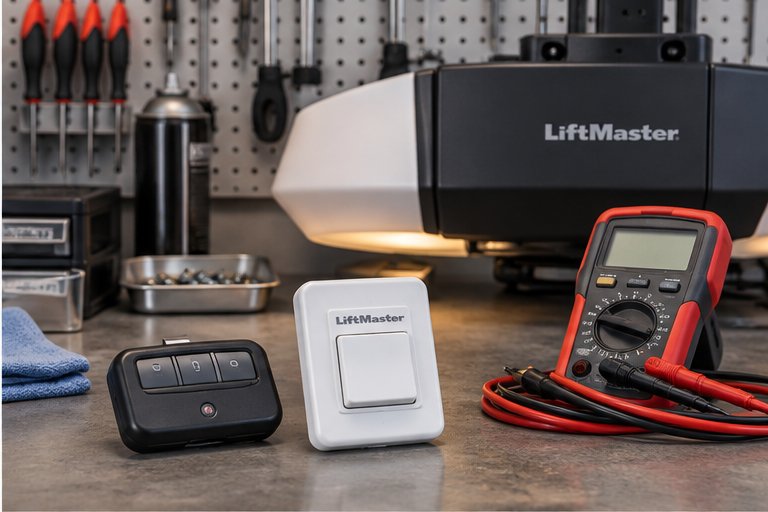
Why an on-and-off problem is harder than a dead opener
When an opener is completely dead, there is usually one clear fault. When it works some of the time, the fault is marginal. A signal is just weak enough to be lost now and then, a connection is just loose enough to separate when the garage vibrates, or a setting sits right at the edge of what the door needs.
That is actually useful information. It means the equipment is mostly sound and the fault is something that changes: a battery that is fading, a wire that moves, a sensor beam that wobbles, or a nearby device that switches on and off.
This page walks through the main groups of causes, shows what you can safely check, and explains where a technician needs to step in. The key is to notice patterns, so start keeping notes. Think about what else has changed in the garage lately. A new freezer, a battery charger left plugged in overnight, a workshop tool, a new smart doorbell or a set of string lights can each add electrical noise or load. Unplug the suspect for a few days and see whether the opener settles. Changes that seem unrelated are exactly the ones that tend to be forgotten when we are asked what is different.
Start by noticing the pattern
Intermittent faults repeat under certain conditions, even if you cannot see them yet. Pay attention to what is different when it fails. Is it the remote, the wall button or both? Is it only in the morning, in the evening, or after rain? Is it only when the car is a certain distance away? Does it help to press twice?
Write the answers down for a week. A pattern that looks random after three failures often becomes clear after ten.
| What you notice | Area to look at | Who handles it |
|---|---|---|
| Remote fails, wall button always works | Remote battery, range, interference, receiver | Owner checks battery; technician for the receiver |
| Both remote and wall button fail | Power, sensors, opener logic or limits | Technician |
| Fails more in the afternoon or after rain | Moisture in a connection, sensor alignment | Technician |
| Light blinks and door will not close | Safety sensors | Owner can look; technician repairs |
| Works only when close to the door | Weak battery or interference | Owner checks battery; technician for range |
| Fails when other equipment is running | Electrical noise or a shared circuit | Technician or electrician |
Remote batteries and weak signals
The most common reason for an on-and-off remote is a fading battery. A coin cell can still light the indicator while no longer sending a strong signal. The remote then works at close range and fails from the street.
Try a fresh battery of the correct type before looking for anything else. Check the contacts inside the remote for corrosion, and make sure the battery sits firmly. Keep the old remote away from keys and coins, which can press the button in a pocket and wear the battery out.
If a new battery helps only briefly, the remote itself may be failing. See our page on a remote that is not working for further steps, and programming garage remotes and keypads for general information on pairing.
- Replace the battery with the correct type and fit it firmly
- Look for green or white corrosion on the contacts
- Compare behavior with a second remote if you have one
- Check whether the wall button works every time
- Avoid leaving the remote in a hot car where heat can drain it
Radio interference around the garage
Remotes and openers communicate by radio. Anything that adds noise on or near the same frequency can drown out a weak signal. Neighbouring openers, security systems, LED lighting, some chargers and even nearby cell equipment can all play a part.
A hint of interference is when failures cluster at certain times, such as when a neighbor leaves for work or when a particular light is on. Another hint is that the problem moves with your location. The remote works at the end of the street but not at your driveway.
Poorly shielded LED bulbs in the opener light socket are a well-known culprit, because some emit radio noise that blocks the receiver. If the trouble started after a bulb change, try the original type. Our page on an opener light that flashes covers the light itself.
Checking the antenna
Most openers have a short wire antenna hanging from the motor unit. If it has been bent, tucked behind a bracket, cut, or covered by stored items, range suffers. Leave it hanging straight down and clear. Do not cut it.
When the receiver is at fault
If the antenna is clear and batteries are new, a failing receiver board may be responsible. That is a technician's check, since it involves the opener's logic circuitry.
Power supply and outlet problems
An opener that gets power in fits and starts will behave the same way. A loose plug, a worn outlet, an overloaded circuit or a tripped ground fault protector can all interrupt power briefly. If the opener's display or lights flicker when it fails, power is the first suspect.
Check that the plug sits fully in the outlet and that nothing else heavy is on the same circuit. Garages often share a circuit with a freezer, a workbench or a charger. When a compressor starts, the voltage can dip enough to confuse the opener.
Surge protectors and extension cords are not recommended for openers. They add resistance and can fail without warning. If you suspect the outlet, an electrician should look at it. Do not open the opener housing yourself.
- Plug seated fully and snug in the outlet
- No extension cord or loose power strip in the path
- Ground fault outlet not tripped
- No heavy appliance sharing the same circuit
- Opener lights steady rather than flickering when power is on
Safety sensors that lose alignment
Two small sensors sit near the floor on either side of the door. They send an invisible beam across the opening. If the beam is interrupted, the door will not close and may reverse. If the beam is weak or misaligned, the door may close on some presses and refuse on others.
Sensors drift out of alignment when the brackets are bumped, when the garage vibrates, or when the mounting loosens. Dirt, spider webs and sunlight hitting the lens can also interfere. A beam that is borderline will work in the morning shade and fail in afternoon glare.
Our page on safety sensor repair describes what we check. Safe things you can do yourself: wipe each lens with a soft cloth, look for webs or leaves, and see whether the indicator lights on each sensor stay steady.
What the sensor lights tell you
Steady lights on both sensors usually mean the beam is aligned. A blinking or dim light on one sensor suggests the beam is not landing squarely. If a light is off entirely, wiring or power to that sensor may be the issue.
What not to do
Do not bypass the sensors or tape them. They exist to protect people, pets and vehicles. A door that closes without working sensors can injure someone.
Loose or damaged wiring
Low-voltage wires run from the opener to the wall control and to each sensor. Staples can pierce them, door vibration can chafe them, and rodents or insects can chew them. A wire with a partly broken conductor works when it touches and fails when it moves.
This is a classic cause of intermittent behavior. The door works when the day is cool, fails when the wire shifts, and recovers as soon as you wiggle something. The fault can sit at a terminal, along the cable, or inside the wall button.
Look along the visible wire for kinks, crushed spots or stripped insulation, without pulling on it. If anything looks damaged, leave it for a technician. Our page on a wall button that is not working covers the control side of the circuit.
- Wires pinched behind brackets or door tracks
- Staples driven through the insulation
- Terminals that look green, dusty or loose
- Insect nests inside the wall control or sensor housings
- Signs of chewing near the floor or ceiling
Limit settings and force settings at the edge
The opener has settings that tell it where the door is open and closed and how much resistance to accept. If those are set close to the limit, a small change in friction can make it stop or reverse. A door that was fine in dry air may stall in humid weather, and a door that was fine yesterday may stall today after a few degrees of temperature shift.
The symptom is usually a door that starts moving and then stops, or one that reverses before it reaches the floor, but it can also look like an opener that simply does nothing. Because the problem is borderline, the door may work for days and then fail.
Adjusting limits and force is a routine task for a technician and involves no spring work. Still, a door that needs a force increase to close may have a mechanical problem that should be fixed, so we look at the door itself. See a door that reverses before closing for more on that angle.
The door itself: balance and friction
An opener works against a door that should be nearly weightless when balanced. If the springs have weakened or the tracks have friction, the opener works harder than it was designed to. The motor then trips on its thermal protection or the logic stops it, and the door seems to work only sometimes.
You may notice that the opener is worse after several cycles in a row, or on hot afternoons, then recovers after a rest. That is a classic sign of a motor working near its limit.
Springs and cables hold dangerous tension. Do not adjust them, and do not test balance by lifting a door that feels very heavy. A technician can check balance safely. Our guide to garage door safety tests describes tests that are suitable for homeowners and which ones to avoid.
Heat and thermal protection
Many openers include a thermal cutout that stops the motor when it overheats. If your opener quits after several cycles and works again after a rest, mention that clearly. It points to a door that is demanding too much effort.
What you can safely check yourself
These checks involve only looking, listening, cleaning and swapping a battery. Keep clear of the door while it moves, and do not reach near the springs, cables or the brackets at the bottom corners.
- Replace the remote battery and try again from different distances
- Press the wall button and see whether the door responds every time
- Look at the opener lights and sensor lights when it fails
- Wipe each sensor lens and look for webs or leaves
- Check that the opener plug is firmly seated
- Make sure the antenna wire hangs straight and is not covered
- Write down times, weather and what you saw
Stop points
If the door starts to close and then stops halfway, hangs crooked, makes a bang, or feels heavy when released, stop and keep clear. If anyone is hurt, call 911.
How we track down an intermittent fault
We begin by asking what you noticed, because the pattern guides the search. Then we test the remote and wall control, watch the opener lights, check power at the unit, and examine the sensors and wiring. We also operate the door through several cycles to see whether the symptom appears.
Next we disconnect the opener and move the door by hand. A door that is balanced and moves smoothly points the search at the opener or its signals. A door that drags or drifts points to the door.
Afterward, we explain what we found and what the options are. For the general flow of a visit, see what happens during a service visit.
Repair options in plain terms
The fix depends on the cause. A fading battery means a new battery. A misaligned sensor means realignment or a new bracket. A damaged wire is repaired or replaced. A weak receiver can be replaced or the opener upgraded. Limits and force are adjusted. A door with friction or balance trouble gets those problems corrected.
When an opener is older and has several marginal parts, replacement may be more sensible than repairing one fault after another. Our page on garage door opener repair describes the repair route, and the choice between repairing and replacing is covered on the opener replacement page.
We lay out each route without pressure, and the decision is yours.
- Remote and keypad battery and pairing work
- Sensor cleaning, realignment or replacement
- Wiring repair at terminals or along the run
- Receiver or logic board replacement
- Limit and force adjustment
- Door balance and friction correction
- Opener replacement when multiple parts are worn
Why intermittent faults should not be ignored
It is tempting to live with an opener that works most of the time. The trouble is that marginal faults rarely stay marginal. A sensor that fails sometimes will one day fail when something is in the path. A door that stalls under load is working a motor near its limit. A wire that connects intermittently may eventually short.
There is also a security angle. An opener that fails to close the door fully, or that leaves it half open overnight, leaves the garage exposed. Check that the door has actually closed before you leave or go to bed.
A small repair now is usually kinder to both the door and the opener than waiting until the fault becomes permanent.
Planning for a visit
When you get in touch, share your notes: what fails, how often, at what time of day, and in what weather. Mention whether the remote, the wall button or both are affected, and whether the lights on the opener or the sensors behave differently when it fails. A short video of a failing cycle, taken from a safe spot, can be very useful. A smartphone makes this easy. Take a simple photo or short video when it fails, and note the time on the screen. Capture the opener lights, the sensor lights and the position of the door. Those few seconds of evidence can save a long conversation later and often show something you did not notice while it was happening.
Please clear the area around the opener and the door, and keep children and pets away from the opening while the door is being looked at.
We will explain what we find and what the options are. Our contact page shows how to reach us.
Questions and answers
The fault is usually marginal: a fading remote battery, a weak signal, a sensor beam that is slightly off, a loose wire, or a setting near its limit. Noting when it fails, and whether the remote, the wall button or both are affected, helps narrow the cause.
Yes. Some LED bulbs give off radio noise that interferes with the opener receiver and cuts the range of the remote. If the trouble started after a bulb change, try a bulb of the original type and see whether the range returns.
It suggests the opener and door are fine and the problem is in the remote, its battery, its pairing or the receiver. Try a fresh battery first. If that does not help, the remote may need reprogramming or replacing, or the receiver may be weak.
No. Sensors protect people, pets and vehicles from a closing door. Bypassing or taping them is dangerous. If sensors work only sometimes, wipe the lenses and look for obstructions, then let a technician realign or replace them.
No. It may mean the motor is overheating because the door is heavy, out of balance or dragging, or because the opener is worn. Do not keep pressing the button. Springs hold dangerous tension, so a technician should check balance and the opener.
A visibly loose low-voltage wire at a terminal is something only a careful, experienced person should handle, and never with the power on. For anything involving the opener housing, damaged insulation or unclear connections, leave it for a technician or an electrician.