
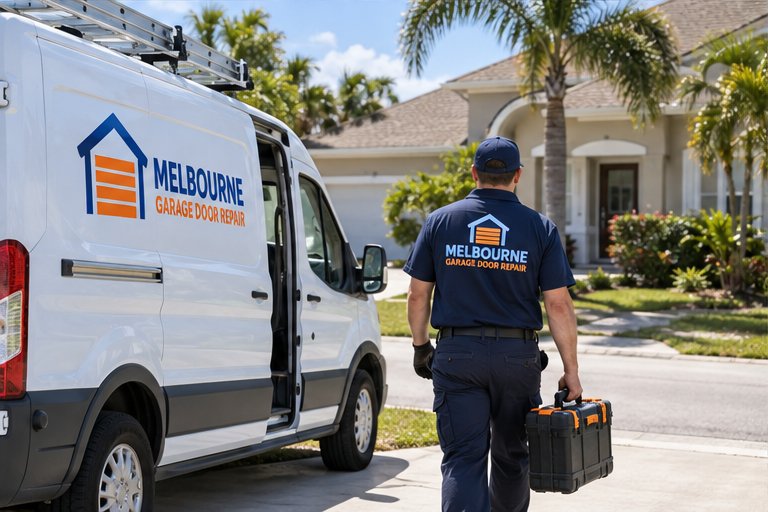
A town where the garage often stands alone
Grant-Valkaria lies in the southern part of Brevard County, close to the Indian River County line. Its character is rural: large lots, long frontage, plenty of trees and a lot of buildings that stand apart from the house.
A detached garage is a small piece of architecture in its own right. It has its own slab, its own roof, often its own power feed, and a door that may be used by one person for one purpose. That makes it easy to forget until it fails.
This page is written for people who own that kind of building. It describes what tends to go wrong, what you can safely look at, and what we do when we visit.
Lot size changes how people live with a garage. When the building is a walk from the house, the door gets used in different ways: opened for a delivery, left up while someone works in the yard, closed by habit at night. These patterns matter, because a door left raised for hours puts a different kind of wear on the opener than one that cycles all day.
Questions to ask before you call anyone
A few questions, answered before we arrive, make a visit more useful. You do not need to be an expert. You only need to describe what you see and hear, as you would to a friend who knows a bit about doors.
- Does the opener respond at all, or is it silent?
- Does the motor run but the door stay put?
- Does the door move a little and then stop, or reverse?
- Is anything visibly bent, frayed, loose or out of its track?
- When did the problem begin, and did a storm, a vehicle or a power cut come just before?
Why the timeline matters
Garage doors tend to fail in a sequence. A roller wears, then a hinge loosens, then the door rubs, then something bends. Knowing when the first sign appeared often points us straight to the cause.
Sizing the door to the building
Because a detached building is often put up for a purpose, the door tends to be chosen for that purpose. A single wide door may serve a truck and trailer. A pair of narrow doors may serve two cars and a mower. A tall door may be there for a boat with a tower.
When we are asked to replace or repair a door like that, we measure the opening and the headroom, check the side room and the back room, and look at what the door must clear. Hardware that is correct for a standard door can be wrong for a tall or wide opening.
Our guides to measuring for a new garage door and residential and commercial garage doors explain the terms we use, which is helpful if your building falls between the two.
The opening itself deserves a look. Framing in older outbuildings can sag, a header can bow under a roof load, and the jamb can rot at the base. A door fitted to a crooked opening will rub no matter how carefully the hardware is adjusted, so we check the structure before we decide what is wrong.
Wind, weather and an exposed building
A building standing alone on a big lot takes the wind more directly than one tucked between houses. In tropical weather, a wide garage door is one of the largest openings in any structure, and it is often the first place that wind finds.
Door hardware, tracks and panel strength all matter in a strong wind, and so does the way the track is fastened to the framing. We look at the track bracket fasteners, the condition of the panels and the stiffness of the door as a whole.
Our hurricane season page, hurricane season garage door service, describes the checks we make, and the basics of preparation are set out in garage door hurricane preparation.
Debris matters too. After a storm, roof tiles, shingles and loose boards may be sitting near the opening, and anything left leaning against the door can be pulled into the tracks when the door is next used. A walk around the building before you run the opener is a sensible habit.
Sun, heat and the finish on the door
South Brevard sun is strong for most of the year. A door facing south or west gets hours of direct heat, and the finish fades, chalks and cracks over time. A dark colored door gets even hotter.
Heat also affects what is inside. Paint and lubricants soften, plastic components become brittle, and an opener housing can reach temperatures that shorten the life of its electronics. Ventilation and shade help, and so does a door with a lighter finish.
If the door finish is breaking down, the steel beneath is exposed to humidity. Touch up damage early. Our guide to garage door colors and finishes explains what holds up and what does not.
Moisture follows heat. A door that bakes in the afternoon and gets soaked by an evening thunderstorm expands and contracts day after day, and over the years that cycle loosens fasteners and opens small gaps at the seams. We look at the edges and joints as well as the face of the door.
Woods, brush and falling branches
Mature trees near a building are pleasant, and they are also a source of risk. A heavy limb in a storm can crush a panel or knock a track out of line. Smaller debris builds up on the roof and in the gutter and finds its way to the opening.
After a storm, take a good look at the door from a safe distance. If a panel is dented, a track is bent, or the door sits crooked in its opening, do not run the opener. Running a damaged door can make the damage worse.
Our page on a garage door hit by a vehicle explains what to look for, and the same principles apply when a limb is the culprit.
Working on your own door: where to stop
Many people on larger properties are practical and capable, and they like to fix things. That is a fine habit for many parts of a garage, and a risky one for a few.
You can safely wipe sensor lenses, replace the batteries in a remote, brush debris from a track, listen to the door run, and look at the cables and springs without touching them. You can apply the right lubricant to rollers and hinges according to a reliable guide.
You should not loosen, tighten or replace a spring, cable or bottom bracket. These parts store enough force to cause serious injury, and the work needs winding bars, experience and a clear understanding of the balance. If you are hurt, call 911.
A calm approach also keeps you safe. If a door has come off its track or a cable has gone slack, the instinct is to lift it back into place. That is how fingers get caught and panels get bent. Step back, keep others away, and tell us what you see.
Power to a separate building
Opener power in a detached garage can come from a dedicated circuit, from a feeder run underground, or from an extension cord used a little too long. Each situation brings its own faults.
A tripped breaker or ground fault outlet is one of the most common causes of a dead opener. Check those first. Water in an outdoor box can also trip a ground fault circuit, particularly after rain.
Anything that involves rewiring belongs with an electrician. What we can do is test the opener, listen for signs of a failing motor or board, and describe whether the fault looks like the opener or the supply. Our page on garage door opener repair covers the way we work.
Outdoor lighting on the same circuit is worth a thought. If a floodlight or a pump shares the line, a surge or overload there can take out the opener too. Telling us what else the circuit feeds helps us understand the pattern of failures.
Repair or replace for an outbuilding
The decision to repair or replace is different for a building that holds lawn gear than for a house garage that frames the front of the home. Appearance matters less. Reliability and weather resistance matter more.
A door that is basically sound with worn parts is usually worth repairing. A door with deep rust, cracked sections, a bent frame or a history of repeated failures starts to cost more to keep than to replace.
We lay out both paths and let you choose. Our guide, repairing or replacing your garage door, has a list of signs that tip the balance.
Keep in mind that a modern replacement door is usually a better fit for a family that plans to stay a long time. A new door can be insulated, fitted with proper seals, and set up with a quiet opener, and the building feels better to be in. We are happy to describe what that would involve without any pressure to proceed.
Workshops that need temperature control
A workshop that is used in all seasons may need an insulated door. Insulation keeps the building cooler in summer and helps with noise, and a stiffer door tends to be quieter and straighter on its track.
An insulated door is heavier than a plain one. That extra weight must be accounted for in the springs, and the opener needs to be rated for the load. We handle these checks as part of any installation.
If you are thinking about it, the page on garage door insulation and window inserts explains the choices in plain terms.
Windows and ventilation are a related topic. A building that is closed up in summer can become an oven, and a door with small inserts brings in light without bringing in much heat. Whether that suits your use depends on what you do inside.
Doors that sit unused for weeks
Not every building is opened daily. Some doors rest for weeks, and a door that sits idle still ages. Lubricant dries, rollers stick, seals flatten against the floor, and insects move in.
When you finally open an idle door, expect some stiffness. Listen for scraping, and watch for the door pulling to one side. If it seems stuck, do not force it, because forcing can bend panels or tear a seal.
A short run of the door every couple of weeks keeps parts loose, and a gentle look at the track now and then lets you spot trouble early.
If a door has been idle for months, ask for a full check before you rely on it. A cable that has frayed while resting, a spring that has rusted or a track that has shifted is easier to find in a planned visit than in the middle of a job.
Remotes, keypads and gates at a distance
Where a driveway is long and a building is far from the house, range matters. Remotes that struggle at forty feet are common, and a weak battery is usually to blame. Interference from other devices can also reduce range.
A wall mounted keypad at the building helps when a remote is not in the vehicle. Some owners want a gate and a garage door on the same remote, which is a question of compatibility and one we can discuss.
Our overview of remote and keypad programming describes what we can set up and how.
A last thought on range: metal buildings can block radio signals, so a remote that works well beside a wooden garage may struggle near a steel one. Moving the antenna wire on the opener, away from metal, sometimes helps, and we can show you where it hangs.
Keeping records of what you have
When something fails on a door that was installed years ago, the first question is often what exactly is there. The label on the door, the opener's model plate and the spring size are all useful clues.
Take a photograph of each and keep it in a folder. If you ever move or sell, the next owner will be glad of it, and it also helps us if you ask us to match a part.
Our guide to reading your garage door label explains what the numbers mean.
If you are buying property here, ask the seller for any paperwork on the doors and openers. Knowing the age of a spring, the type of drive and the date of the last service helps you plan maintenance and avoids surprises in the first year.
What a visit to a Grant-Valkaria property involves
We come to the property, find the building and the door, and ask what has been happening. We look at the door from inside and out, check the hardware and the opener, and test what can be tested safely.
Then we explain the findings in plain words, with the options and what each involves. If you want to keep the door going as it is, we say what to watch for. If it needs work, we explain what and why.
We do not rush the explanation. You should leave the visit knowing what is going on with your door.
We also like to leave you with a short list of things to watch, specific to your building. That list is much more useful than a general checklist, because it reflects the way your door is actually used.
Getting in touch from Grant-Valkaria
Contact us with a short description of the door and what it is doing. Mention whether the building is attached, how big the opening is and what is stored inside.
Photos help. A picture of the door, one of the opener and one of whatever looks wrong tells us a great deal before we arrive.
Use the contact page to reach us and mention that you are in Grant-Valkaria.
Questions and answers
Yes. Detached garages, workshops and outbuildings are common in Grant-Valkaria, and we treat each as its own situation. We look at the door, hardware, opener and power feed, and we ask what the building is used for so we can explain the findings and the options clearly and in plain words. Photos of the door and the building help us plan.
Common causes are a tripped breaker or ground fault outlet, a weak remote battery, a damaged wire, or a failing opener board. Check the outlet and replace the remote battery first. If neither helps, we can test the unit and tell you whether it is the opener or the supply. A note of what else shares the circuit also helps.
No, however capable you are with tools. Springs and cables store dangerous tension and can cause serious injury. Leave winding, adjustment and replacement to a trained technician. You can safely look at them, listen to the door and clean sensor lenses, then stop there and contact us. If you are hurt at any point, call 911 and do not try to move the door.
Do not force it. Dried lubricant, stuck rollers, a flattened seal or an insect nest could be responsible. Check that nothing is in the way and that the opener has power. If the door still resists or pulls to one side, contact us and we will look at it and tell you which parts could wait.
Often, yes. Insulation reduces heat transfer and noise, and gives a stiffer, straighter door. It also adds weight, so the springs and opener must suit the extra load. We check these points during an installation and explain the options and trade offs, including what you plan to store inside. Heavier doors also need balance checked each year.
Yes. A wireless keypad can be mounted by the door, so you do not need a remote in the vehicle. Range and compatibility depend on the opener model, and a steel building can weaken the signal. Tell us the model or send a photograph of the label and we will explain what can be set up.
Look from a safe distance for dented panels, bent track, a door sitting crooked in its opening, or fallen limbs. If anything looks damaged, do not run the opener, because that can worsen the damage. Take photographs, keep children and pets away, and contact us so we can explain what is safe to do. Never lift a damaged door by hand.