
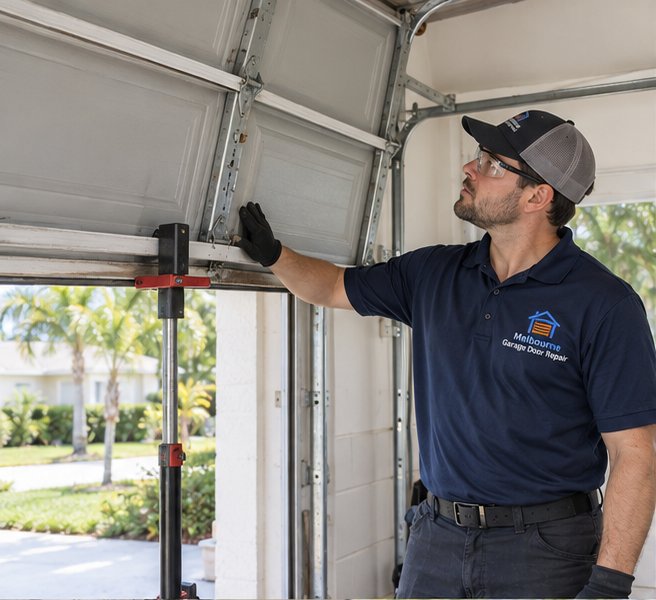
Why rust shows up so often here
Rust is what happens when iron or steel meets oxygen and moisture over time. The Space Coast supplies plenty of both. Warm, humid air, frequent rain, morning dew and a sea breeze that carries salt all work together to speed up corrosion on metal that is not well protected.
A garage door holds a lot of exposed steel: panels, tracks, hinges, brackets, springs, cables, fasteners and the shafts of rollers. Many of these parts sit at the bottom of the door, where water splashes, puddles and lingers. Others hide in corners where air barely moves, which lets moisture stay for hours after a shower.
Salt makes the process faster. Even a thin film of salt on a damp surface helps current flow between metal areas, which speeds up corrosion. This is why doors and hardware closer to the water often show trouble sooner than those inland, though humidity affects every home in the area.
Surface rust versus deep corrosion
Not all rust is equal, and the difference decides what should be done. Surface rust is a thin orange or brown film on top of otherwise sound metal. It stains and roughens the surface but has not eaten into the thickness. Deep corrosion has pitted or flaked the metal, thinning it and weakening the part.
A simple way to tell the two apart is to look and feel from a safe position. Surface rust wipes or brushes away to leave solid metal. Deep corrosion leaves pits, bubbles in the paint, flaking layers or holes. Metal that has swollen or split along an edge is a warning sign.
The table below is a general guide only. A technician has to see the part to judge it.
| Stage | What you see | What it usually means |
|---|---|---|
| Light surface rust | Orange or brown film, metal still solid | Cleaning and protection are often enough |
| Spreading rust | Patches under chipped paint, rough surface | Needs attention soon to stop it from deepening |
| Pitting | Small craters, rough or scaly metal | Part thinned; judged individually |
| Flaking or holes | Layers peeling away, holes or cracks | Part is weakened; replacement is likely |
Which parts of the door are affected
Rust can show up almost anywhere, and each location has its own consequences. Knowing where you see it helps you describe the problem and helps us decide what to check.
- The lower edge of the bottom panel, where water collects and the seal holds moisture
- The vertical tracks near the floor, where splashes and standing water reach
- The track brackets and mounting bolts, which carry loads and corrode where they meet the wall
- Hinges, especially at the bottom of the door and at the end hinges that carry the roller stems
- Roller stems and the metal shells of steel rollers
- The lift cables, particularly the lower ends near the bottom brackets
- The torsion or extension springs and their end fittings
- The opener rail, the trolley and the chain, if the opener is exposed to humid air
The bottom of the door
Water runs down the face of the door and stops at the bottom edge. If the seal is worn or the floor is uneven, it stays there. Steel at the bottom of a panel often rusts from the inside out, so a small orange stain on the surface can hide larger damage underneath.
The tracks and hardware
Tracks are made of steel and usually have a protective coating. When that coating is scratched or worn, rust starts. Because the rollers ride in the track, a rough or pitted surface adds friction and wear.
What rust does to door operation
Rust is not only an appearance matter. It changes how the door moves. Rough track surfaces increase friction, so rollers run less smoothly and the door can become noisy or jerky. Rusted hinges can seize, so panels cannot bend as they should at the curve. A rusted roller stem can bind or snap.
Corrosion on springs and cables is more serious. A spring with rust develops weak spots and tends to wear faster. Cables that are rusted at the bottom ends can fray, which is a safety concern because they carry the load of the door. We never advise owners to touch or treat these parts, and we examine them carefully on a visit.
The opener feels the effects too. A door that binds because of rusty hardware makes the motor work harder. You may hear more strain, see slower movement or notice the door stop and reverse. Over time this adds wear to the opener as well as to the door.
Early warning signs to watch for
Rust seldom appears without warning. If you know the early signs, you can act while the problem is still small. A monthly look at the door, both inside and out, is enough to catch most of them.
If you see any of these, note where and take a photograph. A change over several weeks is useful information for a technician.
- Orange or brown stains on panels, especially at the bottom
- Paint that bubbles, blisters or flakes
- Dusty reddish powder on the floor under the tracks or hinges
- Squeaks, scraping or grinding that were not there before
- Hinges that feel stiff or do not move freely
- Cables with rust at the ends or a rough, uneven look
- Brackets or bolts that look swollen or are stained heavily
Safe cleaning and light protection
A few tasks are reasonable for an owner to do from the floor, with the door closed and the opener left alone. They deal with exterior surfaces only and do not involve springs, cables, brackets under tension or anything that carries the door's weight.
- Wash the lower part of the door with mild soap and water and a soft brush, then rinse and dry
- Brush loose surface rust from the lower panel edge with a soft brush, not a wire brush on a finished surface
- Touch up chips in the paint with a suitable paint made for the door's material once the surface is clean and dry
- Wipe the visible portion of the tracks clean with a dry cloth
- Apply a light coat of a garage door lubricant to hinges and rollers according to the product directions
- Keep the floor in front of the door clear of standing water and debris
Where to stop
Do not scrub, sand or coat the springs, the cables or the brackets that hold them. Do not use a wire brush on a track while the door is operating. Do not lubricate the track surface heavily, because grease collects dust and can make rollers slip. If rust is deep, if a part looks weakened, or if you are unsure, stop and call a technician.
Lubrication: what it does and does not do
Lubrication helps in humid coastal air because it displaces moisture and reduces friction. Hinges, roller stems and the pivot points of the opener benefit from a light coating, applied sparingly. It will not repair rust that has already formed, and it will not restore a part that has been weakened.
The wrong lubricant can make things worse. Heavy grease attracts dust and sand, which sit in the track and wear the rollers. Some products dry out and leave a sticky residue. Following the directions on a product made for garage doors is the safest approach.
Our garage door lubrication guide describes which parts are usually lubricated, which are left alone, and how often a light application makes sense. As with anything near the springs and cables, we leave those parts to a technician.
Coatings, galvanizing and protective finishes
Steel parts are normally protected by some kind of coating. Many tracks and hardware are galvanized, which means covered with a layer of zinc that corrodes before the steel does. Steel door panels typically have a zinc layer under a baked or painted finish. Wood doors rely on paint or stain, and aluminum resists rust but can pit and stain in its own way.
Protection works only while it is intact. A scratch or chip that exposes bare steel lets rust start, and the rust can creep under the paint around it. Salt and moisture then lift the paint further, which exposes more steel. That is why touching up small chips promptly is much easier than repairing large patches later.
Your door's material influences everything here. Our overview of garage door materials describes how steel, aluminum, wood and composite each stand up to humid salt air.
When parts need replacing
Some rust can be cleaned, treated and protected. Other rust means the part is no longer safe or reliable. The line is drawn by how much metal remains and what the part does. A rusty bolt head on a bracket may be treated or swapped for a new fastener. A track with holes or heavy flaking is replaced. A hinge that is seized or pitted near the pivot is usually replaced.
Springs and cables need special care. A spring showing significant rust, or a cable with rusted, frayed or kinked strands, is replaced by a trained technician, not treated. These parts hold the door's weight, and a failure can be sudden and dangerous.
When we examine a door, we look at how much structure is left in each rusted part, whether it affects the door's balance and travel, and how long it can be expected to last. We describe each part in plain terms, so you can decide what to do and in what order.
Rust on panels: dents, blisters and perforation
Steel panels often show rust first at the bottom edge or at dents where the coating was cracked. You may see small blisters in the paint, a brown stain running down the surface, or soft spots that feel rough. In severe cases the metal has holes where water has eaten through.
Minor spots can be cleaned, treated and repainted. When the metal is thin, perforated or crumbling, painting over it only hides the problem. The bottom panel is a frequent trouble spot because it sits in the splash zone, and replacing a single section is a common answer on sectional doors.
If an affected panel has other damage, it can be combined with other repair work. Our page about repairing versus replacing a garage door explains how we weigh a few damaged sections against a door that is worn throughout.
Tracks, hinges and brackets: what we do
For tracks and hinges, the work is straightforward in principle but needs care in practice. A technician removes the affected part in a safe sequence, replaces it, and checks that the track is aligned, level and securely fastened. Brackets that carry high loads are replaced with matching parts.
The door's balance and travel are checked afterward. Rusty parts often hid other problems, such as worn rollers or loose fasteners, and those are addressed at the same visit when appropriate. We pay close attention to how the replaced track meets the old one so the rollers pass smoothly.
You can read about this work on our hinge and track service page. It describes the parts involved and what we look for before replacing anything.
Prevention in a humid, salty climate
You cannot stop humidity or sea air, but you can slow what they do. The main steps are keeping metal coated, keeping it dry, and keeping it moving smoothly.
A seasonal habit works well. Our monthly garage door checklist turns these steps into a short routine you can run from the floor, and a maintenance and tune-up visit covers the parts you should not touch.
- Rinse the lower part of the door with fresh water from time to time, especially after storms that carry salt spray, then dry it
- Repair chips and scratches in the paint promptly
- Keep the bottom seal in good condition so water does not collect under the door
- Make sure water drains away from the door and does not pool at the threshold
- Lubricate hinges and rollers lightly as directed
- Replace corroded fasteners with new ones of matching type
- Schedule a regular inspection so a technician can see what you cannot reach
Coastal conditions and what to expect
Homes close to the ocean, the Indian River Lagoon or tidal waterways see more salt in the air than homes farther inland. Even so, humidity is high across the whole region for much of the year, and many garages are not air conditioned, so metal can stay damp for long periods. Garages that store wet items, boats, coolers or fishing gear add moisture of their own.
Because of this, we expect to see rust more often than owners in drier places. It does not mean the door was poorly made. It means the environment is demanding, and the door needs somewhat more attention than the same door might need elsewhere. Our guide to garage doors in a coastal climate discusses these conditions at greater length.
A door that gets regular care can last a long time. A door that is left alone tends to show its age sooner, and the repairs are larger when they finally come.
Getting rust looked at
If you see rust and are not sure how serious it is, we can take a look. Tell us where it is, how far it has spread and whether the door still runs smoothly. Photographs from several angles are useful, particularly of the bottom panel, the tracks, the hinges and the cables.
At the property, we examine the door and its hardware, check the balance, and explain which areas are cosmetic and which affect the door's reliability. We say plainly what can be cleaned and protected and what should be replaced, and we describe the options.
When you are ready, contact us and describe what you are seeing. We will explain what we find and what the options are.
Questions and answers
Light surface rust on a panel or track is usually a cosmetic and maintenance issue. It becomes a concern if it spreads, causes rough movement or sits on parts that carry load, such as springs, cables and brackets. Have anything near those parts examined, and do not treat them yourself.
For light surface rust on a panel, cleaning, removing loose rust, and applying a suitable primer and paint can slow it. Metal that is pitted, soft or perforated is a different matter, because paint hides the problem without restoring strength. If you are unsure which applies, ask a technician.
Light lubrication on hinges and roller stems helps reduce friction in humid air. It does not repair rust. Avoid heavy grease on the track, as it collects dust and can make rollers slip. Do not apply anything to springs or cables yourself, and do not rely on lubricant to fix a corroded part.
Look for holes, flaking, deep pitting or bends. A track that is only lightly stained can often be cleaned. One that is weakened, or no longer holds the rollers smoothly, is better replaced. Because the track is anchored to the wall and the door rides in it, a technician should judge it.
Water runs down the face of the door and collects at the bottom, especially if the seal is worn or the floor holds puddles. Splash from rain and sprinklers adds to it. Steel at the bottom edge can rust from the inside out, so stains on the surface may hide more damage.
Salt on a damp surface speeds corrosion, so doors and hardware near the water often show rust sooner. Humidity affects the entire region, though, so inland homes see it as well. Rinsing the door, keeping finishes in good shape and having hardware checked regularly all help.
No. Springs and cables carry the weight of the door under high tension. Rust weakens them, and a failure can be sudden. Do not scrub, coat or adjust them. If you notice rust or fraying on either, keep clear of the area and contact us so a technician can inspect them.