
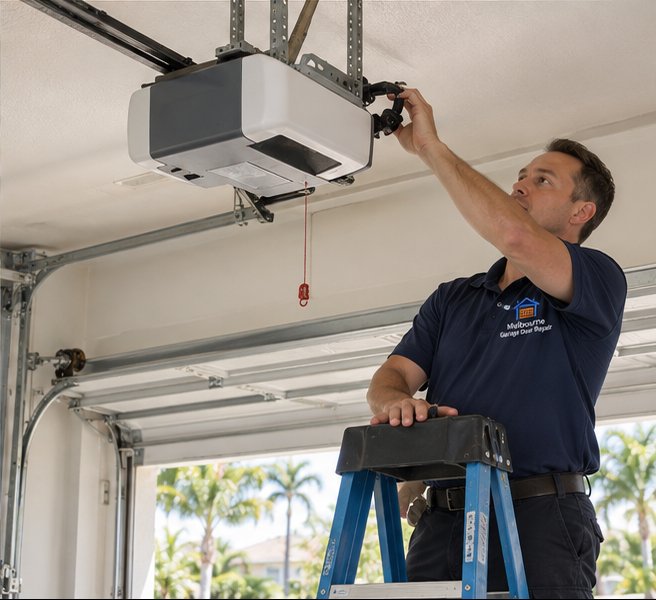
What the manual release is and why it exists
The manual release is the cord, usually red, that hangs from the opener rail or carriage with a handle at the end. Pulling it disconnects the door from the opener's drive, so the door becomes an ordinary counterbalanced door that can be lifted by hand. Its main purpose is to let you get a vehicle out, or the house secured, when the opener cannot run.
Floridians meet this situation more than most. Summer thunderstorms, tropical systems and the occasional blown transformer can all leave a home without power for hours or days. Knowing the release before it is needed turns an irritating evening into a manageable one.
It is also worth saying what the release is not. It is not a way to repair a broken door, and it does not make an unbalanced or damaged door safe. This guide spends as much time on when to leave it alone as on how to use it.
Find the release before you need it
Go and look at it in daylight, with the power on. Stand inside the garage and find the cord. On most installations it hangs from a small trolley or carriage that rides along the opener rail, and the handle sits roughly within reach of an adult.
Notice how it is tied. The cord should hang freely, with no knots tangled around anything and no loops where a hand or a child could catch. If it hangs very low, it can catch on a roof rack or a mirror. If it is out of reach, that matters too, because anyone in the household might need it.
Show everyone in the home who is old enough where it is, and what it is for. A release that only one person knows about is of little use when that person is not home.
When the manual release is fine to use
The safe case is simple. The door is fully closed, it appears normal, it was moving smoothly the last time it ran, and the power is out. In that situation, disconnecting the door and lifting it by hand is an ordinary and expected thing to do.
- The door is fully closed and resting on the floor.
- No one and nothing is under or beside the door.
- The door was working normally before the outage, with no new noises, jerks or leaning.
- You can see no damage to the cables, springs, rollers or track, from a distance.
- You have someone nearby or are able to hold the door steady with both hands.
Why a closed door is the safer starting point
A closed door has its weight resting on the floor and its springs in a stable state. If something unexpected happens, the door has nowhere far to fall. A door that stopped partway up is a different matter, and we cover that case next.
When to stop and not use the release
Treat the springs, cables and brackets as no-go areas. Do not touch or adjust them, even to see what is wrong. Looking from a safe distance is enough to tell you that something is not right.
- The door is stopped partly open. Without the opener holding it, a door that is not balanced can drop suddenly.
- You heard a loud bang before the door stopped. That can mean a broken spring, which our page on a spring that snapped with a loud bang explains.
- A cable is visibly loose, frayed or hanging, or a section has dropped on one side.
- The door is off its track, crooked, or bent.
- The door feels extremely heavy when you try to lift it, which suggests the counterbalance is not working.
- Someone has been hurt. In that case call 911 first.
Step by step with the door closed
Lifting should feel fairly light, in the sense that the springs are carrying most of the weight. If the door feels heavy, stop and put it back down gently. Heaviness suggests a balance problem, and our guide to garage door weights and balance explains why.
- Make sure nothing is under or next to the door, and keep children and pets out of the area.
- Stand clear of the door's path and reach for the cord's handle.
- Pull the cord straight down, then slightly back toward the door, until you hear or feel the carriage release.
- Put both hands on the bottom edge of the door, or on a handle if there is one, and lift smoothly.
- Raise the door only as far as you need, then stop and check that it stays up on its own or is stable.
- To get a car out, make sure the door is high enough to clear the roof and any rack before moving the vehicle.
What a normal lift should feel like
A well-balanced door is easy to lift partway and tends to hover when released at about the middle of its travel. It should rise with steady resistance, without lurching, scraping or tilting. If it feels light for the first foot and then suddenly heavy, or it shifts to one side, the balance is off.
The door should also track evenly. Watch the rollers and the sides: both should move up at the same pace. If one side climbs faster than the other, or the door seems to twist, stop and lower it carefully.
Listen too. A balanced door makes small ordinary sounds, such as rollers rolling and hinges flexing. A pop, a screech, or the sound of a cable loosening is a signal to stop and let it be.
Leaving the door open or closed
Once you have moved the door by hand, you have to decide what to do with it. If you lifted the door to drive out, you will probably want to close it behind you, particularly if the outage may last. Lower it gently with both hands, controlling the descent, and keep fingers clear of the section joints.
A door that is disconnected from the opener is a door that is not locked by the opener's own mechanism. In a long outage or a storm, anyone can lift it. If you need to leave the house secure, ask whether a manual lock bar is fitted and how it works, or consider whether the household is better off keeping the door connected and the car inside.
Never leave a manually opened door propped up halfway for a long time. If the balance is imperfect it can creep down, and a half-open door in a storm is a hazard in itself.
Reconnecting the door to the opener
After the power returns, the door can be reconnected. In most openers the carriage reengages when the opener runs, but the exact method varies, so check your manual. With the door closed, many installations ask you to pull the release cord toward the opener, or to pull it down and then back, until the carriage latches.
The common route is to restore power, press the wall button or remote once, and watch the carriage as the opener drives it along the rail. On many models it clicks back into place as it passes the latch. Some require a second step. Whichever applies, stay out of the door's path while it moves.
If the door does not reconnect, the carriage may not be aligned with the latch, or the mechanism may be worn. Do not force it. Operate the door by hand until a technician can look, and read our page on a door stuck after a power outage for what to expect.
What to do if the cord is stuck
Occasionally the cord does not release. It may be knotted, the handle may have come off, or the mechanism may have corroded in humid air. A stuck release can be frustrating, especially in a storm, and the temptation is to pull hard or reach for a tool.
Resist both. Pulling hard can snap the cord or damage the carriage, and prying near the opener can put your hands close to moving parts. If a gentle, steady pull does not work, leave the door in place and keep people clear.
Our page on an emergency release cord that is stuck describes the situation in more detail, and a technician can work the mechanism loose safely during a visit.
Battery backup as an alternative
Some openers include a battery that keeps the unit running for a number of cycles during a power cut. In many cases it can be added to an opener that lacks one. With a working battery, you can operate the door normally, which means less handling of the release and less chance of leaving the door unsecured.
A battery has its own routine. It needs checking from time to time, and it does not last forever. A backup that has been dead for a year helps nobody, so it is worth knowing the age of yours and testing it by unplugging the opener from the wall for a moment.
If you are weighing the idea, our page on battery backup for garage door openers explains how it works and what to consider.
Storm season and the release
Before a named storm, think through how the door will behave if the power fails and you need to leave or to secure the house. Our guide to garage door hurricane preparation covers the door itself, and the release belongs in that plan.
A sound plan has three parts. Know where the cord is, know who can use it, and decide in advance whether the door should be left closed and connected during the event. For most households the safest condition during a storm is a door that is fully closed and in good condition.
After a storm, look the door over before using it. Wind-driven debris, flooding and changes in the frame can all affect how the door moves. If anything looks wrong, leave it be.
Children, pets and the release cord
A dangling cord with a handle can look like a toy. Teach children early that it is not for play, and that pulling it can drop the door on someone. Younger children should be kept out of the garage altogether during an outage.
Pets are another consideration. A door that has been disconnected moves differently from one that is driven by an opener, and it will not stop when it meets an obstacle. Keep animals out of the garage while you operate the door by hand.
A calm household rule works well: only an adult uses the release, only with the door closed, and only with everyone else stood well back.
Common mistakes during an outage
Most of these come down to rushing. A pause to look at the door and think is usually what separates a smooth outage from a damaged door.
- Pulling the cord while the door is partly open.
- Standing or reaching under the door while lifting.
- Forcing a heavy door upward because the car needs to move.
- Leaving the door disconnected and unsecured for days.
- Reconnecting by pressing the remote repeatedly without watching the door.
- Tying the cord up out of reach so that nobody can use it when needed.
- Using a ladder to reach the release and working near the rail without cutting power.
Why the door feels light, and what that tells you
It surprises many people that a heavy door can be lifted with two hands. The reason is the counterbalance. Springs hold most of the door's weight, so what you lift is only the small difference left over. That is a feature of a healthy system, not a sign that the door is flimsy.
It also explains why a broken spring changes everything. The door's full weight then falls on whoever or whatever is holding it, whether that is you, the opener or a cable. A door that suddenly feels like a car door instead of a feather deserves respect, and the right response is to stop, not to try harder.
Our guide on how a garage door works is a good companion if you want the full picture behind this.
A household plan for a long outage
None of this is complicated, but writing it down once means that nobody has to work it out under pressure. Treat it like a fire drill: small, calm and slightly boring, which is just what you want.
- Decide who is allowed to use the release, and who is not.
- Keep a flashlight or headlamp near the garage entry, so nobody reaches for the cord in the dark.
- Park so that the car can leave without lifting the door more than once.
- Agree that the door is lowered and checked whenever the house is left empty.
- Keep the opener manual somewhere you can find without a phone or internet.
- Note any new noise, drag or lean in the door during the outage, and mention it to a technician afterward.
When to call a technician
Call for help if the door will not lift, will not stay up, will not come down evenly, or makes sounds that worry you. Call if the carriage will not reengage, the release does not work, or the door was damaged by the storm.
A technician looks at the whole picture: the opener, the track, the rollers, and the spring and cable system. We explain what we find, show you what is happening, and talk through the options. Our page on emergency release service describes how we handle the release itself.
If a door is stuck open or half open, keep people and vehicles away from beneath it and contact us through our contact page. If anyone has been hurt, call 911.
Questions and answers
It is generally fine when the door is fully closed and was working normally. Stand clear, pull the cord down and slightly back, then lift the door with both hands. Do not pull it if the door is stopped partway, if you heard a bang, or if a cable or spring looks wrong. In those cases leave it and get help.
A well-balanced door feels fairly light, because its springs carry most of the weight. Heaviness usually means the counterbalance is not working properly, often from a broken or weakened spring. Do not keep forcing it. Lower the door carefully if you can, keep people clear, and have a technician look at the spring system. A technician can talk through the options with you.
We advise against it. Without the opener holding the door, a partly open door that is out of balance can drop suddenly. Keep people and vehicles away from beneath it, leave the release alone, and contact a technician. If the door fell and someone was hurt, call 911 right away. A technician can talk through the options with you.
With the door closed, restore power and operate the opener once, watching the carriage as it moves. On many models it clicks back into the drive latch. Some openers need the cord pulled toward the opener first. Check your manual, stay clear of the door, and do not force anything. If it will not reconnect, ask a technician.
Try a gentle, steady pull only. If it is knotted, corroded or stuck, do not yank it or pry near the opener, because that can break the cord or put your hands near moving parts. Leave the door in place, keep people clear, and have a technician release the mechanism safely during a visit. A technician can talk through the options with you.
Usually not for long. A disconnected door can be lifted by anyone, and it may drift if the balance is imperfect. Once power returns and the door looks normal, reconnect it and test it. If the storm may have damaged it, have a technician look before you rely on the opener. A technician can talk through the options with you.
It can. With a working battery the opener keeps running for a number of cycles, so you can use the door normally during an outage without touching the release. The battery needs occasional checking and eventually replacement. A technician can explain whether your opener supports one and what the options are. A technician can talk through the options with you.