
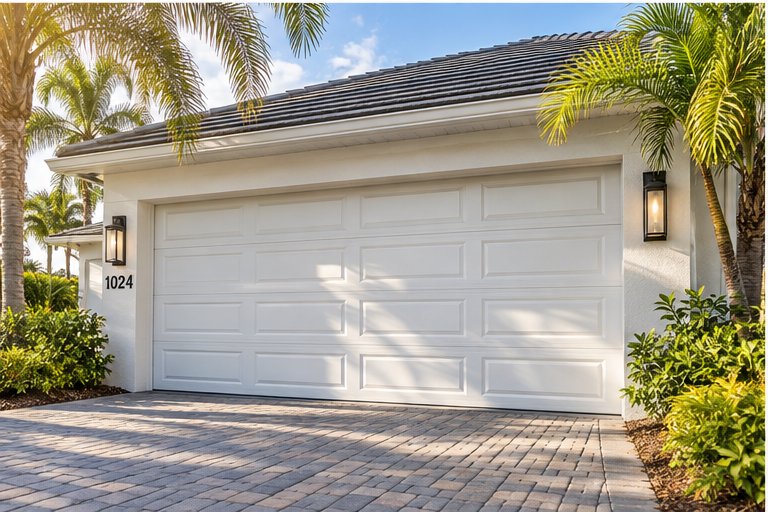
A small town with a different feel
Drive west from the busier parts of Melbourne and the pace changes. Melbourne Village is a small town with larger lots, older plantings and a quieter, more spread-out character than the dense subdivisions nearby. Houses are set back, driveways are longer, and garages come in many forms.
That variety matters to us. A garage door on a mature lot is not the same job as a door on a row of identical new houses. The door may be older, the opener may have been replaced once or twice, and the garage itself may be used for something other than cars. We start every visit by understanding how the space is actually used.
Shade, leaves and what falls on a driveway
Mature trees are a pleasure, but they leave a trail. Leaves, twigs, acorns, pine needles and bits of bark gather at the foot of a garage door, in the tracks and along the bottom seal. In a wet season that debris stays damp, holds moisture against the lower panel and encourages rust or rot.
A door that closes on a small branch or a handful of leaves may stop short, reverse, or seat poorly against the floor. Sweeping the threshold before you close the door and clearing the tracks lightly from the floor are simple habits that save a lot of trouble. If the door is leaving a gap even when clean, see our page on a gap under the garage door.
Why older doors turn up here
Larger, established lots often mean houses that have been there for a while. Some garages were built with doors that have been repaired many times, and some have a door that does not match the age of the house at all. Older doors may have heavier panels, simple hinge arrangements, or tracks that have shifted slightly over the decades.
That does not mean they need replacing. Many older doors can be put back into good working order with new rollers, hinges, cables or a spring set. It does mean that we look carefully at the structure before suggesting what to do, and we tell you honestly where a repair makes sense and where a new door would be a more sensible investment.
Wood and steel together
Some garages have wooden doors or wooden frames. Wood swells in humid weather and can bind in the track or rub against the jamb. If your door sticks on damp days but runs freely when dry, read about a garage door that sticks in humidity.
Frames that have settled
Settling in sandy soil can nudge a door opening slightly out of square. The door then rubs on one side or sits unevenly on the floor. A technician can check the tracks against the opening and adjust what can be adjusted safely.
The detached garage and the long walk
Many properties here have a garage that stands apart from the house, or sits at the end of a long drive. A detached garage matters for a practical reason: you are further from the door when something goes wrong, and the opener may be on a separate circuit that is easy to trip.
If the opener does not respond, check whether the outlet is working and whether a breaker has tripped before you assume the motor has failed. Keep a working remote in the vehicle and a key to the side door. It is surprising how often a household discovers that the only key to the service door is inside the garage itself.
A long drive also affects how the door is used. People tend to open the door from the car well before they arrive, which means the door spends more time open while the vehicle is still moving. That is a good moment to check that no child, pet or bicycle is in the path. Make it a habit to wait until the door has fully closed behind you.
Workshops, tools and a door in constant use
Plenty of garages on larger lots double as workshops. They hold table saws, lawn equipment, bicycles, a workbench and boxes that have been there for years. A door in that kind of building is opened often, sometimes for ventilation, sometimes to move a mower, and sometimes left half open for hours while work goes on.
A door left partway open puts steady stress on the opener and the springs, and it makes the hardware vulnerable to being knocked. If you use your garage as a workspace, think about whether the door can be left fully up and secured, and whether the track area is kept clear of tools and cords. Dust is also a nuisance: it settles on sensors and rollers, so cleaning them more often helps.
Heat is the other factor. A workshop with the door raised all afternoon in summer can run very warm, and a hot opener head works harder. If yours shuts off after repeated cycles, let it cool before trying again and mention it when we visit, because it may point to a motor or capacitor problem.
- Keep the floor under the door clear of cords and hoses
- Wipe sensor lenses when you sweep the shop
- Avoid hanging heavy storage close to the opener rail
- Keep ladders and long boards away from the track
Reading what your own door is telling you
Most owners on a larger property live with a slightly sticky door for years without realising it. The door has become part of the background. A useful exercise is to stand in the driveway one quiet morning and watch it from start to finish, both opening and closing, as if you were a visitor.
Notice whether the door rises level, whether it pauses at the same spot each time, and whether the sound changes halfway. A slow, even travel with a gentle hum is healthy. A jerk at the same height every cycle usually means a roller, a hinge or a section of track is catching. Write down what you see, because it helps a technician to arrive with the right parts and an idea of where to look first.
- Watch for one side of the door rising ahead of the other
- Listen for a change in pitch at the same point every cycle
- Check that the door closes fully and rests on the floor evenly
- Look for gaps of daylight at the sides or the top
Seasonal residents and long absences
Some houses in the area are lived in only part of the year, and others stand empty while owners travel. A garage that is closed up for months develops its own problems. Seals dry out, rollers seize slightly, and openers that have not run in weeks sometimes behave oddly on the first day back.
Before you leave, run the door through a few cycles and clean the tracks. When you return, do the same slowly and listen. If the door has started to reverse on its own, or if the remote needs several presses, replace the remote batteries first, then clean the sensor lenses. If the problem remains, a visit can sort out whether a part has aged in the heat.
Remotes, keypads and gate-style access
On a larger property, the garage door is often part of a wider routine: a gate at the driveway, a side door, a shop door, a keypad by the entry. Several devices share the household's habits, and remotes get lost between them. Radio interference from other equipment can also reduce a remote's range.
Programming a new remote or keypad is a short task that we handle during a visit. If your remote works only when you are very close to the door, replace its battery before anything else. Persistent short range may mean the opener's antenna wire needs repositioning or the receiver is weakening. Our page on a remote that is not working sets out the usual causes.
Storage that crowds the door
Garages on large lots often hold more than the owners realise. Stacked shelves, lumber racks and hanging bikes can end up too close to the moving parts. A door has to travel up and back along the ceiling, and anything that interferes with that path can scrape the panels or catch the opener rail.
Before assuming the opener is at fault, look up while the door is open. Make sure nothing hangs where the door or the opener carriage passes. A technician can also tell you if a door is hitting the ceiling or the rail because of a track problem rather than the storage.
Wildlife, insects and the gaps they use
Where there are mature trees, there are squirrels, lizards, rodents, wasps and spiders. A worn bottom seal or a gap at the side jamb gives them a way in, and a garage with a damaged seal often becomes a nesting spot. Some small animals chew at wiring and insulation near the opener.
Replacing a brittle seal is a simple repair that also improves how the door sits against the floor. See our page on bottom seal and threshold service. If you find chewed wires or droppings near the opener, tell us when we visit so we can check for damage.
Storms, falling limbs and tree strikes
Trees give shade, and in a thunderstorm or hurricane they also drop limbs. A limb that lands on a driveway can strike a parked car or the door itself. Panels can bend, cracked sections can appear, and tracks may be knocked out of line.
After a storm, check the door visually before you operate it. If a panel is bent or the door looks out of the track, do not run the opener. Read our page on garage door damage after a storm and contact us. Operating a damaged door under power can turn a repairable problem into one that needs a full replacement.
Lightning, power and the opener
Afternoon thunderstorms are common in the summer, and a large lot with tall trees can attract strikes nearby. Lightning and power surges damage openers by frying the circuit board that controls limits, lights and the radio receiver. Symptoms include an opener that is dead, flashes lights, or acts on its own.
A surge protector on the opener's outlet is inexpensive protection, and it is wise to unplug the opener during an electrical storm if you will be away. If your opener has stopped responding after a storm, we can test it and tell you whether the board, the motor or just the power supply is at fault. See garage door opener repair.
Wells, septic and what is under your drive
Some larger lots rely on private wells or septic systems, and driveways may be gravel, shell or old concrete with cracks. These affect the garage door more than people expect. A cracked or sloped slab at the threshold prevents the door from sealing, and a driveway that holds water can send runoff into the garage.
We do not do concrete work, but we will tell you if the floor is the reason a door will not seat properly. Sometimes a different seal or a threshold piece can improve the fit; sometimes the slab simply needs attention from someone else.
When a door is a candidate for replacement
A new door is worth considering when the panels have rotted or rusted through, when sections are cracked in several places, or when the cost of repairs approaches the value of starting afresh. It also makes sense when you want better insulation or a style that suits the house.
We help you compare options without pushing you toward a purchase. Our page on new garage door installation describes how measuring, selecting and installing works. On older homes, matching the original look can be as important as function, and a good technician will take time to discuss it.
Insulation is a reasonable thing to ask about for a garage that doubles as a workspace. A door with an insulated core is stiffer, quieter and a little more comfortable to work next to, though the heavier panel means the springs must be matched to it. We explain those trade-offs plainly so that you can choose with the full picture.
A care routine for a shaded property
Shaded garages hold humidity, so lubrication and cleaning matter more. Twice a year, wipe the tracks and the rollers' contact surface, rinse the bottom of the door, and watch for black mold on the weatherstrip. Look for rust at the bottom corners of the door, where moisture collects.
Test the safety reversal monthly. Press the wall button, let the door close on a roll of paper towels, and confirm that it reverses. If it does not, stop using the opener and have the sensors and force settings checked.
What to expect when we visit
We come to the property, walk up to the door, and ask what you have noticed. Then we inspect the springs, cables, rollers, hinges, tracks, panels and the opener. We explain what we find in plain language and talk through the options, repair or replacement, before any work begins.
If the problem is a broken spring or cable, we do the work ourselves because those parts store dangerous force. Our page on torsion spring repair describes what that involves.
Afterward we run the door through several cycles with you watching, test the safety reversal, and show you anything you can maintain yourself. If we noticed something that is not urgent but will need attention in the future, we tell you what it is and roughly when to look at it again, so there are no surprises.
Questions and answers
Yes. We repair and install doors on detached garages, outbuildings and workshops as well as attached garages. A detached building sometimes has a separate power supply or older wiring, so we check that during the visit and explain anything that affects the opener's reliability.
Not necessarily. Humidity can swell wood and make tracks and rollers sticky, and debris collects in damp conditions. Clean the tracks and bottom edge first. If it still binds, the door may be out of balance or the tracks misaligned, and a technician can check.
Look first. If a panel is bent, cracked or the door appears out of the track, do not run the opener, since that can cause more damage. Keep people away from the door and contact us so that we can examine it safely.
Many older doors can be repaired successfully with new rollers, hinges, cables or springs. We look at the condition of the panels and frame, then explain whether repair or replacement makes more sense. There is no obligation to decide during the visit.
Start with the bottom seal and the side weatherstripping, since gaps there are the usual entrance. Replace brittle or torn seals, and keep the floor edge clean. Chewed wires or nests near the opener should be mentioned to us so that we can check for damage.
A power surge or nearby strike may have damaged the circuit board or the radio receiver. First check the outlet and breaker. If power is present and the opener still does nothing, we can test the unit and tell you whether repair or replacement is more sensible.
No. Springs and cables hold dangerous tension, and incorrect handling causes serious injuries. Please leave all spring, cable and bracket work to a trained technician. If you hear a bang or the door suddenly feels heavy, leave it alone and contact us.