
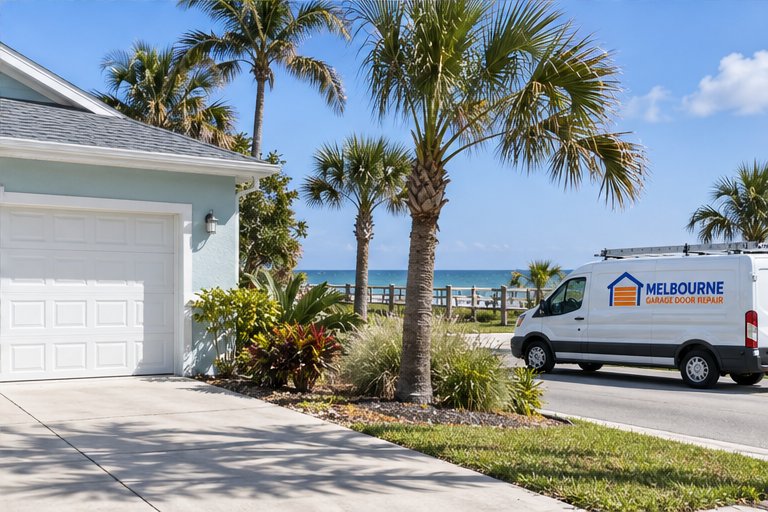
A town built along a narrow island
Indian River Shores occupies a stretch of the barrier island in Indian River County, with the Atlantic on one side and the lagoon on the other. Homes sit close to the water in both directions, so almost every garage door in town has some exposure to moisture and salt.
That geography is the starting point for everything we do on the island. A door here is not simply a door. It is a large metal and insulation assembly standing in a marine atmosphere, and it needs a slightly different kind of attention than one farther inland.
Because the island is narrow, a single storm or a stretch of salty weather affects nearly every house at once. That shared exposure is why we encourage neighbors to compare notes, and why we look for patterns when several doors on one street fail in similar ways.
Larger openings and heavier doors
Many homes in the town have garages designed for two, three or more vehicles, and the doors on them are often wider than the standard double. A wide door means more weight, longer torsion springs or more than one spring, and greater demands on the opener and the track.
Weight changes the repair. A heavy door that loses a spring is not something a person can lift by hand, even partway. It also changes the conversation about balance, because a small error in spring tension becomes a large error in how the door behaves.
Wide doors also flex. Without proper reinforcement across the top section, a long door can sag slightly in the middle over the years, which strains the hinges and makes the opener work unevenly. A straightedge held along the top of a closed door will often show it.
Double doors versus two single doors
Some larger garages use two separate single-width doors rather than one wide door. That arrangement can be easier to live with, because one door can fail without taking the whole garage out of use. It also spreads the load across two openers and two sets of springs. Our comparison of single and double garage doors weighs the trade-offs.
Multiple springs and why they matter
A heavy door may use a pair of torsion springs on one shaft. When one breaks, the other is carrying a load it was never meant to carry alone. We replace springs as a matched pair in most cases, because an older spring left in place is likely to follow its partner.
Salt, wind and the long game
Salt in coastal air is slow and persistent. It does not announce itself. It collects on hinge pins, cable drums, bearing plates and fasteners, then draws moisture and starts a corrosion cycle that can run for months before anything fails.
The most useful habit on the island is a gentle freshwater rinse of the door's exterior and hardware, followed by drying and a light application of a lubricant suited to the parts. Avoid spraying heavy grease on springs or drum surfaces, and never use water near the opener or its wiring.
Ask us about the parts that matter most. A bracket, a bottom fixture or a cable end shows damage first, and catching it early is what keeps a repair small.
Sprinkler overspray is a quiet culprit as well. A head aimed at the lower edge of the door will soak the seal and bottom panel several times a week, and irrigation water is not always gentle. Redirecting it is a small job that prevents a surprising amount of rust and swelling.
Riverfront and oceanfront: two kinds of exposure
Homes on the ocean side meet wind-driven spray and sand, while homes on the lagoon side meet calmer but more humid air and the occasional spell of standing moisture after heavy rain. Neither is gentle on metal, but they leave different traces.
On the ocean side we tend to see rust beginning at the lower edges of the door and the bottom brackets, where spray settles and dries repeatedly. On the lagoon side, humidity encourages mildew on seals and trim, and swelling in any wooden parts. Knowing which you have tells us where to look first.
A door on a covered or recessed entry is sheltered from direct spray, but not from salt in the air. Do not assume that a protected door needs no attention. It simply shows wear in different places.
Finish, color and the look of the facade
In a town where curb appeal carries weight, the garage door is often the largest single element on the front of the house. Faded color, chalky paint, dented panels and weather-cracked trim are all visible from the road.
Replacement is not always required. A door that is straight, balanced and structurally sound may only need a repaint, a panel section replaced or new weatherstripping. When it is time for a new door, wood-look finishes, carriage-style designs and clean modern panels each have their place. Our notes on styles and curb appeal and on colors and finishes cover the choices.
Panel dents deserve a second look as well. A small ding can be cosmetic, but a crease across a panel weakens it, and wind will find that weak line. If a panel has creased, repairing or replacing that section is better done before storm season than during it.
Hurricane season on an exposed island
A barrier island takes the full force of a storm's wind before the mainland does, and a garage door is often the first part of a house to show strain. A door that flexes, bows or is not properly secured can let wind pressure into the home.
Preparation means looking at the door, not just at the calendar. The tracks should be firmly fastened, the panels straight, the hinges tight and the bottom seal intact. If you are considering a new door, ask about wind-rated models and how they are anchored, and see our guide to wind and building rules.
After a storm, do not run the opener on a door that looks bent or has come out of its track. Keep people and vehicles clear and have it examined first.
If you plan to close up a house for the season, take a moment to leave the door in a sound state. Disconnect the opener from power only if you know how, make sure the door is fully closed and locked, and know where the release handle is before the day you need it.
Homes that are shut up for part of the year
Many properties in the town are lived in only part of the year. A door that sits unused for months can still develop trouble. Rubber seals dry and stick, lubricants harden, the opener's backup battery drains and small animals look for shelter in corners and track ends.
If you manage a seasonal home, a visit before you leave and another when you return are worth planning. Before leaving, test the door's reversing behavior, replace remote batteries and make sure the manual release is accessible to anyone who might need it. On return, watch the first few cycles carefully for scraping, shaking or unevenness.
- Ask a caretaker to cycle the door on a regular schedule if possible.
- Keep sensor lenses clean so a spider web does not block them.
- Check the outdoor keypad, which can fail from moisture even when the door itself is sound.
- Confirm that any smart controls are still connected to the home network after an absence.
Opener choices for a large door
A heavy door needs an opener with enough power and a drive type that suits it. Belt drives are quieter, which many people appreciate where the garage sits beneath a bedroom. Chain drives are sturdy, and screw drives have fewer moving parts. We explain each in our guide to opener drive types.
Whatever the drive type, an opener should not be asked to lift a door that is out of balance. Using a stronger motor to compensate for a weak spring wears out the opener and masks a safety issue. We test balance first, then choose an opener to match.
Gates, driveways and the approach to the garage
Many properties in town have a driveway entry gate, a long approach or a motor court before the garage itself. A garage door that works well in isolation can behave oddly when a gate operator, a landscape lighting transformer or a nearby radio source is sharing the neighborhood airwaves.
If a remote works from the road but not from the driveway, or works at some times and not others, interference or a weak antenna may be involved rather than the opener itself. Moving the antenna wire, replacing a failing remote or relocating a wall control can sometimes resolve it.
We also look at the physical approach. Vehicles that arrive at an angle can clip a door edge, and a door that has been bumped may look straight but sit slightly out of alignment in its tracks.
Smart controls and the connected home
Homes in Indian River Shores often have automation that goes beyond the garage: lighting scenes, security cameras, gate controls and phone apps. A garage door opener that links to those systems can tell you whether the door is open and let you close it from a distance.
A connected opener is only as dependable as the network behind it. Weak signal in a garage with thick walls, a router that was replaced without updating the opener's settings, or an expired account can all make a smart opener look broken when the mechanics are fine. Our smart opener and wifi setup page describes how we approach it.
A good rule is to keep the manual operation reliable as the foundation and treat the app as a convenience on top.
Cameras that watch the garage interior are common in the area, and they can show you the door position, a stuck sensor light or an unexpected visitor. They are a helpful early warning, though they cannot replace a person looking at the door and listening to it run.
Insulation, heat and a garage that is also a room
In many upscale homes the garage is conditioned or semi-conditioned, used as a studio, a wine or hobby space, or a place for a second refrigerator. An uninsulated door lets Florida heat pour into that room.
Insulated doors and window inserts change how the garage behaves, and they also change the weight of the door. When insulation is added, the springs often need to be reselected to match. Read more in garage door heat and your garage temperature.
| How the garage is used | What to think about |
|---|---|
| Parking only | Reliable balance and a quiet opener |
| Workshop or studio | Insulation, seals and sensible lighting |
| Storage of boats, bikes and gear | Wide opening, frequent cycles, rust resistance |
| Seasonal home | Maintenance before and after absence |
| Guest space or hobby room | Weather seals and temperature control |
Security and who has access
A garage door is also a way into the house. If the door opens to a hallway, the interior door deserves a good lock, and the opener should use rolling-code technology so a copied signal cannot be reused.
Think about who has remotes and codes: contractors, housekeepers, pool services and landscapers may all have received one at some point. Resetting access periodically costs little compared with the peace of mind. See our garage door security tips for the habits we recommend.
Working with house managers and contractors
Larger homes often have a property manager, a builder on call or a trusted maintenance person who arranges service. We are glad to work through them, and we explain our findings clearly so that the owner can understand them even when absent.
It helps to tell us what is known about the door: when parts were last replaced, what noises were noticed, and whether the opener is part of a larger automation system. Photographs of the door and of any labels on the opener or springs are useful, and they let us arrive prepared.
Where an owner is away, we suggest naming one person who can approve work, so decisions are not delayed and the door is not left in an unsafe condition.
Noise in a quiet neighborhood
On a calm street, a noisy garage door stands out. A groan, a bang or a rattle that goes unnoticed in a busy area becomes a daily annoyance here and can disturb a neighbor next door.
Noise is usually information. Squealing suggests dry rollers or hinges, grinding points to a worn part, and popping can mean a spring or a track misalignment. Each has a different fix, and none is improved by ignoring it.
Condominium and club buildings add a further layer, because a shared overhead door gets many more cycles and more careless handling than a private one. For those properties a scheduled maintenance plan costs far less trouble than waiting for a breakdown, and our commercial garage door service page outlines what we examine.
What can be done about it
Often a careful tune-up solves a noisy door: tightened hardware, correct lubrication, replaced rollers and a rebalanced spring. If the opener is the source, a belt-drive model with a soft start can make an obvious difference.
What a visit looks like here
We arrive, introduce ourselves and ask what you have noticed. Then we examine the door, from the springs and cables to the rollers, hinges, tracks and seals, and test the opener's force and reversing. We explain what we find in ordinary words.
If a part has to be replaced, we describe it and why. If it is a judgment call, we lay out the options and leave the choice with you. We do not push for replacement when a repair would serve, and we do not recommend leaving something unsafe.
A maintenance rhythm for island doors
A garage door that gets regular attention lasts longer and fails less often. For a door in a coastal setting, we suggest a modest routine, with a professional inspection once a year and simple homeowner checks in between.
Read our monthly garage door checklist for the checks that are safe to do yourself, and remember that springs, cables and brackets are for a technician only.
- Rinse and dry the exterior and visible hardware after salt-heavy weather.
- Listen for any change in sound when the door runs.
- Test the auto-reverse with a rolled towel placed in the door's path.
- Keep the area around the door clear so the sensors and release are accessible.
Questions and answers
Salt in the air settles on metal parts and holds moisture, which speeds corrosion on hinges, brackets, cable ends and fasteners. The damage tends to be gradual and hidden. Regular rinsing, drying and suitable lubrication, along with a yearly professional check, helps catch problems before a part fails. We are happy to answer follow-up questions before any visit is arranged.
Yes. Wide doors use heavier springs and place more demand on the opener and tracks, so we pay special attention to balance and hardware. We explain what we find and what the options are before any work begins, and we never ask you to handle the springs or cables yourself. If you are unsure, describe what you see and hear, and we will help you sort it out.
It is a good idea. Seals stiffen, batteries drain and lubricant dries while a house is closed up. A check before departure and a careful first cycle on return helps avoid being stranded with a stuck door. Test the reversing sensors and make sure someone knows where the manual release is. Nothing is decided until you understand what we found and what the options are.
Many modern openers can, using an app and a home network. Success depends on signal strength in the garage, current account settings and compatibility with your system. We can look at what you have and explain what is practical, keeping the basic manual operation dependable regardless of the app. Photographs of the door and any labels can help us prepare before we arrive.
If the garage is used as a room or shares walls with living space, insulation can help with heat and noise. It adds weight, so the springs may need adjusting or replacing to suit. If the garage is used only for parking, the benefit is smaller. We can explain the trade-offs for your situation. Whatever the situation, we explain things in plain language and leave the choice with you.
Do not run the opener, and keep people and vehicles away from the door's path. A bent or displaced door can fall unexpectedly. Take photographs for your records if it is safe, then contact us so we can examine the tracks, panels and hardware and explain what repair or replacement makes sense. We are happy to answer follow-up questions before any visit is arranged.
Modern openers use rolling codes that change with each use, which makes copying difficult. If an old fixed-code opener is in place, consider an upgrade. Reset the memory and reprogram your remotes if one is lost, and change keypad codes whenever contractors or guests no longer need access. If you are unsure, describe what you see and hear, and we will help you sort it out.
Yes. These doors are common on larger homes and need the same careful balance and hardware attention as any other. Decorative hardware, window panels and overlays add weight and sometimes trap moisture, so we check them carefully and explain whether a panel repair or a section replacement is the sensible choice. Nothing is decided until you understand what we found and what the options are.