
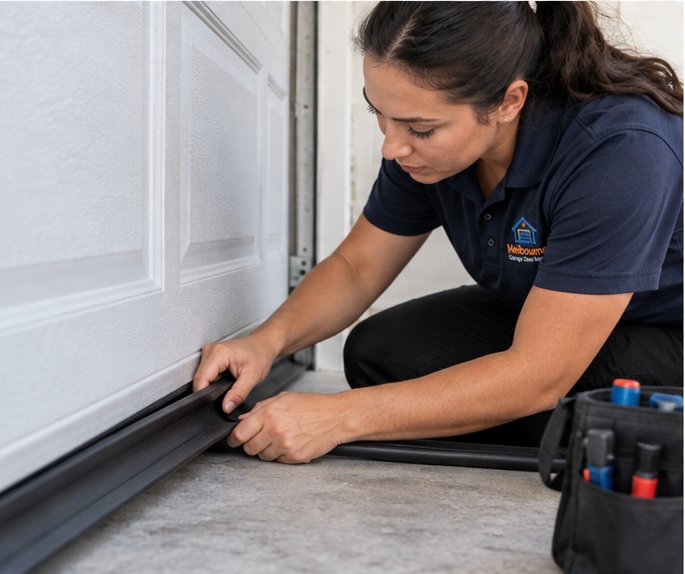
What a gap under the door really tells you
A garage door is built to close against the floor with a flexible rubber or vinyl seal along its bottom edge. When the door is down, that seal presses lightly against the slab and fills the small differences between the two surfaces. If you can see light, feel air or watch debris blow in, the seal is no longer doing that job.
The gap itself is only the symptom. It can come from a worn or hardened seal, a slab that is not level, a door that has settled out of square, a bent bottom section, or a lifting system that no longer lowers the door fully. Each cause calls for a different repair, so guessing at a patch rarely holds.
This page walks through the causes in the order we usually check them, explains what the gap lets into your garage, and describes what is safe for you to look at before you call.
How to tell where the gap is and how big it is
Start by closing the door and standing inside the garage with the lights off, in daytime. Light leaking around the edges shows exactly where the problem sits. A thin even line across the whole width suggests the seal. A wedge that grows wider toward one side suggests a floor slope or a door that is not level.
At night, you can do the reverse. Stand outside with a flashlight pointed low and have someone inside look for the beam. Either method costs nothing and takes a minute, and the pattern you find helps us a great deal when we talk about it.
| What you see | Likely meaning | Who should handle it |
|---|---|---|
| Thin even line of light across the width | Seal hardened, flattened or shrunken | Seal replacement by a technician |
| Gap widens toward one side | Sloped slab or door not level | Technician checks door and floor together |
| Gap only in the middle | Seal torn or bottom section bowed | Technician |
| Gap at both ends but not the middle | Slab crowned in the centre | Technician, possibly with a flooring professional |
| Gap appears only after the door has been used | Door not lowering fully or limit set short | Technician checks opener and balance |
| Seal missing in places | Pulled out of its retainer | Technician or careful owner replacing a loose strip |
Worn, hardened and shrunken bottom seals
The most common cause by far is the seal itself. Rubber and vinyl seals live in a hard environment on the Space Coast. Strong sun dries them out, heat flattens them, and humidity keeps the retainer track damp. Over several seasons a soft, springy strip turns stiff and cracked, then shrinks away from the ends of the door.
A seal can also be pulled out of its channel by a vehicle bumper, a leaf blower, or simply years of opening and closing. Look for a strip hanging loose at one end or a gap where it has slid away from the corner.
Our page on bottom seal and threshold service describes what we do when the seal is the cause. In many cases the seal can be replaced without touching the rest of the door, provided the retainer on the bottom section is still sound.
- Cracks or splits along the face of the seal
- A seal that feels hard when pressed with a fingertip
- Dark or chalky surface from sun exposure
- Ends that have pulled back from the corners
- A strip hanging out of its retainer
Why seals do not all fit the same way
Seals come in different shapes. Some slide into a channel on the bottom section, some use a bulb that sits in a track, and some use a flat flap fastened with clips. The correct replacement depends on the retainer already on your door, so a strip bought without checking the profile often will not seat properly.
Slabs that are not level
Garage floors are usually poured with a gentle slope toward the driveway, so water runs outward. That slope is intentional, but it can leave a wedge-shaped gap under a door that was installed for a flat floor. Over time, slabs can also settle or crack, especially where soil is sandy and heavy rain washes material out from beneath the edge.
A seal can absorb a modest difference, but it cannot make up for a large one. When the slab dips well below the door in one area, the seal hangs in the air instead of resting on a surface. A technician may suggest a thicker seal, a threshold strip fastened to the floor, or a repair to the slab itself, depending on what is going on.
If you suspect the floor, our guide on garage doors in a coastal climate explains how moisture, soil and salt air work on both the door and the building around it.
A door that no longer lowers all the way
Sometimes the gap is not about the seal or the floor at all. The door may be stopping a little short of the slab because the opener travel is set too high, or because the lifting system is out of balance and holding the door up. A door that hangs one or two inches off the floor lets in far more than a worn seal would.
If the gap appears and disappears, or changes from day to day, suspect this cause. Watch the door close and see whether the bottom edge settles on the floor or stops just above it. Then press the wall button again and see whether the door moves.
A door that stops short can also be a sign of a spring or cable issue. Those parts hold dangerous tension and are not for homeowners to touch. If you see a slack cable or hear a bang before the gap appeared, read about a cable that snapped or came off the drum and keep clear of the door.
Opener travel limits
The opener has settings that tell it where the closed position is. If those settings drift or were never set carefully, the door can stop before the seal compresses. Adjusting them is a routine job for a technician and does not involve any spring tension.
Balance and the lifting system
If the springs have weakened or one cable has stretched, the door may hang at an angle or stop above the floor on one side. That is a balance problem, and it needs a careful look rather than a seal replacement.
Bent or bowed bottom sections
The bottom panel takes the most abuse. It gets hit by bumpers, wheelbarrows, mower handles and the occasional ball. A dent or bow in that panel keeps the seal from sitting flat, even when the seal and floor are fine.
A bent bottom edge often shows as a gap that stays the same in one spot no matter how you adjust the opener. You may also see a kink in the aluminum retainer or a crease in the steel behind the seal.
We cover these repairs on our garage door panel repair page. Sometimes the bottom section can be straightened or reinforced, and sometimes it is more sensible to replace that section or the whole door. We explain which is which after looking at the damage.
What comes in through the gap
A gap of even half an inch is enough to let in more than most owners expect. Some of what gets in is merely annoying, and some of it affects your belongings and the building.
Wind-driven rain and leaf litter are the obvious ones. Dust and pollen follow, along with salt-laden air near the coast. Insects use a gap as an entrance, and so do small animals. Light matters too, because a bright line along the floor invites curiosity and can show a passerby that the garage is empty.
- Rain blown across the slab, especially in storms
- Leaves, pine needles and windblown dirt
- Ants, roaches, spiders and other insects
- Lizards, frogs and sometimes rodents
- Hot, humid outside air that raises garage temperature
- Salt and moisture that speed up rust on stored items
A note on pests
A seal helps keep pests out but is not a pest-control product. If you see signs of nesting or droppings, a pest professional should look at the garage. We can make the door close tightly, which removes one easy route in.
Water and the gap
Rain finds a way through a gap with little effort, especially when the driveway slopes toward the door. A seal in good shape stops a surprising amount of surface water, but heavy rain pooling at the threshold can still push through a small opening.
If water is your main concern, our page on water coming in under the garage door goes into slope, thresholds and what a seal can and cannot do. In short, a seal is one part of a larger answer that may also involve drainage, grading and the floor edge.
What you can safely check yourself
Looking and noting are safe. Touching springs, cables or the bottom brackets is not. Keep your hands away from the sides of the door, where the cables run, and from the pinch points between sections.
These checks are all done with the door closed, from inside or outside the garage.
- Look for daylight along the bottom edge and note where it is widest
- Press the seal gently with a finger and see whether it springs back
- Check each end of the seal for pulling or tearing
- Look at the floor under the seal for cracks, dips or standing water marks
- Watch the door close and see whether it settles on the floor or stops above it
- Take a few photographs, including one with a ruler laid on the floor beside the gap
Stop points
If the door looks crooked, a cable looks slack, you hear scraping, or the door will not stay up, stop. Do not use the door and do not push on it. Contact us and describe what you saw.
How we diagnose a gap at the bottom
We begin with the whole picture: how the door sits in the opening, how the seal contacts the floor, and whether the door lowers all the way. Then we look closely at the seal, its retainer, the bottom section and the slab.
We also check balance and the opener setting, since both can leave the door hanging above the floor. Disconnecting the opener and moving the door by hand shows whether the door itself rides evenly.
Once we understand the cause, we explain it in plain words, show you the parts involved and describe the choices. Our page on what happens during a service visit describes the general flow of a visit.
Repair options in plain terms
Which repair makes sense depends on what we find. A worn seal in a sound retainer is replaced with a matching profile. A shifted or missing seal may be reseated if it is still supple. A bowed or bent bottom section may be straightened or replaced. A door that stops short is corrected at the opener or the lifting system.
When the floor is the cause, a thicker or taller seal may close the gap. For larger dips, a threshold strip or a floor repair can help, and some of that work is outside our trade. We tell you honestly when a job belongs to a concrete or flooring professional.
If the door is old and several parts are worn, the comparison between repair and replacement becomes important. Our page on repairing versus replacing a garage door sets out the points to weigh.
- Seal replacement with a matching profile
- Reseating or trimming a seal that has slipped
- Bottom section repair or replacement
- Opener travel adjustment
- Balance correction by a technician
- Threshold or floor-edge solutions where the slab is the cause
Why a rushed patch rarely lasts
Many owners try stuffing foam, weatherstripping tape or a rolled towel into the gap. These can help for a few days, but they also hide the cause. Adhesive tape peels in the heat, foam soaks up moisture and crumbles, and anything stuck to the bottom edge can interfere with the sensors or the door's travel.
A door that must lift a lumpy patch every time it opens works harder, and a bulky strip that catches under the door can cause it to reverse unexpectedly. If the real problem is a sloped slab or a bent panel, the patch will not fix it.
It is better to understand the cause and choose a repair that suits it. If you want to compare approaches before deciding, our comparison of do-it-yourself and professional garage door work lays out what is reasonable to try and what is not.
Storms, heat and salt on the Space Coast
Brevard and Indian River counties see long hot summers, sudden downpours and a good deal of wind during storm season. Sun and heat wear rubber down season after season, and humid air keeps the bottom of the door damp for much of the year. Near the water, salt corrodes the aluminum retainer and bottom brackets.
A seal that was tight in spring can look tired by the end of summer. Checking it before the wettest months is a sensible habit, and a gap that appears during storm season is worth looking at promptly, since wind-driven rain can enter even a small opening.
Our seasonal garage door checklist suggests what to look at and when. It covers seals along with rollers, hardware and the opener.
Planning for a visit
When you reach out, tell us where the gap is and when you first noticed it. Mention whether it changes through the day, whether water comes in, and whether the door has been hit or serviced recently. Photos from a safe position help, particularly a picture of the whole bottom edge with the door closed.
Please clear stored items away from the door so we can reach the seal and the floor beneath it. A broom run along the threshold beforehand removes grit and leaf litter, which makes it easier to see the true shape of the slab edge and the seal contact line. If you have noticed any marks on the floor where water has dried, point them out, since the shape of a stain often shows where the water entered and how far it travelled. Keep children and pets away from the opening while the door is being worked on.
We will explain what we find and what the options are. Our contact page shows how to reach us.
Questions and answers
The most common reason is a worn, hardened or shrunken bottom seal. Other causes include a sloped or settled slab, a bent bottom section, or a door that does not lower fully. Looking at the pattern of light along the floor helps tell them apart, and a technician can confirm the cause.
It may help briefly, but tape and foam peel, soak up moisture and can interfere with the door or the sensors. They also hide the real cause. A proper seal matched to the retainer on your door usually lasts far longer and is safer for the door's operation.
A good seal stops surface water and blowing rain in many cases. It cannot overcome a badly sloped driveway, standing water at the threshold or a large dip in the slab. We look at drainage and the floor edge as well as the seal when water is the concern.
It can. If the gap exists because the door stops above the floor, the opener limits or the balance may need attention. A gap from a worn seal does not affect the opener directly, but a lumpy patch stuck under the door might cause unexpected reversing.
Replacing a seal that slides into a channel is within reach for some owners, but the profile must match and the door must stay clear of springs and cables. If the door is crooked, the cable looks slack or the bottom section is bent, stop and call a technician instead.
If the slab dips or slopes, a thicker seal or a threshold strip can help. Larger dips may need a floor repair, which can involve a concrete professional. We explain which part of the job belongs to us and which does not, after looking at the door and floor together.