
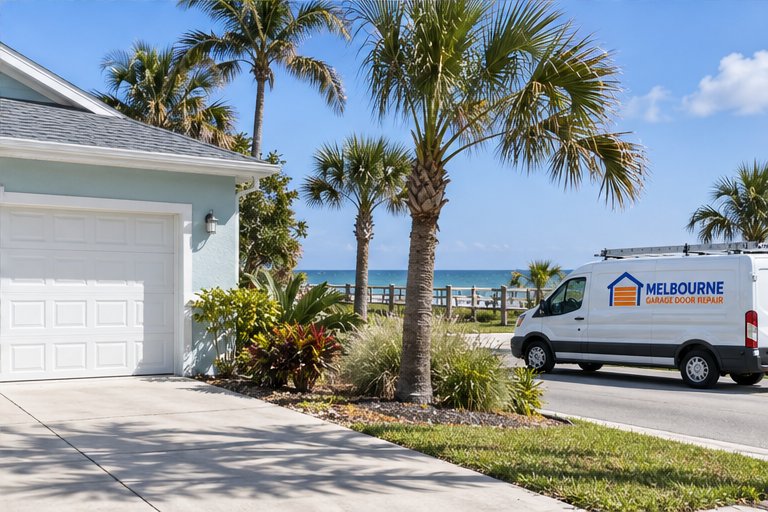
A neighborhood where people come and go
The barrier island between the Atlantic and the Indian River Lagoon is home to a steady mix of long-time residents, retirees, renters and families who have moved here for work. Communities such as Satellite Beach and Indian Harbour Beach sit close to the base, and many of their homes change hands or change tenants more often than homes in other parts of the county.
This page is written about those civilian neighborhoods only. We do not speak for the base, and we do not service anything inside its gates. What we can speak to is the garage door in an ordinary house a short drive away, and the particular ways that door tends to be treated when a household is busy, new to the area or away for months.
Why moving households need a garage door plan
A garage door is the part of a house that nobody inspects at closing. The buyer or renter walks through the kitchen, tests the faucets, looks at the roof, and rarely stands in the garage pressing the wall button ten times. So the first real test of the door often happens on a rainy evening with a car full of boxes.
If you are arriving with a truck or a trailer, that moment is when a worn spring, a loose cable, a slipping opener belt or a missing remote becomes your problem. A short check in the first week, before the household settles into a routine, costs nothing but attention and can prevent a stuck door on a day you cannot afford one.
- Press the wall button and watch the whole travel of the door, up and down
- Listen for scraping, grinding or popping
- Look for frayed cable strands or a door that hangs lower on one side
- Count the working remotes and keypad codes you actually received
- Try the manual release in the cord handle only while the door is closed and nobody is under it
Move-in inspection, step by step
We suggest treating the garage like any other room you are inheriting. Stand outside the path of the door, run it through a full cycle, and note what you see and hear. Then do the same from inside, with the car out of the way.
None of this requires tools. It is simply looking and listening, and writing down what seems off so that you can ask the landlord or seller about it with specifics.
Look at the door while it moves
A healthy door rises evenly, with both sides lifting together and no visible tilt. If one corner leads, or the door shudders as it passes the middle, there is a balance or hardware issue worth having examined.
Look at the rollers in the tracks. Missing or cracked rollers are easy to spot, and they are usually inexpensive parts, but a door running on damaged rollers wears everything else faster.
Listen for the opener
A motor that strains, hums without lifting, or stops partway usually points to a spring or balance problem rather than a motor problem. We cover that pattern on our page about an opener that hums but does not lift.
A clean, steady sound with only a soft rumble is what you want. Anything sharp, rhythmic or metallic deserves a closer look.
Test the safety reversal
Close the door with a roll of paper towels or a similar light object in its path. The door should touch it and reverse. If it crushes the object or ignores it, stop using the opener until the safety system has been checked.
Salt air on the narrow part of the island
Much of the area near the base sits on a thin strip of land with water on both sides. That means salt in the air, moisture in the morning and the afternoon, and steady wind. Salt settles on bare steel and finds every exposed screw, spring coil, hinge pin and track bolt.
Over several years it shows up as orange rust at the hinges, stiff rollers, discoloured track edges and a powdery film on the springs. Rust is not always urgent, but it is a signal. Springs that rust lose strength and can break earlier than their counterparts further inland. Our page on rust on a garage door and track explains what is cosmetic and what is not.
Springs, cables and the sudden bang
The most common failure on any door is a broken torsion spring, and it often happens without warning. A loud bang from the garage, a door that will not lift, or an opener that sounds as if it is lifting nothing are the usual signs.
Do not try to adjust, loosen or replace springs or cables yourself. They hold a great deal of stored force. If you hear the bang, leave the door alone and read our page on a spring that snapped with a loud bang. When you contact us we will look at the door, explain what we find and what the options are, and replace the spring and any worn companion parts together.
Rental homes and the landlord relationship
A good portion of the single-family homes and townhomes near the base are rented. A garage door in a rental has two people responsible for it: the owner who pays for repairs and the tenant who uses it every day. Problems usually begin when something small is ignored for months and becomes something large.
For tenants, the helpful habit is to report early and in writing: a photo of the sagging corner, a note that the remote stopped working, a short description of the noise. For owners and property managers, a periodic look at the door between tenancies is a sensible habit. Our maintenance and tune-up service suits that rhythm well.
When the owner is away
Many households around the base are managed by one adult while the other is away for weeks or months. A garage door that sticks, a remote that dies or an opener that starts reversing can feel larger than it is when you are juggling children, work and a house on your own.
We try to make those visits straightforward. We come to the property, look at the door, explain in plain language what is happening and describe the options. If a decision should wait for a spouse or an owner who is travelling, there is no pressure to decide on the spot, and we can take photos or notes for them to review.
Remotes, keypads and handing over a house
Households that move often accumulate remotes. A tenant leaves with two, a buyer receives one, and a spare sits in a car that has been sold. If you are taking over a house, it is worth clearing the opener's memory and starting fresh so that no former occupant's remote still opens your door.
We can program new remotes and keypads and explain how the codes are managed. For the basics, see our page on remote and keypad programming. If a neighbor's remote seems to open your door, that is a separate issue covered in our article on a neighbor's remote opening your door.
Storm season and an empty house
Hurricane season runs through the late summer and fall, and a barrier island household has to think about it differently from an inland one. Wind loads on a garage door are large because the door is a big, light panel in an otherwise strong wall. A door that is dented, rusted or poorly braced is the weak point in the building.
We do not make claims about a particular door's wind rating. What we can do is look at the condition of the panels, hardware, tracks and opener, and explain what we see. Before a storm, make sure you know where the manual release is, and have a plan for the opener if the power goes out. See our page on hurricane season garage door service.
Power outages and the manual release
After a storm, an outage can leave a door stuck partway or closed with the car inside. Almost every opener has a red release handle that disconnects the door from the motor so that it can be lifted by hand. Use it only when the door is fully closed, and only when you are sure the springs are intact.
If the door feels extremely heavy when disconnected, do not force it. A heavy door often means a spring has weakened or broken. Let it be and call us. Our page on a door that is heavy to lift by hand explains the symptoms.
Some residents leave for long assignments or extended trips. Before you go, run the door through a few full cycles and confirm that it moves smoothly, closes fully and reverses on the paper-towel test. Make sure someone you trust has a working remote or a keypad code, and that they know where the manual release is.
If power may be switched off, remember that a closed door stays closed and can only be opened by hand with the release. A battery backup for the opener can make a long outage less disruptive, and we explain the idea on our page about battery backup for garage door openers.
Shift work, odd hours and a door that must just work
Households connected to the space industry and the surrounding trades often keep unusual schedules. People leave before dawn, return after dark, or come and go in the middle of the night. A garage door in that kind of home is cycled far more often than the average, and it is often operated when the driver is tired and not paying attention to small signs.
That wear shows in a predictable order. Rollers go first because they turn every time the door moves. Then the opener's travel limits drift, then the springs, which are rated for a limited number of cycles, begin to weaken. A door used six or eight times a day wears through those cycles much sooner than a door opened twice. If this describes your house, it is worth having the door looked at on a regular schedule rather than waiting for the morning it fails.
Reading the sounds your door makes
Most garage door trouble announces itself weeks ahead. The sounds are the easiest early warning, and they are worth learning because they tell a technician where to start.
A squeal usually means dry rollers or hinges. A rhythmic pop on each cycle points to a hinge or a roller leaving its track slightly. A grinding noise from the opener head suggests worn gears. A single loud bang followed by a motor that runs without lifting is the classic broken spring. Describe what you heard when you contact us, because it saves time and helps us bring the right parts.
Between visits, some simple care helps a door last longer on the island. Rinse the lower panels and bottom seal with fresh water to remove salt and sand, wipe the track faces so they are clear of grit, and clean the lenses of the safety sensors with a soft cloth. These are all jobs you can do from the floor with the door closed.
Do not grease or adjust anything near the springs, the cable drums or the brackets at the bottom corners. Leave those to a technician. If the door has begun to rub, stick or lean, a gentle clean will not fix it, and the cause may be hardware that needs attention.
What a visit usually looks like
We arrive at the property, look at the door and the opener, and listen to what you have seen and heard. We check the springs, cables, rollers, tracks, hinges, sensors and the wall control. Then we explain what we found in plain terms, including what must be done now and what can wait.
If a part needs to be replaced, we describe the options before we start. You are not asked to commit to anything without understanding it. Our page on all services lists the repairs and installations we handle across the area.
Reaching us about your door
Whether you are a new arrival, a long-time resident or a landlord looking after a property, we are glad to look at the door and explain what we find. We work across the civilian communities near the base and the rest of the Space Coast, and we treat every household the same way: calmly, clearly, and without pressure.
Questions and answers
No. This page is about the civilian neighborhoods near Patrick Space Force Base, the houses, townhomes and small businesses along the barrier island. We make no claims about access to or work on the base. If you live off base and your garage door needs attention, that is the kind of work we do.
It is a sensible step, especially if you do not know the door's history. A fine-looking door can have a worn spring, frayed cable or tired rollers. A maintenance visit lets a technician examine the parts you cannot judge by eye and explain what is close to the end of its life.
Either can contact us to have the door looked at. The question of who pays is between the two of them, and we do not take sides. We will explain what we find in plain language so that both understand the situation and can decide how to proceed.
It speeds up rust on exposed steel, including springs, hinges, track bolts and cable ends. Doors near the water often show corrosion sooner than doors inland. Regular cleaning and a technician's inspection can catch wear early, though we do not promise a particular lifespan for any part.
The opener's memory can be cleared and your own remotes and keypad code programmed afresh. That removes access for any older remote. It is a routine task during a visit, and we can show you how to repeat it in the future if remotes are lost.
Leave it alone if it is partway open and you cannot see the problem. Do not stand under it. If it is closed, you may use the manual release carefully, but never force a heavy door. Contact us and describe what you saw, and we will help you decide the next step.
Yes, for repairs and often for replacements. For replacements, check with your association or owner first about approved styles and colors. We can describe your options and take measurements so that you have clear information when you ask for approval.