
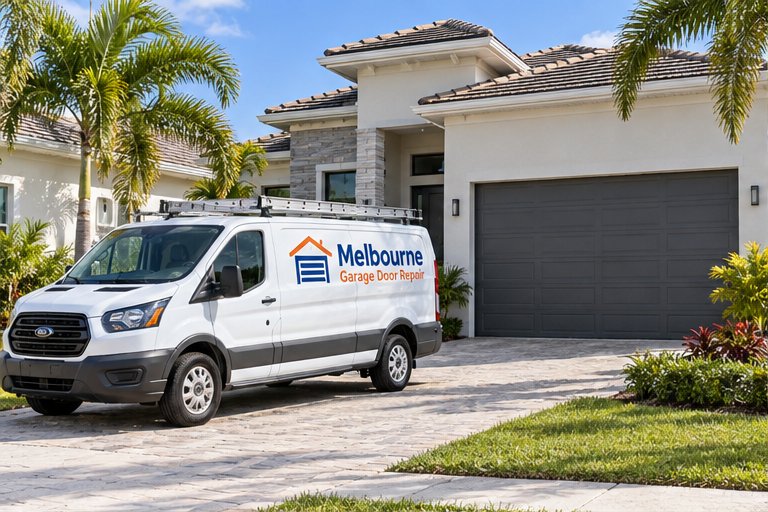
A large city built out in neighborhoods
Port St. Lucie is one of the larger cities in St. Lucie County, and it grew mostly through subdivisions rather than through a single old downtown. Drive a few miles in almost any direction and you pass another set of streets with matching rooflines, matching driveways and, behind them, matching garage doors. That pattern is the starting point for how we think about service here.
A garage door is the largest moving part of most homes. It is also one of the least noticed until it stops working. In a city where many households commute, run errands by car and bring groceries straight in through the garage, the door is not a decoration. It is the main entrance.
On this page we describe what we tend to see on homes across Port St. Lucie, how the age and style of the neighborhood shapes the repair, and how a visit works. Every door is still looked at on its own, but knowing the local housing helps us explain things clearly.
Newer homes, newer problems
Many Port St. Lucie homes are not very old, and people sometimes assume a newer house means a garage without trouble. In practice, a door installed during construction is usually a builder-grade door, chosen to meet a budget and a schedule rather than to last for decades of daily use.
That does not make it a poor door. It means the parts are standard, the springs are sized for a modest number of cycles and the opener is a straightforward model. When those parts reach the end of their rated life, they tend to do so within a few years of each other.
The most common calls on newer homes are a spring that has used up its cycles, rollers that have started to wear and grind, sensors that have been knocked out of alignment, and remotes that need to be reprogrammed after a battery change or a car swap.
- Spring wear from daily commuting use
- Nylon or steel rollers that have gone loose or noisy
- Sensor lenses that have shifted or collected dirt
- Opener travel limits that drifted after a power surge
- Weather seals that have flattened or pulled loose
What a subdivision tells us before we arrive
When we know the neighborhood, we know a good deal about the likely door. Homes built in the same stretch of years commonly share a door style, an opening width and a spring arrangement. If you tell us your street or the general age of the house, we can have a rough idea of the parts involved before we pull into the driveway.
We never assume, though. People replace doors, add openers, convert a single bay to a wide opening and install heavier insulated panels. A door that looks identical from the street can have a very different weight, and weight is what decides the correct spring.
This is why we weigh and inspect rather than guess. A spring that is wrong for the door is a spring that wears out early or leaves the door heavy and unbalanced. You can read how that works on our page about garage door weights and balance.
Two-car, three-car and wide openings
Port St. Lucie has plenty of homes with a double-wide garage opening, and a good number with a third bay for a golf cart, a workshop corner or just extra storage. A wider door carries more weight and puts more load on the springs, the cables and the opener.
Some owners of three-car homes use one bay with a separate single door and the other two with a wide door. Each door has its own springs and its own opener, so each one can wear differently. The bay used most is usually the first to need attention.
If you are thinking of changing the layout, such as turning two single doors into one wide one, it is worth talking it through first. A larger door needs a stronger header, the right track length and a suitable opener. Our page on new garage door installation explains what goes into that kind of change.
Homeowner associations and door rules
A lot of communities in the city have an association, and many of them have rules about what a replacement garage door should look like. The rules usually cover color, panel style, window placement and sometimes hardware. They rarely cover repairs of the working parts, which is a relief for owners who only need a spring or a roller.
If you are replacing a whole door, check your association's guidelines before you choose. Some require approval of the design before installation, and getting that in writing first saves frustration later. Our guide on HOA rules and garage doors covers the usual questions to ask.
We can help you describe the door you want in terms the association will understand, such as panel pattern, overall size and finish. We do not decide what your association will approve, but a clear description makes the process smoother.
Storm season and what it asks of a garage door
The Treasure Coast is hurricane country, and a garage door is often the weakest large opening in a house during high wind. Building rules in Florida address wind resistance for new doors, and many homes in newer subdivisions have doors built to meet those requirements. Older or replaced doors may not.
If you are not sure what your door is rated for, the label on the door often tells you. Our page on reading your garage door label shows where to look and what the markings generally mean.
Before storm season, a check of the track, rollers, hinges, weather seals and fasteners is worth doing. After a storm, a door that was hit by wind or debris should be looked at before it is run again, because a bent track or a cracked panel can fail under the opener. See hurricane season garage door service for what we look at.
Power surges, outages and the opener
Florida summers bring lightning, and lightning brings power surges. An opener is a small computer attached to a motor, and a surge can damage the circuit board, scramble the travel limits or leave the wall control dead. Plugging the opener into a surge protector helps, though it is not a full defense.
When the power goes out, the door will not run from the wall button. Every opener has a manual release cord, usually a red handle hanging from the trolley. Pulling it separates the door from the opener so you can lift it by hand, but only if the springs are intact. If the door feels extremely heavy, do not force it.
A battery backup is an option on many openers. If outages are common where you live and you rely on the garage as your main entrance, it is worth asking about. Details are on our page about battery backup for garage door openers.
Heat, humidity and moving parts
South Florida inland weather is hot and humid for much of the year. Heat dries out lubricant, makes plastic parts brittle over time and raises the temperature inside a closed garage well above the outside air. That heat is hard on openers, on batteries in remotes and on the springs themselves.
Humidity encourages rust on exposed steel, especially on the bottom edge of the door, the track fasteners and the springs. A light coat of the right lubricant on the moving parts, applied twice a year, helps. Heavy grease on the track does not; it collects grit.
If you want a schedule to follow, the seasonal garage door checklist sets out what to look at and when.
Sensors, remotes and daily irritations
Not every problem is a broken spring. A very large share of the calls we get involve the small stuff: a door that reverses when it should close, a remote that works only from the driveway, a keypad that has gone blank.
The safety sensors sit low on each side of the opening, and they are easy to knock with a bin, a bicycle or a lawn mower. If the lights on them are blinking or off, the door will not close properly. You can wipe the lenses with a soft cloth and check that both point at each other, but do not take apart the opener or the wiring.
Our guide to a door that reverses before closing walks through the simple checks, and tells you when to stop and call us.
Rentals, investors and absent owners
Port St. Lucie has many rental homes and second homes. A tenant may report that the garage door is stuck while the owner is hundreds of miles away. In that situation clear communication matters more than anything else.
If you are an owner arranging service remotely, tell us who will be at the property, how to get in and what the tenant has noticed. We will look at the door, explain what we find and what the options are, and you can decide from there.
Rental garages are used by different people with different habits, so small items such as remotes, keypad codes and batteries tend to need attention at turnover. Our page on garage doors for rental properties covers the practical side.
Boats, bikes, carts and the crowded garage
Garages in this part of Florida often hold more than a car. Golf carts, bicycles, fishing gear, kayaks and storage shelves all compete for space, and stuff stacked too close to the door can interfere with the track or the sensors.
Keep a clear zone on both sides of the opening and under the door. A sensor beam blocked by a box, or a track partly hidden behind a shelf, makes ordinary service harder and a failure more likely.
If your garage doubles as a workshop or hobby room, the door may be opened and closed more than it was designed for. That is worth mentioning when we visit, because spring life is measured in cycles, not years.
What a visit to a Port St. Lucie home looks like
We come to the property, look at the door and listen to what you have noticed. Then we check the springs, cables, rollers, hinges, track alignment, balance, opener operation and safety reversal. We explain what we find in plain language, and we describe the options before any work starts.
If a part needs replacing, we tell you which one and why. If something can wait, we say so. If something is unsafe to use, we say that too and explain what to avoid until it is fixed.
Our overview page what happens during a garage door service visit has the full sequence if you like to know in advance.
Driveways, drainage and the bottom of the door
Much of Port St. Lucie sits on flat ground, and driveways are generally gently sloped toward the street. After a heavy summer downpour, water can pool for a short time at the garage threshold. A door sitting in standing water now and then will show it first in the bottom seal and the lowest panel.
A bottom seal that has flattened, split or pulled out of its channel lets in water, leaves, insects and the occasional small animal. Replacing it is a modest job compared with the damage that damp can do to stored boxes and to the lower edge of the door itself. Our page on bottom seal and threshold service describes what is involved.
If water keeps coming in under the door, the cause may be the seal, the floor slope or the threshold, and sometimes all three. We look at what is happening, tell you which part of the problem belongs to the door and which does not, and leave the rest to you.
Choosing a replacement door for a newer home
When a door has reached the end of its useful life, owners often ask whether to repeat what they had or choose something different. Steel doors are common and sturdy. Insulated panels hold a little more heat out of the garage and tend to run quieter. Aluminum with glass suits some modern designs, and composite or wood-look finishes are popular where appearance matters.
In a coastal state with strong sun, finish and fasteners matter as much as the panel material. A door that looks wonderful on day one but fades or corrodes within a few seasons is a poor choice. Ask about how the finish is applied and what hardware comes with it.
Our comparison pages, including steel, aluminum, wood and composite doors, lay out the differences without a sales pitch. Take your time, check your association's rules, and ask us anything you are unsure about before you commit.
Small commercial doors across the city
Besides homes, Port St. Lucie has shops, workshops, storage units and light industrial buildings with overhead doors. These doors are used more heavily than a home door and often run on larger, heavier springs.
The same principles apply: inspect, balance, lubricate and correct wear before it becomes a failure. For businesses, an unexpected door problem can mean a delivery that cannot be received or a bay that cannot be locked. See commercial garage door service if that is your situation.
Keeping a Port St. Lucie door in good shape
The most useful habit is an ordinary one: look and listen. Once a month, watch the door go up and down. Notice unusual sounds, a slight lean, a pause at the same spot. A door tends to tell you before it fails.
Twice a year, wipe the track, lubricate the hinges and rollers, and test the safety reversal. Use the monthly garage door checklist as a guide, and call us if anything looks off.
Never try to adjust springs, cables or the brackets that hold them. Those parts hold dangerous tension. Leave them to a trained technician.
Questions and answers
We serve homes and businesses in Port St. Lucie and across the Treasure Coast and Space Coast communities listed on our areas page. If you are not sure whether your street is covered, get in touch and tell us the neighborhood. We will let you know and then look at the door once we are there. It helps to give us a street name or the name of your subdivision, since that tells us a lot about the likely age and style of the door before anyone arrives.
Builder-grade doors use standard parts rated for a limited number of cycles. A household that uses the door several times a day can reach that point sooner than expected. Rollers, springs, seals and sensor alignment are the usual items. A door can be fairly new and still need basic attention. If you are not sure which of these applies, tell us what you see and hear when the door moves, and we will start from there.
Sometimes, if the door style is still available and the damaged section is not part of a wider structural problem. In other cases the panels no longer match, and a full replacement makes more sense. We look at the door, explain which option fits, and describe the trade-offs so you can choose. We never promise that a part can be matched until we have seen the door in person and checked the style and finish.
Stay safe first. Do not run a door that has been hit by debris or wind damage. If the power is out, use the manual release carefully only if the door moves freely. If something looks bent, cracked or off the track, leave it alone and contact us once conditions are safe. Photos of any visible damage, taken from a safe distance, are useful when you get in touch.
Usually not for working parts like springs, rollers and openers. Replacing the whole door or changing its appearance often does require approval. Check your association's guidelines and keep a record. We can describe the door you want in simple terms to help with the application. A short written note from the association before work begins can save a lot of back and forth later.
A broken torsion spring often makes a loud bang from inside the garage. The door then feels very heavy or will not lift at all, and the opener may strain. If you suspect it, stop using the door and keep clear of the springs and cables. See our page on a snapped spring for more detail. Do not try to release, wind or adjust the springs yourself, because they hold dangerous tension and can cause serious injury.
If power outages are common where you live and you rely on the garage as your main entrance, a backup can help. It lets the opener run for a limited time without mains power. Not every opener supports one, so we check yours and explain whether it makes sense. It is a practical upgrade, not an essential one, and we are happy to explain the real benefits and limits first.