
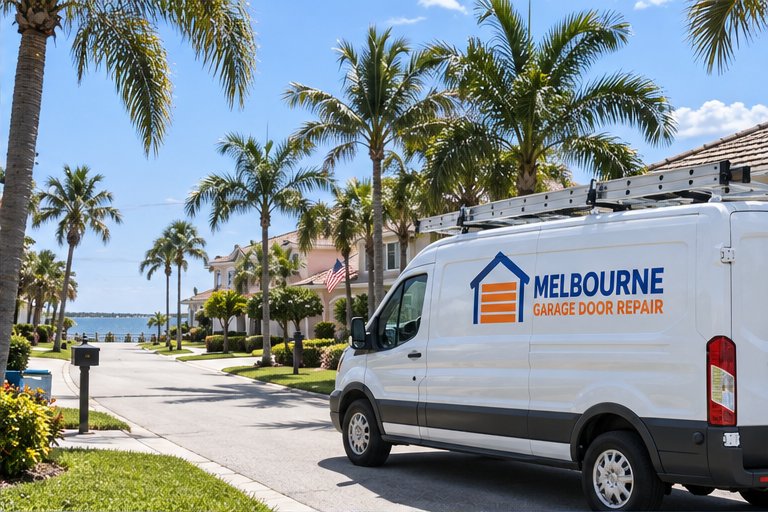
Where Sharpes sits and what that means for doors
Sharpes lies in the northern half of Brevard County, in the stretch between Cocoa and Titusville that runs along the western shore of the Indian River Lagoon. It is a quiet area compared with the busy beach towns, with a mix of long established homes and open land.
For a garage door technician, that picture tells a lot. Homes that have been standing a long time tend to have doors that were installed long ago, repaired more than once, and asked to keep going well past what the manufacturer imagined.
So a visit to Sharpes often starts with a conversation about history. Who installed the door? Was it replaced when the house was bought? How many times has it been fixed? The answers help us decide what to look at first.
The door you inherited
Many owners tell us they did not choose their garage door. They bought the house with it, and nobody wrote down its age or its make. That is perfectly normal, and we are used to working it out from the label, the hardware and the way the door behaves.
Older doors tell their story in the details: the style of the hinges, the shape of the track, whether the springs sit on a bar above the door or run along the sides, and whether the panels are wood, steel or something else.
Our guide to reading your garage door label shows where to look for the date and model. A photograph of the label and the opener is a good thing to send us before we visit.
Carports, shed doors and open garages
Not every building in a rural community is a tidy attached garage. You may have a carport that was walled in years ago, a lean to with a roll up door, a shed with a sectional door added later, or a barn opening that has been fitted with an opener.
Each of these asks a different thing of a door. A walled in carport may have a slab that slopes outward and a header that was never meant to carry a door track. A lean to may flex in the wind and twist the opening out of square.
We look at the opening and the frame before we talk about the door. A door can only work as well as the building around it, and sometimes the frame needs attention before any door will run smoothly.
A converted carport
The opening may be wider or lower than a standard door. Custom sizing, a header that sags or a track bolted to light framing are common findings.
A shed or workshop
These doors are often lighter and used less, but they sit in damp, dusty buildings where rust and wasp nests are frequent.
Gravel, dust and the long drive
Unpaved and rough drives carry dust and grit into the garage every time a car or a mower goes through. That fine abrasive settles in the tracks, packs around rollers and coats the lower edge of the door.
Rollers and hinges wear faster in a gritty garage, and a dirty track makes the door noisy. A habit of wiping the tracks with a dry cloth and sweeping the threshold goes a long way.
Wet weather turns that dust into mud, which cakes on the bottom seal and dries into a crust. A seal that is stiff with dried mud no longer presses evenly on the floor, and it lets in water and insects. Rinse it gently with a hose when the door is closed, let it dry, and look for cracks or flattened areas that suggest it needs replacing.
Standing at the end of a long drive and pressing a remote is also a test for range. If the remote works only when you are close, the battery, the antenna wire or the remote itself may need attention. Our page on a remote that is not working covers the basics.
Wood doors and the work of keeping them
Older homes in the area are likelier than newer ones to have wood garage doors. Wood is handsome and repairable, but it is heavy and it drinks up moisture. In our humid climate a wood door swells, sticks and sometimes rots at the bottom edge.
A wood door that has taken on water weighs more than the springs were set for. The extra weight makes the opener strain and speeds up wear on the cables and rollers. A door that was balanced years ago may now be out of balance without anyone noticing.
Sealing the edges, including the bottom, helps a wood door last. Our comparison of steel, aluminum, wood and composite doors explains the trade offs if you are considering a change.
Storms, wind and the lagoon side
North Brevard feels the same tropical storms and summer thunderstorms as the rest of the Space Coast. Open land lets wind move freely across a property, and a garage door on an exposed side of a building can take a hard push.
A door in good condition resists this better than a tired one. Panels that have begun to sag, hinges that have worked loose and tracks that have bent a little are the first places to fail.
Know where the manual release is and how to use it with the door closed. After a storm, if you see a bent panel, a sagging section or a track pulled from the wall, keep the door closed and do not try the opener. Our page on a garage door damaged after a storm explains the safe checks.
When the power flickers
Rural lines are long, and a storm or a falling limb can take out power for hours. Brief flickers are common in between. An opener goes through a lot of power cycles over the years, and each dip tests its electronics.
A power cut does not trap you if you know the manual release. Pull the red cord with the door fully closed, then lift the door by hand. If the door feels very heavy, stop and wait for help rather than forcing it.
Owners who rely on a generator should know that an unsteady supply can upset opener boards. Our guide to the manual release during a power outage explains what to do step by step.
Creatures that move into garages
A garage on open land is attractive to animals. Mud daubers and paper wasps like the ends of rails and the openings in opener housings, mice chew wire insulation, and snakes and lizards come in out of the sun.
Animals cause real faults: a chewed sensor wire makes a door refuse to close, a nest in a roller track makes it bind, and droppings in an opener housing can corrode the board. If you spot signs, deal with the pest first and let us look at the door afterward.
A well fitted bottom seal does a lot to keep creatures out. Please do not reach into a nest near the door or put your hands in a gap you cannot see.
Boats, trailers and utility vehicles
Near the water, a garage may shelter a small boat, a trailer, fishing gear or a four wheeler. Tall and wide vehicles brush the door opening or the top of the track, and a clip from a trailer hitch can dent a panel or knock a door off its rollers.
If you often park close to the door, consider marking a line on the floor or the wall where the vehicle should stop. A door that is hit even lightly can twist and need attention. Our page about a garage door hit by a car explains what to do after an impact.
Rinsing a boat or trailer near the garage sends salty and muddy water across the threshold. That is hard on the bottom seal and the lower panel, so it is worth directing runoff away from the door.
Seasonal homes and empty months
Some properties around Sharpes are used for part of the year, or sit empty while the owner is away. A closed garage left alone through a hot, damp summer can develop trouble silently: grease dries, rust spots form, batteries in remotes leak and seals stick to the slab.
Before you leave, give the door a simple look and test, and leave it closed and locked. When you return, run the door through a cycle before you rely on it. Our garage door vacation checklist sets out a sensible routine.
If the house is looked after by a neighbor or a caretaker, make sure they know how the door works, where the manual release is and whom to call if something goes wrong.
Security on a property with space around it
More land means more distance between your garage and the nearest neighbor. A door that stands open at night or a keypad code shared too widely is a risk that is easy to avoid.
Check that the door closes fully every time, that the lock, if you have one, is actually used, and that the release cord cannot be reached from outside. Replace the codes on a keypad now and then, and remove remotes you no longer need.
A door that is open for long stretches while you work in the yard is also an invitation, so closing it behind you is a habit worth forming. Tell the family and any helpers, and make sure the wall control inside is out of reach of small children.
Good lighting at the door deters trouble. The opener light helps inside, and a lamp outside helps when you arrive. The opener bulb that burns out repeatedly is a symptom we can look at.
Parts for older equipment
Equipment that is decades old can be harder to match. A hinge, a roller or a bracket from a discontinued model may not be stocked, and an opener from a long vanished brand may not have parts at all.
Rural properties also sit farther from supply houses, so a part that has to be ordered can add a wait. We prefer to say so early and to suggest what can be done safely in the meantime, rather than leave you wondering.
When this happens we explain the choice honestly. Sometimes a close match works. Sometimes the sensible route is to replace a worn component with a modern equivalent. And sometimes a door or an opener has reached the end of its service life and replacement is the more reasonable course.
Our guide to repairing or replacing your garage door lists the questions that help settle this.
What happens when we visit
We come to the property, find the door or doors that need attention and ask what has been happening. A short walk around the building helps us see the setting, the slab and the frame.
Then we examine the door, hardware, opener and power, test the safety features and explain what we find. Where there are options, we lay them out and say which we would lean toward.
Nothing is changed until you understand it. If a part needs ordering, we tell you before we leave.
Older openers in older buildings
An opener that has outlived two owners tells its own tale. Chain drives that have stretched, screw drives that have dried, motors that hum before they commit and wall controls with worn buttons are all part of the picture in homes that have stood a long while.
Older units were also built to older safety standards. Many lack the monitored sensors and the sensitive reversing response that new openers include, and wiring in an old building may not match what a modern unit expects. We check the reversing and the sensors on every opener we touch, whatever its age.
If an opener is working but ancient, we tell you what we see without pushing a replacement. Some owners are happy to keep a reliable old unit and repair it as needed, while others prefer to modernize, and either is a reasonable choice. Our page on garage door opener repair describes how we approach it.
Sun, humidity and the slow work of weather
Long, bright summers fade paint, bake rubber and dry the grease out of hinges. Humidity then does the opposite, encouraging rust where the coating has failed and swelling anything made of wood. A door sees both extremes in the same year.
On an open property the sun reaches the door for most of the day, and a dark door in full sun can grow very hot. Seals along the edges harden and crack, and the gap that results lets in dust, insects and rain.
A simple walk around the door once a season, looking at the seals, the paint, the hinges and the lower edge, catches many small things. Our monthly garage door checklist suggests an easy routine.
Getting in touch from Sharpes
If your door is sticking, noisy, crooked or no longer opening, contact us and tell us what you notice. It helps to say what kind of building the door is on, how wide the opening is and roughly how old the door seems.
You can reach us through the contact page. We will explain what we find and what the options are.
Questions and answers
Yes. We serve homes and properties across the Space Coast, including Sharpes and the nearby communities of Cocoa and Titusville. We come to the property, look at the door and opener, and explain what we find and what the options are before anything is changed. Contact us and describe the building and the problem.
Yes. Wood doors are heavy and sensitive to moisture, so we look at the panels, the balance and the hardware, and tell you honestly whether repair is sensible. We handle spring and cable work ourselves and ask owners not to try it. If a replacement makes more sense, we describe what it would involve.
Not necessarily. Unusual sizes and light framing are common on converted buildings. We check the opening, the header and the track mounting before we discuss parts, and explain what is workable. Sometimes the frame needs attention first. Tell us the width, the height and what the building is used for.
Keep clear and do not disturb nests near the door. Have the nest dealt with first, then let us check the rails, rollers and opener for damage. Chewed wires and nests in moving parts can stop a door, and we can find and fix those once the area is safe.
A weak battery is the usual cause, followed by a bent or coiled antenna wire on the opener, moisture in the remote, or radio noise from a bulb. Try a fresh battery and test the remote again from the end of the drive. If the range does not improve, we can check the receiver and the remote.
Yes, when the door is fully closed and balanced. Pull the red cord with the door down, then lift by the handle. Never release an open door, since a weak spring can let it fall. If the door feels very heavy or unusual, stop and contact us rather than forcing it.
Yes. A check before a long absence helps catch worn parts and sticking seals. We look at the door, the springs and cables, the opener and the remotes, and explain what we find. Ask us when you contact us and tell us how long the property will be empty.