
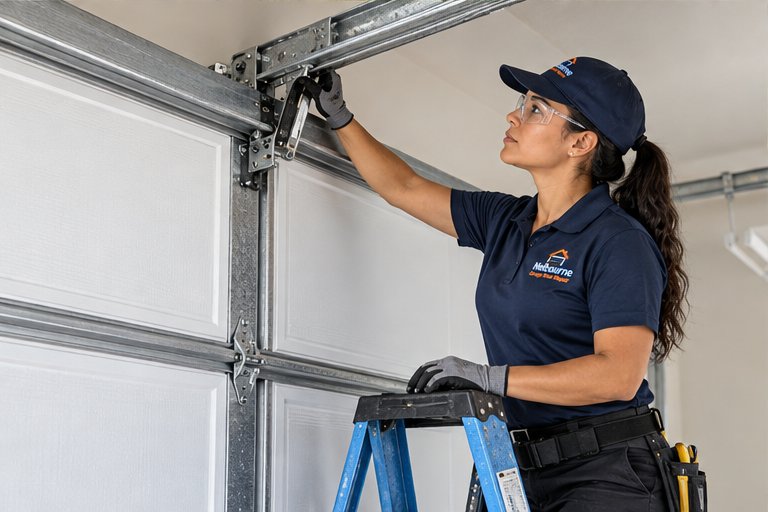
Why the garage door belongs on your travel list
Most people remember to stop the mail, set a thermostat and turn off a few lights before a long trip. The garage door often gets left out, even though it is the biggest opening in the house and the one that moves with the most force. A door that fails while you are gone can leave the garage open, the car exposed and the house door behind it unprotected.
A failure while you are away also costs you something harder to measure: you will not know about it. A door that is slightly off track on Monday can be fully jammed by the time you return, and a seal that was only tired in May can let in a summer of rain by August. A short check before you leave catches those small problems while they are still small.
This guide is written for homeowners on the Space Coast and anywhere else with warm, humid weather and a long storm season. It sticks to things you can see, hear and test with ordinary care. It never asks you to touch the springs, the cables or the brackets that hold them, because those parts carry dangerous tension and belong to trained technicians.
The week-out inspection: look at the whole door
With the door fully closed, stand in the driveway and look at the door as a whole. The bottom edge should sit level, with no light showing along one side that is not showing along the other. The panels should line up in a clean row. A door that looks slightly tilted, bowed or uneven is telling you something is already wrong.
Then step inside and look along each side of the door. The tracks should be straight, firmly attached to the wall and clear of dents. The rollers should sit inside the track, not hanging out of it. The hinges between the panels should look flat and tight, with no cracks or bent metal around them.
- Look along the top edge of each panel for cracks, splits or soft spots.
- Check the bottom panel closely, since it takes the most abuse from mowers, bicycles and bumpers.
- Look at the tracks for dents, rust streaks or gaps where they meet the wall.
- Look at the hinges and roller stems for rust, cracks or a loose fit.
- Look at the cables that run along each side, but do not touch them. Note any that look frayed, unwound or sitting off their drum.
- Look at the springs above the door, again without touching. Note any gap in the coil, an obvious stretch or a sagging look.
Listen to one full cycle
Stand inside the garage and run the door through one complete cycle from the wall button: open, pause, close. Do not do this while anyone or anything is under the door. Listen to the whole movement, not just the start.
A healthy door has a steady, even sound. Rollers rolling, the opener motor humming, and a soft stop at each end. What you are listening for is anything that was not there last month: grinding, popping, scraping, squealing, or a rhythmic knock as the door travels. Those sounds are early warnings, and a long trip is a poor time to ignore them.
Watch the movement as well. The door should rise and lower smoothly, without a shudder, a jump or a pause. If it hesitates, stops partway or reverses without a reason, write down exactly what happened and when. That description will help a technician more than any guess about the cause.
Sounds worth writing down
A single odd noise once is not a crisis, but a sound that repeats on every cycle is a pattern. Note where in the travel it happens, near the bottom, near the top or all the way through, and whether it comes from one side. If you want a sound by sound reference, a guide to diagnosing garage door noises explains what each one usually points to.
Movement worth writing down
Slow starts, jerky travel, one side moving ahead of the other, or the opener straining are all worth a note. If the door feels wrong, do not keep running it to see whether it improves. Repeated cycles on a struggling door can turn a small problem into a bigger one.
Test the photo eyes and the reversal
The safety sensors sit near the floor on either side of the door, and they are what stop a closing door from landing on a person, a pet or a car bumper. Before you leave, make sure they are doing their job, because a house sitter or a neighbor may be using the door while you are away.
First, wipe each lens gently with a soft, dry cloth. Dust, pollen and cobwebs build up faster than most people expect. Then check that the indicator light on each sensor is steady and not blinking. A blinking light often means the two sensors are no longer pointing at each other, a problem covered in more detail in the explainer on blinking sensor lights.
Finally, run a simple obstruction check. With the door open, place a roll of paper towels or a similar light object in the path of the beam and press the close button. The door should stop or refuse to close. If it keeps closing, do not use it that way and do not leave it unaddressed. Have the sensors looked at before you go.
Remotes: count them, test them, collect the strays
Before a trip, take inventory of every remote that opens your door. Visor remotes in cars, small keychain remotes, remotes in a spare drawer, and the one a previous owner may have left behind all count. A remote that is not accounted for is a way into your garage that you do not control.
Test each remote you plan to keep. If one is weak or inconsistent, replace the battery now rather than when you return. Batteries in remotes tend to fail without much warning, and a house sitter standing in the driveway with a dead remote is a small problem that gets bigger.
If you are leaving a car at the house, think about where its visor remote will be. A vehicle parked in the driveway with a remote clipped to the visor is an invitation. Take the remote with you or store it inside the house.
- Gather every remote and keychain fob in one place.
- Replace weak batteries and test each remote from the driveway.
- Take visor remotes out of any car that will stay parked outside.
- Remove or erase remotes you no longer recognize, using the steps in your opener manual.
- Give a spare to your house sitter only if they truly need it, and plan to collect it afterward.
Keypad codes and temporary access
A wireless keypad on the outside of the garage is convenient, and it also makes a good point to tidy up before you leave. If the same code has been in place for years, now is a sensible time to change it. Many families give out the code to a cleaner, a landscaper, a relative or a contractor and never think about it again.
If your keypad supports a temporary code, consider using one for a house sitter, so the access ends on its own. If it does not, choose a new code for the trip and change it again when you get home. Avoid easy patterns such as birthdays, street numbers or repeated digits.
The general steps for changing a keypad code differ from one model to another, so rely on the manual that came with your opener. If you need background on how remotes and keypads pair with the opener, programming garage remotes and keypads gives the general picture and the idea behind rolling codes.
Lock mode on the wall control
Many wall controls have a lock or vacation setting. In general terms, this setting tells the opener to ignore signals from remotes and keypads while still allowing the wall control itself to work. The idea is that nobody can open the door from the driveway, even with a valid remote, until you switch the lock off.
The name, the button combination and the exact behavior vary by opener, so check your manual. Some openers show a blinking light on the wall control while the lock is active. Test it before you leave: turn the setting on, step outside, press a remote, and confirm the door does not respond. Then step back inside and confirm that turning it off restores normal operation.
Be sure everyone in the household knows the setting is on. A family member who comes home early and cannot get in is a common result of a forgotten lock setting. A note on the inside of the house door, or a message to the group chat, avoids a lot of confusion.
Should the opener stay plugged in?
Some people unplug the opener for a long trip. There are reasons for it: it prevents the door from being triggered by a stray signal, and it removes the opener from the circuit during a power surge. There are also reasons against it. An unplugged opener cannot respond to a smart control, cannot run a battery backup properly, and can leave the garage light off at night.
There is no single right answer for every home. What matters is that you decide on purpose and that your choice does not leave the door in an unsafe state. If you unplug the opener, make sure the door is fully closed and latched first, and remember that an unplugged opener does not lock the door in the way a secured lock mode would.
A surge protector designed for the opener's plug is a simple middle path. It keeps the opener powered while giving it some protection during Florida's frequent summer thunderstorms. If you are unsure, ask a technician about the specifics of your model when you schedule your pre-trip check.
A note on the emergency release cord
The red cord that hangs from the opener track disconnects the door from the opener so it can be moved by hand. Some people pull it before a long trip, thinking it locks the door. It does not. A disconnected door can often be lifted by hand, which makes it easier to open, not harder. Leave the release alone unless you have a specific reason, and read using the manual release during a power outage if you want the safe way to use it.
Smart openers and notifications while you are away
If your opener connects to a phone app, a trip is where that feature pays off. You can see whether the door is open or closed, receive an alert when it moves, and in some systems close it remotely if you realize you left it up. Before you leave, open the app and make sure it is connected and reporting the right state.
Turn on notifications for door activity, and decide who else should receive them. A neighbor who gets the same alert you do can walk over and look if the door opens unexpectedly. Check that your home Wi-Fi is stable and that your router will not restart in a way that logs the opener out of the network.
Review who has access to the app. Old family members, former tenants and past house sitters sometimes stay on an account long after they need to. Remove anyone who should no longer have access, and use a strong, unique password. For more on how these systems work and the habits that keep them safe, see smart garage door openers: the basics.
Power outages, storms and the closed-door problem
In this part of Florida, a long trip often falls inside storm season, and a power outage while you are away is a real possibility. A standard opener will not run without power, which is not itself a problem if the door is closed and latched. The trouble comes when someone needs to open the door during an outage and does not know how.
If you have a battery backup on the opener, check its indicator before you go. Batteries in these units wear out over time and often give no sign until the day they are needed. If you do not have one, make sure your house sitter knows the manual release exists and has been shown how to use it, or leave the operation to a technician.
If a named storm is forecast while you are away, your garage door is part of your storm plan. A guide on preparing your garage door for storm season covers what to inspect and what to ask about, and it is worth reading before you leave for the summer rather than after the forecast changes.
Seals, gaps and what the weather can do in your absence
A garage that sits closed for weeks in humid heat behaves differently than one that is opened daily. The bottom seal can stick to the floor in the heat, then tear when the door first moves. Moisture can collect along the threshold. Insects and small animals look for any gap under or beside the door.
Look at the rubber seal along the bottom edge of the door. It should be flexible, continuous and in contact with the floor along its full length. A seal that is cracked, flattened or pulled away from its retainer is worth replacing before a summer of rain and heat. The side and top seals matter as well, since they keep out wind-driven rain.
If you see daylight under a closed door, or water has reached the floor after a storm, that is useful information to share with a technician. Gaps and leaks are covered further in the pages on bottom seal and threshold service, which explains the options in general terms.
Instructions for a house sitter or neighbor
Whoever is watching your home should know three things about the garage: what normal looks like, what to do if something seems off, and what not to do. A one page note taped inside the house is better than a long conversation that will be forgotten by the second day.
Include whether the lock setting is on and how to turn it off. Tell them that if the door will not open or close, they should not try to force it, should not stand under it and should not touch the springs or cables. Give them the contact information for the company you want them to call, and make clear that a call is better than a guess.
- Where the wall control is and whether lock mode is on.
- Which remotes or codes they may use.
- What to do if the door does not respond: stop, do not force it, and call.
- Who to contact and how to reach you.
- A reminder to call 911 if anyone is hurt.
A one page checklist you can copy
Use the table below as a working list. Print it, copy it into your notes, or tick it off on your phone. The right column shows what a good result looks like, so you know when a step is done and when it needs a second look.
| Step | What a good result looks like |
|---|---|
| Look at the closed door from outside | Level edge, even panels, no visible lean or bow |
| Look along the tracks and hinges | Straight tracks, rollers in the track, tight hinges |
| Run one full cycle and listen | Smooth travel, no new grinding, popping or scraping |
| Wipe sensor lenses and check their lights | Both lights steady, no blinking |
| Test the obstruction check | Door stops or refuses to close with an object in the beam |
| Count and test remotes | Every remote accounted for and working, batteries fresh |
| Change or review keypad code | A code only the right people know |
| Turn on lock mode and test it | Remote ignored from outside, wall control still works |
| Decide on opener power | A deliberate choice, door closed and latched |
| Check smart app and alerts | Connected, correct door state, alerts going to the right people |
| Check bottom and side seals | Flexible, continuous, touching the floor |
| Lock the house door and any side door | Locked and in good working order |
| Brief your house sitter | A written note with contact information |
When to call before you leave
Some findings are small and can wait for a regular visit. Others are better handled before you travel. If you see a frayed or off-drum cable, a gap in a spring coil, a door that leans, a track that has pulled from the wall or a door that reverses for no clear reason, stop using the door and have it looked at.
A garage door that is already in trouble is a poor candidate for weeks of unattended storage. If the opener strains, the door shakes, or you hear a bang followed by a door that feels heavy, do not run it again. A snapped spring, for example, is described in more detail under a spring that snapped with a loud bang, and it is not something to leave alone.
When you contact us, describe what you saw and heard, how old the door is if you know, and when you plan to leave. We will explain what we find and what the options are, and you can decide what makes sense before you travel.
When you get home: the return checklist
Arriving home is a good moment for a second look. Before you pull into the garage, stop in the driveway and look at the door. Is it where you left it? Is it closed? Is there anything on the ground in front of it? Water stains, debris or disturbed items near the door tell you something happened while you were away.
Turn off lock mode, restore opener power if you removed it and run the door through one full cycle while standing clear. Listen for new sounds, watch for any change in how it travels and check the sensors. If you changed your keypad code or removed remotes, confirm that the new setup works for everyone who needs it.
Write a short note about anything unusual, even if the door seems fine. Small changes show up in a log long before they show up as a breakdown. A regular routine of the kind described in a monthly garage door checklist is the natural next step once you are settled back in.
Questions and answers
It depends on your home and your opener. Unplugging removes the opener from the circuit and stops stray signals, but it also disables smart features, battery backup and the garage light. Whatever you choose, make sure the door is fully closed first. A lock mode on the wall control is often a simpler option, and your manual explains how it works on your model.
No. The red cord disconnects the door from the opener so it can be moved by hand. A disconnected door can often be lifted manually, so pulling the cord can make the door easier to open, not harder. It is meant for outages and emergencies. Leave it alone before a trip unless a technician has told you otherwise for your door.
Turn the lock or vacation setting on at the wall control, then step outside and press a remote. The door should not respond. Go back in and confirm the wall control still works, then switch the setting off and test a remote again. The exact steps and indicator lights vary by opener, so follow the manual that came with yours.
Tell them what is normal, how to use the wall control and whether lock mode is on. Make clear that if the door will not move, they should stop, avoid forcing it and never touch the springs or cables. Leave a contact number for a technician and for you. A short written note works better than a verbal briefing.
Yes, any mechanical system can fail at any time. Springs, cables, rollers and sensors wear with use and weather. A pre-trip inspection will not prevent every failure, but it often catches signs of wear before they turn into a breakdown, so you can have the door looked at before you leave rather than finding a problem when you return.
In hurricane season it is wise to plan ahead. Know who can check the property, whether your door is rated for wind in your area and whether the opener has a battery backup. Check your local building rules and your HOA if you plan any changes. A technician can review the door and explain the general options.
Look at the door from the driveway first, then turn off lock mode and restore power if you removed it. Run one full cycle while standing clear, listen for new noises and check the sensors. Look at the seals and floor for signs of water or pests. Note anything unusual so a technician can see the pattern.