
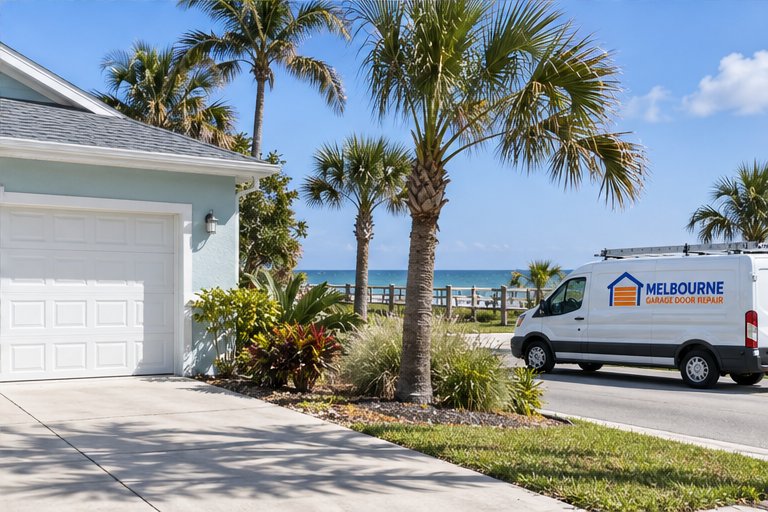
Living on a long strip of sand
Hutchinson Island is a barrier island that stretches along the Atlantic coast and is shared by St. Lucie and Martin counties. The Indian River Lagoon lies to the west, the ocean to the east, and in many places the island is only a short walk wide. Almost every garage on it sits within easy reach of salt air.
That one fact explains most of what we see on garage doors here. Metal parts that would last a long time inland tend to corrode sooner when they are bathed in damp, salty air week after week. Hinges, track brackets, cable ends and the hardware that holds the opener to the ceiling all feel it.
This page is written for people who own, rent, manage or look after property on the island. It starts with the setting, moves through the kinds of buildings you find here, and then explains what we look at when we are asked to visit a garage door.
What salt air does to moving metal
A garage door is a machine with a lot of moving metal parts, and salt is hard on every one of them. Rollers have steel shafts and bearings, hinges have pins, tracks carry the load, and springs are coiled steel wire. When moisture and salt settle on bare metal, rust starts at the edges and in the tight spots where parts rub together.
Rust on the surface is not always a problem, but rust that pits the metal or locks a hinge pin is. A seized roller no longer turns, so it drags along the track instead and makes a scraping sound. A spring that is rusted along its coils can lose strength or break sooner than one that has been kept clean and lightly lubricated.
- Look for orange or brown streaks around hinges and track brackets.
- Check whether rollers still spin freely or have stopped turning.
- Notice any white powdery crust on hardware, which is a sign of salt buildup.
- Listen for new squeaks or scraping that were not there last season.
Beach homes and ground level garages
Single family homes on the island range from older cottages to large modern beach houses. Many are raised on pilings or elevated slabs, with the garage and storage tucked underneath at ground level. These garages face the wind, blowing sand and, during heavy weather, standing water.
Because the door is at the base of the building, it often takes the brunt of what the weather throws at it. Sand works its way into tracks and sits in the bottom seal. Wet floors keep the lower panels damp, and over time that can corrode the bottom bracket and the lower edge of a steel panel.
A door that is cleaned and looked at now and then holds up far better in this setting. Brushing sand out of the track, wiping the lower panel and checking the seal are small habits that matter. Our maintenance and tune-up service covers all of these points in one visit.
A day in the life of a vacation property
A good share of the homes and condos on the island are second homes or rentals, and they sit unused for stretches of the year. You might think a door that is rarely opened would last forever. In practice it can be the opposite, because parts that do not move are the ones that seize.
Cables and springs under tension stay under tension. Lubricant dries out. Seals harden in the heat. When the owners finally arrive for the season, the first thing they do is press the remote, and that is when a stiff or damaged part gives way.
If you manage a property like this, a visit before the busy months is sensible. We can check the door while it is still working, rather than after it has failed with guests waiting. Our guide to the garage door vacation checklist lists what to check before you leave.
Wind, storms and the island
Barrier islands feel storms first. A garage door is among the largest openings in a house, and a door that is weak or poorly maintained can be a point of failure when strong wind arrives. For that reason the condition of your door, its track and its fasteners matter before a storm, not after.
We do not make claims about how any door will perform in a particular storm, and we are not a substitute for local building rules. What we can do is look at the door, check that the panels, hinges, track and mounting are sound, and tell you plainly where the weak points are.
Read garage door hurricane preparation for the practical steps that belong to the owner, and see our hurricane season service for what we can inspect on the door itself.
Timing is worth thinking about as well. Doors tend to fail at inconvenient moments, often just as a storm is approaching and many households are asking for help at once. Looking at the door in calm weather leaves time to repair a worn part properly, instead of hurrying under pressure.
After the storm has passed
Once the weather clears, a garage door deserves a careful look before anyone tries to use it. Wind can push panels out of shape, bend the track, knock rollers loose or shift the opener on its mounting. A door that looks fine from outside may be sitting off its track on the inside.
If the door is stuck or looks twisted, stop and do not keep pressing the button. Running the opener against a door that is jammed can bend panels further or strip the opener gears. If there has been flooding, keep clear of any opener that has been in water, because the electrical parts may not be safe.
Signs the door took damage
Panels that bow inward, gaps along the edge of the door, a track that no longer looks straight, or a cable hanging loose are all signs that something moved. Take a photograph before touching anything. It helps when you speak to an insurer and when you explain the situation to us.
What to leave alone
Springs, cables and the brackets that hold them are under great tension and must be left to a trained technician. If you see a damaged spring or a loose cable, keep people away from the door. Read about a garage door damaged after a storm for a fuller checklist.
Openers in a damp environment
The opener is the part most people think of first, and in a coastal setting it needs some extra care. Moisture can find its way into the housing, onto the circuit board and into the connections at the wall button and safety sensors. A board that has been damp may behave strangely, with lights flashing or the door reacting on its own.
Chain drive openers can pick up rust on the chain itself, which makes the opener louder. Belt drives avoid that particular problem but still depend on a clean, dry rail and trolley. Whatever type you have, keeping the opener dry and the mounting tight helps.
If your opener has started to hum, stutter or ignore the remote, it is worth having it looked at before it stops completely. See garage door opener repair for what is involved, and battery backup if power cuts are a concern on the island.
Power outages and getting the car out
Storms and even ordinary summer thunderstorms can interrupt power on the island. When that happens an electric opener will not lift the door, and the emergency release becomes the only way in or out. Every household member who drives should know how it works.
The release is usually a red cord with a handle hanging from the trolley. Pulling it disconnects the door from the opener so it can be moved by hand. This is safe only when the door is closed and the springs are in good order, because a door with a broken spring can fall or be very heavy.
We explain the sequence step by step in using the manual release during a power outage. If the cord is stuck or the door refuses to move by hand, do not force it, and have the door looked at.
Springs, cables and the load they carry
Behind the calm look of a panel door sits a counterbalance system that does the real lifting. Springs store energy, cables transfer it, and the opener mostly guides the door rather than carrying its weight. If the springs fail, the opener is asked to do a job it was never built for.
In a salt air setting both springs and cables deserve attention. Light surface rust on a spring is common, but heavy rust or visible gaps in the coils are not. Frayed strands on a cable, or a cable that has slipped off its drum, are warnings that should be taken seriously.
None of this is work to attempt yourself. Springs and cables hold dangerous tension and can cause serious injury if released. Learn more in broken torsion spring repair and in our page on a spring that snapped with a loud bang.
Seals, gaps and the creatures that visit
A worn bottom seal does more than let in air. On an island with sandy ground and frequent rain, a gap under the door lets in blowing sand, water, leaves and small animals. Garages near the water also attract insects and the occasional lizard looking for shade.
Seals are inexpensive in the scheme of things to replace compared with the damage they prevent. A cracked or flattened bottom seal, or a gap at the sides or top of the door, is visible from inside with the door closed and the light behind you.
Our pages on weather seal replacement and a gap under the garage door explain what we check and what the options are.
Boats, bikes and beach gear in the garage
Island garages are full of the things that make island life enjoyable. Paddleboards, kayaks, bicycles, fishing rods, folding chairs and sometimes a golf cart all compete for space. The door has to clear all of it, and the opener has to cope with being opened and closed many times in a day.
Frequent use shortens the life of springs and rollers, which are built for a certain number of cycles. If your door is opened every time someone heads to the beach, it will reach the end of that life sooner than a door used only for parking.
Mention how the garage is used when you ask for a visit. A door that works hard may benefit from different parts, or simply from more regular attention. Read how long garage door springs last for the reasoning behind this.
Commercial doors along the island
Not every garage door on the island belongs to a house. Marinas, small shops, service buildings and maintenance sheds use overhead doors too, and some of them are opened and closed all day. A busy commercial door wears out its parts sooner, and downtime is a real cost to the business.
Commercial doors are often larger and heavier than home doors, with stronger tracks and different springs. They also face the same salt air, so corrosion is a regular concern. Planned maintenance usually costs the owner less trouble than an unplanned failure.
If you run a business on the island, our commercial garage door service page explains how we approach larger doors, and maintenance for business owners gives a practical routine.
What to expect when we visit
We come to the property, listen to what you have noticed, and then look at the door in person. We open and close it, watch how it moves, check the balance by hand, and look at the springs, cables, rollers, hinges, track, seals and opener. We do not guess from a distance.
Once we have seen the door we explain what we found in plain language, including what is urgent, what can wait and what is simply wear. You will hear the options before any work begins, and you decide what to do.
If you want to know more about the process, see what happens during a garage door service visit. If you have questions first, contact us and we will talk it through.
Simple checks you can do between visits
You do not need tools to keep an eye on a garage door. A few minutes every month, with the door closed and then open, can catch problems early. Rinse away salt or sand where you can, and never use a pressure washer on the opener or electrical parts.
Stop and call someone if anything looks wrong with the springs or cables. Do not try to adjust them, and do not stand under a door that is moving unevenly.
- Watch the door travel and note any jerks, tilts or new noises.
- Test the safety sensors by waving an object in the path while the door closes.
- Press the remote from the driveway and from inside to check reception.
- Wipe sensor lenses with a soft cloth to remove salt film or dust.
- Check that the door stays still when lifted halfway by hand with the opener disconnected, only if you are confident the springs are intact.
Questions and answers
It can. Salt and moisture speed up rust on hinges, rollers, track brackets, cable ends and springs. A door on the island that is cleaned and lightly lubricated often lasts well, while one that is ignored may show corrosion sooner. We look at the metal parts during a visit and tell you which ones show wear. See garage doors in a coastal climate.
That depends on your association. Some buildings treat the door as the unit owner's responsibility, while others own and maintain every door. Check your governing documents or ask your property manager before arranging a visit. We can inspect the door and explain what is wrong, and you or the association decide how to proceed. Contact us with any questions.
Yes, it is sensible. Parts that do not move tend to seize, lubricant dries, and seals harden in the heat. Opening the door for the first time after a long gap is when a stiff or worn part is most likely to fail. A visit before the busy season lets us find problems early. See maintenance and tune-up.
Use the manual release, which is usually a red cord hanging from the opener trolley. Pull it only with the door fully closed and, if possible, with the springs in good order. Then lift the door by hand carefully. If the door is heavy, crooked or stuck, stop and do not force it. Read about the manual release.
Often, yes. We look at panels, hinges, track, rollers, springs and the opener to see what was affected and whether it can be repaired or needs replacing. Take photographs before anything is moved, and keep clear of damaged springs and cables. See a garage door damaged after a storm for what to check. We explain what we find before any work begins, so you can decide.
Yes. Marinas, shops and service buildings use overhead doors too, and we look at them in much the same way, allowing for their larger size and heavier parts. Busy doors benefit from regular maintenance. Our commercial garage door service page explains the approach, and you can contact us to arrange a visit. We explain what we find before any work begins, so you can decide.