
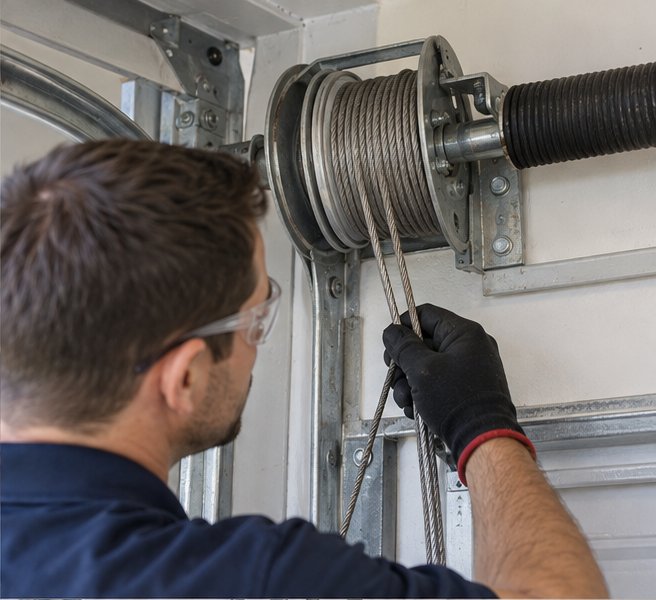
Two thin cables with a big job
On most residential sectional doors, a steel cable runs up each side of the door. It looks slim and unremarkable beside the broad panels, which makes it easy to overlook. Yet each cable is connected to the lower corner of the door at one end and to a drum at the top at the other, and together they carry the lifting force that the springs create.
When the system is working, you never think about them. The door goes up, the cables wind onto their drums, and the door comes down as they unwind again. When one cable frays, slips or breaks, the effect is immediate. One side of the door loses its support, and the door can tilt, jam or fall.
That is why cable condition is a safety topic and not only a repair topic. Understanding what the cables do, and why the hardware around them must be left alone, helps you protect yourself and your family.
How the cable system works
Torsion springs are mounted on a bar above the door. At each end of the bar is a drum with a groove. The cable is anchored to the drum, and the other end is attached to a bracket near the bottom of the door. As the spring unwinds, it turns the bar and the drums, and the cables wind onto the drums, lifting the door.
The spring supplies the force, the cable delivers it, and the drum converts the turning of the bar into a lifting pull. Both sides must be even, because the door is wide and each side needs to rise at the same rate. If one cable is slack or one drum is slipping, the door goes up crooked.
Extension spring systems use cables differently. There, the cable runs through pulleys and acts as a safety restraint and a lifting path. The details differ, but the principle holds that the cable is part of a loaded system. Read our guide to how garage doors work for the full picture of how these parts fit together.
Why the lower bracket is dangerous to touch
The bracket at the bottom corner of the door deserves special attention. It is attached to the door and holds the cable end under tension whenever the door is closed. This is the single most hazardous spot for an untrained person. Loosening or removing the bracket while the cable is loaded can release a great deal of force suddenly.
Serious injuries from garage doors have happened to people who tried to adjust a bottom bracket, remove a panel or move a door without realizing that the cable was loaded. The danger is not obvious from the outside, since the bracket looks like an ordinary piece of hardware.
We do not recommend that anyone other than a trained technician adjust, loosen or replace cables, brackets, drums or springs. The safe approach is to observe, keep clear and call for help.
What you can safely look at
You do not need to touch anything to learn a great deal. With the door closed and nobody under it, stand to the side and look at each cable. Does it run straight and taut from the bottom corner to the drum? Is it seated in the groove? Does it look the same on both sides?
From the floor you can also notice whether the door sits level, whether the two sides appear to rise together, and whether a cable has loosened or hangs. Look from a safe distance and avoid reaching toward the area, even briefly. A flashlight can help you see details without getting close.
A short description to a technician, such as a loose cable on the left side or a strand sticking out near the bracket, gives them an advantage before they arrive. Photos taken from a distance can help, as long as you stay clear while taking them.
- Look from the side, not from underneath the door
- Compare the left and right cables
- Note any visible fraying, rust or kinks
- Notice whether the door sits level when closed
- Never touch the bottom bracket, the drum or the springs
Signs of cable wear
Steel cable is made of many fine strands twisted together. As the cable wears, individual strands break and stick out like tiny wires. This is called fraying, and it is one of the clearest signs that a cable is nearing the end of its useful life. You may see it near the drum, where the cable winds, or near the bottom bracket.
Other signs include rust, a flattened or kinked section, a cable that looks thinner in one place, or a cable that has started to loop or hang with slack. In coastal Florida, moisture and salt can accelerate corrosion, so a cable that looks dull or discolored deserves attention.
Not every blemish is serious, and not every cable that looks rough is about to fail. The point is to notice changes and report them, so that a technician can decide whether the cable should be replaced before it gives way.
Signs that a cable has slipped or come off the drum
Sometimes the cable does not break but leaves its groove. This can happen when the door is hit, when a spring has broken and the door has dropped, when the cable has gone slack, or when something has jammed the door. A cable that has come off the drum no longer lifts its side, and the door will tilt.
You may see one side of the door higher than the other, a cable that hangs loose near the track, or a cable wound unevenly on the drum. You may hear a bang, a scrape or a thud. The opener may run but not lift the door properly, or the door may jam partway.
If this is happening, stop using the door. Running the opener can make matters worse by bending the door or tangling the cable. Our page about a cable that snapped or came off the drum explains what the situation looks like and what a technician will do about it.
When a cable breaks
A cable that breaks usually does so with a snap and a sudden loss of support on one side. The door may drop, tilt or jam, and the broken end can whip as it releases. If you were nearby, the sound can be alarming.
The first rule is to stay clear. Do not stand under the door, do not try to reattach the cable and do not try to lift the door by hand with the opener engaged. If someone is injured, call 911. If no one is hurt, keep people and pets away from the garage door area.
A broken cable also means the door may be unstable. It may look closed, but it could shift. Treat it as unsafe until a technician has made it safe. Photos from a distance and a clear description will help the technician plan the repair.
Why a cable break often means other problems
A cable does not usually fail in isolation. It may break because it is old and worn, but it may also break because the door was unbalanced, because a spring let go, or because the cable was rubbing on something. The cause matters, since replacing only the cable without addressing the reason can lead to a repeat failure.
When one cable fails, the other is likely to be the same age and have the same wear. Technicians often recommend replacing both cables for the same reason they recommend replacing springs in pairs. The pair carries the load together, and it makes sense to keep them matched.
The drums and the bearings are also checked, since a rough drum or a worn bearing can wear through a new cable in a short time. Our garage door cable repair page describes what a full repair involves.
The connection between springs and cables
Because the cables are driven by the springs, a spring problem often shows up as a cable problem and the other way around. When a spring breaks, the cables go slack because there is nothing pulling them tight. When a cable breaks, the spring may be left winding with nothing to move.
This relationship is why a technician looks at the whole system and not only the visible failure. If you have a loud bang followed by a door that will not lift, it could be either part, and the repair may involve both. Read our guide to how long garage door springs last for the spring side of the story.
Because the parts depend on each other, replacing one while ignoring the other can leave you with a door that is not truly fixed. A thorough repair addresses the system.
Cables on extension spring doors
Doors with extension springs use a safety cable that runs through the spring. If the spring breaks, the cable contains it so the pieces do not fly across the garage. This is a valuable safety feature, and it is one more reason to leave these systems to professionals.
On these doors a separate lift cable runs over a pulley at the top of the track. Cable wear, pulley wear and stretched springs all change how the door behaves. A door with extension springs that is out of balance can be hard to diagnose without experience.
If your door has extension springs and you notice a loose cable, a sagging spring or a door that rises unevenly, do not attempt to fix it. Leave the work to a technician who handles these systems every day.
Using the manual release when cables are involved
The manual release lets you disconnect the opener so the door can be moved by hand. In normal circumstances it is a useful tool, especially in a power outage. When a cable has failed or a spring has broken, though, using it can be dangerous, because a door that is no longer supported may drop or be extremely heavy.
Before pulling the release, ask yourself whether the door is behaving normally. If you heard a bang, if the door is tilted, if a cable hangs loose, or if the door seems stuck, leave the release alone and call for help. The release does not make a broken door safe.
Our guide to using the manual release during a power outage explains the safe conditions for using it and the signs that mean you should stop.
Keeping children and pets safe around the cables
Cables and brackets are at about the height where children's hands reach. A curious child may be tempted to touch or pull a cable, and a pet may brush against the corner. Because those parts can carry tension, it is worth teaching everyone in the household that the sides of the garage door are off limits.
Do not allow children to play in the garage while the door is moving. Keep remotes out of reach of small children, and consider placing the wall control at a height that is difficult for little hands. Make it a household rule that nobody walks under a moving door.
We have more suggestions in our guide to garage door safety for kids and pets, including ideas for talking about the door with older children.
What a technician does when replacing a cable
A technician begins by securing the door so that it cannot move unexpectedly. The spring tension is managed with proper winding bars and clamps, following a set sequence. The old cable is removed, the drum and bearing are inspected, and the new cable is matched to the door's height and weight.
The new cable is seated in the drum groove, attached to the bottom bracket, and tensioned evenly on both sides. The technician then checks the balance of the door, adjusts the spring tension as needed, and tests that both sides of the door rise together.
The door is cycled several times to confirm that everything is working, and the sensors and reversal behavior are tested. You are told what was replaced and what to watch for. The point is that each step is deliberate and uses tools made for the job.
Common myths about garage door cables
One myth is that a cable is just a thin wire and cannot do much harm. In reality a cable under load stores and transmits a great deal of force, and a failure releases that force all at once. Treat it with the same respect you would give a taut rope holding up a heavy gate.
Another myth is that a door with a frayed cable is fine as long as it still moves. A frayed cable can part without warning, and the moment it does, the door may drop or tilt. A door that works today is not necessarily safe tomorrow, and fraying is a reason to schedule a look.
A third myth is that the opener holds the door up. In fact the springs and cables carry the weight, and the opener mostly guides the movement. That is why a door can be extremely heavy to lift by hand when a spring or cable has failed, even though the opener seems healthy.
Finally, some people believe that tightening a loose cable themselves is a minor job. The cable is attached to parts under real tension, and what looks like a small adjustment can release stored energy. A trained technician uses clamps and bars made for the purpose.
Maintenance that protects the cables
Cables last longer when the door is balanced, the drums and bearings are in good shape, and corrosion is held off. A technician can lubricate the appropriate parts and check for early fraying during a regular visit. This is a good reason to schedule an annual inspection, and another before hurricane season.
Keep an eye on the area around the door. Make sure nothing is stored where it can rub the cable, and keep vehicles and equipment clear of the door's sides. A cable that is repeatedly struck by objects will wear out sooner.
You can also include a visual cable look in your monthly routine, using our monthly garage door checklist. It takes a moment and may let you catch a problem before it becomes a failure.
Questions and answers
They connect the lower corners of the door to the drums on the spring bar, carrying the lifting force the springs create. As the door rises the cables wind onto the drums, and as it lowers they unwind. Both sides must carry the load evenly so the door rises level.
No. The cable and the bottom bracket are under tension whenever the door is closed, and releasing or loosening them can cause serious injury. Look from a safe distance, keep your hands away and call a trained technician if you see fraying, slack or damage.
You may see tiny wire strands sticking out from the cable, usually near the drum or the bottom bracket. The cable may also look rusty, flattened or thinner in one spot. Report what you see and avoid using the door heavily until a technician has examined it.
Stop using the door and keep people and vehicles clear. Do not run the opener, pull the release or try to reattach the cable. Describe what you see to us and, if you can do so safely from a distance, send a photo so we can plan the repair.
Technicians usually recommend it. Both cables have had the same wear and the same exposure, so the second may be close to failing. Replacing the pair keeps the load even and avoids a second visit. We will explain the condition of both cables so you can decide.
Yes. When one side loses support, the door can tilt, jam in the track or bend panels, and the opener can be strained if it keeps running. Stopping use right away reduces the chance of added damage. A technician can assess the door and the track as part of the repair.
Keep the door balanced, lubricate and inspect the hardware on a regular schedule, and fix noisy or binding parts early. Look at the cables from a distance each month for fraying or slack. An annual inspection and one before hurricane season help catch wear before it becomes a failure.