
What the Lift Cables Actually Do
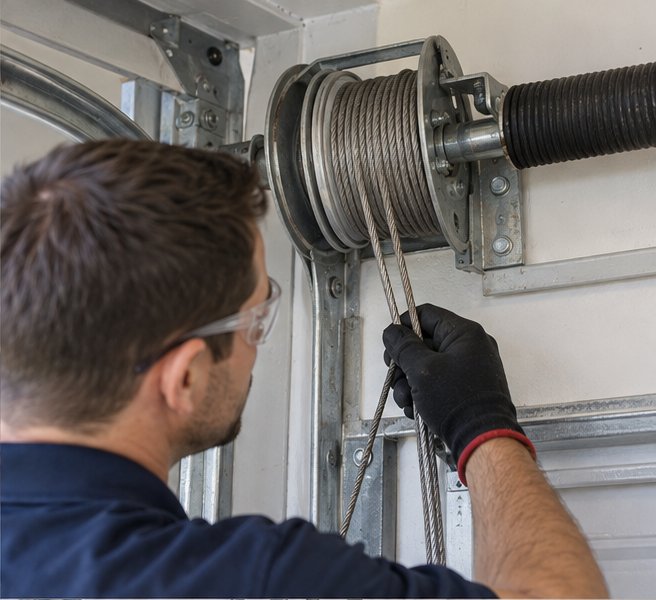
On most homes there is a steel cable running up each side of the garage door. The bottom end attaches to a bracket near the lowest corner of the door. The top end winds onto a grooved drum fixed at the end of the torsion bar above the door.
When the opener lifts the door, the spring turns the bar and the drums, and the cables wind onto the drums and raise both sides together. When the door lowers, the cables unwind in a controlled way. The cables are the link between the spring's energy and the door's weight.
Because they carry so much load, the cables are under constant tension, even when the door is closed. That is why a cable problem deserves respect, and why it should be handled by someone with the right tools and training.
Signs a Cable Has Snapped
A cable break often happens with a sharp sound, and it is easy to confuse with a spring failure. The difference is in what you see afterward. A snapped cable leaves a loose, dangling length of steel on one or both sides of the door.
Here are the clues homeowners most often report.
- A loud snap or crack from the garage, followed by a door that will not lift.
- A cable hanging loose beside the door or lying coiled on the floor.
- One side of the door sitting lower than the other.
- Frayed strands visible at the bottom bracket or along the cable.
- The door lifts a short distance, then tilts and sticks.
- A bent or twisted door section near the bottom corner.
Rust and fraying come first
Cables rarely fail without warning. Rust at the bottom bracket, broken wire strands that look like tiny hairs, or a flattened section are all signs of wear. Salt air near the coast speeds this up, so cables in coastal homes are worth watching.
Signs a Cable Slipped Off the Drum
A cable that has come off the drum is different. The cable is not broken, but it has left its groove and is now loose, tangled or wound the wrong way. This usually happens when the door jams, the cable goes slack, or a roller leaves the track.
You may notice that the door looks twisted when partly open, that one cable looks slack while the other is tight, or that the cable is sitting outside the drum on the bar. Sometimes the door simply will not move because the cable has bunched up.
A cable that has slipped can look harmless, which is part of the danger. The cable may still be carrying tension, and attempting to put it back by hand can pull a hand into the drum or release a spring's stored energy.
Why a Cable Problem Is a Safety Problem
The cables, drums and springs form one tensioned system. Touching or loosening one part can change the load on the others. The brackets at the bottom corners of the door are particularly hazardous, because they are under spring tension and can fly off if disturbed.
People have suffered serious injuries trying to fix a cable themselves. The force involved is not obvious from the outside, and a door that looks quiet and still can still hold a great deal of energy. This is why our advice is simple: look from a distance, and do not touch.
An uneven door can fall
If one cable is gone, only one side of the door is supported by the spring system. The other side can drop, and a door in this state can jam, twist or come down with little warning. Never stand under it.
Why the bottom bracket matters
The bottom bracket on each side holds the cable end in place under tension. It is not designed to be removed by hand while the door is under load. Leave it alone.
What To Do Right Away
The first few minutes should be about safety and about not making the problem larger. Nothing here requires touching the door hardware. The steps are the same whether the cable has snapped or merely slipped.
If anyone has been hurt, call 911 first.
- Stop pressing the remote or wall button.
- Keep people and pets away from the door.
- Do not walk or park under the door.
- Leave the door in whatever position it is in.
- Look from a distance and note which side looks wrong.
- Take a photo from a safe spot if that is easy to do.
- Contact us so a technician can look at the system.
What Not to Do
These are the mistakes that turn a repair into an injury. They are common because the parts look simple, and because it is tempting to try putting a cable back where it belongs.
Please avoid all of the following until a technician has made the door safe.
- Do not try to rewind a cable onto a drum by hand.
- Do not loosen set screws on the drums or winding cones.
- Do not detach or unbolt the bottom brackets.
- Do not use pliers, clamps or tape on a cable.
- Do not force the door up or down, or try to move it with the opener.
- Do not use the manual release if the door is open or crooked.
- Do not prop the door with a ladder, a jack or a stack of boxes.
About the manual release
The release cord is meant for a balanced, working door during a power outage. With a damaged cable the door may be badly out of balance, and releasing the opener can let it fall or swing. Leave the release alone unless a technician has told you otherwise.
Why Cables Fail
Cables are steel wire rope, and like any rope they wear with use. Every open and close flexes the strands where they wrap the drum, and rust gets into the gaps between them. The weakest spot is usually near the bottom bracket, where moisture collects and corrosion starts out of sight.
Homes on the Space Coast live with salt in the air, high humidity and frequent rain. That combination attacks bare steel, and it can shorten the life of cables and brackets. Lubricating and inspecting them is a small cost compared with an emergency failure.
A cable may also fail because something else went wrong first. A door that is out of balance, a roller that jams in a track, or a spring that has broken can all put abnormal strain on the cables. Our page on a loud bang from the garage describes that related situation.
How a Cable Repair Works
A technician begins by making the door safe. That means securing the door in position, relieving the tension in the system in a controlled way, and checking each part before anything is removed. This step is the reason the job should not be attempted at home.
Next they examine the cable, the drum, the bracket, the track, the rollers and the spring. If the cable is simply off the drum, the drum may be damaged or the cable may be kinked. If it has broken, both sides are usually inspected, because a worn cable on one side often means its twin is close behind.
The new cable is fitted and wound onto the drum, the brackets are checked, and tension is set again. Finally the door is balanced and run through a full cycle to make sure it travels evenly and the safety reversal still works. You can read about the full process on our page about garage door cable repair.
Why both cables are often checked
The two cables share the same load and the same age. When one fails, the technician will look at the other and explain whether it is still sound. You will see what we see and have the choice.
Drums, bearings and brackets
A cable that came off a drum can leave nicks or burrs on the drum's groove. If the drum is damaged, a new cable can fray again. Drums and bearings are part of the inspection, and the page on drum and bearing service explains their role.
Snapped Versus Slipped: A Comparison
The two cable problems look similar from across the garage but differ in cause and in what is usually needed. The table summarizes the contrast.
| Question | Snapped cable | Slipped off drum |
|---|---|---|
| Is the cable intact | No, it has broken | Usually yes, but it may be kinked or frayed |
| What you see | Loose length of steel, hanging or coiled | Cable outside the drum or bunched up |
| Common cause | Rust, wear, frayed strands | Jam, slack cable, roller out of track |
| Typical repair | New cable, bracket and drum check | Re-seat or replace cable, check drum and track |
| Safe to handle at home | No | No |
Cable Trouble and Other Door Problems
Cable problems rarely come alone. Because the cables are tied into the track, drums and spring, a failure often shows up as one of several other symptoms. Matching your symptom to the right page can help you describe the issue clearly.
If the door looks twisted and has left its rails, see a door that is off track. If one side sits lower than the other, the page about a crooked or uneven door explains what usually causes that.
Door is crooked and stuck
A door that tilts and will not move often has a loose cable on the low side. The slanted door can bind in the tracks and jam, which makes it even harder to move safely.
Door lifts a little then stops
If the opener lifts the door a short way and then stops, the cable on one side may have dropped, or the spring may have failed. Either way, stop pressing the button.
A Typical Cable Failure, Step by Step
It helps to picture how these failures usually unfold, because it shows why the warning signs matter. A cable starts to rust at the bottom bracket where rainwater and humidity settle. Over many months a few outer strands snap, and the cable becomes slightly thinner and stiffer at that point.
One morning the door is lifting as usual. The weakened spot gives way under the load, the cable snaps, and that side of the door drops a little while the other side is still pulled upward. The door twists in the track, a roller may pop out, and the opener stops or strains.
By the time you reach the garage, the door is crooked, a cable is loose and the opener is humming or silent. Nothing in that sequence was dramatic until the last second, which is why a short monthly look at the cables is worth the effort.
Questions Worth Asking the Technician
A good visit is a conversation. You are entitled to understand what is wrong and why, in plain words. Here are some questions that homeowners find useful, and we are happy to answer all of them on site.
- What caused this cable to fail, and could it happen again soon?
- Is the other cable still in good condition?
- Are the drums, bearings and brackets worn or damaged?
- Did the failure damage the door sections or the track?
- Is the spring in good shape, or should it be looked at too?
- What can I do at home to keep the new cable lasting longer?
Asking to see the old parts
You can ask to see the worn cable and the drum. Rust, flattened sections and broken strands are easy to point out once the part is in hand, and seeing them tells you more than any description could.
Getting Ready for the Visit
A little preparation helps the technician work safely and saves time on the day. You do not need any tools or experience. The goal is to give clear access and good information.
Think about when you first noticed the problem, whether there was a noise, and whether anything hit the door beforehand. Tell us if a vehicle, bicycle or storage item was near the door when it happened.
- Clear stored items away from both sides of the door.
- Move vehicles away from the door if you can do so without using the opener.
- Make a note of the age of the door and opener if you know it.
- Photograph the loose cable or the crooked side from a safe distance.
- Mention any earlier repairs, rust or fraying you have seen.
Preventing the Next Cable Problem
A cable that is checked and lubricated tends to last much longer than one that is ignored. A short visual look every month will catch many problems early. You can do this from the floor with a flashlight, without touching anything.
Look for fraying, rust at the bottom bracket, a cable that looks slack, or a door that sits unevenly when closed. If you notice any of these, contact us before the cable gives out. Our maintenance and tune-up service looks at these parts in one visit.
For more on keeping this hardware safe, the guide to garage door cable safety covers what the cables do and why they should never be handled by hand.
Questions and answers
We strongly advise against it. The cable, drum and spring are under serious tension, and a slipped cable can still be loaded. Rewinding it by hand can pull fingers into the drum or release stored energy. A technician has the tools to make the system safe first and to check why the cable came off.
No. With one cable gone, only one side of the door is supported properly. The door can tilt, jam in the tracks or drop. The opener may also be strained. Stop using it, keep everyone clear, do not park or walk beneath it, and contact us so the door can be looked at and made safe by someone with the proper tools and training.
A broken spring often shows a gap in a coil above the door and a door that feels very heavy. A cable problem usually leaves a loose or hanging cable and an uneven door. They can happen together, so do not try to decide for certain yourself. Describe what you see and we will confirm on site.
The usual causes are a jam that makes the cable go slack, a roller leaving the track, a worn or damaged drum, or a door that was out of balance. Sometimes a spring failure lets the cable go loose. We look for the root cause during the visit, so the problem does not repeat after the cable is replaced.
Often it makes sense, because both cables have the same age and the same use. The second cable may be close to failing too. We inspect it and explain what we see, such as rust, fraying or flattening, so you can decide whether to replace one or both. We do not push a choice before you understand it.
Yes. Rust gets between the strands of the wire rope and eats away at the steel from inside, so a cable can look acceptable and still be weak. This is more common in humid, salty coastal air. Regular lubrication and inspection reduce the risk, and cables with visible rust or fraying should be looked at.
Tell us what you saw and heard, which side looks wrong, whether the cable is hanging or on the floor, and whether the door moves at all. Mention the door and opener type if you know them. A photo taken from a safe distance helps, but please do not reach into the door area to take it.