
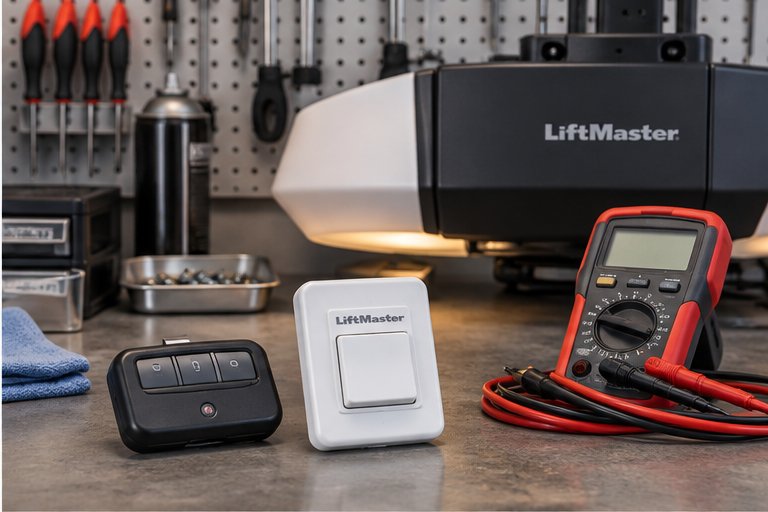
What an opener really does
An opener is a motor, a drive system and a control board that moves a garage door along its track. It does not carry the weight of the door. The springs do that. A well balanced door feels light in your hands, and the opener only has to guide it up and down and hold it in position.
That is the most useful idea to carry into any buying decision. If the springs are worn or the door is out of balance, a larger motor will not fix the real problem. It will simply strain against a door that is fighting it. Good choices begin with a healthy door and a clear idea of how you use the garage.
Start with the door, not the opener
Before you compare models, look at the door the opener will serve. Its weight, size, material and condition decide which openers are sensible. A single steel door with no insulation is a very different load from a wide, insulated, double door with windows and a heavy wood overlay.
If the door is sticking, scraping, drifting open or hard to lift by hand with the opener disconnected, address that first. A technician can check the springs, cables, rollers and track during a visit, and our page on balance and adjustment explains what that inspection involves. An opener installed on a poorly balanced door will wear out early and may reverse or stall unpredictably.
- Note the width and height of the door and whether it is single or double.
- Note the material: steel, aluminum, wood, composite or fiberglass.
- Note whether the door is insulated, has windows, or carries extra decorative hardware.
- Check that the door lifts smoothly by hand when the opener is disconnected.
- Look at the springs and cables for visible wear, but never touch or adjust them.
The three main drive types
Most residential openers use one of three drive systems: a chain, a belt or a threaded steel rod called a screw. Each moves the same trolley along a rail, and each has a different feel in terms of noise, upkeep and cost of ownership.
We cover the mechanics and the trade offs in detail on our page about garage door opener drive types. For this guide, the short version is enough. Chain drives are sturdy and familiar. Belt drives run quieter. Screw drives have few moving parts and suit some layouts well.
When a chain drive makes sense
A detached garage, a workshop or a space where nobody sleeps above the door is a natural home for a chain drive. The sound it makes is a metallic rattle during travel, which matters far less when no bedroom shares the wall.
When a belt drive makes sense
If a bedroom or living room sits above or beside the garage, a belt drive is worth serious thought. The reinforced belt carries the trolley with much less metallic noise, so the sound that reaches the house is mostly the motor itself.
When a screw drive makes sense
A screw drive uses a long threaded rod and a small number of moving parts. People who want a simple mechanism and do not mind a bit of mechanical sound often choose it. It can be sensitive to temperature swings, so ask a technician how it behaves in a warm, humid climate like ours.
Horsepower and what it means in practice
Opener motors are usually described in fractions of horsepower, and it is tempting to assume that bigger always means better. In practice, the motor size needs to match the job. A standard single door in good balance does not need an oversized motor, while a heavy insulated double door benefits from one with more capacity.
Think of horsepower as headroom. A motor that runs close to its limit on every cycle works hard, runs hot and tends to wear sooner. A motor with comfortable headroom runs more calmly. The goal is a sensible match, not the largest number on the box.
Ask the technician how the model you are considering handles your particular door. They can look at the weight, the width and any extras such as windows or a layered overlay, and tell you whether a standard unit or a stronger one is the more sensible fit.
Noise, and who hears it
Opener noise is mostly a question of where the garage sits. A garage under a bedroom transmits motor hum and door movement straight into the house. A detached garage at the back of the lot transmits almost nothing. Match the quiet of the machine to the layout of your home.
Part of the sound comes from the opener and part from the door. Dry rollers, loose hardware and a door out of balance all add noise that no opener can remove. If the current door is loud, a technician can sort out what belongs to the door and what belongs to the opener.
- Attached garage with rooms above: favor a quieter drive and a soft start and stop feature.
- Attached garage beside living areas: a belt drive or a well mounted screw drive is worth comparing.
- Detached garage or workshop: noise is rarely the deciding factor.
- Early morning or late night use: consider how the sound carries to bedrooms.
Travel feel: soft start, soft stop and speed
Many modern openers ease the door into motion and slow it near the end of its travel. This soft start and soft stop feature reduces jolts on the hardware and softens the sound. It is a worthwhile feature on any opener that serves a heavy door.
Travel speed varies between models, but it is rarely the most important trait. A rushed door can feel abrupt, and the safety reversal system works the same regardless. We would put smooth, steady movement ahead of raw speed when comparing models in a showroom or a catalog.
Safety features you should expect
Every opener sold for home use today includes an automatic reversal system and a pair of photo-eye sensors near the floor. When the beam between the sensors is broken, the door should stop and reverse. The opener should also reverse when the door meets resistance on the way down.
These features are part of what makes a modern opener safe around children, pets and vehicles. Check that the model you choose includes both, and ask the technician to test them after installation. Our guide on garage door safety tests describes the checks a homeowner can repeat later.
An opener should also have a working manual release so the door can be moved by hand during a power outage. The release should be easy to find and reach, and everyone in the household should know it exists.
Remotes, keypads and rolling codes
Current openers use a rolling code system. Each time a remote is pressed, it sends a different code from a long, changing sequence, so a recorded signal cannot be replayed to open the door. This is a basic security feature and one reason older fixed code openers are worth replacing.
Think about how many remotes you need. A household with several drivers may want a remote for each vehicle plus a keypad on the outside wall. A wireless keypad is especially handy for family members who walk, jog or arrive without a remote in hand.
If you want to understand how remotes and keypads pair with the opener, read our general guide on programming garage remotes and keypads. The exact steps depend on the model, so the owner's manual is always the final word.
Battery backup for outages and storms
Our area has thunderstorms, tropical systems and the occasional extended outage. An opener with a battery backup keeps working when the power goes off, so you can still raise and lower the door with the wall button or a remote.
Without a backup, the door still opens by hand using the manual release, but that takes a little effort and some familiarity. A backup battery is a comfort feature that becomes a real convenience during storm season, and some households treat it as the reason to upgrade.
Our page on battery backup for garage door openers explains how the system works, how long a battery typically needs attention, and what to ask a technician about replacement.
Lighting and wall controls
Built in opener lights are a small but daily convenience. Look for a light that stays on for a set period after the door moves, and check whether it uses standard bulbs or integrated LEDs. Some models use bulbs that are easy to replace, while others have fixed light modules.
A wall control with a lock mode is useful when you leave the house for a while. A multi function panel may also adjust the light, show a diagnostic code or let you disable remotes. Newer wall panels are often more capable than the simple button that came with older units.
Smart features, plainly explained
Some openers connect to your home network so you can open and close the door or check its status from a phone. This can be convenient if you often wonder whether you closed the door, or if you let guests and delivery people in while you are away.
It also adds a new thing to maintain: the network connection, the app, and the account behind it. Read our page on smart garage door opener basics before you decide, and think about what you will actually use. If a simple remote does everything you need, a standard opener is a perfectly sound choice.
Headroom, ceiling and mounting layout
An opener mounts to the ceiling above the door and needs a certain amount of clearance. Low headroom, a finished ceiling, a storage rack or a ceiling-mounted heater can all change which rail and bracket arrangement will work. A technician can measure and tell you what fits.
Garages with a high ceiling may need an extended rail or an extra bracket. Garages with a low ceiling may need a low headroom kit. These are ordinary adjustments that a professional makes during a site visit, and they are one more reason to have the space looked at before you buy a unit online.
Side-mount and wall-mount options
Doors with unusual hardware or very limited headroom sometimes use a different style of opener that mounts beside the door rather than over it. They are less common, and a technician will tell you if your layout calls for one.
Garages with storage or lifts overhead
Overhead storage platforms and car lifts can interfere with the opener rail and the door's travel path. Mention them when you discuss options so that placement can be planned around them.
Special cases: heavy, wide or insulated doors
A wide double door, an insulated door with layered panels or a wood door with heavy overlays places more demand on every part of the system. The springs have to be matched to that weight, and the opener needs to be one that is rated comfortably above it.
In these cases, pay attention to the rail strength, the bracket quality and the way the opener attaches to the door. A heavy door pushing against a lightly built opener will show its strain in noise, uneven travel and early wear.
- Tell the technician about any added insulation or overlays.
- Mention the presence of windows or decorative glass.
- Ask whether the springs on the door suit its true weight.
- Choose an opener with comfortable headroom above the door's weight.
Questions worth asking before you decide
A good conversation with a technician is more valuable than a long comparison chart. Bring your own list and expect clear, plain answers. If something is not clear, ask again. A reputable technician is happy to explain.
Here are the questions that matter most.
- Which drive type fits my layout and why?
- Is the motor size a sensible match for my door's weight?
- How does this model handle a power outage?
- Which safety features are built in, and how will they be tested after installation?
- How many remotes and keypads can the opener learn?
- Can the opener be serviced later, and what parts typically wear first?
Common mistakes to avoid
The most common mistake is buying an opener to fix a door problem. A door that is heavy, noisy or uneven needs the door fixed. A new opener installed on a faulty door may move it for a while, but the underlying problem keeps wearing the new machine.
A second mistake is choosing on a single feature without thinking about how the garage is used. A quiet belt drive is wasted in a detached workshop, while a basic chain drive may disappoint someone with a bedroom above the garage. Match the unit to the use.
A third mistake is assuming that a self-install kit is the simplest path. Mounting an opener, setting travel limits and testing the safety reversal take care and the right tools. Setup of this kind should stay with a trained technician.
What happens when you replace an opener
A replacement usually begins with a look at the door, the springs, the track and the existing opener. The technician removes the old unit, mounts the new rail and motor, connects the wall control and sensors, and sets the travel limits and force settings for your door.
After installation the technician programs your remotes and keypad, tests the sensors, tests the reversal on contact and shows you how the manual release works. You should leave knowing how to use every control and what to do in an outage.
If you are weighing repair against replacement on the machine you already have, our page on garage door opener replacement describes how that decision is made and what we look at.
Questions and answers
Not necessarily. The motor needs to match the door, and a healthy, balanced door only needs a sensible amount of capacity. Extra headroom helps with heavy insulated or double doors, but a larger motor cannot make up for worn springs or a door that binds. Fix the door first, then choose an opener that suits its weight and size.
Belt drives are generally the quietest of the common types because the reinforced belt avoids the metallic rattle of a chain. A soft start and soft stop feature also helps. If your garage sits under or beside a bedroom, comparing belt models is a sensible place to begin, and a technician can tell you what to expect.
It is optional, but it is a comfort during storm season. Without it, the door still works by hand using the manual release, though that takes some effort and familiarity. With a backup battery, the opener keeps running when the power is out. Think about how often you rely on the garage as your main entry.
Sometimes, but not always. Remotes and openers need to use compatible signal systems, and older fixed code remotes usually do not work with modern rolling code units. A technician can tell you whether yours will pair. Many households choose to replace remotes during an opener upgrade for security and reliability.
No. A door that feels heavy by hand usually has a spring or balance problem, and a new opener only hides it temporarily while the strain wears the new motor. Have the springs and balance checked by a trained technician before or alongside any opener decision. Never try to adjust springs yourself.
Only if the features match how you live. Phone control, status alerts and guest access are useful for some households and unnecessary for others. A standard opener with a good remote and keypad is perfectly sound. If you do choose smart control, plan to keep the app, the network and your account details secure.
Size depends on the weight, width and height of the door and any extras such as insulation or windows. A technician can assess those during a visit and recommend a unit with comfortable headroom. Bring details about the door and any problems you have noticed, and they will explain what they find and what the options are.