
How to use this glossary
The entries are grouped by function instead of alphabetically, because parts only make sense in relation to their neighbors. A roller means little until you know it rides in a track, and a drum means little until you know a cable winds onto it. Read the group that matches the problem you are looking at.
Some terms differ slightly between manufacturers. Where this happens, the entry gives the most common name and mentions alternatives. Your own door may have a few unusual parts, and a label or manual is the most reliable source for those. See our page on reading your garage door label for where to find model details.
Take your time with the groups that apply to you, and skip the rest. Several parts hold dangerous tension. Whenever an entry involves a spring, a cable or a bracket under load, it is marked as work for a trained technician. Understanding the part is useful, and attempting to adjust it is not.
The door body
A sectional garage door is built from horizontal pieces that fold as the door travels. The pieces and the surfaces around them have their own names.
Section or panel
One horizontal slice of the door, usually several feet wide and about two feet tall. A typical residential door has four or five of them, joined by hinges. People use section and panel interchangeably.
Top section
The uppermost panel, which carries the top fixtures where the door connects to the opener arm. It is built to take extra load and often has a reinforced rail.
Bottom section
The lowest panel. It has brackets on each lower corner where the lifting cables attach, and it carries the bottom seal. Because it is under load, it is more prone to damage if it is struck.
Stile and rail
On raised panel and wood doors, stiles are the vertical frame members and rails are the horizontal ones. In steel doors the same words describe the framing members that give a section its stiffness.
Skin and core
The skin is the outside surface, often steel, aluminum or composite. The core is whatever sits inside, such as foam insulation or an empty hollow cavity.
Hinges and how the panels connect
Hinges are what let a flat wall of panels bend to follow the curve in the track. They sit between sections and are numbered from the bottom up, because different positions need different strengths.
Hinge
A two-leaf metal piece that joins one section to the next. One leaf is fastened to each panel, and a pin or a pivot allows them to bend. Hinges at the lower positions often use heavier metal.
Hinge gauge
A number that describes the thickness of the metal. A lower gauge number means thicker metal. Heavier or wider doors generally need heavier hinges.
End hinge and center hinge
End hinges sit at the sides and hold the roller stems. Center hinges sit between and add strength across the width of the panel.
Strut or reinforcing bar
A horizontal metal bar fastened across a panel, to stop it from sagging or bowing under its own weight, or under wind load. Wide doors commonly have one on the top section or several.
Rollers and what they ride on
Rollers are small wheels that run inside the tracks, and they carry the door as it moves. Their quality has a direct effect on noise and wear.
Roller
A wheel on a stem that slides into a hinge. Rollers may be steel, nylon or have sealed bearings, and each type has a different noise and durability profile. Steel, nylon and sealed types differ in noise and durability.
Roller stem
The shaft that connects the wheel to the hinge. A bent stem makes the wheel run crooked and can make the door catch in the track.
Bearings
Small steel balls inside a roller, which reduce friction. A roller with exposed bearings is noisier and wears faster than a sealed one.
Bottom roller bracket
The fixture at each bottom corner that holds both a roller and the lifting cable end. It is under severe tension and is never a homeowner job.
Tracks and their hardware
Tracks guide the rollers in a path from vertical to horizontal. Their hardware holds them in a precise position, and small shifts in alignment cause large problems.
Vertical track
The straight section on each side of the opening, running up the wall. It keeps the door in the opening when closed.
Curved section or radius
The bend that connects the vertical and horizontal tracks. The radius decides how tightly the door has to turn, and it relates to the headroom required above the opening.
Horizontal track
The section that runs along the ceiling, carrying the door when it is open.
Track bracket and jamb bracket
Heavy metal pieces that fasten the track to the wall or the ceiling. Loose or bent brackets let the track move and can cause the door to come off its guides.
Track flag angle
The connecting piece between the vertical track and the jamb bracket. Together they give the track the freedom to be adjusted by trained hands.
Torsion spring parts
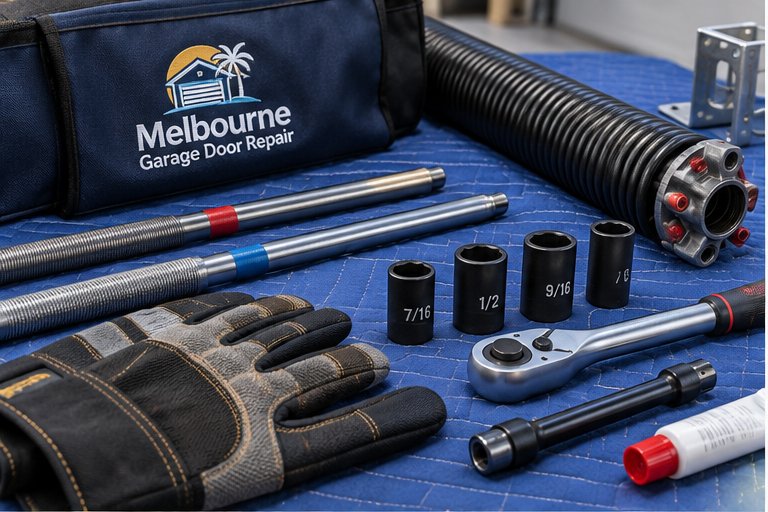
Torsion springs sit on a shaft above the door opening and twist to store energy. The components around them are specialized, and all of this hardware belongs to trained technicians. Our guide on torsion and extension springs covers the two systems side by side.
Torsion spring
A heavy coil of steel wire wound on a shaft. When the door closes, the coil is wound tighter, and when the door opens, the coil releases its energy and helps lift the weight.
Torsion shaft or tube
The steel bar that runs across the top of the opening. The springs and drums are mounted on it, and it transfers the turning force to both cables evenly.
Winding cone and stationary cone
The two ends of a spring. The winding cone is the end where a technician adds tension with winding bars. The stationary cone is the fixed end at the center bracket.
Center bracket
The plate that anchors the stationary end of the spring to the wall above the door. It also supports the middle of the shaft.
End bearing plate
The bracket at each end of the shaft. It holds a bearing that lets the shaft turn smoothly.
Extension spring parts
Extension springs run along the horizontal tracks and stretch as the door closes. They are simpler to describe and equally dangerous when under load.
Extension spring
A long coil that stretches and contracts. It sits above the horizontal track, one on each side.
Pulley
A small wheel at the front of the spring that redirects the lifting cable. A worn pulley can fail and let the cable slip.
Safety cable
A wire run through the center of each extension spring and fastened at both ends. If the spring breaks, the cable contains it. It is not decoration. Do not remove it.
Spring fastener and eye bolt
The hardware at the end of the spring that sets how much stretch it has. These are adjusted only by trained technicians.
Cables and drums
Cables do the actual lifting. They connect the bottom of the door to the drums and carry nearly the whole weight of the door as it rises. Read more about them on our page about garage door cable safety.
Lift cable
A braided steel cable that connects the bottom bracket to a drum on the shaft, or to a pulley on an extension spring system.
Drum
A grooved wheel on the torsion shaft that the cable winds onto as the door rises. The groove guides the cable so it stacks neatly.
Cable stop or cable end
The fitting at the end of the cable that locks it into the bracket or drum.
Set screw
A screw that holds the drum or cone in place on the shaft. These carry large forces and must only be handled by trained technicians.
Opener parts
The opener is a separate machine that moves the door, and it has its own vocabulary. It does not carry the door weight, since that is the job of the springs.
Power head or motor unit
The box mounted to the ceiling that holds the motor, the logic board and the lights.
Rail
The metal beam that extends from the power head toward the door. It carries the trolley.
Trolley and carriage
The part that slides along the rail and pulls the door arm. It also holds the emergency release connection.
Drive: chain, belt, screw
The mechanism that moves the trolley. Chain, belt, screw and jackshaft designs each work differently.
Door arm and header bracket
A bar that links the trolley to a bracket on the top section of the door.
Limit settings
Adjustments that tell the opener where open and closed positions are.
Safety and control devices
Modern openers use several devices to stay safe and respond to commands. These are the parts you meet most often day to day.
Photo eye or safety sensor
A pair of small units mounted near the floor on each side of the door. They send an invisible beam across the opening, and if something breaks it during closing, the door reverses.
Emergency release cord
A red rope with a handle that disconnects the door from the opener so it can be moved by hand. It must be used with care, and only when the door is closed and sound.
Wall control
The button panel inside the garage, often with a lock or light switch.
Remote and keypad
Radio devices that signal the opener. Most use a rolling code, which changes with each use.
Receiver and logic board
The electronics in the power head that listen for signals and command the motor.
Seals, trim and weather parts
The edges of the door deal with water, wind and pests. In Florida, where driving rain and humid air are common, these small parts do a lot of work.
Bottom seal or astragal
A flexible strip, often rubber or vinyl, along the bottom of the door that closes the gap against the floor.
Retainer
The channel that holds the bottom seal. It is fastened along the lower edge.
Weatherstripping or stop molding
The strip fastened around the jambs and head of the opening that the door closes against.
Threshold
A raised strip on the floor under the door, which can add to sealing and help with water.
Window insert
A glazed panel in a section. It adds light and style.
Opening measurements and space
Several measurements describe the space around a door. They matter when choosing a door or an opener, and they come up in the guide on measuring for a new garage door.
Opening width and height
The finished size of the doorway, measured between the jambs and from the floor to the header.
Headroom
The space between the top of the opening and the ceiling or any obstacle above. The track curve and the springs need it.
Sideroom
The wall space to the left and right of the opening, where vertical tracks and brackets mount.
Backroom
The depth from the opening into the garage along the ceiling, needed for the horizontal tracks and the opener.
Locks, handles and security hardware
Many doors carry a few pieces of hardware that have nothing to do with lifting. They matter for security and for convenience, and they are a common source of questions during service visits.
Slide lock or bolt lock
A bar on one side of the door that slides into a hole in the track. It prevents the door from being raised by hand and is usually a manual device. It must be released before the opener is used, or the door and the lock can be damaged.
Lift handle and pull rope
A handle fixed on the door for use when it is lifted by hand, and a rope on the bottom section for pulling it down. They are common on doors without openers, and are also useful on doors that have lost power.
Vacation lock or lock mode
A feature on many wall controls that stops the remotes from working while it is switched on. If a remote suddenly seems dead, check that lock mode has not been enabled by accident.
Fasteners and small hardware
Behind every part in this glossary is a collection of small fasteners, and these are the pieces most likely to work loose over time. Knowing their names helps you describe a rattle or a sag.
Carriage bolt and lag screw
A carriage bolt has a rounded head and a square neck that grips the wood or metal, and it is common on track brackets. A lag screw is a heavy wood screw used to fasten brackets to framing.
Nut, lock washer and flange nut
These hold bolts tight. Lock washers and flange nuts resist loosening from vibration. A bolt that has lost its lock washer may begin to rattle.
Cotter pin and clevis pin
Small pins that hold the door arm to the trolley or to the bracket on the door. If one is missing, the arm can slip out, and the pin should be replaced.
Ceiling hanger or perforated angle
Slotted steel strips that connect the opener rail and power head to the structure above. They should be firmly fastened and without sway.
Words about performance and condition
These are not parts, but technicians use them constantly, and they help you follow an explanation of what is wrong.
Cycle
One complete opening and closing of the door. Spring life is usually described in cycles.
Balance
A door is balanced when the springs carry its weight so it stays where you leave it at mid-height. See door weight and balance.
Off track
A condition where one or more rollers have left the track. The door should not be moved.
Fatigue
The gradual weakening of metal from repeated stress, such as a spring after many cycles.
R-value
A measure of insulation resistance. A higher number means more resistance to heat flow.
Wind load rating
A statement of the pressure a door is designed to resist. Local building officials decide what a property needs.
Putting the vocabulary to use
When you describe a problem, say which part you believe is involved and what you see or hear. A phrase such as a cable hanging loose at the bottom left bracket is far more useful than the door looks wrong. Photographs help.
Do not worry if you use the wrong term. A technician will look and explain. Describing the symptoms is enough: when it happens, which side, what you heard, and what you already tried.
If you would like a technician to look at your door and explain each part and what it is doing, you are welcome to contact us.
Questions and answers
Nothing meaningful. Both words describe one of the horizontal pieces that make up a sectional garage door, and people use them interchangeably. A technician may say section when talking about the structure of the door and panel when talking about the surface, finish or damage. Either word will be understood if you describe which part you mean.
A drum is a grooved wheel mounted on the torsion shaft. The lifting cable winds onto it as the door rises and unwinds as the door lowers. The groove keeps the cable lined up. Drums, cables and set screws carry high loads, so inspection and any work on them should be left to a trained technician.
It is a wire run through the center of the spring and fastened at both ends. If the spring ever breaks, the cable keeps the broken pieces from flying across the garage. It is an important safety part, and it should never be removed. If one is missing, mention it to a technician, who can advise on options.
Headroom is the space between the top of the door opening and the ceiling or the nearest obstruction above. The tracks, springs and opener all need room there. If headroom is limited, special track layouts may be needed. Our page on measuring for a new door explains how headroom, sideroom and backroom are checked. Planning for these spaces early avoids surprises, and a photograph of the ceiling area is often helpful when asking a technician.
The trolley is the part that slides along the rail and pulls the door arm, which in turn moves the door. It also contains the connection point for the emergency release cord. When the cord is pulled, the trolley separates from the drive carriage so you can move the door by hand, which is the situation covered in our manual release guide.
Parts differ between doors, and the right spring, cable, drum or roller depends on the door's weight, height and construction. The model information and the measurements help identify the right parts and avoid mistakes. A photograph of the labels on the door and on the opener is often all that is needed. Include the door width and height if you know them.
R-value is a number describing resistance to heat flow through a material, where a higher number means more resistance. It is relevant to insulated doors, which have foam or similar material inside the panels. The rating of a door is a guide to comparison, and real results also depend on seals, sunlight and how the garage is used.