
Why the garage door deserves a place on your list
When you tour a home, attention goes to kitchens, bedrooms and the yard. The garage door tends to get a glance, and perhaps a press of the wall button. Yet it is a heavy machine that moves several times a day, and its condition says something about how the house has been looked after.
A door that runs smoothly and quietly usually means somebody kept up with it. A door that shudders, grinds or hangs crooked can mean years of small neglect, or it can mean one fixable part has worn out. The point of looking is to tell the difference before you commit.
We are not home inspectors, and nothing here replaces the report from the professional you hire for the purchase. This is a practical companion for a buyer who wants to ask better questions about one part of the house.
Before you arrive: what to bring and what to expect
You do not need tools. A phone for photos and notes is enough, plus a flashlight if the garage is dim. Wear shoes you can stand in comfortably, because you will be looking up at the door and down at the floor.
Ask the listing agent whether the garage will be accessible and whether the opener is powered. In a vacant house the power is sometimes off, which means you will be judging the door by hand rather than by motor. That is still useful, and we explain how to do it safely further down.
- A phone or camera for close photos of labels, hardware and any damage.
- A flashlight to see the top of the door, the springs and the track.
- A short list of questions for the seller or the listing agent.
- Time to watch several full cycles of the door without rushing.
The first look from the driveway
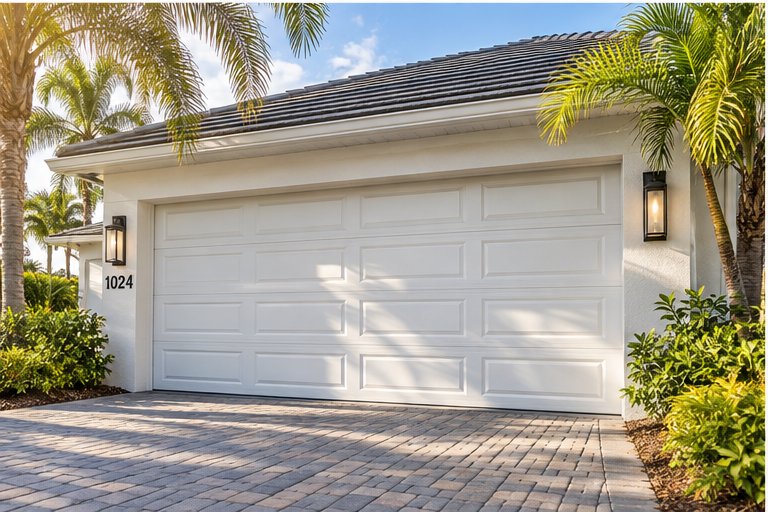
Stand back and look at the door from the outside before touching anything. Panels should line up in a clean grid, the bottom edge should sit level, and the gaps at the sides should look even from top to bottom. A door that leans, bows or shows a wavy line across the panels deserves a closer look.
Note the material and finish. Steel, aluminum, wood and composite all age differently, and in a coastal climate like ours the salt air and strong sun are hard on paint, hardware and wood edges. Peeling finish, rust bleeding from hinges, and soft or swollen lower panels are worth photographing.
Panel condition
Look for dents, cracks, delaminated layers and sections that have been patched. A single dent from a bumped bicycle is cosmetic. Several panels with creases in the same area can point to an old impact that stressed the whole section.
Weather seals and the bottom edge
The rubber strip along the bottom should be flexible and unbroken. Daylight visible along the floor when the door is closed, or a seal that has hardened and split, is a common and usually modest item, but it tells you the door has not had attention in a while.
Running the door: what you should see and hear
Use the wall button first, then the remote if the seller provides one. Watch the whole trip up and the whole trip down. A healthy door moves with a steady, even motion, with no jerks, no pauses and no sideways wobble.
Listen as much as you watch. Some mechanical sound is normal, but sharp bangs, loud scraping, rhythmic squeaks and a motor that strains or hums without moving the door are all signs that something needs service. We cover noises in more detail in our guide to diagnosing garage door noises.
Run the door through at least three full cycles. Intermittent problems often hide on the first pass and show up on the second or third.
- Does the door start promptly when you press the button?
- Does it travel smoothly, without shaking or tilting to one side?
- Does it stop where it should at the top and at the bottom?
- Is the motor noise steady, or does it strain, stutter or grind?
- Do the opener lights work when the door moves?
Testing the safety reversal and sensors
Modern openers are built to stop and reverse if something is in the way. The photo-eye sensors near the floor are one part of that system, and the opener itself senses resistance as the other. Both are worth testing at a showing if the seller allows it.
For the sensors, close the door with the button and pass your foot or a sturdy object through the beam near the bottom as it comes down. The door should stop and go back up. Do this carefully and keep your body out of the door path. If the door keeps closing, or the sensor lights are dark or blinking, note it for the inspector and for the seller.
Our guide to garage door safety tests describes these checks step by step, with clear stop points. If anything seems unsafe, stop and leave it for a technician.
Doing a careful hand check with the opener disconnected
If the power is off, or you want a sense of the door's balance, the red release cord can disconnect the door from the opener so it moves by hand. Only do this with the door fully closed, and only if the seller or agent agrees. Pulling the cord with the door open can let it drop.
With the door disconnected and closed, lift it gently by the handle or bottom edge. A well balanced door feels manageable and tends to stay where you leave it around waist height. A door that feels very heavy, or one that rushes upward or slams down, may have springs that are worn or out of adjustment.
Do not touch the springs, cables or the brackets at the bottom corners. They hold dangerous tension. Looking is all that is needed, and anything that looks wrong goes on your list for a technician.
What to look at overhead and along the sides
Shine your light along the top of the door. You should see one or two springs, usually above the door on a horizontal bar, or along the sides on older extension-spring setups. Learn the difference in our torsion and extension spring guide. Gaps in a spring, a spring that has pulled apart, or one that is visibly stretched are signs of a problem.
Cables run from the bottom corners up to the spring system. They should be straight and intact, with no frayed strands and no loops hanging loose. Rollers should sit snugly in the tracks, and hinges between the panels should be firm and straight.
Tracks and mounting
Tracks should be straight, firmly bolted and without big dents. A track pushed out of line by a bump, or one with a visible kink, can cause the door to bind or jump off.
Rust and corrosion
Surface rust on a hinge is common in Florida. Deep, flaking rust on springs, cables or bearing plates is more serious, because it weakens parts that work under load.
Reading the opener and its age
Look at the label on the opener motor housing. Many carry a model number and sometimes a date or date code. Photograph it, so you can look up the age later or share it with a technician. The opener's age matters for parts, features and safety systems.
Check the wall control, any keypad outside, and the remotes provided. Ask how many remotes come with the house, and whether the seller has changed codes. After closing, it is wise to reset the codes so previous owners no longer have access. Our guide to programming garage remotes and keypads explains how that generally works.
- Photograph the opener label and the door label.
- Count the working remotes and test each one.
- Test the wall control and the keypad if there is one.
- Look for a battery backup unit, and ask when its battery was last replaced.
- Check that the opener light comes on and turns off normally.
Signs of past storm damage or repairs
On the Space Coast, a garage door has probably been through at least one serious storm season. Ask directly whether the door was damaged in a storm, whether any panels, tracks or the opener were replaced, and whether the work was done by a professional. A seller who can describe the work and show paperwork is a good sign.
Mismatched panels, new hardware on one side only, and patched sections can indicate repairs. They are not automatically a problem, since a good repair makes a door sound again. They are simply a prompt to ask what happened and when. Read more in our guide on hurricane preparation for garage doors.
Questions to ask the seller or the listing agent
Some of the most useful information is not visible. The seller lives with the door and knows its habits. A few polite questions can fill gaps, and the answers go in your notes whether or not they affect the deal.
Write down the answers and ask for anything in writing that the seller is willing to share, such as receipts for a spring or opener replacement. We are not offering legal advice, and any questions about disclosure belong with your agent or attorney.
- When was the door last serviced, and what was done?
- Have the springs, cables or opener ever been replaced?
- Has the door ever come off the track or been hit by a vehicle?
- Does the opener work every time, or does it sometimes need a second press?
- Is there any noise, sticking or shaking the seller has noticed?
- Are there original paperwork, manuals or remotes for the door and opener?
Sorting findings into what matters most
Not every note you take is a reason to worry. A useful way to organize what you saw is by safety, function and appearance. Safety items come first, because they can hurt people. Function items affect daily use. Appearance items are about looks and long-term value.
A buyer who sorts findings this way tends to make calmer decisions and negotiate more clearly. A cracked panel is not in the same category as a door that will not reverse when something is in its path.
| Category | Examples | Typical next step |
|---|---|---|
| Safety | Door does not reverse, damaged cable, broken or gapped spring | Have a technician look before relying on the door |
| Function | Door sticks, remote unreliable, loud grinding, slow or uneven travel | Ask for a technician's opinion and a clear list of options |
| Appearance | Dents, faded paint, worn seals, mismatched panels | Note for later and weigh against your plans for the home |
| Unknown | Opener will not power on, no remotes, seller cannot say | Ask for details and consider an in-person evaluation |
When a technician visit before closing makes sense
If the door runs poorly, if you saw something that concerns you, or if your inspector flags the door, a technician can look at it in more detail. We come to the property, look at the door, explain what we find, and describe what repair or replacement would involve. That information can help you decide what to ask of the seller or how to plan your own budget after the move.
A technician visit is most useful when you have access to the garage and the opener is powered. Coordinate that with your agent, since the house is not yours yet. You can reach us through our contact page to describe the situation.
Repair or replace: planning after you move in
Once the house is yours, you will have time to decide what the door needs. Some buyers choose to repair what is wrong and move on. Others find the door is near the end of its life and plan a replacement. Our guide on when to repair and when to replace sets out how to weigh that.
It also helps to know what a routine visit involves. Read what happens during a garage door service visit to see what a technician checks, so you know what to expect when you book a first service for your new home.
Your first week in the house
A few simple steps in the first week make the garage safer and more secure. Reset the keypad code, collect and test every remote, and make sure everyone in the household knows where the red release cord is and what it does.
Clean the photo-eye lenses with a soft cloth, test the door's reversal with a sturdy object, and set up a habit of looking over the door once a month. Our monthly garage door checklist covers a routine you can repeat without tools.
- Change the keypad code and clear any old remote programming.
- Replace remote batteries so you know they are fresh.
- Walk the household through the manual release and when not to use it.
- Wipe the sensor lenses and check that the lights are steady.
- Keep a folder of any paperwork you received about the door and opener.
A note on older homes and newer subdivisions
Homes built decades ago along the Indian River and the beaches often have garage doors that were replaced once or twice since construction. You may find a newer door on an older opener, or the reverse. Mixed ages are normal, and what matters is whether the parts work together and move safely.
In newer subdivisions the door and opener are often original and still under their first life. They tend to look good, yet a home that sat empty during construction or sales may have had little use, so dry seals and stiff hardware are worth a look. Either way, the same checks apply: watch it run, listen, look for damage and ask questions.
If the home is part of an association, rules about door style and color may affect any future replacement. Our guide to HOA rules and garage doors explains the general idea so you can ask the right questions early.
Questions and answers
Practices vary, so ask your inspector what is covered. Many inspectors test the opener and the safety reversal and note obvious damage, but they may not examine springs, cables and hardware in depth. If your report mentions the door, or you have concerns, a garage door technician can look more closely at the door and explain the findings.
Usually yes, with the seller or agent's permission. Use the wall button and remotes, and watch the full travel. Keep clear of the door path and never touch springs, cables or the brackets at the bottom corners. If the door behaves oddly, stop and note it instead of forcing it.
Anything that affects safety stands out: a door that does not reverse when it meets an obstruction, frayed or loose cables, or a spring with a visible gap. Heavy rust on moving parts and a door that falls or drifts when released are also concerning. A technician should look at these before a technician before anyone relies on the door.
Not always. Many noises come from dry rollers, loose hardware or worn hinges, which are common maintenance items. Loud banging, grinding or a motor that strains is more serious. Note what you hear and when it happens, and a technician can usually tell you the likely cause and what the options are.
Often that can be arranged with your agent, since you will need access to the property and the seller's agreement. We can look at the door, explain what we find and describe the repair or replacement options. Use the contact page to tell us about the situation and we will take it from there.
It is a sensible step. Previous owners, neighbors and tradespeople may have known the old code, and old remotes may still be programmed to the opener. Resetting the keypad and clearing remote memory gives you a clean start. The opener's manual explains the process, or a technician can do it during a visit.
There is no single age. What matters is condition, parts availability and whether it has modern safety features such as photo-eye sensors. An older opener that runs well and reverses properly can still serve, while one that is unreliable or lacks current safety features may be worth replacing. A technician can help you decide.