
Why a garage door needs springs at all
A garage door is heavy, and the opener is not strong enough to lift it on its own for long. Springs take over the work of lifting. They store energy when the door closes and release it when the door opens, so the opener only has to guide the door.
There are two common ways to store that energy. One twists a coil of steel wire, the other stretches it. The physics is different, but the goal is identical: make a heavy door feel nearly weightless.
If you open your garage and look up, you can usually tell which type you have in a few seconds. That tells you a lot about the age of the door, how it was built and what to expect from it.
Without springs, the opener would carry the full weight at every cycle. Its gears, chain or belt, and motor would wear out in a fraction of the time, and the door would slam shut the moment the opener let go. Springs are what let a household use the same door thousands of times without noticing the effort.
How to tell which type you have
Look at the area directly above the closed door. If you see a horizontal steel shaft with one or two thick coils mounted on it, close to the wall, you have torsion springs. The coils sit on the shaft and do not change length as the door moves.
Now look along the side tracks, the long metal rails that run back from the door toward the rear of the garage. If you see a long, thinner spring on each side, running parallel to the horizontal track, you have extension springs.
- Torsion: coil above the door, on a rotating shaft, with drums and cables at the ends.
- Extension: a pair of long springs beside the horizontal tracks, with pulleys and safety cables.
- Some doors have neither on view, for example certain commercial or rolling doors with springs inside a barrel.
How a torsion spring works
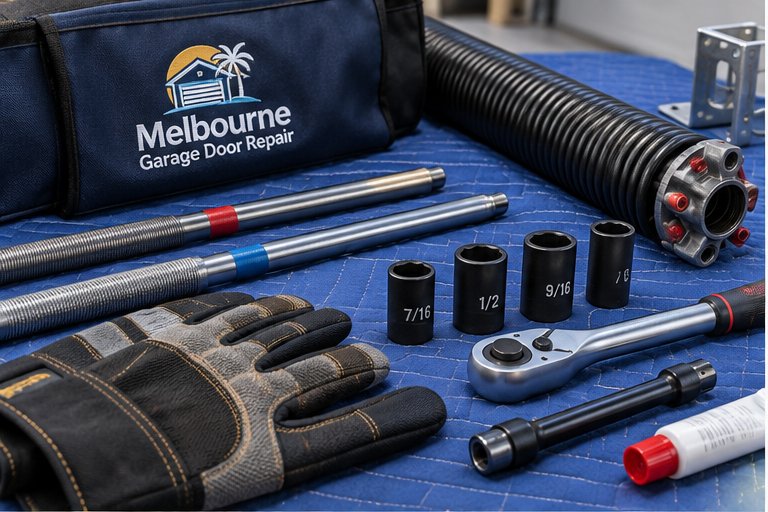
A torsion spring is a tightly wound coil of steel wire fitted over a steel tube or shaft. One end is fixed to a stationary plate, and the other end is fixed to a winding cone attached to the shaft. When the door closes, the cables pull on the drums and turn the shaft, which winds the spring tighter. That is how the energy is stored.
When the door opens, the spring unwinds and the shaft turns the other way, pulling the cables upward and lifting the door. Because the force comes from twisting, it is smooth and even. The door starts and stops gently, and it holds its position when it is part open.
A torsion spring does its work out of sight above the door. Its mounting at the center of the header keeps the force balanced between both sides of the door through the shaft and cables.
Many torsion systems use a pair of springs, sometimes of different lengths, placed side by side on the same shaft. Others use a single long spring in the middle. The arrangement depends on the door width and weight, and the cables on each side must stay evenly loaded for the door to rise level.
How an extension spring works
An extension spring is a long coil that stretches when the door closes. One end is anchored near the front of the track and the other runs back to the rear, connected by a pulley and a cable to the door. As the door goes down, the springs lengthen and gather energy.
When the door rises, the springs shorten and pull the cables through the pulleys, helping lift the door. Because the force depends on the amount of stretch, the lift is strongest when the springs are most extended and weakest when the door is fully open.
That uneven force is one reason extension systems are less smooth than torsion systems. The door can feel slightly jerky at the start or end of its travel if the springs are tired or mismatched.
Because the springs run along the sides of the garage and not above the opening, they take up space near the ceiling and along the track. They also depend on pulleys and cables at the front, which wear and need to be examined alongside the springs themselves.
Where each type is typically used
Torsion springs are the standard choice on most modern residential garages, especially for double doors and heavier or insulated doors. They handle weight well and last in a controlled way. Many new door installations come with torsion springs for these reasons.
Extension springs are more common on older homes and lighter single doors. They are inexpensive to produce and simple to fit in a garage with limited headroom. You will often see them on doors that were installed many years ago.
Local housing matters here. In an area with a mix of older and newer homes, such as Melbourne and the Space Coast, you will see both. Our page on extension spring replacement covers the older style, and you can read about torsion work in broken torsion spring repair.
Another factor is the garage itself. Low headroom, a finished ceiling, or storage racks above the door can limit which system fits. It is one reason we like to see the space before suggesting a change.
The safety cable on extension springs
Extension springs carry a safety feature that torsion springs do not need in the same way. A steel cable runs through the center of each extension spring and is anchored at both ends. If the spring breaks, the cable keeps the pieces from flying across the garage.
Without this cable, a broken extension spring can whip with enough force to damage a car or injure a person. Many older installations lack the cable altogether, or have one that has rusted or become unattached. That is a real hazard.
If you can see extension springs in your garage and no cable runs through them, treat that as something to mention to a technician. Do not stand near them while the door is moving, and do not attempt any work on them yourself.
What happens when each type breaks
When a torsion spring breaks, there is often a single loud bang from the garage, as if something had fallen. Afterward the door feels very heavy or will not lift. You may see a gap in the coil. If the door has two springs, one may remain whole, but the door will still be out of balance.
When an extension spring breaks, the bang is similar, but the door may tilt or hang crookedly because one side has lost its lifting force while the other still pulls. You may also see the broken spring and its safety cable hanging loose.
In either case, stop using the opener. Pressing the button strains the motor and can damage the door. Read a spring that snapped with a loud bang for what to do and what to avoid.
Lifespan in general terms
Springs are rated by how many times they can open and close the door before they are expected to tire. That rating is built into the wire size, coil length and design. A spring made for a higher number of cycles lasts longer for the same use, all else being equal.
How long that is in calendar time depends on how often the door is used. A door that opens a few times a day will reach the end of a spring's life later than a door used constantly by a busy household or a small business. Climate matters too, because moisture and salt can corrode coils.
We do not promise a particular number of years, since too many factors are involved. Our page on how long garage door springs last looks at this in more detail.
Torsion versus extension in everyday terms
Torsion springs generally give a smoother, more controlled lift and are better suited to heavy doors. They also tend to be seen as the more durable option when properly sized. Extension springs are simpler and less costly up front but are less forgiving and can be harder on the track and hardware.
The table below summarizes the usual differences. These are general patterns and not rules, and a good technician looks at your particular door and not just the label.
| Feature | Torsion spring | Extension spring |
|---|---|---|
| Where it sits | On a shaft above the door | Along the side horizontal tracks |
| How it stores energy | By twisting | By stretching |
| Typical doors | Modern, heavy, double and insulated | Older, lighter, single |
| Smoothness of lift | Even and controlled | Stronger at the start, can feel uneven |
| Safety cable | Not needed in the same way | Strongly recommended through each spring |
| Headroom needed | More space above the door | Less space above the door |
Why both types are dangerous to handle
Both kinds of spring hold a large amount of stored energy, and it can be released all at once. Torsion springs are wound under tension and fitted with winding cones that must be handled with the correct tools. A slip can send a winding bar flying or snap the spring suddenly.
Extension springs are stretched and can lash out if a fitting fails. Even the cables and brackets that connect to them are loaded with force and can cause serious injury when released.
For these reasons, adjusting, loosening or replacing springs is not a task for the home owner. The risk is simply not worth the saving. If you suspect a problem, keep people clear of the door and arrange for it to be examined.
Matching springs to the door
Springs are not interchangeable. The correct spring depends on the weight of the door, its height, the size of the drums and, for torsion springs, the length and wire size. A spring that is too weak will not hold the door up, and one that is too strong will make it rise on its own.
That is why replacing a spring is not a matter of finding one that looks similar. The door must be weighed or assessed, and the spring chosen to match. If the door has been changed since it was installed, for example by adding insulation or a heavier panel, the old spring may no longer be right.
Our garage door weights and balance guide explains the connection between weight and spring force, and the label on your door may help too, as described in reading your garage door label.
Replacing one spring or both
On a door with two springs, it is common advice to replace both when one breaks. They have been through the same number of cycles and were installed together, so the second is often close to failing. Replacing only one can leave the door unevenly balanced.
This is a judgment call that a technician can explain once they see the springs. It also depends on the type: on a door with extension springs, the pair is similarly matched, and mixing an old and a new spring can lead to uneven lifting.
Sometimes the right answer is to replace one and keep the other, and sometimes both. Ask for the reasoning, because it should be clear and not rushed.
Converting or upgrading from one type to another
Some homeowners with extension springs ask whether they can switch to torsion. In many cases it is possible, though it involves more than swapping the springs. A torsion system needs a shaft, drums, bearing plates and a suitable place to mount them above the door.
Reasons to consider a change include a heavier door, a desire for smoother operation, or wanting a longer lasting setup. Reasons not to include limited headroom, a lightweight door that works well as it is, or no practical way to mount the hardware.
We explain the practical side of this in spring conversion and upgrade. A site visit is the only way to know what is possible for your garage.
Signs your springs are tired
Springs rarely fail without warning, though the warning is easy to miss. A door that has become gradually heavier, one that closes with a bump or opens more slowly, or one that is noisier than before may be telling you the springs are tired.
Visible clues include rust along the coils, gaps in a torsion coil, stretched or uneven extension springs, or a door that sits crooked when it stops. None of these should be tested by touch or force.
- The opener strains, hums or struggles more than it used to.
- The door feels heavy when lifted by hand after the opener is disconnected.
- The door drifts down when left part open.
- You hear popping or creaking from the springs as the door moves.
- One side of the door sits higher than the other.
Myths that are worth dropping
A few ideas about springs come up often, and most of them lead people in the wrong direction. One is that a spring only needs attention once it breaks. In fact, signs of wear usually appear first, and catching them early is far easier on the door and on the household.
Another is that a spring can be tightened a little to make a heavy door feel lighter. Changing spring tension without training is exactly the kind of adjustment that causes injuries, and a door that feels heavy usually has a deeper cause such as wear, a bent track or a damaged cable.
A third is that any spring of the right length will do. Springs are matched to the weight of the door, the drum size and the way the door is hung. The wrong spring leaves the door heavy, or lets it spring open on its own, and both are hazards.
Finally, some people assume that a door which still opens must have good springs. A door can open with a nearly worn spring because the opener makes up the difference, but that extra effort shortens the life of the opener and the rest of the system.
When to call us
If you hear a bang, see a gap in a coil, or notice any of the signs above, stop using the door and keep children and pets away from it. Do not try to lift a door with a broken spring, because it is far heavier than it appears.
If anyone is hurt, call 911. Otherwise contact us, and we will come to the property, look at the door, explain what we find and what the options are.
Questions and answers
Look above the closed door. A horizontal shaft with one or two thick coils on it means torsion springs. Long thin springs running along the side tracks mean extension springs. Do not touch either type. If you are unsure, take a photograph and send it to us, and we will tell you what you have when we visit.
It depends on the door. Torsion springs usually suit heavier and double doors, give smoother lifting, and are common on modern installations. Extension springs are found on older and lighter doors and need a safety cable. Neither is right for every garage, so a technician has to look at the weight, headroom and layout. See conversion and upgrade.
No. Both types hold a great deal of stored energy that can injure or kill if released suddenly. Winding and unwinding springs needs the correct tools, training and a clear understanding of the door's weight. We strongly advise leaving spring and cable work to a trained technician and keeping people clear of the area. We explain what we find before any work begins, so you can decide.
Usually yes, if the door has two. Both springs have worked the same number of cycles, so the second is often close to the end of its life, and a mismatched pair can leave the door unevenly balanced. A technician can look at the remaining spring and explain the reasoning. See torsion spring repair. We explain what we find before any work begins, so you can decide.
It runs through the center of the spring and is anchored at both ends. If the spring breaks, the cable catches the pieces so they do not fly across the garage. Many older garages lack one or have a damaged one, which is a hazard. If you see extension springs without a cable, mention it to a technician. See extension spring replacement.
There is no single answer. Springs are built for a certain number of open and close cycles, so a busy door wears them out sooner than one used lightly. Moisture, salt air and heavy doors also play a part. We do not promise a set number of years, but can tell you what we see when we inspect the springs. See how long springs last.