
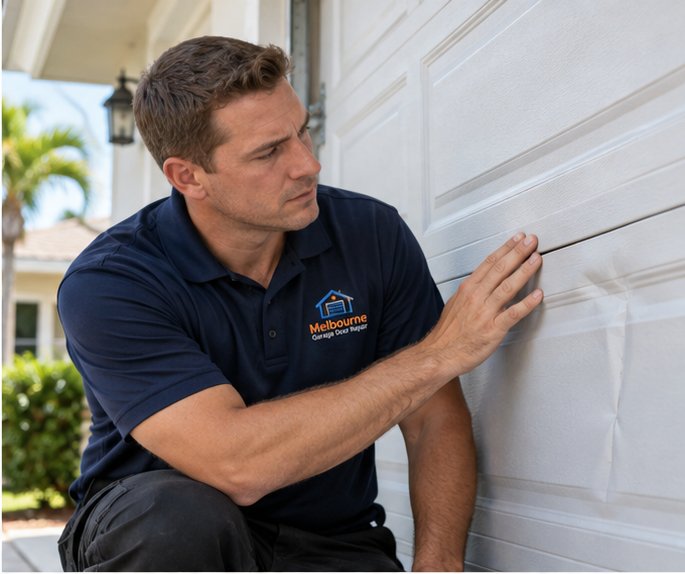
What a bent panel actually looks like
Homeowners describe bent panels in many ways. Some see a single sharp crease running across the width of one section. Others notice a shallow bulge near the middle of a panel, a corner that has folded inward, or a ripple that catches the light at certain times of day. All of these are forms of the same thing: the metal, wood or composite skin of a section has moved out of its original plane.
The difference between a dent and a bend matters. A dent is a local depression, often round, where something struck the surface. A bend or buckle is a change in the shape of the whole section, usually along a line, and it tends to affect how the section meets the sections above and below it. A dent may stay a cosmetic issue for years. A buckle usually does not.
Look at the door from the driveway first, then from inside the garage with the door closed. From inside you can often see whether the horizontal joints between sections still run in straight, even lines. If a joint opens up into a wedge or one edge sits proud of its neighbor, the damage goes deeper than the surface.
Why a straight line matters on a sectional door
A sectional garage door is built from several horizontal panels joined by hinges. As the door rises, each panel follows the curve of the track and then lies flat along the ceiling. The rollers on the sides of each panel have to remain in line with the track for that to work. A panel that is bowed or twisted pushes its hinges and rollers slightly out of position.
That small change shows up in several ways. The door may rub on the track, scrape the weather seal, or bind at the point where the vertical track curves into the horizontal. You may hear a creak or a pop each time the bent section passes the same spot. Over time the extra friction asks more of the opener and of the springs that carry the weight of the door.
For a broader look at how the parts cooperate, see how a garage door works. Once you see how each section depends on its neighbors, it is easier to understand why we treat even one damaged panel with care.
Common causes of bending and buckling
Most bent panels trace back to a handful of causes. Knowing which one applies to your door helps decide what else to inspect, because the force that bent the panel may also have affected the track, hinges or opener.
- A vehicle, bicycle, ladder, lawn equipment or a swinging load striking the door from outside or inside the garage
- A door that was closed while something was in the way, so the panel folded around the obstruction
- Wind pressure during a strong storm pushing against a door that lacks enough reinforcement
- A spring or cable problem that lets one side of the door drop or lift unevenly while it moves
- An opener pulling hard on a door that is binding, which can flex the top section where the opener arm attaches
- Long exposure to heat, moisture or salt air that weakens thin skins or the edges of wood and composite panels
- An earlier repair that was done with mismatched parts or without the proper reinforcement
Impact from outside
A bumper tap in the driveway can leave a shallow dent, but a firmer hit can push a panel inward and crease it along a stiffener. When that happens the panel often has a visible line at the point of contact and a gentle curve on either side.
Impact from the inside
Garages hold bikes, shelves, ladders and long lumber. A load that leans into the door path can be pinned against a panel as the door descends. The result is usually a crease that matches the shape of whatever was in the way.
How the opener and the springs can bend a panel
Not every bent panel comes from something hitting the door. Sometimes the door bends itself because it is no longer moving as designed. If a roller leaves its track, or a cable slips off its drum, one side of the door can travel while the other stays behind. The panels then twist, and the weakest section folds first.
The top section is a frequent victim. It carries the bracket where the opener arm attaches, and every time the opener starts or stops it applies force at that single point. On a door that is out of balance or binding, that force can flex the top panel until it develops a bow or a crack around the bracket.
If your door is crooked while it moves, read about a door that is crooked or uneven. If the damage arrived with the door leaving its track, off track garage door repair describes what that involves. In both cases the panel is often a symptom rather than the original cause.
What you can safely check yourself
A few simple observations tell you a great deal and carry no risk, as long as you stay on the floor and keep your hands away from moving parts. Begin with the door fully closed, and stand back far enough to see the entire face of the door.
- Look across the door at a shallow angle in good light and note any ripple, bulge or crease
- Check whether the lines between sections are even from left to right
- Look for daylight at the edges that was not there before
- Listen as a family member operates the door from the wall control while you stand clear, and note where any scrape or pop occurs
- Look at the visible hinges and rollers from the floor for bent metal, missing screws or rollers that are out of the track
- Take clear photographs of the damage from several angles for your own records
Where to stop
Do not touch, adjust or loosen the springs, the cables or the brackets at the ends of the door. Those parts hold a large amount of stored energy, and a slip can cause serious injury. Do not try to bend a panel back by hand or with tools while the door is on its tracks. If the door is stuck partway open, keep people and vehicles out from under it.
Dent, crease or buckle: three different problems
It helps to sort the damage into three groups, because each one points to a different outcome. The groups below are a general guide only. A technician has to see the door in person to be sure.
Photographs taken before any repair are also useful if you plan to ask your insurance provider about a claim for impact or storm damage. We do not handle insurance decisions, but a clear record of the original condition makes any later conversation easier.
| Type of damage | What it looks like | Usual concern |
|---|---|---|
| Shallow dent | A rounded depression with no sharp line, panel still flat overall | Mostly appearance, sometimes finish damage that invites rust |
| Crease | A sharp fold running across or along the panel | Weakened section that may flex further under load |
| Buckle | A bowed or twisted panel, joints no longer even | Interference with rollers, track and seals; strain on the opener |
| Corner fold | A bent corner near the end stile | Roller and hinge misalignment at the track |
Can a bent panel be repaired?
Sometimes. A shallow dent on a steel panel can occasionally be worked out or filled, and a minor surface issue on wood can be sanded and refinished. In those cases the section is still structurally sound and the work is mainly about appearance.
A creased or buckled section is harder. Metal that has folded has been stretched and work hardened along the fold, and it rarely returns to its original strength even if it looks straight afterward. Reinforcing the area with a strut can help certain doors, but the technician has to judge whether the section would still carry the hinges and rollers reliably.
When repair is reasonable
Repair is more likely to make sense when the damage is limited to one section, the panel is still flat, the joints are even, and the track and hardware are straight. In that situation the door can often keep working as it did before.
When repair is a poor fit
Repair tends to be a poor fit when the fold crosses a hinge location, when the skin has torn, when the end stile is distorted, or when the section will not sit flat against its neighbors. A repair that leaves the door binding simply moves the strain to the opener and springs.
When replacing a single section makes sense
Many sectional doors allow one damaged panel to be replaced without replacing the whole door. This is often the practical answer when the rest of the door is in good shape and a matching section is available. The technician removes the damaged section, fits a new one, and transfers the hinges, rollers and any hardware that can be reused.
Matching is the main challenge. Panels come in different heights, thicknesses, profiles and finishes, and they can fade or weather over time. A new section may be the right size and shape yet still look slightly different in color or texture from panels that have been in the sun and salt air for years. We will talk through what is realistic before any work is planned.
Our page on garage door panel repair explains how replacement is carried out and what has to be checked afterward, including balance and the travel of the door through the track.
When the whole door is the better answer
There are times when replacing one section would be a short-term fix. If several panels are bent, if the door is old and the finish is failing, if parts for that model are hard to obtain, or if the door has been repaired repeatedly, a new door may be the more sensible choice. A door of a different make can also vary enough in size that a single section cannot be matched.
This is a decision about the whole door, not just the damaged panel. The age of the springs, the condition of the track and the opener all enter into it. Our comparison of repairing versus replacing a garage door sets out the questions we usually ask and why.
We try to lay out the choices plainly. Some customers prefer to repair what they have; others would rather start fresh. Either is reasonable when the facts are on the table.
What a technician evaluates on site
When we come to look at a bent panel, we do not look at the panel alone. We want to know what bent it and whether anything else is now at risk. The visit generally covers the following areas.
After that we explain what we found and what the options are. If a repair is possible, we say what it would involve and what its limits are. If a section or door should be replaced, we say why.
- The damaged section itself, including the skin, the stiffening ribs, the end stiles and any cracks
- The hinges and rollers on that section and the ones beside it
- The vertical and horizontal tracks for bends, gaps or loose mounting
- The cables and springs, checked by eye for fraying or uneven wear, without tampering
- The balance of the door when it is disconnected from the opener and moved by hand with proper care
- The top bracket and opener arm where the opener pushes on the door
- The weather seal along the bottom and sides, which often shows where the door has been rubbing
Wood, steel, aluminum and composite panels
The material of your door changes how it bends and how it can be repaired. Steel panels tend to crease and hold their new shape. Thin steel can dent easily, while thicker, insulated steel resists denting but can still buckle along its stiffening ribs. Wood can crack or split along the grain and may swell where moisture reaches it. Aluminum with glass panels can bend at the frame and break the glass. Composite and fiberglass can crack at an impact point without any obvious dent.
Each material also behaves differently with age. In our humid, salty coastal air, unprotected edges are where trouble usually starts, because moisture and salt find their way into any scratch or chip. If the damaged area has also lost its paint or coating, the repair needs to deal with that so the problem does not return.
Read more in our guide to garage door materials compared, which describes how each material ages and what it asks of the owner.
Storms, wind and Space Coast conditions
Along the Space Coast, a strong summer thunderstorm or a named storm can put real pressure on a garage door. The door is the largest moving opening in most homes, and a panel without enough reinforcement can flex inward under heavy wind. Flying debris is another cause of dents and creases.
If you suspect storm damage, treat the door carefully. Do not use the opener if the panels are visibly distorted, because the motor may force a door that is binding. Use the wall control only if the door moves smoothly, and stop at any strange sound or sudden resistance.
Our page about a garage door damaged after a storm covers storm-related issues in more detail, including what to look at once conditions are safe.
Preventing panel damage
A regular look at the hardware and balance also protects the panels, because a door that moves evenly puts less strain on any one section. For routine care, see the guide to garage door weight and balance.
- Keep the area inside the door clear of ladders, bikes, shelves and long items that could lean into the path
- Teach everyone in the household that the door travels down and that nothing should be left near it
- Check that the safety sensors are clean and aimed correctly so the door reverses when something is in the way
- Back out slowly and use the wall control or remote, not a hand pushed against a moving door
- Have a technician look at the door when it begins to scrape, pop or tilt, rather than waiting until it sags
- Keep the finish in good shape, since chips and scratches let salt and moisture reach the metal
Planning the visit and what to have ready
Before we come out, a few notes help. Tell us what you think happened, when you first noticed the damage, and whether the door still opens and closes. Mention any scraping, popping or tilting you have observed, and send photographs if you can. If the door is stuck, say so, and keep it closed or clear of people and vehicles.
On the day, we ask that someone with knowledge of the door's history be available, along with access to the garage and, if possible, a clear space around the door. We will examine the section and the hardware, explain what we see in plain terms, and describe the options.
We do not promise a particular outcome until we have seen the door. What we do promise is a clear explanation. If you are ready to have the door looked at, you can contact us and describe what you are seeing.
Questions and answers
It depends on how bad the bend is. A shallow dent usually does not affect operation. A crease or buckle can make the door bind, scrape or twist, which strains the opener and springs. If the door makes new noises, tilts, or stops partway, stop using it and have it looked at. Keep people and vehicles clear while it is in that condition.
We advise against it. Forcing a panel while the door is mounted can disturb hinges, rollers and the stored energy in the springs and cables. Metal that has been creased also weakens at the fold, so hand straightening seldom restores it. The safer step is to photograph the damage and have a technician inspect it.
On many sectional doors a single section can be replaced. It depends on whether a matching section is available and whether the rest of the door is sound. Color, texture and profile may differ slightly from older panels. If several panels are damaged or the door is worn, a full replacement can be the more sensible choice.
It can add strain over time. A panel that binds in the track makes the opener work harder, and the top section can flex where the opener arm attaches. You may notice louder operation, hesitation or the door reversing. Having the cause corrected protects the opener and the springs as well as the panel.
A shallow dent with a flat panel and even joints is often only a cosmetic concern. It is still worth watching for chipped paint or exposed metal, because salt air and humidity can start rust at a scratch. A technician can tell you whether the finish needs attention or whether the dent can simply be left alone.
The panel assessment is similar, but storms can also affect tracks, hinges, the opener and the seal. We look at the whole door because wind and debris rarely hit only one part. Photograph the damage before anything is moved, and avoid using the opener if the panels look distorted or the door resists.
Signs include rubbing sounds, rollers that sit out of line, gaps between the track and the wall, and a door that jerks at the curve. From the floor you can sometimes see a kink or a loose bracket. Do not adjust the track while the door is under spring tension. A technician can check it safely.