
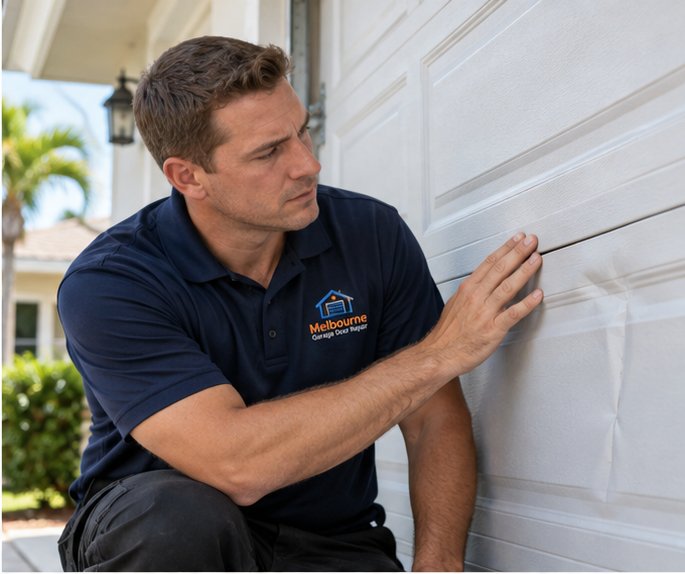
Why panels get damaged
A sectional garage door is made of several horizontal panels joined by hinges and guided by rollers in the tracks. Each panel is a fairly thin shell, often steel wrapped around a foam core, and it is designed to be light enough for the springs to balance. That lightness is exactly why panels are easy to dent.
In our experience, most damage comes from ordinary life. A bicycle falls against the door, a reversing car bumps the lower panel, a ladder slips, a basketball hits the same spot for years, or a delivery truck clips the door. Storms add their own causes, from flying debris to tree limbs and the force of wind pressing a door that was already weakened.
Damage also appears without any single event. Panels can bow after years of heat, rust from the bottom edge upward, crack along old stress lines, or start to separate from hinges that were never properly reinforced. Knowing how the damage happened helps us judge whether it is isolated or a sign of something bigger. A panel that has been dented at the same height on several occasions, for instance, may be telling us that the car, the cans or the toys stored near the door are the real issue, and a small change in where things are kept can protect the repair.
Types of damage we see
Not every dent is the same, and the type of damage decides what can be done about it. We group panel problems into a few common families.
- Shallow dents that have not creased the metal or broken the paint.
- Sharp creases where the steel has folded and will not return to shape.
- Cracks in the skin, around hinge points or along the panel edges.
- Bent bottom panels from vehicle contact, often with a damaged seal retainer.
- Rust perforation along the bottom edge where water collects.
- Bowed or sagging panels that no longer sit flat against the neighbors.
- Separated layers, where the outer skin pulls away from the insulation or backing.
- Broken window inserts and cracked glazing in panels that carry glass.
Cosmetic versus structural
A cosmetic dent changes how the door looks without changing how it works. A structural problem affects the strength of the panel, the line of the door or how the hinges and rollers hold. A crease across the width of a panel, for example, can weaken it enough that the section flexes whenever the door moves. We separate the two kinds of damage during the visit and tell you which one you have.
What a damaged panel does to the whole door
A single bad panel can create a chain of problems. A bent section may not roll smoothly through the curve of the track, causing noise or a jerky motion. A bowed panel may rub against the weather seal or the door jamb. A cracked panel can let hinges tear loose, which in turn shifts the load onto neighboring sections.
Because the door is balanced by springs, any change to its weight or shape can affect how it behaves. A panel that has absorbed water may become heavier. A section replaced with a lighter or heavier one may change the balance. Those are good reasons to have the work done by a technician who understands the whole system, not just the surface.
If the door is crooked, hangs unevenly or looks as though it is leaning to one side, there may be more going on than a single dent. Our page on a crooked or uneven door explains the usual causes.
Safety comes first with damaged panels
A door that has been struck by a vehicle or hit hard by debris should be treated with caution. Panels, hinges, tracks and the lifting hardware can all be stressed in ways that are not obvious from the outside. Operating the door through its full travel may make the damage worse or cause a section to fall.
If your door has been hit, stop using the opener, keep people and pets clear, and do not try to straighten tracks, bend panels back or adjust any hardware yourself. The springs and cables hold dangerous tension and must never be touched by anyone untrained. If someone is hurt, call 911.
Our page on a garage door hit by a car explains what to do in the first few minutes, and our guide on garage door safety tests covers the simple checks that are safe for an owner to do.
Can a dent be repaired?
Sometimes. Shallow dents in a steel panel, particularly where the metal is not creased and the paint is intact, can sometimes be improved by working the metal back toward its original line. The result depends on the depth of the dent, the thickness of the steel and the construction of the panel.
Deep dents, sharp creases and panels with cracked skin generally do not return to a sound condition. Pushing a creased panel flat may look better for a while, but the metal has been stretched and the panel can remain weak. Filling and repainting can improve appearance but does not restore strength.
We give you an honest opinion at the door. If a repair will hold up and look acceptable, we say so. If it would only hide the damage temporarily, we tell you that too, and explain what replacing the section would involve.
Section replacement: how it works
Many sectional doors are built so a single panel can be replaced without replacing the whole door. The technician removes the damaged section from the stack, fits a matching section in its place, transfers the hinges and rollers, and restores the door's balance and operation.
The tension on the door's springs is a serious hazard whenever sections are removed, so this work is done with the door secured and the tension managed properly by trained hands. It is not a project for an owner with a ladder and a screwdriver, and we advise strongly against attempting it.
The key question is availability. A replacement section must match the thickness, height, profile, hinge positions and construction of your existing door. If your door is a current, widely made style, matching is often straightforward. If your door is older or from a discontinued line, finding a compatible section can be difficult, and we will tell you plainly when that is the case.
Which panels are most often replaced
The bottom section takes most of the abuse. It meets the ground, collects water, is struck by vehicles and carries the bottom seal. It is therefore the panel we replace most often. Top sections are replaced less often, but they carry some of the heaviest hardware loads and are important to a door's operation.
Matching style, color and finish
A new section that stands out against faded neighbors is a disappointment. Matching depends on several things: the panel design, such as flat, raised or recessed; the surface texture; the paint or finish; the age and fading of the existing door; and the way light falls on the garage face.
Color is the hardest part. Even when a manufacturer supplies the same named color, the new panel will be fresher than the sun worn ones beside it. In Florida sunshine, the contrast can be noticeable at first. Some owners choose to paint the new panel to blend with the rest, or to repaint the door as a whole, so the finish looks uniform.
We discuss the options openly. If a perfect match cannot be supplied, we explain what the closest option would look like and whether painting is a good route. If your community has rules about door colors, our guide on the rules of your homeowners association is worth reading before you choose.
Reinforcing weakened panels and hinge points
Some doors suffer from panels that crack at the hinges or flex under the load of the opener. In these cases, simply swapping the panel may not solve the problem. A weak area can be reinforced with strengthening members or struts fitted across the panel, which spreads the load and keeps the section straight.
Reinforcement is common on wider doors and on panels where the opener bracket attaches, since the opener's pull can crack the top section over time. It is also useful for doors with heavy glass or when a door has been repaired after an impact.
We look at where the cracks begin, how the hinges are fixed and how the opener connects, then recommend reinforcement only where it is genuinely needed. Our pages on hinge and track service describe related work that often goes along with a panel repair.
Rust, moisture and the bottom edge
On the Space Coast, rust is a recurring theme. Humidity, rain, salt in the air and water that collects at the bottom of the door all attack steel panels, and the lower edge is the first place it shows. Rust typically begins where the paint is scratched or where water sits against the bottom seal.
Surface rust on a sound panel can be treated and repainted before it spreads. Rust that has eaten through the metal, or that has weakened the edge where the seal is held, usually means the section has reached the end of its useful life. Replacing the bottom section and its seal is often the right solution.
If your door has been damaged by a storm, rust may follow soon where paint has been chipped. Our page on rust on a garage door and track explains what to look for, and our guide on garage doors in a coastal climate covers how the environment wears on materials.
Window panels, insulation and special sections
Some doors include window inserts, decorative glass or insulated sections that complicate replacement. A cracked window pane can sometimes be replaced separately, but the frame or insert may be part of the panel and not available alone.
Insulated panels contain foam or similar material bonded to the steel. When the outer skin is damaged, moisture can enter the core and reduce the insulating value, so a damaged insulated section is more than a cosmetic problem. We check for signs of water, separation or a hollow sound when tapped.
If you are thinking about adding insulation or windows to a door while repairing it, our page on insulation and window inserts describes what is possible. For some doors, upgrades are practical. For others, the construction makes it better to consider a new door.
Repair, replace a section or replace the door
The right answer depends on the age of the door, the number of damaged panels, how well the hardware is holding up and whether matching panels exist. One damaged section on a sound door is usually a candidate for section replacement. Damage to several panels, a door that is already worn, or a model that is no longer made often points toward a new door.
We try to keep this decision practical. We consider what the door is worth, what the repair would involve, how long the rest of the door can be expected to last, and what you want from your garage. Spending money on a section for a door that is otherwise failing is rarely good value.
Our guide on deciding between repair and replacement walks through the factors, and our comparison page on repair versus replace sets them side by side. If replacement is the better route, our service page on new garage door installation explains how that works.
Storm damage and impact
Hurricane season and summer storms bring flying debris, fallen branches and gusting winds. A door that took a hit may look worse than it is, or it may be more damaged than it seems. Panels can be dented without any visible crack, and tracks and hinges can be bent out of alignment.
After a storm, do not run the opener if the door appears bent, misaligned or has pulled away from its tracks. Keep clear of the door and call for an inspection. A door that is damaged in a storm needs to be assessed as a system, not just a panel.
Our page on a garage door damaged after a storm describes how to approach the first steps safely. If you are preparing ahead of the season, our guide on hurricane preparation is a good place to start.
What happens during a panel visit
A technician arrives, looks at the damaged panel and the full door, and checks the tracks, hinges, rollers and balance. We measure the panel and note its height, profile, material and construction. We take photos where they help us find matching parts.
We then explain what we find, using plain language and pointing to the damage on the door itself: whether the damage is cosmetic or structural, what the repair options are, and whether matching sections are available. You can ask questions at any point and decide how to proceed. We do not carry out work you do not understand and have not agreed to.
If a section must be ordered, we tell you so, and the door remains in a safe condition until the work is done. When the new section arrives, the technician fits it, restores the door's operation and checks the balance and safety functions before leaving.
Taking the next step
If one or more of your garage door panels is dented, cracked, bent or rusting, get in touch and tell us what you see. A few photos and a description of how the damage happened will help. We serve Melbourne and the surrounding Space Coast, and we will come to your property to look at the door.
We will explain what we find and what the options are, whether that is a repair, a section replacement or a conversation about a new door.
Questions and answers
On many sectional doors, yes. A single section can often be replaced without replacing the whole door, as long as a matching section is available in the same thickness, height and profile. Older or discontinued doors can be harder to match. We check your door and tell you honestly whether a section replacement is realistic.
It may not match exactly. Even when the color name is the same, sun and weather fade the existing panels. Some owners paint the new section to blend in or repaint the whole door. We explain the likely result before you decide, so there are no surprises.
We advise against it. Pushing on a panel can stress hinges, rollers and tracks, and a creased panel can be weaker than it looks. The door is also held in balance by springs under heavy tension. Leave panel work and any hardware adjustments to a trained technician.
Please do not run it until it has been checked. Impact can bend tracks, loosen hinges and damage panels in ways that are hard to see. Operating a damaged door can make things worse or cause a section to fall. Keep people clear and contact us for an inspection.
The bottom section sits where water collects, and Space Coast humidity and salt air speed up rust. Scratched paint and a worn bottom seal make it worse. Light surface rust can be treated, but rust that has eaten through the edge usually means the section should be replaced along with the seal.
It depends on how the door is built. Some doors can accept window inserts or added insulation, while others are not suited to it. We look at the construction and explain what is practical, including when a new door would make more sense.
A single damaged section on an otherwise sound door often suits a section replacement. Several damaged panels, an older door, worn hardware or a style that is no longer made points toward a new door. We weigh these factors with you and explain the options.