
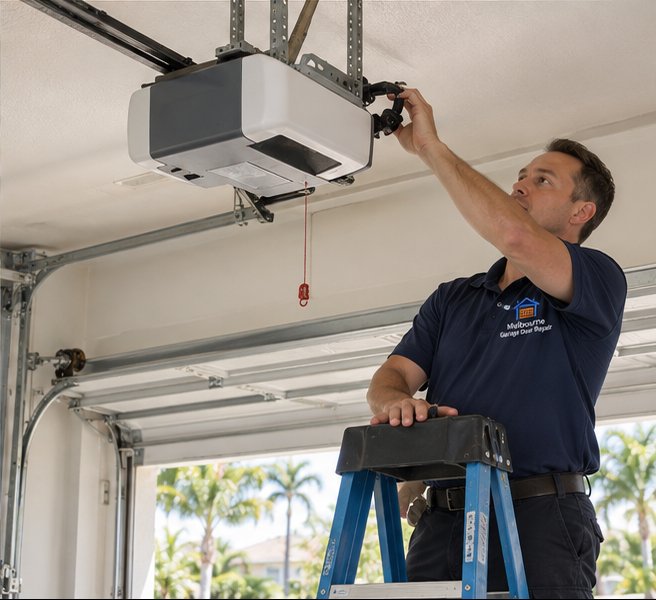
What the red cord is for
Nearly every residential opener has a rope with a red handle hanging from the trolley, the carriage that rides on the opener rail. Pulling the rope releases a latch inside the trolley so the opener lets go of the door. After that, the door can be raised and lowered by hand.
The cord is an emergency control. It is there for power outages, for a dead opener, and for situations where the door must be opened with nobody able to run the motor. It is also a safety device in some scenarios, since it provides a way to release a door in an unusual event.
Because it is rarely used, it is easy to forget about until the day it is needed. That is why a stuck or broken cord is so often discovered at exactly the wrong time, in the middle of a storm or on the morning you need to leave.
Signs the release has a problem
Some problems are obvious. The cord snaps and leaves a short stub, or the handle pulls off. Others are subtler and show up only when you try to use the release.
Look at the cord and handle in daylight with the door closed. Check for fraying, knots, a handle that has cracked, or a cord that has slipped back into the trolley and is out of reach. Note whether the cord hangs straight or has become tangled around the rail.
- The cord feels rigid and will not move when pulled gently.
- The handle has cracked or separated from the rope.
- The rope is frayed, stretched, or has a knot jammed against the trolley.
- The cord is too short to reach comfortably.
- The trolley does not disconnect even though the cord moves.
- The release works, but the door will not reconnect afterward.
Why cords get stuck
The most common cause is load. If the release is pulled while the opener is still pushing or pulling on the door, the latch has pressure on it and may not let go. The latch holds tighter against force, so a harder pull makes the situation worse rather than better.
Another cause is a door that is not at rest. If the door is partway open and the springs are doing most of the supporting, the arm can bind against the trolley. In that case the release can seem frozen until the door is brought to a resting position.
Dirt, rust, and old lubricant can also seize the latch. Coastal moisture is hard on the steel pieces inside the trolley, and a latch that was last moved years ago can behave like a rusted hinge. Finally, plain wear matters. Plastic handles go brittle in heat, and rope fibers weaken after years in a warm, humid garage.
Why cords snap
A cord that breaks has usually been under strain. Pulling hard on a binding release, hanging items from the rope, or letting a vehicle bumper or roof rack catch it can all overload the fibers.
Age is a big factor. A cord that has hung unchanged in the garage for ten or fifteen years has gone through countless heat cycles. UV from the garage windows can add to the damage. The rope may look fine and still be weak inside.
Some cords are hooked on a bent metal wire or a hook that gives way before the rope does. In that case the handle may stay intact while the connection to the latch fails. Either way, a broken cord should be treated as a sign the release needs attention, not as a one-off accident.
The risks of leaving it alone
A release that cannot be used leaves you with a door you cannot open by hand in an emergency. During a power outage, that can mean a vehicle trapped inside, or a household unable to leave through the garage. It can also mean a door that cannot be freed if the opener fails partway through a cycle.
There is a second risk, which is the temptation to improvise. People sometimes reach up and pry at the trolley, pull on the arm with force, or climb a ladder under a door that is not secure. None of that is a good idea. The parts overhead sit near springs and cables that hold dangerous tension.
A stuck release is worth handling calmly and promptly, but it is rarely an emergency that justifies taking a risk. Keep the door in a stable position, keep people away from it, and call for help. If anyone is injured, call 911.
What not to try
Resist the urge to force it. Hard pulls, pliers on the cord, or pulling on the handle with your full weight can break the cord, crack the trolley housing, or hurt you if the handle gives way suddenly.
Do not try to open the trolley housing, remove screws from the carriage, or disconnect the arm from the door while the door is raised. If the door is partway up, a release at the wrong moment can allow it to drop.
Do not adjust, loosen, or touch springs, cables, drums, or the brackets that hold them. Those parts are not related to the release but sit nearby, and the tension in them can cause serious injury.
- Do not yank on a cord that will not move.
- Do not use tools to pry at the trolley while the door is raised.
- Do not stand under a door that is not fully down.
- Do not tie extra weight to the cord or hang items from it.
- Do not touch spring or cable parts at any time.
A gentle check you can try
If the door is fully closed and resting on the floor, there is one calm thing worth trying. Run the opener once, if it has power, so it reaches the closed position and takes tension off the arm. Then pull the cord gently down and slightly back toward the opener.
If power is out, make sure the door is fully down and not leaning in the tracks. A door that rests squarely is easier on the latch. Try the pull once or twice with steady pressure, not a sudden jerk.
If the cord still does not move, stop. Another attempt will not help, and a broken handle or rope makes the repair more awkward. Describe what happened when you call, including whether the opener was running when you tried the release.
How a technician frees a stuck release
A technician starts by looking at the situation from a safe position. The door is secured, the opener is unplugged if necessary, and the load is taken off the latch. That alone often makes a stuck release let go.
If the latch is rusted or dirty, it can be cleaned and treated with an appropriate lubricant. If the door arm has bound against the trolley, it can be freed by bringing the door to a stable position first. If the housing is cracked or the latch is damaged, the trolley may need to be replaced.
Because the tools and the sequence matter, this is a job for someone trained. The aim is to restore a release that works smoothly every time, not just one that works once. We cover this type of work on our emergency release service page.
Replacing a snapped cord and handle
If the rope broke but the latch still works, the repair can be simple. A new rope and handle are attached to the release arm, set to a length that hangs where it can be reached without being in the way of vehicles.
Length matters more than most people think. A cord that hangs too low can catch on a roof rack or the mirror of a tall vehicle. A cord that hangs too high is hard to reach in a hurry. The right height is a balance, usually within comfortable reach for an adult standing on the floor.
We also look at what the cord is connected to. If the release arm is bent or the attachment point is worn, a new rope alone would only fail again. Replacing the faulty piece makes the repair last.
When the trolley itself is the problem
Sometimes the cord is fine but the carriage is worn out. Plastic parts can crack, the latch spring can weaken, and the internal metal can corrode. In that case the release may feel loose, may not fully disconnect, or may let go at the wrong time.
A trolley that disconnects unexpectedly is a different concern. If the door suddenly stops responding to the opener while the motor runs, the release may have tripped on its own. See an opener that runs but the door does not move for that symptom.
Replacing a trolley is usually a modest repair compared with a full opener replacement. It is also an opportunity to look at the rail, the chain or belt, and the drive. Our garage door opener repair page describes what that involves.
What the repair visit looks like
When we arrive, we ask when the problem started and what was happening at the time. Was the opener running, was the power out, did the cord break during a pull, or was it already stiff? That history often points straight at the cause.
Then we examine the cord, the handle, the release arm, the trolley, and the way the door arm sits against the carriage. We check that the door is at rest and stable before touching anything overhead. If the door is raised, we secure it first.
After the release is working again, we test it from start to finish: disconnect, move the door by hand, and reconnect. We also look at the opener rail and drive, since a cord that has been struggling often shares a garage with other parts that are tired. We explain what we found and what the options are, and we leave you with a release you can reach and trust.
Preventing a stuck release
A little care goes a long way. Use the release once or twice a year, with the door fully closed, to confirm it works. Watch how it feels and make a note if it seems stiff.
Keep the cord clear of storage, hooks, and vehicle accessories. Do not hang anything on it. Replace a frayed rope and a cracked handle early, before they fail. Have the trolley and latch looked at during a regular service visit, because rust and dirt build up quietly.
Our maintenance and tune-up service includes a look at the release as part of the opener check, which is a convenient time to catch small problems.
- Test the release annually with the door fully down.
- Keep the cord untangled and out of the way of vehicles.
- Replace frayed rope or cracked handles early.
- Do not attach anything to the cord.
- Have the trolley inspected during routine service.
Teaching the household
The release only helps if the people who need it know how to use it. Show family members, tenants, caretakers, and anyone who might be alone at home. Explain that the door should be down before the cord is pulled and that the red handle should be pulled once, steadily.
Children should be told that the cord is not a toy. A cord hanging within reach of a child can be tugged and can release a door unexpectedly. Keep it above a child's reach where possible, and keep children out of the garage during door operation.
For households with seniors or people with limited strength, think about how the door will be lifted once released. If lifting is a problem, consider a backup battery for the opener so the release is needed less often.
Release problems at a glance
This table pairs common situations with what usually causes them and what to do next.
| Situation | Usual cause | Sensible response |
|---|---|---|
| Cord will not pull at all | Load on the latch or rust | Stop, do not force, call |
| Cord pulls but door stays connected | Worn latch or broken linkage | Call for trolley inspection |
| Handle came off | Brittle plastic or old rope | Replace handle and rope |
| Rope snapped | Age, strain, or hard pull | Replacement and latch check |
| Cord is out of reach | Rope slipped or cut too short | Have a longer cord fitted |
| Release works but door will not reconnect | Trolley or arm damage | Call for service |
| Door partway open and cord stuck | Door under load | Keep clear and call |
Questions and answers
Usually the latch is under load because the opener or the door is pressing against it, or it has rusted or collected dirt. Pulling harder tends to make it worse. Make sure the door is fully down, try one gentle pull, and if it still will not move, stop and call a technician.
No. Opening the housing or disconnecting the arm while the door is raised can let the door drop, and the area overhead sits close to springs and cables with dangerous tension. Leave the trolley closed and let a trained technician handle the work.
A temporary rope may seem fine, but the attachment point and the latch also need to be checked. A rope tied to a bent or worn arm can fail again, and an unreliable release is exactly what you do not want in an emergency. We replace the rope and check the parts it connects to.
If the door is fully down and the opener has power, use the wall button or remote. If the opener cannot run and the cord will not work, do not pry or force anything. Keep clear of the door and call for help so the release can be freed safely.
Once or twice a year is a reasonable habit. Do it with the door fully closed, pull the cord gently, lift the door a short way by hand, then reconnect following your manual. If it feels stiff, gritty, or does not disconnect, mention it so it can be looked at before an emergency.
Yes. A cord that hangs too low can snag on a roof rack or mirror and be pulled by accident. One that is too short or has slipped upward may be hard to reach in a hurry. A technician can set the length so it is reachable without being in the way.
Not necessarily. The release is a mechanical part of the trolley, separate from the motor and the electronics. It can stick while the opener works fine. Still, while we are looking at the trolley, we also check the rail, the drive, and the opener, so any wear is spotted early.