
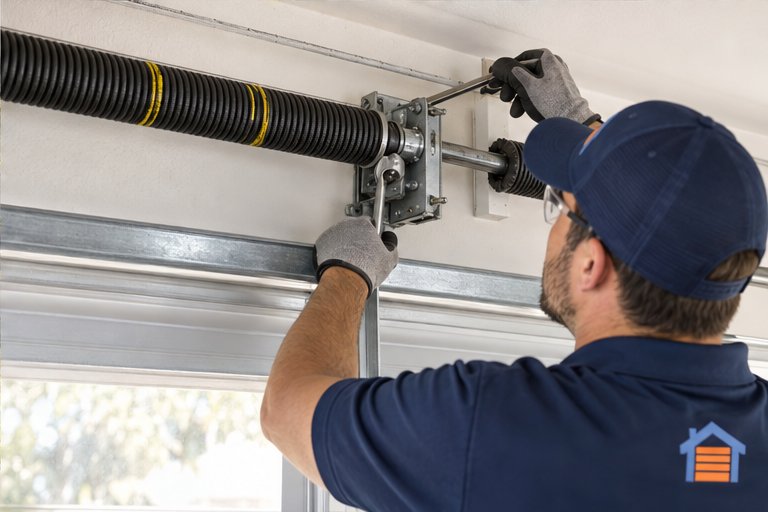
Treat this as a safety problem first
A garage door often weighs well over a hundred pounds, and a residential double door can be much heavier. Springs hold that weight so the door feels light and moves under control. When the door slams down, those springs or the cables that connect them are no longer carrying their share.
A falling door can injure people, crush a bumper, damage a car roof, and harm pets. It can also drop without warning while someone is standing under it or reaching for something stored in the garage.
If the door has slammed once, assume it can do it again. Keep people and vehicles clear of its path until it has been looked at, and do not use the opener repeatedly to see what happens.
What a healthy door does
A balanced door stays where you leave it. Lift it halfway with the opener disconnected and the door fully supported by your hands, and a well balanced door tends to hover or move only a little. The opener's job is mainly to move a door that is already nearly weightless.
When closing, the door descends at a steady pace, controlled by spring tension and by the opener's chain, belt or screw. It reaches the floor gently and the opener stops it.
You can read more about the underlying system on our page explaining how a garage door works. Understanding the basics makes the symptoms below easier to interpret.
What slamming looks like in practice
Slamming can show up in a few different ways, and describing yours accurately helps. In some homes the door moves normally at first and then drops hard over the last stretch. In others it comes down all at once, with a bang at the floor.
In some cases the opener strains and the door still falls, or the opener runs but the door drops faster than the motor can control. Sometimes you hear the opener groan, or you see the chain or belt go slack as the door goes down.
Note also whether the door was fine yesterday and fell today, or whether it has slowly been getting harder to control. A sudden change often points to a broken part, while a gradual change often points to wear.
- The door drops hard at the end of the closing cycle
- The door falls all the way down when released partway
- The opener strains or the chain or belt looks slack as it closes
- One side drops faster than the other
- A loud bang happened just before the problem began
- The door seems very heavy to lift by hand
A broken or weakened spring
The most common cause of a slamming door is a spring that has lost its strength or broken. Torsion springs sit on a shaft above the door, and extension springs run along the sides of the horizontal tracks. When one weakens, the door becomes heavy, and gravity takes over when the opener lets it descend.
On a door with two springs, one may break while the other still holds some tension. The door may then seem to work but behave unevenly. Springs wear with each cycle, and a home that opens the door many times a day uses up spring life sooner. A household with several drivers, a home business, or a garage used as the main entrance may cycle the door far more often than the average home.
Read more on a spring that snapped with a loud bang. If you suspect a spring problem, do not try to wind, adjust or replace it. Our torsion spring repair service and our extension spring work cover this work.
A damaged or slipped cable
Lifting cables run from the bottom corners of the door up to drums on the torsion shaft, or over pulleys on extension spring systems. If a cable frays, snaps, or slips off the drum, one side of the door loses its support.
The door then falls on that side, tilts, and often jams in the track. Sometimes the cable has been slowly wearing for months, helped along by rust or contact with a bent bracket.
A cable under tension can whip or release with force. Do not touch it, do not pull on it, and do not try to put it back on the drum. Our page about a cable that snapped or came off the drum explains what it looks like; we also repair and replace cables.
Balance that has drifted over time
Even without a broken part, a door can become heavy as springs lose some of their stored energy. The change is gradual, so most people do not notice until the door starts to feel difficult or begins dropping.
Temperature, age and the number of cycles all matter. Springs have a rated life measured in cycles, and doors that are used often reach the end of that life earlier than those used rarely.
Balance can also be thrown off by changes to the door. Adding insulation, a heavier cladding, windows, or a layer of paint on a door can increase its weight enough that the original springs no longer match. If you have changed the door, tell us.
Opener problems that can make a door drop
The opener holds the door at the limit of its travel and controls its descent. If the opener's gear is stripped, the trolley has come loose from the carriage, or the chain or belt has slipped, the door may no longer be held back.
Some openers will not lift a door that has become too heavy, and others will hold a door while the load exceeds what the springs would normally leave. Trouble in the opener tends to produce a hum, a click, or a motor that runs while the door does nothing.
A door that drops because of the opener may still be safe to hold up by hand if its springs are in good order, but it should not be tested without care. If you are unsure, assume the springs are the problem and stop.
Why you should stop using the door
A door that slams down is not simply loud. It is a door that may not be controllable. Pressing the wall button again may lift it partway and then let it fall. Operating it also adds stress to every other part, since a door that is lifting itself badly pulls cables and brackets harder than usual.
If you keep using the door, you risk turning a single worn part into several damaged ones. A cable may jump a drum, a bracket may bend, and a panel may be damaged by the impact.
Our garage door safety tests page describes tests the homeowner can safely run, including a visual look at the cables. Treat any failure as a reason to call, and do not push on to test the door further than the page describes.
Safe steps to take right now
There are a few things you can do while you wait for a visit. Keep them modest and cautious.
Park vehicles outside, away from the door's path. Make sure no one stands or works under the door. Keep children and pets out of the garage, and keep the interior entry door closed so no one wanders in while the door is unreliable.
If the door is fully closed and stays closed, leave it that way. Disconnecting the opener with the red release cord is only suitable when the door is fully closed. If the door is open or partly open, do not pull the cord, since the door may drop.
- Keep people, pets and vehicles clear of the door
- Do not use the opener or wall button repeatedly
- Do not pull the emergency release if the door is open or partly open
- Do not place hands or tools in the track or near the springs
- Take note of any bangs, frayed cable strands, or a crooked door
- If anyone is hurt, call 911
What not to do
Do not try to prop the door open with your body. Do not wedge boards or tools under the door unless the door is fully supported and a professional has told you how. Do not try to wind, tighten, or loosen a spring.
Do not take a damaged cable off its drum or try to reattach it. Do not remove the bracket at the bottom corners of the door. These brackets are under load and can release.
Do not lift a door by hand that feels very heavy. If it slips, the door can fall on your hands or your head.
Table of causes and what they tend to look like
This table is a general aid. We confirm the cause at the property, because several issues can overlap.
| Likely cause | What you might notice | Who should handle it |
|---|---|---|
| Broken torsion spring | Loud bang, a gap in the coil, heavy door | Technician only |
| Weak or worn springs | Door gradually heavier, drops near the end | Technician only |
| Slipped or snapped cable | One side lower, cable loose or frayed | Technician only |
| Extension spring failure | Spring stretched out or hanging, door tilts | Technician only |
| Stripped opener gear | Motor runs, door does not respond | Technician or opener service |
| Door weight changed | Door heavier after adding insulation or windows | Technician to rebalance |
What we check during a visit
Springs and tension
We look at the springs, count the coils, and check for gaps, rust, or signs of fatigue. Using the right tools and methods, we find out whether the springs are the source of the drop and whether both springs are doing their job.
Cables, drums and brackets
We examine cable condition, the drums and pulleys, the bottom brackets, and the places where the cables wear. A fraying strand or a rust spot tells us a lot.
Track, rollers and panels
After a fall, tracks can bend and panels can crack. We check for damage and for anything that could cause the door to jam or drop again.
The opener
We confirm that the opener is holding the door properly and that its travel and force settings suit the door, so that the repair is complete rather than partial.
Repair choices once we know the cause
Once we know what failed, we explain the options. A broken spring usually means replacement, and since springs wear in pairs, it often makes sense to talk about replacing both. A frayed cable should be replaced, and the drums and bracket should be checked at the same time.
If the door was hit hard when it dropped, panels, hinges, or tracks may need work. We will tell you what is urgent and what can wait, and we do not promise results that depend on what we find after we look.
If your door is old and the repair list is long, we will help you decide whether to repair or replace the door. See repair or replace your garage door if you want to think about it beforehand.
Questions we hear from homeowners
Could it just be the opener settings?
Opener settings affect how hard and where the door stops, but they do not make a door fall. If a door drops because the opener lets go, the cause is mechanical. Changing settings on a door that is out of balance can hide the issue for a while and make it worse.
Why did it happen suddenly?
Springs and cables carry load every time the door moves, and they look fine right up to the moment they fail. A part can be worn for a long time before it gives way. That is why a sudden drop does not mean you missed something obvious.
Is it urgent if it happened only once?
Yes, treat it as urgent in the sense that you should avoid using the door. A single drop is a sign that the door is not controlled by its springs. Leaving it alone until the next morning is fine if the door is closed and nobody is near it.
Why timing matters for safety
Springs and cables rarely fail in a convenient way. They tend to let go when the door is used, often on the way down or up when the load is highest. A door that already shows signs of trouble has less margin left.
Having the door checked before it fails completely avoids damage to the car, the panels and the track, and avoids the risk of someone being under the door at the wrong moment.
If your door has dropped, take it seriously, keep it clear, and reach out through our contact page. We will explain what we find and what the options are.
Questions and answers
The most common cause is weakened or broken springs, which no longer offset the weight of the door. Cable trouble, a changed door weight, or an opener that has lost its hold can also let the door drop. Because the door can fall without warning, stop using it and have it inspected by a technician who can test the balance safely and explain what is worn.
We advise against it. Each cycle can put unusual stress on cables, brackets and the opener, and the door may drop with someone underneath. Keep people and vehicles clear and avoid repeated operation until a technician has looked at the springs, cables and balance.
No. Torsion and extension springs hold dangerous tension, and attempts to wind or replace them cause serious injuries every year. Cables and bottom brackets are also under load. Please leave spring, cable and bracket work to a trained technician with the right tools.
Only if the door is fully closed and you need to disconnect the opener. Pulling it with the door open or partly open can let a heavy door fall. If the door is not closed, keep clear and call us instead of testing it.
Usually not. Springs wear with use, cables fray with age, and humidity speeds up corrosion. Added weight from insulation or windows can matter, though, so tell us if the door has been changed. A technician can identify what failed and why, without blaming anyone, and then lay out the repair choices so you can decide calmly.
Tell us when it started, whether you heard a bang, whether the door is closed or open, whether one side hangs lower, and whether anything was added to the door. A photo of the springs, cables and tracks taken from a safe distance can also help us prepare.