
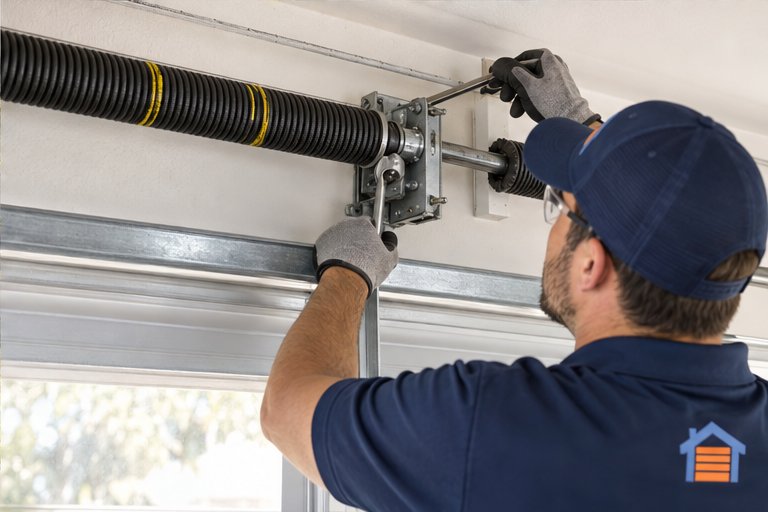
What drifting actually tells you
A garage door is a heavy object that feels light only because its springs offset most of its weight. The spring system is tuned so that the door hovers when it is not being pushed by the opener. When the door drifts downward on its own, that offset is no longer complete.
Think of it like a seesaw with a child on one end and an adult on the other. As long as the weights roughly match, the seesaw stays level. Change one side, and it tips. A door that sinks is telling you the spring side has become the weaker one.
This page explains the idea behind the balance test, the reasons springs lose strength, and the steps that make sense for a homeowner. It also marks clearly where a technician needs to take over.
Different ways a door can drift
Not every drifting door behaves the same. The pattern gives useful clues. Write down which pattern matches yours before you call, and describe it to us in your own words.
Some doors creep down a few inches after being opened and then stop. Others settle all the way to the floor over a few minutes. A few rise on their own, which is the opposite problem and also an imbalance. The sections below deal mostly with a door that sinks.
- The door slowly lowers by itself once fully open
- The door stops partway up and then sags further
- The door rests on the floor but is hard to lift by hand
- The door rises too easily and will not stay down
- One side seems to sag more than the other
- The door stays up only while the opener holds it
The balance test, explained
Technicians use a simple concept to judge balance: with the door disconnected from the opener and fully supported, a balanced door should stay in place when released about halfway up, or move only slightly. A door that falls from that position is heavy relative to its springs. A door that flies upward is too light.
We describe this test here so that you understand what a technician is doing, not so that you perform it. The test requires disconnecting the opener and lifting a heavy door that may be out of balance. If the springs are weak or broken, the door can fall suddenly and cause injury.
If you are comfortable with garage doors in general, a very limited version is possible: with the door fully closed, you can pull the release cord and try to lift the door a short distance with great care and stop at the first sign of heaviness. Otherwise, wait for a visit. Our garage door weights and balance guide covers the principles.
How springs lose tension
Springs are made of tempered steel wound into coils. Each time the door goes up, the spring unwinds a little; each time it comes down, it winds back up. This happens twice with every open and close, and a busy household can easily add up several thousand cycles in a few years. After thousands of cycles the metal fatigues and loses some of its stored energy.
Torsion springs, mounted on a shaft above the door, tend to lose tension slowly and then break, usually with a bang. Extension springs, stretched along the sides of the track, can stretch or lose strength, and in some cases a spring on one side weakens before the other.
Heat, humidity and salt can also corrode springs. A rusty spring may snap sooner than a clean one. For more on how long springs generally last, see our page about how long garage door springs last.
Springs that have been set too lightly
Not all drift is wear. A door can also drift because the springs were never set quite right. This can happen after a previous repair that left the tension a little low, or after a new door was installed with springs that did not suit its weight.
Springs are chosen for the weight of the door, and the right strength depends on weight, height and the type of spring system in use. A heavier door needs stronger springs. When someone replaces a door section, adds insulation or a window kit, or changes the cladding, the weight changes and the springs may no longer be ideal.
If the drifting started soon after work on the door, tell us. That detail often shortens the diagnosis a great deal.
Cables, drums and equalizing
Cable stretch and slack
Cables run from the bottom corners of the door to the drums or pulleys. If one cable has stretched or slipped on the drum, that side carries a different share of the load, and the door can sag on that side.
Drum position
On torsion systems, the drums sit on the shaft and take up cable as the door rises. A drum that has shifted on the shaft can make the door unbalanced even if the springs are still in decent shape.
Why we do not suggest fixing these yourself
Cable and drum adjustments are done while the spring system holds stored energy. They are among the more dangerous tasks in this trade. Please leave them to a trained technician.
Opener behavior that hides the problem
Many people never notice a door out of balance, because the opener muscles the door up and down. The opener hides the problem until the springs get very weak. By then the door may be heavy enough to strain the motor and wear the gear.
Some openers will lift a heavy door but cannot hold it at a set position without help. The door drifts down once the motor stops. Others stop and reverse, tripping the safety system. A few simply refuse to move at all, which can be mistaken for an opener fault when the real cause is door weight.
If the opener seems to be working harder than it used to, or if it makes more noise on the way up, that can be an early sign of changing balance.
Table comparing drift patterns and causes
The table below is a general guide that helps us talk through the likely causes. It is not a replacement for a hands-on look at the door.
| Pattern | Possible reason | Urgency |
|---|---|---|
| Slow sag after opening | Springs have lost some tension | Moderate, arrange a visit |
| Falls to the floor on release | Springs very weak or one broken | High, stop using the door |
| One side lower | Cable slack, uneven springs, drum issue | High |
| Rises on its own | Springs set too tight | Moderate |
| Heavy to lift, stays down | Broken spring likely | High |
| Drifts only after a repair | Spring tension set low | Moderate |
Safe things you can look at
You can learn a lot by looking. Use a good flashlight and keep a respectful distance from the springs and cables. Do not touch them. Stand to the side rather than directly beneath the door.
With the door closed, look at the torsion spring above the door or the extension springs along the track. A visible gap in the coil, a spring that looks stretched or twisted, or a broken end is a clear sign of failure.
Look at the cables for frayed strands, a loose cable hanging down, or a cable that has jumped off its drum.
Take a few photos from a safe distance. Pictures of the springs, the drums, and both bottom corners of the door let us see what you saw, and they are useful if you want to compare the door before and after a repair.
Coastal homes deserve a closer look at rust. Orange staining on a spring or at a cable end suggests moisture has been working on the metal. That does not always mean failure is close, but it is worth mentioning.
- Gaps or breaks in the spring coil
- Rust or heavy corrosion on springs
- Cables that appear loose, frayed or off the drum
- One side of the door sitting visibly lower than the other
- Gaps between the door and the weatherstripping on one side only
- Anything hanging down that should not be
What to avoid doing
Do not try to wind, loosen, or tighten a spring. Do not touch the cables or the brackets at the bottom of the door. A bracket under tension can release suddenly, and a cable can whip.
Do not prop the door open with ladders or boards and then walk away. Do not leave the door standing open in a way that depends on the opener to hold it up. If the door is open and drifting, keep clear of it.
If the door has fallen and caused an injury, call 911. For a related symptom where the door actually crashes down, see a garage door that slams down.
Temporary steps while you wait
If the door is closed and stays closed, leave it closed. Use another entrance to the house if the garage door is your usual route. Park vehicles outside if the door might drift while a car is underneath.
If the door is open and drifting, do not park under it and do not stand beneath it. Close it with the opener if the opener can do so smoothly. If the door will not close smoothly, contact us for guidance.
Avoid repeatedly cycling the door to watch the drift. Each cycle puts additional stress on parts that may already be weak.
If you must use the door in the meantime, for example to get a car out, run it once, watch from a safe side position, and stop if anything looks or sounds wrong. Do not walk under it while it moves. Let everyone in the household know the door is unreliable so no one assumes it will stay where it is left.
Why a heavy door can feel normal for a while
Because the opener does most of the work, a door that is becoming heavy may not feel any different to the person pressing the button. People often discover the problem only when the power goes out and they must lift the door by hand.
That is one reason we encourage a yearly visual check and a balance review. It takes little time and can reveal weakening springs well before they break, and it gives you time to plan a repair rather than react to a failure. If your door is heavy to lift manually, our page on a garage door that is heavy to lift by hand describes the symptom in detail.
What we do on a visit
Check the door and hardware
We look at the springs, cables, drums, brackets, rollers, tracks and hinges, since each one contributes to balance.
Test the balance safely
We disconnect the opener when it is safe to do so and test how the door behaves, using the right tools and methods for the spring type.
Explain the options
If the springs are tired or broken, we explain what replacement involves. If the tension is simply off, we explain adjustment. Our balance and adjustment service describes this work.
Torsion or extension, and why it matters
The type of spring changes the repair. Torsion systems use a spring on a shaft above the door and usually offer smoother lift and longer life. Extension systems use stretched springs along the track and often rely on safety cables inside the springs.
Whether a door has one spring or two, replacing both together is often sensible, since they have lived the same number of cycles. Our guide on torsion and extension springs explains the differences.
Springs also come in different sizes and strengths, chosen for the door's weight and height. We match the replacement to the door, not just to the old spring.
Doors with insulation, glass panels, or a wood overlay are heavier than a plain steel door of the same size. A spring that suited the door when it was built may not suit it after changes, and a mismatch is a classic reason for drift. If you replaced panels or added insulation, mention it.
Keeping the balance right
Once the door has been put right, a few habits keep it that way. Avoid additions that change the weight of the door. Lubricate the correct moving parts sparingly. Avoid hitting the door or the track.
Have the door inspected at least once a year, and sooner after a storm or any impact. Watch the door as it moves, and note any change. A door that suddenly feels different deserves a look.
If the door has been unbalanced for some time, other parts such as the opener, rollers, and cables may have taken extra strain. We check those at the same visit.
Getting help with a door that will not stay up
If your door drifts, sags or will not stay open, we can come to the property, look at the door, and explain what we find and what the options are. Please keep the door clear of people and vehicles until then.
Reach us through the contact page, describe how the door behaves, and tell us if anything changed recently, such as a repair, a new opener, added weight, or a storm.
Questions and answers
A sinking door usually means the springs no longer fully offset its weight. They may have lost tension with age, been set low during a past repair, or one of a pair may be broken. A door that sinks is not safe to rely on, so keep clear of it and have it checked.
It can be. A door that cannot hold its position may fall without warning on a person, a pet or a vehicle. The cause is often a spring or cable issue, which carries high tension. Keep people clear and avoid repeated use until a technician has looked at it.
No. Winding or adjusting springs is one of the most dangerous tasks in this trade, and mistakes cause serious injuries. Tension must also be matched to the door's weight. Please leave all spring and cable work to a trained technician who has the right tools.
A technician disconnects the opener when it is safe, lifts the door partway, and checks whether it stays in place, falls, or rises. A balanced door stays put or moves only a little. We explain the idea here so you understand it, but we do not recommend homeowners run it on a weak door.
Sometimes, if the opener is not holding the door at its stop point, but drifting usually points to springs. Many openers can mask a balance problem by simply lifting a heavy door until it gets too heavy. A technician can separate opener faults from spring faults by testing the door on its own, with the opener disconnected, before deciding which part needs work.
On a two spring system, replacing both together is usually sensible, since they have the same age and cycle count. If one has broken, the other is often close behind. We look at both and explain what we see so that you can decide with full information, rather than being pushed toward a choice you do not understand.