
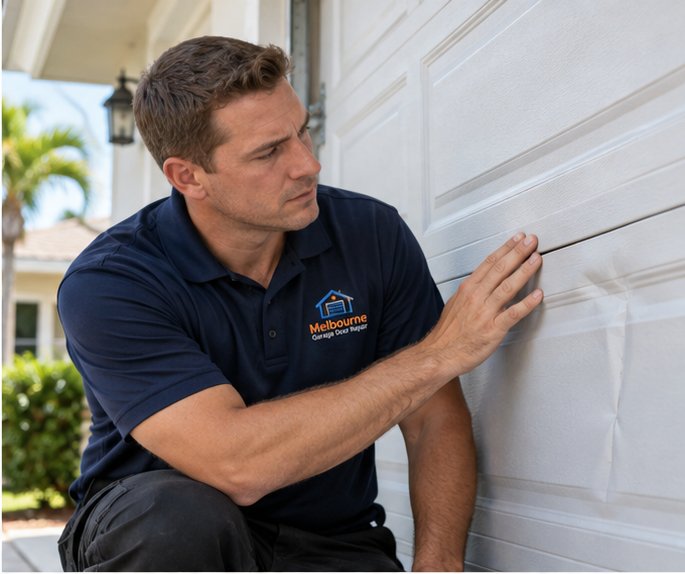
What sagging and bowing look like
Sagging is easiest to spot when the door is closed. Stand in the driveway and look along the top edge of the door, or crouch and sight along the lower edge of a single panel. A healthy panel is straight from end to end. A sagging panel dips in the middle, so the center sits lower than the ends, and the horizontal joint above it may open into a thin wedge or a smile-shaped gap.
Bowing is related but not identical. A bowed panel pushes outward or inward across its face, so the middle of the panel stands proud of the track line while the ends stay put. You may notice it as a wavy reflection in the surface, a shadow that changes along one panel, or a section that looks fine at the edges but soft in the center.
Some doors show both at once. The top panel is the usual place, because it carries the opener bracket and sits where the door bends as it travels, but any panel on a wide door can be affected. The wider the door, the more room there is for a panel to flex between its two ends.
How a panel is built to stay straight
A garage door section is a long, thin shape that must resist bending across a span of eight, nine, sixteen or even eighteen feet. Steel sections get their stiffness from the way the skin is formed, from a core of foam or other insulation bonded to the skin, and from horizontal reinforcement in places. Wood, composite and aluminum-and-glass sections rely on frames, rails and stiles instead.
On a wide door, the manufacturer often adds a horizontal strut, sometimes called a stiffener or reinforcing bar, along the back of one or more panels. The strut is a rigid length of metal that ties the two ends of the section together so the panel acts like a beam rather than a floppy sheet. The top panel almost always has one, because the opener bracket pulls on it.
When we talk about sagging, we are really talking about that beam failing in some way. Either the beam is missing or too light for the span, it has separated from the skin, the skin itself has lost strength, or something is loading the panel in a direction it was never designed for.
Struts, stiffeners and where they live
Look at the inside face of the door. On many doors you will see a metal angle or channel fastened across the top section, running from one end almost to the other. Some doors carry additional struts on the second panel as well, particularly doors that are wide, heavy or fitted with an opener that pulls hard on the top.
Struts are fastened with screws or rivets, and the fasteners matter. If screws have worked loose, backed out or stripped the thin skin, the strut stops sharing load and the panel begins to flex. You may see a fastener standing a little proud, or a small crack in the paint around one, or a spot where the strut no longer sits flat against the panel.
A missing strut is its own problem. Doors are sometimes installed without one, or a replacement section is ordered without the stiffener that the original had. A panel that looks fine for a few seasons can then start to bow as the opener repeats its pulling load thousands of times. If you are unsure whether your door should have one, a technician can compare your section with the door's specifications and explain what we would expect to see.
Age, repetition and material fatigue
A garage door is one of the most used moving parts of a house. Every cycle flexes the sections a little, and every cycle loads the hinges, the top bracket and the struts. Over many years the foam core can break down, the bond between core and skin can weaken, and the skin itself can develop tiny stress lines along the joints.
Thin-skinned steel doors and older wood doors show fatigue most readily. Wood absorbs moisture and dries again, so rails and panels slowly move out of true. Steel does not absorb moisture, but it does suffer where the finish has failed, because rust under the paint weakens the metal at precisely the points that carry load.
None of this is sudden. Sagging that appears gradually over several years is usually fatigue, and it tends to progress. That does not mean the door is unsafe the day you notice it, but it does mean the condition is unlikely to reverse by itself, and a door that is already dipping is less forgiving of rough use, strong wind and a heavy or stiff opener.
Heat, sun and the Florida climate
On the Space Coast a garage door lives in strong sun, high humidity, salt in the air near the water and the occasional tropical storm. A dark-colored door facing south or west can get very hot on its outer face while the inside stays comparatively cool, and that temperature difference makes a panel want to curl in a direction it was not built to go.
Heat also softens some adhesives and plastics. Where a foam core is bonded to a skin, long summers can weaken that bond, and the skin may begin to ripple or bow between its fasteners. Wood doors swell in wet months and shrink in dry ones, which can open up joints and change how the panel sits in its frame.
Salt air near the coast speeds up corrosion on fasteners, strut ends and hinge areas. A strut that has rusted at its fasteners is a strut that no longer holds the panel straight. For a wider look at how our local climate wears on doors, see garage doors in a coastal climate.
Opener force and the top bracket
Most residential openers lift the door by pulling on a bracket fastened to the top section. That bracket sits at or near the center of the panel, so the opener's force is concentrated right where the panel is least supported if it has no strut. Each cycle pulls up on the middle of the top panel, and the ends are left to follow along.
When the door is correctly balanced, the springs do most of the lifting and the opener only guides and nudges. When the door is out of balance, the opener has to do the work, and the pull on the top bracket grows. That is one of the reasons a sagging top panel and a door that feels heavy often show up together.
If the door is heavy to lift by hand, that is a separate symptom with its own causes, and it connects to the way the springs are counterbalancing the weight. Our page on a garage door that is heavy to lift by hand explains what that tells us. We do not recommend adjusting any spring or cable yourself, because those parts hold dangerous tension.
Added weight and later modifications
Doors are designed for a certain weight. Anything that adds weight to a panel can push it past what the springs and struts expect. Common examples are a heavy coat of paint on a door that was originally light, added insulation panels, thick window inserts, decorative overlays, or a mounted accessory such as a storage rack, a hanging bracket or a mounted shelf attached to the panel.
Added weight leans on the panel itself. A bracket that hangs from one section loads that section locally, and over time it bows around the point of attachment. A rack that sits on the top track area changes how the door travels and can twist the top panel as it moves.
Insulation upgrades deserve a mention too. A properly engineered insulation kit or a factory-insulated door is fine, but thick foam stuffed into a hollow door can add weight in the wrong places. If you have changed anything on the door since it was installed, mention it when you call us, because it can help explain a panel that has started to give.
Impact damage and storm loads
A single bump from a vehicle, a ladder or a thrown ball may leave no mark you can see, yet the panel has been stressed. Panels that have been hit often stay straight for a while and then develop a bow along the line of the old impact, because the fatigue starts at the weak spot.
Wind is a bigger factor than most people expect. A storm pushes pressure against a closed door, and a wide door with a light panel can flex noticeably. After a strong wind event, check whether any panel looks more curved than before. A flexed panel can take a permanent set, leaving the door with a slight but visible bow.
If your door was bent or dented rather than sagging, our page on bent garage door panels covers that case in more detail, and if a vehicle was involved we also look beyond the visible damage.
Hinges, rollers and what sagging does to them
A sagging panel does not stay a cosmetic problem, because the hinges, rollers and tracks have to follow the panel. A middle hinge can be pushed out of line with its neighbors, and a roller can end up riding at a slightly wrong angle in the track.
That is when you might hear new sounds. A panel that bows scrapes at the weather seal or the track on its way past. A hinge that has been stressed will creak or pop, and a roller that has been pushed against the edge of the track may bind. The door may feel like it is dragging in a particular spot along its travel.
A hinge under strain can crack, and a cracked hinge adds to the damage because the panel loses a point of support. If you can see a crack, a bend or a hinge that is clearly loose, treat it as a reason to have the door looked at rather than a reason to keep using it normally. Our page on hinge and track service explains how those parts are inspected and replaced.
What you can safely check from the floor
You can learn a lot without touching any tensioned part. Close the door and stand back far enough to see the whole width. Sight along each panel and note which sections look straight and which dip. Take a photo from the same spot, because it makes it easy to compare later.
Then go inside and look at the back of the door. Note whether there is a strut on the top panel, whether its fasteners look tight, and whether any paint is cracked or rust has formed around them. Look for cracks in the skin near the hinges and the top bracket.
Do not climb onto the door, do not pry at the strut, and do not touch the springs, the cables or the brackets at the end of the door. Those parts hold dangerous tension, and an injury from a released spring is serious.
- Sight along the top edge and along each panel to see where it dips
- Photograph the door from the same spot so you can compare over time
- Look at the strut and fasteners on the inside without touching them
- Note any new sounds, any rubbing, and any spot where the door seems to drag
- Watch the door open and close once, from a safe distance, and note whether the sag changes as it travels
When a sagging door should stop being used
Not every sag is an emergency, but some signs say the door should be left alone until someone has examined it. Stop using the door if a panel has visibly separated from a hinge, if a crack runs across the skin, if the door binds or jumps in the track, or if the opener strains, hesitates or reverses where it never did before.
If the door is partly open and looks unstable, stay out from under it and keep people and pets clear. Do not try to force it up or down. If your door has an emergency release, our page on using the manual release during a power outage explains when it is appropriate and what the precautions are, but it is not a substitute for having a damaged door inspected.
If anyone has been hurt, call 911 first. Everything else can wait.
How a technician approaches a sagging panel
We start by looking at the whole door rather than only the panel that is dipping. That means checking the track alignment, hinge condition, roller wear, the top bracket and the strut. A sagging panel is sometimes the first visible sign of a problem that began elsewhere, and treating only the symptom would leave the cause in place.
Next we assess the panel itself: whether the skin is cracked, whether the foam core is intact, whether the strut is present and secure, and how far the panel has moved from straight. We also check the balance of the door, because an out-of-balance door loads the top section harder than a balanced one.
Then we explain what we found in plain terms and lay out the options. Sometimes a strut can be refastened or a reinforcing strut added to a section that can take it. Sometimes the panel has gone too far and a new section is the sensible choice. Sometimes the whole door is at the end of its useful life and replacement is the honest answer. We do not decide that before we have looked.
Reinforce, replace a section, or replace the door
Reinforcing is appropriate when the panel is structurally sound but flexes because it lacks stiffness. A strut matched to the width and weight of the section can be fastened to the back so the panel behaves like a beam again. This suits cases where the skin is intact and the bow is mild.
Replacing a single section is appropriate when the damage is limited to that panel and a matching section is available. The challenge is matching: the profile, color, thickness and insulation must line up with the existing door, and a door that has weathered for many years may not match a new section precisely.
Replacing the whole door is sensible when several panels are failing, when matching sections are no longer made, or when the door has other issues such as worn tracks, rust and an obsolete opener. Our guide on repairing or replacing your garage door walks through how that decision is usually made. Cost depends on the details, so we explain the options after we have seen the door.
Preventing a second sag
Once the panel has been dealt with, a few habits help it last. Keep the door balanced, because a balanced door loads the top section less. Keep the rollers and hinges lubricated so the door travels without drag, and keep the tracks clear. Our monthly garage door checklist shows simple tasks that are safe to do yourself.
Avoid hanging anything from the panels. If you want storage on the garage wall, mount it on the wall or ceiling framing, not on the door. Be careful with paint: a dark, heavy coat on a light door adds weight and heat. If you plan to repaint, ask us about a suitable finish.
Finally, treat unusual sounds and visible changes as early warnings. A door that begins to sag, rub or strain is giving you the chance to deal with a small problem before it becomes a bigger one.
Questions and answers
A slight sag is not usually an immediate danger, but it means the panel has lost stiffness and the condition tends to get worse. A badly sagging panel can stress hinges, rollers and the top bracket, and a failed part can drop or twist the door. Keep people clear of a door that looks unstable and have it inspected rather than ignoring it.
The top section carries the opener bracket, which pulls on the middle of the panel with every cycle. If the panel has no strut, or the strut has loosened, the pull concentrates in the middle and the panel slowly dips. The top panel also bends the most as it follows the curve of the track.
Often yes. If the skin is intact, a reinforcing strut can be fastened to the back of the panel to restore its stiffness. If the section is cracked or the foam core has failed, a new section may be needed. A technician has to see the panel before we can say which option applies.
It can contribute. A dark door in strong sun heats on the outside more than the inside, and the difference makes a panel want to curl. Over many seasons that stress can loosen the bond between skin and core, or open joints on wood doors. Heat is rarely the only cause, but it speeds up fatigue.
The opener pulls on the top panel, so a stiff or poorly aligned opener can add to the load, particularly if the door is out of balance and the opener is doing work the springs should be doing. The opener is seldom the root cause, but it is part of what we check.
We advise against it. The right strut depends on the width, weight and construction of the panel, and fastening one in the wrong place can crack the skin or throw the door out of balance. The door also holds springs and cables under tension, so leave the work to a trained technician.
A sag is a dip along the length of a panel, so the middle sits lower than the ends. A bow is an outward or inward push across the face of the panel. Both mean the panel is not straight, and both are worth showing a technician. Photos from the same spot help.
We cannot say, because it depends on your policy, the age of the door and what caused the damage. If a storm or a vehicle was involved, ask your insurer. We can describe what we find and explain the cause so you have something clear to share with them.